Thank you for visiting SNEWPapers!
Sign up free
Literary
September 27, 1804
Norfolk Gazette And Publick Ledger
Norfolk, Virginia
What is this article about?
Essay by Mr. Gilpin discussing picturesque beauty in landscapes, focusing on effects of sunlight at different times, especially in forests, contrasts with storms, and advice for painters on light and shade.
Merged-components note: Merged two sequential components of the same essay on picturesque beauty due to continuous text content and adjacent bounding boxes.
Clipping
OCR Quality
95%
Excellent
Full Text
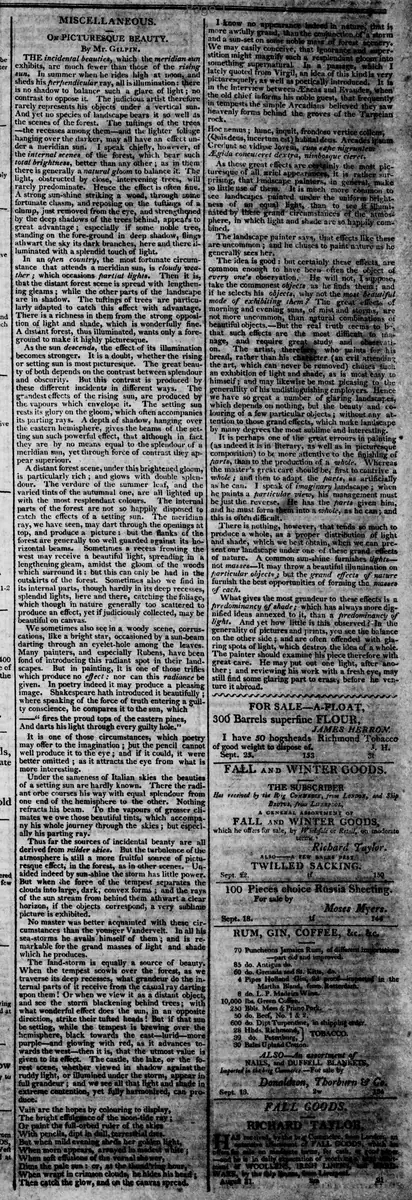
MISCELLANEOUS
ON PICTURESQUE BEAUTY.
By Mr. GILPIN.
THE incidental beauties, which the meridian sun exhibits, are much fewer than those of the rising sun.
In summer when he rides high at noon, and sheds his perpendicular ray, all is illumination: there is no shadow to balance such a glare of light; no contrast to oppose it.
The judicious artist therefore rarely represents his objects under a vertical sun.
And yet no species of landscape bears it so well as the scenes of the forest.
The tuftings of the trees --the recesses among them and the lighter foliage hanging over the darker, may all have an effect under a meridian sun.
I speak chiefly, however, of the internal scenes of the forest which bear such total brightness, better than any other; as in them there is generally a natural gloom to balance it.
The light, obstructed by close intervening trees, will rarely predominate.
Hence the effect is often fine.
A strong sun-shine striking a wood, through some fortunate chasm, and reposing on the tuftings of a clump, just removed from the eye, and strengthened by the deep shadows of the trees behind, appears to great advantage; especially if some noble tree, standing on the fore-ground in deep shadow, flings athwart the sky its dark branches, here and there illuminated with a splendid touch of light.
In an open country, the most fortunate circumstance that attends a meridian sun, is cloudy weather ; which occasions partial lights.
Then it is, that the distant forest scene is spread with lengthening gleams; while the other parts of the landscape are in shadow.
The tuftings of trees are particularly adapted to catch this effect with advantage.
There is a richness in them from the strong opposition of light and shade, which is wonderfully fine.
A distant forest, thus illuminated, wants only a fore-ground to make it highly picturesque.
As the sun descends, the effect of its illumination becomes stronger.
It is a doubt, whether the rising or setting sun is most picturesque.
The great beauty of both depends on the contrast between splendour and obscurity.
But this contrast is produced by these different incidents in different ways.
The grandest effects of the rising sun, are produced by the vapours which envelope it.
The setting sun rests its glory on the gloom, which often accompanies its parting rays.
A depth of shadow, hanging over the eastern hemisphere, gives the beams of the setting sun such powerful effect, that although in fact they are by no means equal to the splendour of a meridian sun, yet through force of contrast they appear superior.
A distant forest scene, under this brightened gloom, is particularly rich ; and glows with double splendour.
The verdure of the summer leaf, and the varied tints of the autumnal one, are all lighted up with the most resplendant colours.
The internal parts of the forest are not so happily disposed to catch the effects of a setting sun.
The meridian ray, we have seen, may dart through the openings at top, and produce a picture: but the flanks of the forest are generally too well guarded against its horizontal beams.
Sometimes a recess fronting the west may receive a beautiful light, spreading in a lengthening gleam, amidst the gloom of the woods which surround it : but this can only be had in the outskirts of the forest.
Sometimes also we find in its internal parts, though hardly in its deep recesses, splendid lights, here and there, catching the foliage, which though in nature generally too scattered to produce an effect, yet if judiciously collected, may be beautiful on canvas.
We sometimes also see in a woody scene, corruscations, like a bright star, occasioned by a sun-beam darting through an eyelet-hole among the leaves.
Many painters, and especially Rubens, have been fond of introducing this radiant spot in their landscapes.
But in painting, it is one of those trifles which produce no effect : nor can this radiance be given.
In poetry indeed it may produce a pleasing image.
Shakespeare hath introduced it beautifully ; where speaking of the force of truth entering a guilty conscience, he compares it to the sun, which
.." fires the proud tops of the eastern pines,
And darts his light through every guilty hole."
It is one of those circumstances, which poetry may offer to the imagination ; but the pencil cannot well produce it to the eye; and if it could, it were better omitted ; as it attracts the eye from what is more interesting.
Under the sameness of Italian skies the beauties of a setting sun are hardly known.
There the radiant orb courses his way with equal splendour from one end of the hemisphere to the other.
Nothing refracts his beam.
To the vapours of grosser climates we owe those beautiful tints, which accompany his whole journey through the skies ; but especially his parting ray.
Thus far the sources of incidental beauty are all derived from milder skies.
But the turbulence of the atmosphere is still a more fruitful source of picturesque effect; in the forestry as in other scenes.
Unaided indeed by sun-shine the storm has little power.
But when the force of the tempest separates the clouds into large, dark, convex forms ; and the rays of the sun stream from behind them athwart a clear horizon, if the objects correspond, a very sublime picture is exhibited,
No master was better acquainted with these circumstances than the younger Vandervelde.
In all his sea-storms he avails himself of them; and is remarkable for the grand masses of light and shade which he produces.
The land-storm is equally a source of beauty.
When the tempest scowls over the forest, as we traverse its deep recesses, what grandeur do the internal parts of it receive from the casual ray darting upon them!
Or when we view it as a distant object, and see the storm blackening behind trees; with what wonderful effect does the sun, in an opposite direction, strike their tufted heads!
But if that sun be setting, while the tempest is brewing over the hemisphere, black towards the east-lurid -more purple -and glowing with red, as it advances towards the west- then it is, that the utmost value is given to its effect.
The castle, the lake, or the forest scene, whether viewed in shadow against the ruddy light, or illumined under the storm, appear in full grandeur ; and we see all that light and shade in extreme contention, yet fully harmonized, can produce.
Vain are the hopes by colouring to display
The bright effulgence of the noon-tide ray
Or paint the full-orbed ruler of the skies
With pencils, dipt in dull, terrestrial dyes
But when mild evening sheds her golden light
When morn appears arrayed in modest white
When soft effusions of the vernal shower,
Dims the pale sun : or, at the thundering hour
When wrapt in crimson clouds he hides his head
Then catch the glow, and on the Canvas spread,
I know no appearance indeed in nature (that is more awfully grand, than the coruscation of storm and a sun-set on some noble mass of forest scenes
We may easily conceive that Ignorance and superstition might magnify such a resplendant gloom into something supernatural.
In a passage which I lately quoted from Virgil, an idea of this kind is very picturesquely, as well as poetically introduced.
It is in the interview between Aeneas and Evander.
When the old chief informs his noble guest, that frequently in tempests the simple Arcadians believed they saw heavenly forms behind the groves of the Tarpeian rock.
Hoc nemus; hunc, inquit, frondoso vertice collem (Quis deus, incertum est) habitaudicus.
Arcades iram Credunt se vidisse Jovem, cum fulmina vibraret Aegida conculeret dextra, nimbosque cieret.
As these great effects are certainly the most picturesque of all aereal appearances it is rather surprising, that landscape painters, in general make so little use of them.
It is much more common to see landscapes painted under the uniform brightness of an equal light than to see them illuminated by these grand circumstances of the atmosphere, in which light and shade are so happily combined.
The landscape painter says, that effects like these are uncommon; and he chuses to paint nature as he generally sees her.
The idea is good: but certainly these effects are common enough to have been often the object of every one's observation.
He will not I suppose, take the commonest objects as he finds them; and if he selects his objects, why not the most beautiful mode of exhibiting them ?
The great effects of morning and evening suns, of mist and storms, are not more uncommon, than natural combinations of beautiful objects.
But the real truth seems to be, that such effects are the most difficult to imagine, and require great study and observation.
The artist, therefore who paints for his bread, rather than his character (an evil attending the art, which can never be removed) chuses such an exhibition of light and shade, as is most easy to himself: and may likewise be most pleasing to the generality of his undistinguishing employers.
Hence we have so great a number of glaring landscapes which depends on nothing, but the beauty and colouring of a few particular objects ; without any attention to those grand effects, which make landscape by many degrees the most sublime and interesting.
It is perhaps one of the great errors in painting (as indeed it is in literary, as well as in picturesque composition) to be more attentive to the finishing of parts, than to the production of a whole.
Whereas the master's great care should be; first to contrive a whole; and then to adapt the parts, as artificially as he can.
I speak of imaginary landscape; when he paints a particular view, his management must be just the reverse.
He has the parts given him, and he must form them into a whole, as he can; and this is often difficult.
There is nothing, however, that tends so much to produce a whole, as a proper distribution of light and shade, which we best obtain, when we can present our landscape under one of these grand effects of nature.
A common sun-shine furnishes lights--not masses--It may throw a beautiful illumination on particular objects ; but the grand effects of nature furnish the best opportunities of forming the masses of each.
What gives the most grandeur to these effects is a predominancy of shade; which has always more dignified ideas annexed to it, than a predominancy of light.
And yet how little is this observed?
In the generality of pictures and prints, you see the balance on the other side; and are often offended with glaring spots of light, which destroy the idea of a whole.
The painter should examine his piece therefore with great care.
He may put out one light, after another: and reviewing his work with a fresh eye may still find some glaring part to erase before he venture it abroad.
ON PICTURESQUE BEAUTY.
By Mr. GILPIN.
THE incidental beauties, which the meridian sun exhibits, are much fewer than those of the rising sun.
In summer when he rides high at noon, and sheds his perpendicular ray, all is illumination: there is no shadow to balance such a glare of light; no contrast to oppose it.
The judicious artist therefore rarely represents his objects under a vertical sun.
And yet no species of landscape bears it so well as the scenes of the forest.
The tuftings of the trees --the recesses among them and the lighter foliage hanging over the darker, may all have an effect under a meridian sun.
I speak chiefly, however, of the internal scenes of the forest which bear such total brightness, better than any other; as in them there is generally a natural gloom to balance it.
The light, obstructed by close intervening trees, will rarely predominate.
Hence the effect is often fine.
A strong sun-shine striking a wood, through some fortunate chasm, and reposing on the tuftings of a clump, just removed from the eye, and strengthened by the deep shadows of the trees behind, appears to great advantage; especially if some noble tree, standing on the fore-ground in deep shadow, flings athwart the sky its dark branches, here and there illuminated with a splendid touch of light.
In an open country, the most fortunate circumstance that attends a meridian sun, is cloudy weather ; which occasions partial lights.
Then it is, that the distant forest scene is spread with lengthening gleams; while the other parts of the landscape are in shadow.
The tuftings of trees are particularly adapted to catch this effect with advantage.
There is a richness in them from the strong opposition of light and shade, which is wonderfully fine.
A distant forest, thus illuminated, wants only a fore-ground to make it highly picturesque.
As the sun descends, the effect of its illumination becomes stronger.
It is a doubt, whether the rising or setting sun is most picturesque.
The great beauty of both depends on the contrast between splendour and obscurity.
But this contrast is produced by these different incidents in different ways.
The grandest effects of the rising sun, are produced by the vapours which envelope it.
The setting sun rests its glory on the gloom, which often accompanies its parting rays.
A depth of shadow, hanging over the eastern hemisphere, gives the beams of the setting sun such powerful effect, that although in fact they are by no means equal to the splendour of a meridian sun, yet through force of contrast they appear superior.
A distant forest scene, under this brightened gloom, is particularly rich ; and glows with double splendour.
The verdure of the summer leaf, and the varied tints of the autumnal one, are all lighted up with the most resplendant colours.
The internal parts of the forest are not so happily disposed to catch the effects of a setting sun.
The meridian ray, we have seen, may dart through the openings at top, and produce a picture: but the flanks of the forest are generally too well guarded against its horizontal beams.
Sometimes a recess fronting the west may receive a beautiful light, spreading in a lengthening gleam, amidst the gloom of the woods which surround it : but this can only be had in the outskirts of the forest.
Sometimes also we find in its internal parts, though hardly in its deep recesses, splendid lights, here and there, catching the foliage, which though in nature generally too scattered to produce an effect, yet if judiciously collected, may be beautiful on canvas.
We sometimes also see in a woody scene, corruscations, like a bright star, occasioned by a sun-beam darting through an eyelet-hole among the leaves.
Many painters, and especially Rubens, have been fond of introducing this radiant spot in their landscapes.
But in painting, it is one of those trifles which produce no effect : nor can this radiance be given.
In poetry indeed it may produce a pleasing image.
Shakespeare hath introduced it beautifully ; where speaking of the force of truth entering a guilty conscience, he compares it to the sun, which
.." fires the proud tops of the eastern pines,
And darts his light through every guilty hole."
It is one of those circumstances, which poetry may offer to the imagination ; but the pencil cannot well produce it to the eye; and if it could, it were better omitted ; as it attracts the eye from what is more interesting.
Under the sameness of Italian skies the beauties of a setting sun are hardly known.
There the radiant orb courses his way with equal splendour from one end of the hemisphere to the other.
Nothing refracts his beam.
To the vapours of grosser climates we owe those beautiful tints, which accompany his whole journey through the skies ; but especially his parting ray.
Thus far the sources of incidental beauty are all derived from milder skies.
But the turbulence of the atmosphere is still a more fruitful source of picturesque effect; in the forestry as in other scenes.
Unaided indeed by sun-shine the storm has little power.
But when the force of the tempest separates the clouds into large, dark, convex forms ; and the rays of the sun stream from behind them athwart a clear horizon, if the objects correspond, a very sublime picture is exhibited,
No master was better acquainted with these circumstances than the younger Vandervelde.
In all his sea-storms he avails himself of them; and is remarkable for the grand masses of light and shade which he produces.
The land-storm is equally a source of beauty.
When the tempest scowls over the forest, as we traverse its deep recesses, what grandeur do the internal parts of it receive from the casual ray darting upon them!
Or when we view it as a distant object, and see the storm blackening behind trees; with what wonderful effect does the sun, in an opposite direction, strike their tufted heads!
But if that sun be setting, while the tempest is brewing over the hemisphere, black towards the east-lurid -more purple -and glowing with red, as it advances towards the west- then it is, that the utmost value is given to its effect.
The castle, the lake, or the forest scene, whether viewed in shadow against the ruddy light, or illumined under the storm, appear in full grandeur ; and we see all that light and shade in extreme contention, yet fully harmonized, can produce.
Vain are the hopes by colouring to display
The bright effulgence of the noon-tide ray
Or paint the full-orbed ruler of the skies
With pencils, dipt in dull, terrestrial dyes
But when mild evening sheds her golden light
When morn appears arrayed in modest white
When soft effusions of the vernal shower,
Dims the pale sun : or, at the thundering hour
When wrapt in crimson clouds he hides his head
Then catch the glow, and on the Canvas spread,
I know no appearance indeed in nature (that is more awfully grand, than the coruscation of storm and a sun-set on some noble mass of forest scenes
We may easily conceive that Ignorance and superstition might magnify such a resplendant gloom into something supernatural.
In a passage which I lately quoted from Virgil, an idea of this kind is very picturesquely, as well as poetically introduced.
It is in the interview between Aeneas and Evander.
When the old chief informs his noble guest, that frequently in tempests the simple Arcadians believed they saw heavenly forms behind the groves of the Tarpeian rock.
Hoc nemus; hunc, inquit, frondoso vertice collem (Quis deus, incertum est) habitaudicus.
Arcades iram Credunt se vidisse Jovem, cum fulmina vibraret Aegida conculeret dextra, nimbosque cieret.
As these great effects are certainly the most picturesque of all aereal appearances it is rather surprising, that landscape painters, in general make so little use of them.
It is much more common to see landscapes painted under the uniform brightness of an equal light than to see them illuminated by these grand circumstances of the atmosphere, in which light and shade are so happily combined.
The landscape painter says, that effects like these are uncommon; and he chuses to paint nature as he generally sees her.
The idea is good: but certainly these effects are common enough to have been often the object of every one's observation.
He will not I suppose, take the commonest objects as he finds them; and if he selects his objects, why not the most beautiful mode of exhibiting them ?
The great effects of morning and evening suns, of mist and storms, are not more uncommon, than natural combinations of beautiful objects.
But the real truth seems to be, that such effects are the most difficult to imagine, and require great study and observation.
The artist, therefore who paints for his bread, rather than his character (an evil attending the art, which can never be removed) chuses such an exhibition of light and shade, as is most easy to himself: and may likewise be most pleasing to the generality of his undistinguishing employers.
Hence we have so great a number of glaring landscapes which depends on nothing, but the beauty and colouring of a few particular objects ; without any attention to those grand effects, which make landscape by many degrees the most sublime and interesting.
It is perhaps one of the great errors in painting (as indeed it is in literary, as well as in picturesque composition) to be more attentive to the finishing of parts, than to the production of a whole.
Whereas the master's great care should be; first to contrive a whole; and then to adapt the parts, as artificially as he can.
I speak of imaginary landscape; when he paints a particular view, his management must be just the reverse.
He has the parts given him, and he must form them into a whole, as he can; and this is often difficult.
There is nothing, however, that tends so much to produce a whole, as a proper distribution of light and shade, which we best obtain, when we can present our landscape under one of these grand effects of nature.
A common sun-shine furnishes lights--not masses--It may throw a beautiful illumination on particular objects ; but the grand effects of nature furnish the best opportunities of forming the masses of each.
What gives the most grandeur to these effects is a predominancy of shade; which has always more dignified ideas annexed to it, than a predominancy of light.
And yet how little is this observed?
In the generality of pictures and prints, you see the balance on the other side; and are often offended with glaring spots of light, which destroy the idea of a whole.
The painter should examine his piece therefore with great care.
He may put out one light, after another: and reviewing his work with a fresh eye may still find some glaring part to erase before he venture it abroad.
What sub-type of article is it?
Essay
What themes does it cover?
Nature
What keywords are associated?
Picturesque Beauty
Landscape Painting
Sunlight Effects
Forest Scenes
Atmospheric Effects
What entities or persons were involved?
By Mr. Gilpin.
Literary Details
Title
On Picturesque Beauty.
Author
By Mr. Gilpin.
Subject
Effects Of Light And Atmosphere On Picturesque Beauty In Forest Landscapes
Key Lines
The Incidental Beauties, Which The Meridian Sun Exhibits, Are Much Fewer Than Those Of The Rising Sun.
It Is A Doubt, Whether The Rising Or Setting Sun Is Most Picturesque.
Shakespeare Hath Introduced It Beautifully ; Where Speaking Of The Force Of Truth Entering A Guilty Conscience, He Compares It To The Sun, Which .." Fires The Proud Tops Of The Eastern Pines, And Darts His Light Through Every Guilty Hole."
I Know No Appearance Indeed In Nature (That Is More Awfully Grand, Than The Coruscation Of Storm And A Sun Set On Some Noble Mass Of Forest Scenes