Thank you for visiting SNEWPapers!
Sign up free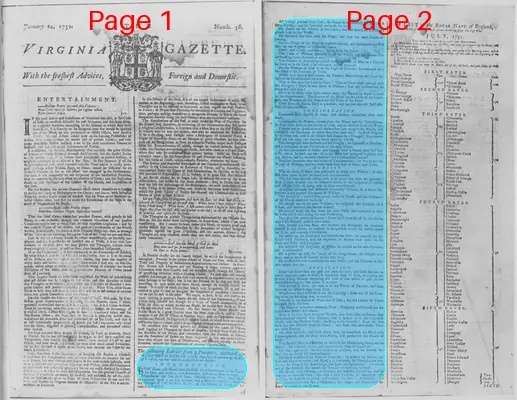
The Virginia Gazette
Richmond, Williamsburg, Richmond County, Virginia
What is this article about?
Extract from the pamphlet 'The OECONOMY of HUMAN LIFE,' attributed to the Earl of C-f-d, presenting religious and moral instructions in sections: Introduction on God's wisdom and creation; Consideration on self-reflection and prudence; Modesty on humility versus arrogance; Application on diligent use of time against idleness.
Merged-components note: Continuation of the extract from 'OECONOMY of HUMAN LIFE' pamphlet, sequential reading order and text flows directly.
Clippings
1 of 2
OCR Quality
Full Text
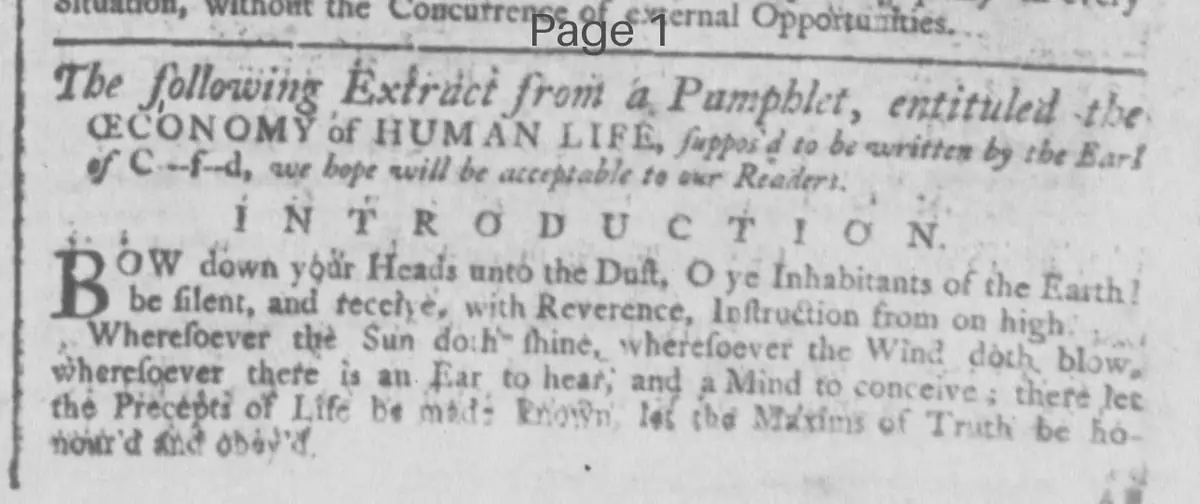
OECONOMY of HUMAN LIFE, supposed to be written by the Earl
of C-f-d, we hope will be acceptable to our Readers.
INTRODUCTION.
BOW down your Heads unto the Dust, O ye Inhabitants of the Earth!
be silent, and teach ye, with Reverence, Instruction from on high
Whereoever the Sun doth shine, whereoever the Wind doth blow
whereoever there is an ear to hear, and a Mind to conceive: there let
the Precepts of Life be made known; let not the Maxims of Truth be ho-
noured and observed.
All Things proceed from God; his Power is unbounded, his Wisdom is from Eternity, and his Goodness endureth for ever.
He sitteth on his Throne in the Center, and the Breath of his Mouth giveth Life to the World.
He toucheth the Stars with his Finger, and they run their Course rejoicing.
On the Wings of the Wind he walketh abroad, and performeth his Will thro'all the Regions of unlimited Space.
Order, and Grace, and Beauty, spring from his Hand.
The Voice of Wisdom speaketh in all his Works, but the human Understanding comprehendeth it not.
The Shadow of Knowledge passeth over the Mind of Man as a Dream; he seeth as in the Dark: he reasoneth, and is deceived.
But the Wisdom of God is as the Light of Heaven; he reasoneth not; his Mind is the Fountain of Truth.
Justice and Mercy wait before his Throne; Benevolence and Love enlighten his Countenance for ever.
Who is like unto the Lord in Glory? Who in Power shall contend with the Almighty? Hath he any equal in Wisdom; Can any in Goodness be compared unto him?
He it is, O Man, who hath created thee; thy Station on Earth is fixed by his Appointment: The Powers of thy Mind are the Gifts of his Goodness, the Wonders of thy Frame are the Work of his Hand.
Hear then his Voice, for it is gracious; and he that obeyeth shall establish his Soul in Peace.
CONSIDERATION.
Commune with thyself, O Man, and consider wherefore thou wert made.
Contemplate thy Powers, contemplate thy Wants and thy Connections; so Shalt thou discover the Duties of Life, and be directed in all thy Ways.
Proceed not to speak or to act before thou hast weigh'd thy Words, and examin'd the Tendency of every Step thou shalt take: So Shall Disgrace fly far from thee, and in thy House shall Shame be a Stranger; Repentance shall not visit thee, nor Sorrow dwell upon thy Cheek.
The thoughtless Man bridleth not his Tongue; he speaketh at Random, and is entangled in the Foolishness of his own Words.
As one that runneth in Haste, and leapeth over a Fence, may fall into Pit, which he doth not see: so is the Man that plungheth suddenly into any Action, before he hath consider'd the Consequences thereof.
Hearken therefore unto the Voice of Consideration; her Words are the Words of Wisdom, and her Paths shall lead thee to Safety and Truth.
MODESTY.
Who art thou, O Man, that presumest on thine own Wisdom? or why dost thou vaunt thyself on thine own Acquirements.
The first Step towards being wise, is to know that thou art ignorant: And if thou wouldst not be esteem'd foolish in the Judgment of others, cast off the Folly of being wise in thine own Conceit.
As a plain Garment best adorneth a beautiful Woman, so a decent Behaviour is the greatest Ornament of Wisdom.
The Speech of a modest Man giveth Lustre to Truth, and the Diffidence of his Words absolveth his Error.
He relyeth not on his own Wisdom; he weigheth the Counsels of a Friend, and receiveth the Benefit thereof.
He turneth away his Ear from his own Praise, and believeth it not; he is the last in discovering his own Perfections.
Yet, as a Veil addeth to Beauty; so are his Virtues set off by the Shade, which his Modesty casteth upon them.
But, behold the vain Man, and observe the Arrogant; he clotheth himself in rich Attire, he walketh in the publick Street, he casteth round his Eyes, and courteth Observation.
He tosseth up his Head and overlooketh the Poor; he treateth his Inferiors with Insolence, and his Superiors in Return look down on his Pride and Folly with Laughter.
He despiseth the Judgment of others, he relyeth on his own Opinion; and is confounded.
He is puffed up with the Vanity of his Imagination; his Delight is to hear, and to speak of himself all the Day long.
He walloweth with Greediness his own Praise, and the Flatterer in Return eateth him up.
APPLICATION.
Since the Days that are past are gone for ever, and those that are to come, may not come to thee; it behoveth thee, O Man, to employ the present Time, without regretting the Loss of that which is past, or too much depending on that which is to come.
This Instant is thine, the next is in the Womb of Futurity, and thou knowest not what it may bring forth.
Whatsoever thou resolveth to do, do it quickly; defer not 'til the Evening what the Morning may accomplish.
Idleness is the Parent of Want and of Pain; but the Labour of Virtue bringeth forth Pleasure.
The Hand of Diligence defeateth Want; Prosperity and Success are the industrious Man's Attendants.
Who is he that hath acquired Wealth, that hath risen to Power, that hath clothed himself with Honour, that is spoken of in the City with Praise, and that standeth before the King in his Council? Even he that hath shut out Idleness from his House; and hath said unto Sloth, Thou art mine Enemy.
He riseth up early, and lieth down late; he exerciseth his Mind with Contemplation, and his Body with Action, and preserveth the Health of both.
The Slothful Man is a Burthen to himself, his Hours hang heavy on his Hand: He loitereth about, and knoweth not what he would do.
His Days pass away like the Shadow of a Cloud, and he leaveth behind him no Mark for Remembrance.
His Body is diseased for Want of Exercise; he withereth for Action, but hath not Power to move; his Mind is in Darkness, his Thoughts are confused; he longeth for Knowledge, but hath no Application. He would eat of the Almond, but hateth the Trouble of breaking its Shell.
His House is in Disorder, his Servants are wasteful and riotous, and he rusheth on towards Ruin: He seeth it with his Eyes, he heareth it with his Ears, he shaketh his Head, and wisheth, but hath no Resolution: 'Til Ruin cometh upon him like a Whirlwind, and Shame and Repentance descend with him to the Grave.
What sub-type of article is it?
What themes does it cover?
What keywords are associated?
What entities or persons were involved?
Literary Details
Title
The Oeconomy Of Human Life
Author
Supposed To Be Written By The Earl Of C F D
Form / Style
Prose Moral Treatise In Sections
Key Lines