Thank you for visiting SNEWPapers!
Sign up free
Alexandria Advertiser And Commercial Intelligencer
Alexandria, Virginia
What is this article about?
Reflections in the New-York Evening Post on the recent peace preliminaries between Great Britain and France, assessing minimal direct impacts on US affairs, positive economic adjustments, and warnings about French acquisition of Spanish territories west of the Mississippi posing threats to American interests.
Clipping
OCR Quality
Full Text
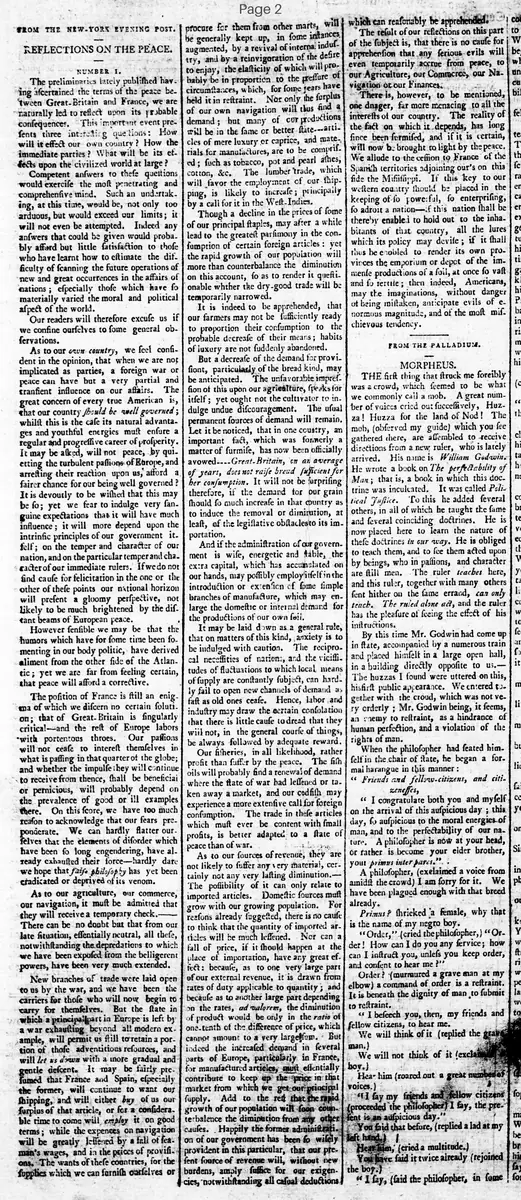
REFLECTIONS ON THE PEACE.
NUMBER I.
The preliminaries lately published having ascertained the terms of the peace between Great-Britain and France, we are naturally led to reflect upon its probable consequences. This important event presents three interesting questions: How will it affect our own country? How the immediate parties? What will be its effects upon the civilized world at large?
Competent answers to these questions would exercise the most penetrating and comprehensive mind. Such an undertaking, at this time, would be, not only too arduous, but would exceed our limits: it will not even be attempted. Indeed any answers that could be given would probably afford but little satisfaction to those who have learnt how to estimate the difficulty of scanning the future operations of new and great occurrences in the affairs of nations; especially those which have so materially varied the moral and political aspect of the world.
Our readers will therefore excuse us if we confine ourselves to some general observations.
As to our own country, we feel confident in the opinion, that when we are not implicated as parties, a foreign war or peace can have but a very partial and transient influence on our affairs. The great concern of every true American is, that our country should be well governed; whilst this is the case its natural advantages and youthful energies must ensure a regular and progressive career of prosperity.
It may be asked, will not peace, by quieting the turbulent passions of Europe, and arresting their reaction upon us, afford a fairer chance for our being well governed? It is devoutly to be wished that this may be so; yet we fear to indulge very sanguine expectations that it will have much influence; it will more depend upon the intrinsic principles of our government itself; on the temper and character of our nation, and on the particular temper and character of our immediate rulers. If we do not find cause for felicitation in the one or the other of these points our national horizon will present a gloomy perspective, not likely to be much brightened by the distant beams of European peace.
However sensible we may be that the humors which have for some time been fermenting in our body politic, have derived aliment from the other side of the Atlantic; yet we are far from feeling certain, that peace will afford a corrective.
The position of France is still an enigma of which we discern no certain solution; that of Great-Britain is singularly critical—and the rest of Europe labors with portentous throes. Our passions will not cease to interest themselves in what is passing in that quarter of the globe: and whether the impulse they will continue to receive from thence, shall be beneficial or pernicious, will probably depend on the prevalence of good or ill examples there. On this score, we have too much reason to acknowledge that our fears preponderate. We can hardly flatter ourselves that the elements of disorder which have been so long engendering, have already exhausted their force—hardly dare we hope that false philosophy has yet been eradicated or deprived of its venom.
As to our agriculture, our commerce, our navigation, it must be admitted that they will receive a temporary check. There can be no doubt but that from our late situation, essentially neutral, all these, notwithstanding the depredations to which we have been exposed from the belligerent powers, have been very much extended. New branches of trade were laid open to us by the war, and we have been the carriers for those who will now begin to carry for themselves. But the state in which a principal part in Europe is left by a war exhausting beyond all modern example, will permit us still to retain a portion of those adventitious resources, and will let us down with a more gradual and gentle descent. It may be fairly presumed that France and Spain, especially the former, will continue to want our shipping, and will either buy of us our surplus of that article, or for a considerable time to come will employ it on good terms; while the expenses on navigation will be greatly lessened by a fall of seamen's wages, and in the prices of provisions. The wants of these countries, for the supplies which we can furnish ourselves or procure for them from other marts, will be generally kept up, in some instances augmented, by a revival of internal industry, and by a reinvigoration of the desire to enjoy, the elasticity of which will probably be in proportion to the pressure of circumstances, which, for some years have held it in restraint. Not only the surplus of our own navigation will thus find a demand; but many of our productions will be in the same or better state.—articles of mere luxury or caprice, and materials for manufactures, are to be comprehended; such as tobacco, pot and pearl ashes, cotton, &c. The lumber trade, which will favor the employment of our shipping, is likely to increase; principally by a call for it in the West-Indies.
Though a decline in the prices of some of our principal staples, may after a while lead to the greatest parsimony in the consumption of certain foreign articles: yet the rapid growth of our population will more than counterbalance the diminution on this account, so as to render it questionable whether the dry-good trade will be temporarily narrowed.
It is indeed to be apprehended, that our farmers may not be sufficiently ready to proportion their consumption to the probable decrease of their means; habits of luxury are not suddenly abandoned. But a decrease of the demand for provisions, particularly of the bread kind, may be anticipated. The unfavorable impression of this upon our agriculture, speaks for itself; yet ought not the cultivator to indulge undue discouragement. The usual permanent sources of demand will remain. Let it be noticed, that in one country, an important fact, which was formerly a matter of surmise, has now been officially avowed.—Great-Britain, on an average of years, does not raise bread sufficient for her consumption. It will not be surprising therefore, if the demand for our grain should so much increase in that country as to induce the removal or diminution, at least, of the legislative obstacles to its importation.
And if the administration of our government is wise, energetic and stable, the extra capital, which has accumulated on our hands, may possibly employ itself in the introduction or extension of some simple branches of manufacture, which may enlarge the domestic or internal demand for the productions of our own soil.
It may be laid down as a general rule, that on matters of this kind, anxiety is to be indulged with caution. The reciprocal necessities of nations, and the vicissitudes of fluctuations to which local means of supply are constantly subject, can hardly fail to open new channels of demand as fast as old ones cease. Hence, labor and industry may draw the certain consolation that there is little cause to dread that they will not, in the general course of things, be always followed by adequate reward.
Our fisheries, in all likelihood, rather profit than suffer by the peace. The fish oils will probably find a renewal of demand where the state of war had lessened or taken away a market, and our codfish may experience a more extensive call for foreign consumption. The trade in these articles which must ever be content with small profits, is better adapted to a state of peace than of war.
As to our sources of revenue, they are not likely to suffer any very material, certainly not any very lasting diminution. The possibility of it can only relate to imported articles. Domestic sources must grow with our growing population. For reasons already suggested, there is no cause to think that the quantity of imported articles will be much lessened. Nor can a fall of price, if it should happen at the place of importation, have any great effect: because, as to one very large part of our external revenue, it is drawn from rates of duty applicable to quantity; and because as to another large part depending on the rates, ad valorem, the diminution of product would be only in the ratio of one-tenth of the difference of price, which cannot amount to a very large sum. But indeed the increased demand in several parts of Europe, particularly in France, for manufactured articles; must essentially contribute to keep up the price in that market from which we get our principal supply. Add to the rest that the rapid growth of our population will soon counterbalance the diminution from any other causes. Happily the former administration of our government has been so wisely provident in this particular, that our present sources of revenue will, without new burdens, amply suffice for our exigencies, notwithstanding all casual deductions which can reasonably be apprehended.
The result of our reflections on this part of the subject is, that there is no cause for apprehension that any serious evils will even temporarily accrue from peace, to our Agriculture, our Commerce, our Navigation or our Finances.
There is, however, to be mentioned, one danger, far more menacing to all the interests of our country. The reality of the fact on which it depends, has long since been surmised, and if it is certain, will now be brought to light by the peace. We allude to the cession to France of the Spanish territories adjoining ours on this side the Mississippi. If this key to our western country should be placed in the keeping of so powerful, so enterprising, so adroit a nation—if this nation shall be thereby enabled to hold out to the inhabitants of that country, all the lures which its policy may devise; if it shall thus be enabled to render its own provinces the emporium or depot of the immense productions of a soil, at once so vast and so fertile; then indeed, Americans, may the imaginations, without danger of being mistaken, anticipate evils of enormous magnitude, and of the most mischievous tendency.
What sub-type of article is it?
What keywords are associated?
Where did it happen?
Foreign News Details
Primary Location
Europe
Event Date
Lately Published
Outcome
peace between great britain and france; cession of spanish territories west of the mississippi to france
Event Details
The article discusses the terms of the peace between Great Britain and France, reflecting on its effects on the United States, including limited influence on governance, temporary checks to agriculture, commerce, and navigation offset by ongoing demands, benefits to fisheries and revenue, and a major concern over French control of western territories enabling influence over American inhabitants and trade routes.