Thank you for visiting SNEWPapers!
Sign up free
Literary
December 12, 1827
The Massachusetts Spy, And Worcester County Advertiser
Worcester, Worcester County, Massachusetts
What is this article about?
A narrative from letters in the London New Monthly Magazine describes a young Greek exile from Scio recounting the 1822 massacre: her family's murder by Turks, her feigned death to survive mutilation, and flight to safety amid the Greek War of Independence.
Merged-components note: These two components form a continuous literary piece: an introduction and the main narrative of 'The Exile of Scio'.
Clipping
OCR Quality
98%
Excellent
Full Text
MISCELLANY.
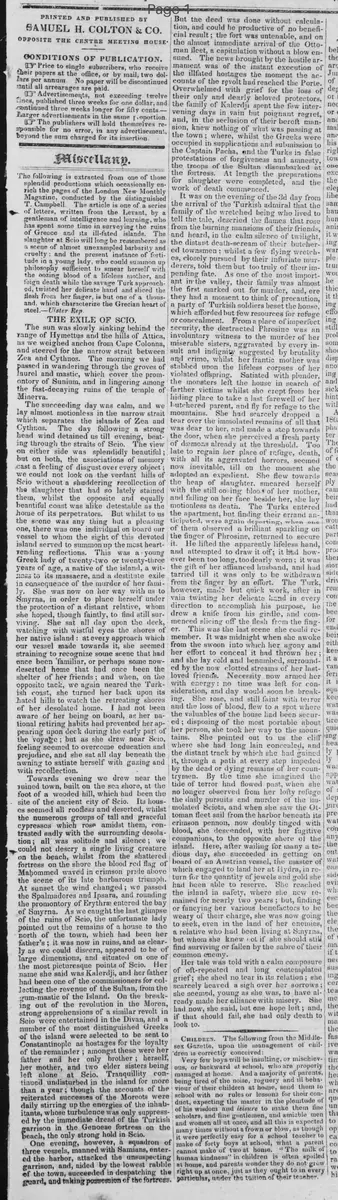
The following is extracted from one of those splendid productions which occasionally enrich the pages of the London New Monthly Magazine, conducted by the distinguished T. Campbell. The article is one of a series of letters, written from the Levant, by a gentleman of intelligence and learning, who has spent some time in surveying the ruins of Greece and its ill-fated islands. The slaughter at Scio will long be remembered as a scene of almost unexampled barbarity and cruelty: and the present instance of fortitude in a young lady, who could summon up philosophy sufficient to smear herself with the oozing blood of a lifeless mother, and feign death while the savage Turk approached, twisted her delicate hand and sliced the flesh from her finger, is but one of a thousand, which characterize the Grecian heart of steel.—Ulster Rep.
THE EXILE OF SCIO.
The sun was slowly sinking behind the range of Hymettus and the hills of Attica, as we weighed anchor from Cape Colonna, and steered for the narrow strait between Zea and Cythnos. The morning we had passed in wandering through the groves of laurel and mastic, which cover the promontory of Sunium, and in lingering among the fast-decaying ruins of the temple of Minerva.
The succeeding day was calm, and we lay almost motionless in the narrow strait which separates the islands of Zea and Cythnos. The day following a strong head wind detained us till evening, beating through the straits of Scio. The view on either side was splendidly beautiful; but on both, the associations of memory cast a feeling of disgust over every object; we could not look on the verdant hills of Scio without a shuddering recollection of the slaughter that had so lately stained them, whilst the opposite and equally beautiful coast was alike detestable as the home of its perpetrators. But whilst to us the scene was any thing but a pleasing one, there was one individual on board our vessel to whom the sight of this devoted island served to summon up the most heart-rending reflections. This was a young Greek lady of twenty-two or twenty-three years of age, a native of the island, a witness to its massacre, and a destitute exile in consequence of the murder of her family. She was now on her way with us to Smyrna, in order to place herself under the protection of a distant relative, whom she hoped, though faintly, to find still surviving. She sat all day upon the deck, watching with wistful eyes the shores of her native island: at every approach which our vessel made towards it, she seemed straining to recognize some scene that had once been familiar, or perhaps some now-deserted home that had once been the shelter of her friends; and when, on the opposite tack, we again neared the Turkish coast, she turned her back upon its hated hills to watch the retreating shores of her desolated home. I had not been aware of her being on board, as her national retiring habits had prevented her appearing upon deck during the early part of the voyage; but as she drew near Scio, feeling seemed to overcome education and prejudice, and she sat all day beneath the awning to satiate herself with gazing and with recollection.
Towards evening we drew near the ruined town, built on the sea shore, at the foot of a wooded hill, which had been the site of the ancient city of Scio. Its houses seemed all roofless and deserted, whilst the numerous groups of tall and graceful cypresses which rose amidst them, contrasted sadly with the surrounding desolation; all was solitude and silence; we could not descry a single living creature on the beach, whilst from the shattered fortress on the shore the blood red flag of Mahommed waved in crimson pride above the scene of its late barbarous triumph.
At sunset the wind changed; we passed the Spalmadores and Ipsara, and rounding the promontory of Erythrae entered the bay of Smyrna. As we caught the last glimpse of the ruins of Scio, the unfortunate lady pointed out the remains of a house to the north of the town, which had been her father's; it was now in ruins, and as clearly as we could discern, appeared to be of large dimensions, and situated on one of the most picturesque points of Scio. Her name she said was Kalerdji, and her father had been one of the commissioners for collecting the revenue of the Sultan, from the gum-mastic of the Island. On the breaking out of the revolution in the Morea, strong apprehensions of a similar revolt in Scio were entertained in the Divan, and a number of the most distinguished Greeks of the island were selected to be sent to Constantinople as hostages for the loyalty of the remainder; amongst these were her father and her only brother; herself, her mother, and two elder sisters being left alone at Scio. Tranquillity continued undisturbed in the island for more than a year; though the accounts of the reiterated successes of the Moreots were daily stirring up the energies of the inhabitants, whose turbulence was only suppressed by the immediate dread of the Turkish garrison in the Genoese fortress on the beach, the only strong hold in Scio.
One evening, however, a squadron of three vessels, manned with Samians, entered the harbor, attacked the unsuspecting garrison, and, aided by the lowest rabble of the town, succeeded in despatching the guard, and taking possession of the fortress. But the deed was done without calculation, and could be productive of no beneficial result; the fort was untenable, and on the almost immediate arrival of the Ottoman fleet, a capitulation without a blow ensued. The news brought by the hostile armament was of the instant execution of the ill-fated hostages the moment the accounts of the revolt had reached the Porte. Overwhelmed with grief for the loss of their only and dearly beloved protectors, the family of Kalerdji spent the few intervening days in vain but poignant regret, and, in the seclusion of their bereft mansion, knew nothing of what was passing at the town; where, whilst the Greeks were occupied in supplications and submission to the Captain Pacha, and the Turks in false protestations of forgiveness and amnesty, the troops of the Sultan disembarked at the fortress. At length the preparations for slaughter were completed, and the work of death commenced.
It was on the evening of the 3d day from the arrival of the Turkish admiral that the family of the wretched being who lived to tell the tale, descried the flames that rose from the burning mansions of their friends and heard, in the calm silence of twilight, the distant death-scream of their butchered townsmen: whilst a few flying wretches, closely pursued by their infuriate murderers, told them but too truly of their impending fate. As one of the most important in the valley, their family was almost the first marked out for murder, and, ere they had a moment to think of precaution, a party of Turkish soldiers beset the house, which afforded but few resources for refuge or concealment. From a place of imperfect security, the distracted Phrosine was an involuntary witness to the murder of her miserable sisters, aggravated by every insult and indignity suggested by brutality and crime, whilst her frantic mother was stabbed upon the lifeless corpses of her violated offspring. Satiated with plunder, the monsters left the house in search of farther victims whilst she crept from her hiding place to take a last farewell of her butchered parent, and fly for refuge to the mountains. She had scarcely dropped a tear over the immolated remains of all that was dear to her, and made a step towards the door, when she perceived a fresh party of daemons already at the threshold. Too late to regain her place of refuge, death, with all its aggravated horrors, seemed now inevitable, till on the moment she adopted an expedient. She flew towards the heap of slaughter, smeared herself with the still oozing blood of her mother, and falling on her face beside her, she lay motionless as death. The Turks entered the apartment, but finding their errand anticipated, were again departing, when one of them observed a brilliant sparkling on the finger of Phrosine, returned to secure it. He lifted the apparently lifeless hand, and attempted to draw it off; it had however been too long, too dearly worn; it was the gift of her affianced husband, and had tarried till it was only to be withdrawn from the finger by an effort. The Turk, however, made but quick work, after in vain twisting her delicate hand in every direction to accomplish his purpose, he drew a knife from his girdle, and commenced slicing off the flesh from the finger. This was the last scene she could remember. It was midnight when she awoke from the swoon into which her agony and her effort to conceal it had thrown her; and she lay cold and benumbed, surrounded by the now clotted streams of her last-loved friends. Necessity now armed her with energy: no time was left for consideration, and day would soon be breaking. She rose, and still faint with terror and the loss of blood, flew to a spot where the valuables of the house had been secured; disposing of the most portable about her person, she took her way to the mountains. She pointed out to us the cliff where she had long lain concealed, and the distant track by which she had gained it, through a path at every step impeded by the dead or dying remains of her countrymen. By the time she imagined the tide of terror had flowed past, when she no longer observed from her lofty refuge the daily pursuits and murder of the immolated Sciots, and when she saw the Ottoman fleet sail from the harbor beneath its crimson pennon, now doubly tinged with blood, she descended, with her fugitive companions, to the opposite shore of the island. Here, after waiting for many a tedious day, she succeeded in getting on board of an Austrian vessel, the master of which engaged to land her at Hydra, in return for the quantity of jewels and gold she had been able to reserve. She reached the island in safety, where she now remained for nearly two years; but, finding or fancying her various benefactors to be weary of their charge, she was now going to seek, even in the land of her enemies, a relative who had been living at Smyrna, but whom she knew not if she should still find surviving or fallen by the sabre of their common enemy.
Her tale was told with a calm composure of oft-repeated and long contemplated grief; she shed no tear in its relation; she scarcely heaved a sigh over her sorrows; she seemed, young as she was, to have already made her alliance with misery. She had now, she said, but one hope left; and, if that should fail, she had only death to look to.
The following is extracted from one of those splendid productions which occasionally enrich the pages of the London New Monthly Magazine, conducted by the distinguished T. Campbell. The article is one of a series of letters, written from the Levant, by a gentleman of intelligence and learning, who has spent some time in surveying the ruins of Greece and its ill-fated islands. The slaughter at Scio will long be remembered as a scene of almost unexampled barbarity and cruelty: and the present instance of fortitude in a young lady, who could summon up philosophy sufficient to smear herself with the oozing blood of a lifeless mother, and feign death while the savage Turk approached, twisted her delicate hand and sliced the flesh from her finger, is but one of a thousand, which characterize the Grecian heart of steel.—Ulster Rep.
THE EXILE OF SCIO.
The sun was slowly sinking behind the range of Hymettus and the hills of Attica, as we weighed anchor from Cape Colonna, and steered for the narrow strait between Zea and Cythnos. The morning we had passed in wandering through the groves of laurel and mastic, which cover the promontory of Sunium, and in lingering among the fast-decaying ruins of the temple of Minerva.
The succeeding day was calm, and we lay almost motionless in the narrow strait which separates the islands of Zea and Cythnos. The day following a strong head wind detained us till evening, beating through the straits of Scio. The view on either side was splendidly beautiful; but on both, the associations of memory cast a feeling of disgust over every object; we could not look on the verdant hills of Scio without a shuddering recollection of the slaughter that had so lately stained them, whilst the opposite and equally beautiful coast was alike detestable as the home of its perpetrators. But whilst to us the scene was any thing but a pleasing one, there was one individual on board our vessel to whom the sight of this devoted island served to summon up the most heart-rending reflections. This was a young Greek lady of twenty-two or twenty-three years of age, a native of the island, a witness to its massacre, and a destitute exile in consequence of the murder of her family. She was now on her way with us to Smyrna, in order to place herself under the protection of a distant relative, whom she hoped, though faintly, to find still surviving. She sat all day upon the deck, watching with wistful eyes the shores of her native island: at every approach which our vessel made towards it, she seemed straining to recognize some scene that had once been familiar, or perhaps some now-deserted home that had once been the shelter of her friends; and when, on the opposite tack, we again neared the Turkish coast, she turned her back upon its hated hills to watch the retreating shores of her desolated home. I had not been aware of her being on board, as her national retiring habits had prevented her appearing upon deck during the early part of the voyage; but as she drew near Scio, feeling seemed to overcome education and prejudice, and she sat all day beneath the awning to satiate herself with gazing and with recollection.
Towards evening we drew near the ruined town, built on the sea shore, at the foot of a wooded hill, which had been the site of the ancient city of Scio. Its houses seemed all roofless and deserted, whilst the numerous groups of tall and graceful cypresses which rose amidst them, contrasted sadly with the surrounding desolation; all was solitude and silence; we could not descry a single living creature on the beach, whilst from the shattered fortress on the shore the blood red flag of Mahommed waved in crimson pride above the scene of its late barbarous triumph.
At sunset the wind changed; we passed the Spalmadores and Ipsara, and rounding the promontory of Erythrae entered the bay of Smyrna. As we caught the last glimpse of the ruins of Scio, the unfortunate lady pointed out the remains of a house to the north of the town, which had been her father's; it was now in ruins, and as clearly as we could discern, appeared to be of large dimensions, and situated on one of the most picturesque points of Scio. Her name she said was Kalerdji, and her father had been one of the commissioners for collecting the revenue of the Sultan, from the gum-mastic of the Island. On the breaking out of the revolution in the Morea, strong apprehensions of a similar revolt in Scio were entertained in the Divan, and a number of the most distinguished Greeks of the island were selected to be sent to Constantinople as hostages for the loyalty of the remainder; amongst these were her father and her only brother; herself, her mother, and two elder sisters being left alone at Scio. Tranquillity continued undisturbed in the island for more than a year; though the accounts of the reiterated successes of the Moreots were daily stirring up the energies of the inhabitants, whose turbulence was only suppressed by the immediate dread of the Turkish garrison in the Genoese fortress on the beach, the only strong hold in Scio.
One evening, however, a squadron of three vessels, manned with Samians, entered the harbor, attacked the unsuspecting garrison, and, aided by the lowest rabble of the town, succeeded in despatching the guard, and taking possession of the fortress. But the deed was done without calculation, and could be productive of no beneficial result; the fort was untenable, and on the almost immediate arrival of the Ottoman fleet, a capitulation without a blow ensued. The news brought by the hostile armament was of the instant execution of the ill-fated hostages the moment the accounts of the revolt had reached the Porte. Overwhelmed with grief for the loss of their only and dearly beloved protectors, the family of Kalerdji spent the few intervening days in vain but poignant regret, and, in the seclusion of their bereft mansion, knew nothing of what was passing at the town; where, whilst the Greeks were occupied in supplications and submission to the Captain Pacha, and the Turks in false protestations of forgiveness and amnesty, the troops of the Sultan disembarked at the fortress. At length the preparations for slaughter were completed, and the work of death commenced.
It was on the evening of the 3d day from the arrival of the Turkish admiral that the family of the wretched being who lived to tell the tale, descried the flames that rose from the burning mansions of their friends and heard, in the calm silence of twilight, the distant death-scream of their butchered townsmen: whilst a few flying wretches, closely pursued by their infuriate murderers, told them but too truly of their impending fate. As one of the most important in the valley, their family was almost the first marked out for murder, and, ere they had a moment to think of precaution, a party of Turkish soldiers beset the house, which afforded but few resources for refuge or concealment. From a place of imperfect security, the distracted Phrosine was an involuntary witness to the murder of her miserable sisters, aggravated by every insult and indignity suggested by brutality and crime, whilst her frantic mother was stabbed upon the lifeless corpses of her violated offspring. Satiated with plunder, the monsters left the house in search of farther victims whilst she crept from her hiding place to take a last farewell of her butchered parent, and fly for refuge to the mountains. She had scarcely dropped a tear over the immolated remains of all that was dear to her, and made a step towards the door, when she perceived a fresh party of daemons already at the threshold. Too late to regain her place of refuge, death, with all its aggravated horrors, seemed now inevitable, till on the moment she adopted an expedient. She flew towards the heap of slaughter, smeared herself with the still oozing blood of her mother, and falling on her face beside her, she lay motionless as death. The Turks entered the apartment, but finding their errand anticipated, were again departing, when one of them observed a brilliant sparkling on the finger of Phrosine, returned to secure it. He lifted the apparently lifeless hand, and attempted to draw it off; it had however been too long, too dearly worn; it was the gift of her affianced husband, and had tarried till it was only to be withdrawn from the finger by an effort. The Turk, however, made but quick work, after in vain twisting her delicate hand in every direction to accomplish his purpose, he drew a knife from his girdle, and commenced slicing off the flesh from the finger. This was the last scene she could remember. It was midnight when she awoke from the swoon into which her agony and her effort to conceal it had thrown her; and she lay cold and benumbed, surrounded by the now clotted streams of her last-loved friends. Necessity now armed her with energy: no time was left for consideration, and day would soon be breaking. She rose, and still faint with terror and the loss of blood, flew to a spot where the valuables of the house had been secured; disposing of the most portable about her person, she took her way to the mountains. She pointed out to us the cliff where she had long lain concealed, and the distant track by which she had gained it, through a path at every step impeded by the dead or dying remains of her countrymen. By the time she imagined the tide of terror had flowed past, when she no longer observed from her lofty refuge the daily pursuits and murder of the immolated Sciots, and when she saw the Ottoman fleet sail from the harbor beneath its crimson pennon, now doubly tinged with blood, she descended, with her fugitive companions, to the opposite shore of the island. Here, after waiting for many a tedious day, she succeeded in getting on board of an Austrian vessel, the master of which engaged to land her at Hydra, in return for the quantity of jewels and gold she had been able to reserve. She reached the island in safety, where she now remained for nearly two years; but, finding or fancying her various benefactors to be weary of their charge, she was now going to seek, even in the land of her enemies, a relative who had been living at Smyrna, but whom she knew not if she should still find surviving or fallen by the sabre of their common enemy.
Her tale was told with a calm composure of oft-repeated and long contemplated grief; she shed no tear in its relation; she scarcely heaved a sigh over her sorrows; she seemed, young as she was, to have already made her alliance with misery. She had now, she said, but one hope left; and, if that should fail, she had only death to look to.
What sub-type of article is it?
Prose Fiction
Epistolary
What themes does it cover?
Liberty Freedom
Political
War Peace
What keywords are associated?
Scio Massacre
Greek Exile
Turkish Atrocities
Phrosine Kalerdji
Greek Revolution
Family Murder
Feigned Death
What entities or persons were involved?
From Letters In The London New Monthly Magazine, Conducted By T. Campbell
Literary Details
Title
The Exile Of Scio.
Author
From Letters In The London New Monthly Magazine, Conducted By T. Campbell
Subject
The Massacre At Scio During The Greek Revolution
Form / Style
Narrative Account In Letter Form
Key Lines
She Flew Towards The Heap Of Slaughter, Smeared Herself With The Still Oozing Blood Of Her Mother, And Falling On Her Face Beside Her, She Lay Motionless As Death.
The Turk, However, Made But Quick Work, After In Vain Twisting Her Delicate Hand In Every Direction To Accomplish His Purpose, He Drew A Knife From His Girdle, And Commenced Slicing Off The Flesh From The Finger.
Her Tale Was Told With A Calm Composure Of Oft Repeated And Long Contemplated Grief; She Shed No Tear In Its Relation; She Scarcely Heaved A Sigh Over Her Sorrows; She Seemed, Young As She Was, To Have Already Made Her Alliance With Misery.