Thank you for visiting SNEWPapers!
Sign up free
Literary
September 22, 1911
Northern Wisconsin Advertiser
Wabeno, Forest County, Wisconsin
What is this article about?
In an interview with Sterling Heilig, renowned Spanish dancer Caroline Otero argues that women are loveliest at forty, emphasizing health, self-control, and mastery of disdain. She uses the flamenco dance as a metaphor for woman's life stages and critiques men's attitudes toward aging women, highlighting Paris beauties' radiance.
Clipping
OCR Quality
92%
Excellent
Full Text
Woman Loveliest at Forty
As Explained by Caroline Otero to Sterling Heilig
Woman is loveliest at forty!
The speaker herself seemed never lovelier than when admitting forty-one years past. For twenty years Paris has called her The Beautiful Otero; and she is still at the height of fortune as the most famous Spanish dancer and the most bejeweled professional beauty of the gay French capital.
She explained herself:
"I refer to fine women. In health and the enjoyment of rational luxuries, they need only two things to triumph in the charm of their full flowering—will to keep in condition, and mastery of that pathetic disdain which tempts them to stand back in the shadow."
She rose and paced the room with cat-like grace. She snatched a man's hat from the table, cocked it over her eye, flung the end of a cloak over her shoulder, and struck an attitude.
"I have our value impressed on me ever in the Spanish dance," she said. "The grand dance of the flamenca! What a dance, monsieur, what a drama! It is the whole of woman's life in three acts: desire, seduction, tragic triumph. Never has dramatic work expressed femininity with the grace, mystery and intensity of those three scenes. Now, look you, in the south of Spain they say it takes eight years to form a flamenca. Perfection is unattainable; because this exhausting dance—twelve minutes!—shows me a danseuse of the opera who will accept a variation of twelve minutes—contains three roles that are unconnected: the ingenue, the amoureuse, and the tragedienne. One ought to be sixteen years old to dance the first—and forty to dance the end of the drama, in which Rubia, magnificent at fifty, fixed the tradition."
"Madame," I asked, "is it possible that you are old enough to dance that third act?"
"I am forty-one," she laughed. "I had made two trips to the United States before I settled in Paris in 1891; and I was just of age when starting out. If I am not worn like some great flamencas, it is thanks to the life of Paris. Those who remain in Spain use themselves up, monsieur. It is a magnificent public, but it fatigues the artiste. In Paris, the good people interest themselves as much in my jewels and accept what I give them. So I have been able to live reasonably. Luxury is good for a woman of self-control. Those soft creatures who lie around and overeat, I have no patience with them! I have always had unconscious training from my work, though I owe much to the Turkish bath."
"The Hammam?" I asked.
"No, no: I have a sweat-box in my apartment fitted with fifty electric-light bulbs. I often take it four times a week when not dancing, followed with a tepid douche, turning cold. There is an apparatus to frighten young beauties, monsieur!"
Certainly a remarkable woman. On the stage, from Copenhagen to Vienna, from London to Rome, she is known, always and above all, as a beauty. She sings after a fashion. She has made successful ventures into pantomime. And now, at forty, she has made herself an actress of merit, appearing in emotional roles on the great Paris stage. Now, also, at forty, she continues to pose for the best selling beauty photographs on the European market. After her comes Lina Cavalieri, with no third in their class. Other beauties sell as well in certain successful poses; but Otero and Cavalieri never cease posing.
"Women of forty!" exclaimed Otero. "What pathetic disdain, what proud anticipation, what unhappy acquiescence, hastening out to meet fate more than half-way, cause so many to ignore their splendor and even wander into self tractions, yes—and also the maniere de s'en servir! The way to use them! Here is the triumph of the woman of forty—when she gladly lets herself loose!"
"Why not?" I murmured, fascinated by one who certainly lets herself loose. She continued gaily:
"Why, the intuitions of the very young man are unerring in this matter. The youth of seventeen, with senses painfully fresh and keen, begins with a grande passion for the woman of forty. Instinct tells him that she is the loveliest. The thing is traditional, from Harry Esmond down to Porter Charlton. And Joseph even; how did she get that coat? We laugh. Laughter is a sudden glory—over human mis-chance. The youth himself refuses to arrive at charming forty beside a woman of sixty-three; yet his first untroubled judgment was to award the apple where it belongs."
"The man of forty evidently..." I began.
"The worst enemy of the woman of forty is the man of forty," persisted Otero. "She is the mirror in which he dreads to see the shadow of his own degeneracy—forgetting that his wear and tear of ten years past have not been hers. So the man of forty marries the girl of twenty-three. In spite of his wear and tear, she finds in the charm of the full man her profound satisfaction—without looking ahead. Why look ahead? In Paris we see daily men of forty making inexperienced young fellows appear foolish. For example, I will cite 'the best loved-man of Paris,' over whose elegant person five hat-pin duels have been fought in the past three years—the latest on the Biarritz boardwalk, between a young matron and a bud of society. He will be forty-two years old next February."
Otero did not cite his name, so I will imitate her wise discretion.
"The man of forty is vain and suspicious," said Otero. "Even when in full possession of his physical and mental perfections, he must punish unoffending loveliness that walks beside him in the path of years. Oh, yes, he makes the woman of forty suffer! The fair creature would be more than human not to resent it. Unspoken malice in her laughing eye causes the fatuous fellow to grit his teeth with hate. And so two perfect creatures, at the flood of all that is best in them, too often turn their backs upon each other, leaving opportunity open to less prejudiced hearts and heads—to girls with their intuitions, and to men of fifty purged of petty vanity!"
Even so, women of forty rule Paris. Madame Otero collects portrait photographs. Scattering a package of foremost Paris beauties on the table, she called off their ages for me. I was surprised.
"Who thinks of their ages?" she said. "Some were not so beautiful when younger. Look at this one and this. Here is a lady with an almost insignificant nose; and her eyes were never much until she had them tattooed where actresses pencil. Here is one with not a perfect feature, yet her physique and temperament are delightful. And this other, without the noble spirit breathing through her look, would she not be almost plain?"
She said true; yet I had passed all as charming. All have beauty reputation. When a woman like this gives away her sisters it is edifying. Otero showed me how one splendid creature fought for years against a double chin and conquered; how another began bony; how another has learned to dissimulate a trumpet nose.
"Stop!" I exclaimed. "You will make me think that all young women are full of defects!"
"They are," said Otero. What is time for but to correct them? Scatter the photographs and look again. You will find them beauties now in any case! They are radiant. They have learned their power!"
It was even so. There were flashes of ecstasy, gleams of delight, eyes that spoke soul awakenings, lips parted in mystery. There were coy faces, faces that asked baffling questions, confidential faces, high, courageous faces, faces that breathed sweet, sad reverie.
"All kinds of faces, except wooden twenty-year-old faces, hein?" laughed the subtle Spaniard. "A Paris photographer has given me a partial reason why their faces are lovelier at forty. It is because they have been photographed so much."
"The effort to resemble one's best picture?" I mused.
"All that, in general; but he claims a particular influence of self-suggestion. We come to resemble our best photographs by gentle degrees, unconsciously, when they follow each other in a long, changing series."
"Living up to last week's photograph makes next week's photograph still handsomer," I said.
"A hundred photographs completes the cure."
"He was a photographer, of course, and gave the entire credit to his art," replied Otero. "Perhaps the secret is encouragement. How often we have seen plain women bloom out. We women guess the secret cause—the transfigured one is happy in love. She has been encouraged."
"Oh, well then," I said, "any way to encourage oneself!"
"That's it! Beauty is a habit!" exclaimed Otero. "It is the habit of those who have started—encouraged! Let the woman of forty merely conceal her age, and the trick is half won."
No doubt! Loveliness is a living thing made of beauty, charm, grace—physical at-
acts: desire, seduction, tragic triumph. Never has dramatic work expressed femininity with the grace, mystery and intensity of those three scenes.
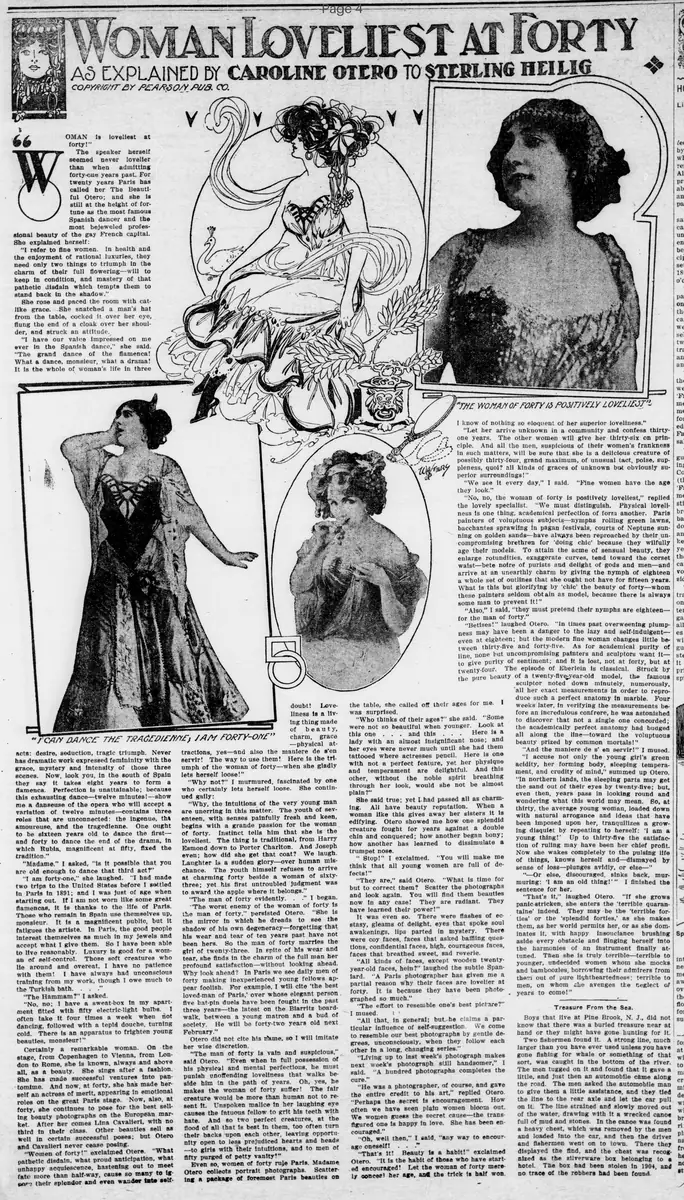
La Danseuse Tragédienne: I Am Forty-One
sculptor noted down minutely, numerously, all her exact measurements in order to reproduce such a perfect anatomy in marble. Four weeks later, in verifying the measurements before an incredulous confrere, he was astonished to discover that not a single one concorded; the academically perfect anatomy had budged all along the line—toward the voluptuous beauty prized by common mortals!"
"And the maniere de s'en servir!" I mused.
"I accuse not only the young girl's green acidity, her forming body, sleeping temperament, and crudity of mind," summed up Otero. "In northern lands, the sleeping parts may get the sand out of their eyes by twenty-five; but, even then, years pass in looking round and wondering what this world may mean. So, at thirty, the average young woman, loaded down with natural arrogance and ideas that have been imposed upon her, tranquilizes a growing disquiet by repeating to herself: 'I am a young thing!' Up to thirty-five the satisfaction of ruling may have been her chief profit. Now she wakes completely to the pulsing life of things, knows herself and—dismayed by sense of loss—plunges avidly, or else—"
"Or else, discouraged, sinks back, murmuring: 'I am an old thing!'"
I finished the sentence for her.
"That's it," laughed Otero. "If she grows panic-stricken, she enters the 'terrible quarantine' indeed. They may be the 'terrible forties' or the 'splendid forties,' as she makes them, as her world permits her, or as she dominates it, with happy insouciance brushing aside every obstacle and flinging herself into the harmonies of an instrument finally attuned. Then she is truly terrible—terrible to younger, undecided women whom she mocks and bamboozles, borrowing their admirers from them out of pure lightheartedness; terrible to men, on whom she avenges the neglect of years to come!"
As Explained by Caroline Otero to Sterling Heilig
Woman is loveliest at forty!
The speaker herself seemed never lovelier than when admitting forty-one years past. For twenty years Paris has called her The Beautiful Otero; and she is still at the height of fortune as the most famous Spanish dancer and the most bejeweled professional beauty of the gay French capital.
She explained herself:
"I refer to fine women. In health and the enjoyment of rational luxuries, they need only two things to triumph in the charm of their full flowering—will to keep in condition, and mastery of that pathetic disdain which tempts them to stand back in the shadow."
She rose and paced the room with cat-like grace. She snatched a man's hat from the table, cocked it over her eye, flung the end of a cloak over her shoulder, and struck an attitude.
"I have our value impressed on me ever in the Spanish dance," she said. "The grand dance of the flamenca! What a dance, monsieur, what a drama! It is the whole of woman's life in three acts: desire, seduction, tragic triumph. Never has dramatic work expressed femininity with the grace, mystery and intensity of those three scenes. Now, look you, in the south of Spain they say it takes eight years to form a flamenca. Perfection is unattainable; because this exhausting dance—twelve minutes!—shows me a danseuse of the opera who will accept a variation of twelve minutes—contains three roles that are unconnected: the ingenue, the amoureuse, and the tragedienne. One ought to be sixteen years old to dance the first—and forty to dance the end of the drama, in which Rubia, magnificent at fifty, fixed the tradition."
"Madame," I asked, "is it possible that you are old enough to dance that third act?"
"I am forty-one," she laughed. "I had made two trips to the United States before I settled in Paris in 1891; and I was just of age when starting out. If I am not worn like some great flamencas, it is thanks to the life of Paris. Those who remain in Spain use themselves up, monsieur. It is a magnificent public, but it fatigues the artiste. In Paris, the good people interest themselves as much in my jewels and accept what I give them. So I have been able to live reasonably. Luxury is good for a woman of self-control. Those soft creatures who lie around and overeat, I have no patience with them! I have always had unconscious training from my work, though I owe much to the Turkish bath."
"The Hammam?" I asked.
"No, no: I have a sweat-box in my apartment fitted with fifty electric-light bulbs. I often take it four times a week when not dancing, followed with a tepid douche, turning cold. There is an apparatus to frighten young beauties, monsieur!"
Certainly a remarkable woman. On the stage, from Copenhagen to Vienna, from London to Rome, she is known, always and above all, as a beauty. She sings after a fashion. She has made successful ventures into pantomime. And now, at forty, she has made herself an actress of merit, appearing in emotional roles on the great Paris stage. Now, also, at forty, she continues to pose for the best selling beauty photographs on the European market. After her comes Lina Cavalieri, with no third in their class. Other beauties sell as well in certain successful poses; but Otero and Cavalieri never cease posing.
"Women of forty!" exclaimed Otero. "What pathetic disdain, what proud anticipation, what unhappy acquiescence, hastening out to meet fate more than half-way, cause so many to ignore their splendor and even wander into self tractions, yes—and also the maniere de s'en servir! The way to use them! Here is the triumph of the woman of forty—when she gladly lets herself loose!"
"Why not?" I murmured, fascinated by one who certainly lets herself loose. She continued gaily:
"Why, the intuitions of the very young man are unerring in this matter. The youth of seventeen, with senses painfully fresh and keen, begins with a grande passion for the woman of forty. Instinct tells him that she is the loveliest. The thing is traditional, from Harry Esmond down to Porter Charlton. And Joseph even; how did she get that coat? We laugh. Laughter is a sudden glory—over human mis-chance. The youth himself refuses to arrive at charming forty beside a woman of sixty-three; yet his first untroubled judgment was to award the apple where it belongs."
"The man of forty evidently..." I began.
"The worst enemy of the woman of forty is the man of forty," persisted Otero. "She is the mirror in which he dreads to see the shadow of his own degeneracy—forgetting that his wear and tear of ten years past have not been hers. So the man of forty marries the girl of twenty-three. In spite of his wear and tear, she finds in the charm of the full man her profound satisfaction—without looking ahead. Why look ahead? In Paris we see daily men of forty making inexperienced young fellows appear foolish. For example, I will cite 'the best loved-man of Paris,' over whose elegant person five hat-pin duels have been fought in the past three years—the latest on the Biarritz boardwalk, between a young matron and a bud of society. He will be forty-two years old next February."
Otero did not cite his name, so I will imitate her wise discretion.
"The man of forty is vain and suspicious," said Otero. "Even when in full possession of his physical and mental perfections, he must punish unoffending loveliness that walks beside him in the path of years. Oh, yes, he makes the woman of forty suffer! The fair creature would be more than human not to resent it. Unspoken malice in her laughing eye causes the fatuous fellow to grit his teeth with hate. And so two perfect creatures, at the flood of all that is best in them, too often turn their backs upon each other, leaving opportunity open to less prejudiced hearts and heads—to girls with their intuitions, and to men of fifty purged of petty vanity!"
Even so, women of forty rule Paris. Madame Otero collects portrait photographs. Scattering a package of foremost Paris beauties on the table, she called off their ages for me. I was surprised.
"Who thinks of their ages?" she said. "Some were not so beautiful when younger. Look at this one and this. Here is a lady with an almost insignificant nose; and her eyes were never much until she had them tattooed where actresses pencil. Here is one with not a perfect feature, yet her physique and temperament are delightful. And this other, without the noble spirit breathing through her look, would she not be almost plain?"
She said true; yet I had passed all as charming. All have beauty reputation. When a woman like this gives away her sisters it is edifying. Otero showed me how one splendid creature fought for years against a double chin and conquered; how another began bony; how another has learned to dissimulate a trumpet nose.
"Stop!" I exclaimed. "You will make me think that all young women are full of defects!"
"They are," said Otero. What is time for but to correct them? Scatter the photographs and look again. You will find them beauties now in any case! They are radiant. They have learned their power!"
It was even so. There were flashes of ecstasy, gleams of delight, eyes that spoke soul awakenings, lips parted in mystery. There were coy faces, faces that asked baffling questions, confidential faces, high, courageous faces, faces that breathed sweet, sad reverie.
"All kinds of faces, except wooden twenty-year-old faces, hein?" laughed the subtle Spaniard. "A Paris photographer has given me a partial reason why their faces are lovelier at forty. It is because they have been photographed so much."
"The effort to resemble one's best picture?" I mused.
"All that, in general; but he claims a particular influence of self-suggestion. We come to resemble our best photographs by gentle degrees, unconsciously, when they follow each other in a long, changing series."
"Living up to last week's photograph makes next week's photograph still handsomer," I said.
"A hundred photographs completes the cure."
"He was a photographer, of course, and gave the entire credit to his art," replied Otero. "Perhaps the secret is encouragement. How often we have seen plain women bloom out. We women guess the secret cause—the transfigured one is happy in love. She has been encouraged."
"Oh, well then," I said, "any way to encourage oneself!"
"That's it! Beauty is a habit!" exclaimed Otero. "It is the habit of those who have started—encouraged! Let the woman of forty merely conceal her age, and the trick is half won."
No doubt! Loveliness is a living thing made of beauty, charm, grace—physical at-
acts: desire, seduction, tragic triumph. Never has dramatic work expressed femininity with the grace, mystery and intensity of those three scenes.
La Danseuse Tragédienne: I Am Forty-One
sculptor noted down minutely, numerously, all her exact measurements in order to reproduce such a perfect anatomy in marble. Four weeks later, in verifying the measurements before an incredulous confrere, he was astonished to discover that not a single one concorded; the academically perfect anatomy had budged all along the line—toward the voluptuous beauty prized by common mortals!"
"And the maniere de s'en servir!" I mused.
"I accuse not only the young girl's green acidity, her forming body, sleeping temperament, and crudity of mind," summed up Otero. "In northern lands, the sleeping parts may get the sand out of their eyes by twenty-five; but, even then, years pass in looking round and wondering what this world may mean. So, at thirty, the average young woman, loaded down with natural arrogance and ideas that have been imposed upon her, tranquilizes a growing disquiet by repeating to herself: 'I am a young thing!' Up to thirty-five the satisfaction of ruling may have been her chief profit. Now she wakes completely to the pulsing life of things, knows herself and—dismayed by sense of loss—plunges avidly, or else—"
"Or else, discouraged, sinks back, murmuring: 'I am an old thing!'"
I finished the sentence for her.
"That's it," laughed Otero. "If she grows panic-stricken, she enters the 'terrible quarantine' indeed. They may be the 'terrible forties' or the 'splendid forties,' as she makes them, as her world permits her, or as she dominates it, with happy insouciance brushing aside every obstacle and flinging herself into the harmonies of an instrument finally attuned. Then she is truly terrible—terrible to younger, undecided women whom she mocks and bamboozles, borrowing their admirers from them out of pure lightheartedness; terrible to men, on whom she avenges the neglect of years to come!"
What sub-type of article is it?
Dialogue
Essay
What themes does it cover?
Social Manners
Love Romance
Moral Virtue
What keywords are associated?
Beauty At Forty
Caroline Otero
Spanish Flamenco
Women Aging
Paris Beauties
Self Control
Maturity Charm
What entities or persons were involved?
As Explained By Caroline Otero To Sterling Heilig
Literary Details
Title
Woman Loveliest At Forty
Author
As Explained By Caroline Otero To Sterling Heilig
Subject
On The Loveliness Of Women At Forty And The Spanish Flamenco Dance
Form / Style
Conversational Essay In Prose
Key Lines
Woman Is Loveliest At Forty!
It Is The Whole Of Woman's Life In Three Acts: Desire, Seduction, Tragic Triumph.
Beauty Is A Habit!
The Worst Enemy Of The Woman Of Forty Is The Man Of Forty.