Thank you for visiting SNEWPapers!
Sign up free
Jenks' Portland Gazette. Maine Advertiser
Portland, Cumberland County, Maine
What is this article about?
Detailed geographical, climatic, and health description of Havana, Cuba, by former US Consul John Morton, highlighting city layout, yellow fever prevalence, and seasonal conditions.
Clipping
OCR Quality
Full Text
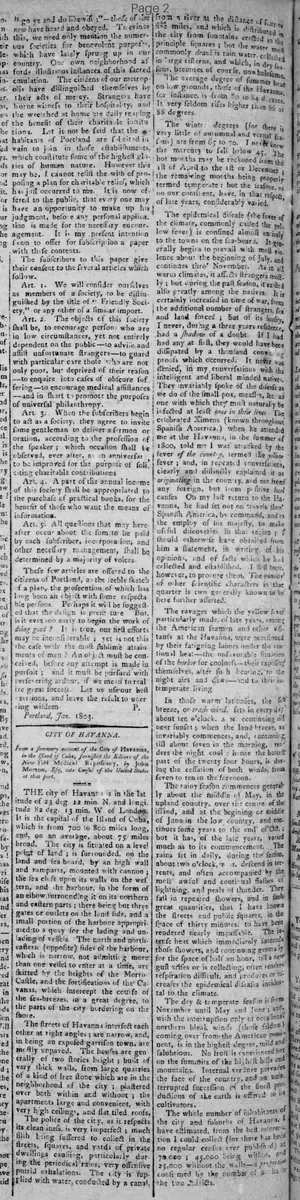
From a summary account of the City of Havanna, in the Island of Cuba, furnished the Editors of the New York Medical Repository, by John Morton, Esq. late Consul of the United States at that port.
THE city of Havanna is in the latitude of 23 deg. 12 min. N. and longitude 82 deg. 13 min. W. of London. It is the capital of the Island of Cuba, which is from 700 to 800 miles long, and, on an average, about 75 miles broad. The city is situated on a level point of land; is surrounded, on the land and sea board, by an high wall and ramparts, mounted with cannon; the sea close upon its walls on the western, and the harbour, in the form of an elbow, surrounding it on its northern and eastern parts; there being but three gates or outlets on the land side, and a small portion of the harbour appropriated to a quay for the lading and unlading of vessels. The north and north-eastern (opposite) sides of the harbour, which is narrow, not admitting more than one vessel to enter at a time, are skirted by the heights of the Morro Castle, and the fortifications of the Cabanas, which-intercept the course of the sea-breezes, in a great degree, to the parts of the city bordering on the shore.
The streets of Havanna intersect each other at right angles; are narrow, and, in being an exposed garrison town, are mostly unpaved. The houses are generally of two stories height; built of very thick walls, from large quarries of a kind of free stone which are in the neighborhood of the city; plastered over both within and without; the apartments large and convenient, with very high ceilings, and flat tiled roofs.
The police of the city, as it respects its cleanliness, is very imperfect; much filth being suffered to collect in the streets, squares, and yards of private dwellings causing, particularly during the periodical rains, very offensive putrid exhalations. The city is supplied with water, conducted by a canal, from a river at the distance of four or five miles. and which is distributed in the city from fountains erected in the principal squares; but the water most commonly drank is rain water. collected in large cisterns, and which, in dry seasons, becomes of course, unwholesome.
The average degree of summer heat on low grounds, those of the Havanna, for instance, is -from 80 to 84 degrees. It very seldom rises higher than 86 or 88 degrees.
The winter degrees (for there is very little of autumnal and vernal season-) are from 65 to 70. I never knew the mercury to fall below 45. The hot months may be reckoned from the 1st of April to the 1st of December; the remaining months being properly termed temperate : but the seasons, as on our continent, have, in that respect, of late years, considerably varied.
The epidemical disease (the fever of the climate, commonly called the yellow fever) is confined almost entirely to the towns on the sea-board. It generally begins to prevail with most violence about the beginning of July, and continues thro' November.' As in all warm climates, it affects strangers most. ly : but during the past season, it existed also greatly among the natives. It is certainly increased in time of war, from the additional number of strangers, sea and land forces ; But of its locality, I never, during a three years residence, had a shadow of a doubt. If I had had any at first, they would have been dissipated by a thousand convincing proofs which occurred. It never was denied, in my, conversations with the intelligent and liberal minded natives. They invariably spoke of the disease as we do of the small pox, measles, &c. as one with which they must naturally be infected at least once in their lives The celebrated Ximenes (known throughout Spanish America.) when he attended me at the Havanna, in the summer of 1800, told me I was attacked by the fever of the country, termed the yellow fever ; and, in repeated conversations, clearly and distinctly explained it as originating in the country, and not from any foreign, but from positive local causes On my last return to the Ha- vauna, he had set out on travels thro' Spanish America, by command, and in the employ of his majesty, to make useful discoveries in that region ; should otherwise have obtained from him a statement, in writing, of his opinions, and of facts which he had collected and established. I still hope, however, to procure them. The paucity of other scientific characters in that quarter is too generally known to be here further asserted.
The ravages which the yellow fever particularly made. of late years, among the American seamen and other visitors at the Havanna, were occasioned by their fatiguing labors under the continual heat-the unfavorable situation of the harbor for coolness- their exposing themselves, after such sweating.to the night airs and dews-and to their intemperate living
In those warm latitudes, the sea breeze, or trade wind. sets in every day about ten o'clock. A M: continuing till near sunset : when the land breeze, as invariably commences, and, continuing till about seven in the morning, renders the night cool : hence the hottest part of the twenty four hours, is during the cessation of both winds. from seven to ten in the forenoon.
The rainy season commences generally about the middle of May, in the upland country, over the centre of the island, and at the beginning or middle of June in the low country, and continues some years to the end of Oct. ; but it has, of the late years, varied much as to its commencement. The rains set in daily, during the season, about two o'clock. p. m. descend in torrents, and often accompanied by the most awful and continual flashes of lightning, and peals of thunder. They fall in repeated showers, and in such great quantities, that I have known the streets and public squares, in the space of thirty minutes. to have been rendered nearly impassable. The intense heat which immediately succeeds those showers, and continuing generally for the space of half an hour, till a new cloud arises or is collecting, often renders respiration difficult, and produces or increases the epidemical diseases incidental to the climate.
The dry & temperate season is from November until May and June ; and, with the interruption only of occasional northero bleak winds (those seldom) coming over from-the American conti- nent, is in the highest degree, mild and salubrious. No frost is experienced but on the summits of the highest hills and mountains. Internal verdure pervades the face of the country, and an uninterrupted succession of the best pro- ductions of the earth is offered to its cultivators.
The whole number of inhabitants of the city and suburbs of Havanna, I have estimated, from the best informa- tion I could collect (for there has been no regular census ever published)at 70,000 ; 45,000 being within, and confined by the walls, and 25,000 without the walls-a toleration the two districts.
What sub-type of article is it?
What keywords are associated?
What entities or persons were involved?
Where did it happen?
Foreign News Details
Primary Location
City Of Havanna, Island Of Cuba
Event Date
Summer Of 1800
Key Persons
Outcome
yellow fever ravages american seamen and visitors due to labor, heat, exposure, and intemperance; affects strangers mostly but also natives in past season; increased in wartime.
Event Details
Summary account of Havana's geography, fortifications, streets, housing, water supply, climate, rainy and dry seasons, and yellow fever epidemic, which is local to the climate and prevalent from July to November, based on three years' residence by US Consul.