Thank you for visiting SNEWPapers!
Sign up free
Vermont Watchman And State Journal
Montpelier, Washington County, Vermont
What is this article about?
Ex-President Martin Van Buren writes from Brattleboro, VT, on Aug. 11, 1849, declining a delegate appointment to the Rome Convention. He expresses earnest desire for reuniting the Democratic party on its founding principles, amid discussions of party dissolution and coalitions with Hunkers and Barnburners.
Clipping
OCR Quality
Full Text
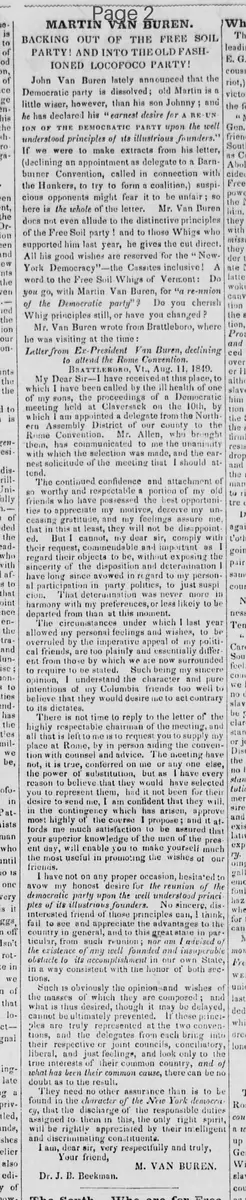
BACKING OUT OF THE FREE SOIL
PARTY! AND INTO THE OLD FASH-
IONED LOCOFOCO PARTY!
John Van Buren lately announced that the
Democratic party is dissolved; old Martin is a
little wiser, however, than his son Johnny; and
he has declared his "earnest desire for A RE-UN-
ION OF THE DEMOCRATIC PARTY UPON THE WELL
understood principles of its illustrious founders."
If we were to make extracts from his letter
(declining an appointment as delegate to a Barn-
burner Convention, called in connection with
the Hunkers, to try to form a coalition,) suspi-
cious opponents might fear it to be unfair; so
here is the whole of the letter. Mr. Van Buren
does not even allude to the distinctive principles
of the Free Soil party! and to those Whigs who
supported him last year, he gives the cut direct
All his good wishes are reserved for the "New
York Democracy"—the Cassites inclusive! A
word to the Free Soil Whigs of Vermont: Do
you go, with Martin Van Buren, for "a re-union
of the Democratic party"? Do you cherish
Whig principles still, or have you changed?
Mr. Van Buren wrote from Brattleboro, where
he was visiting at the time:
Letter from Ex-President Van Buren, declining
to attend the Rome Convention.
BRATTLEBORO, Vt., Aug. 11, 1849.
My Dear Sir—I have received at this place, to
which I have been called by the ill health of one
of my sons, the proceedings of a Democratic
meeting held at Claverack on the 10th, by
which I am appointed a delegate from the North-
-ern Assembly District of our County to the
Rome Convention. Mr. Allen, who brought
them, has communicated to me the unanimity
with which the selection was made, and the ear-
nest solicitude of the meeting that I should at-
tend.
The continued confidence and attachment of
so worthy and respectable a portion of my old
friends who have possessed the best opportuni-
ties to appreciate my motives, deserve my un-
ceasing gratitude, and my feelings assure me.
that in this at least, they will not be disappoint-
ed. But I cannot, my dear sir, comply with
their request, commendable and important as I
regard their objects to be, without exposing the
sincerity of the disposition and determination I
have long since avowed in regard to my person-
al participation in party politics, to just suspi-
cion.
That determination was never more in
harmony with my preferences, or less likely to be
departed from than at this moment.
The circumstances under which I last year
allowed my personal feelings and wishes, to be
overruled by the imperative appeal of my politi-
cal friends, are too plainly and essentially differ-
ent from those by which we are now surrounded
to require to be stated. Such being my sincere
opinion, I understand the character and pure
intentions of my Columbia friends too well to
believe that they would desire me to act contrary
to its dictates.
There is not time to reply to the letter of the
highly respectable chairman of the meeting, and
all that is left to me is to request you to supply my
place at Rome, by in person aiding the conven-
tion with counsel and advice. The meeting have
not, it is true, conferred on me or any one else.
the power of substitution, but as I have every
reason to believe that they would have selected
you to represent them, had it not been for their
desire to send me, I am confident that they will,
in the contingency which has arisen, approve
most highly of the course I propose; and it af-
fords me much satisfaction to be assured that
your superior knowledge of the men of the pres-
ent day, will enable you to make yourself much
the most useful in promoting the wishes of our
friends.
I have not on any proper occasion, hesitated :
avow my honest desire for the reunion of the
democratic party upon the well understood princi-
ples of its illustrious founders. No sincere, dis-
interested friend of those principles can, I think,
fail to see and appreciate the advantages to the
country in general, and to this great state in par-
ticular, from such reunion; nor am I advised of
the existence of any well founded and insuperable
obstacle to its accomplishment in our own State,
in a way consistent with the honor of both sec-
tions.
Such is obviously the opinion—and wishes of
the masses of which they are composed; and
what is thus desired, though it may be delayed,
cannot be ultimately prevented. If these princi-
oles are truly represented at the two conven-
tions, and the delegates from each bring into
their respective or joint councils, conciliatory,
liberal, and just feelings, and look only to the
true interests of their common country, and of
what has been their common cause, there can be no
doubt as to the result.
They need no other assurance than is to be
found in the character of the New York democra-
cy, that the discharge of the responsible duties
assigned to them in this, the only right spirit,
will be rightly appreciated by their intelligent
and discriminating constituents.
I am, dear sir, very respectfully and truly,
Your friend,
M. VAN BUREN.
Dr. J. B. Beekman.
What sub-type of article is it?
What themes does it cover?
What keywords are associated?
What entities or persons were involved?
Where did it happen?
Story Details
Key Persons
Location
Brattleboro, Vt.; New York
Event Date
Aug. 11, 1849
Story Details
Martin Van Buren declines appointment as delegate to the Rome Convention due to his son's illness and prior determination to avoid party politics, while expressing desire for reunion of the Democratic party on its founding principles, amid commentary on party divisions and his shift from Free Soil support.