Thank you for visiting SNEWPapers!
Sign up free
Republican Herald
Providence, Providence County, Rhode Island
What is this article about?
Naval court of inquiry proceedings in Brooklyn, December 1842-1843, reviewing Captain Mackenzie's account of a mutiny plot on the U.S. Brig Somers. Midshipman Philip Spencer led plans to murder officers and turn the ship into a pirate vessel, leading to the execution of Spencer, Cromwell, and Small at sea on December 1, 1842.
Clipping
OCR Quality
Full Text
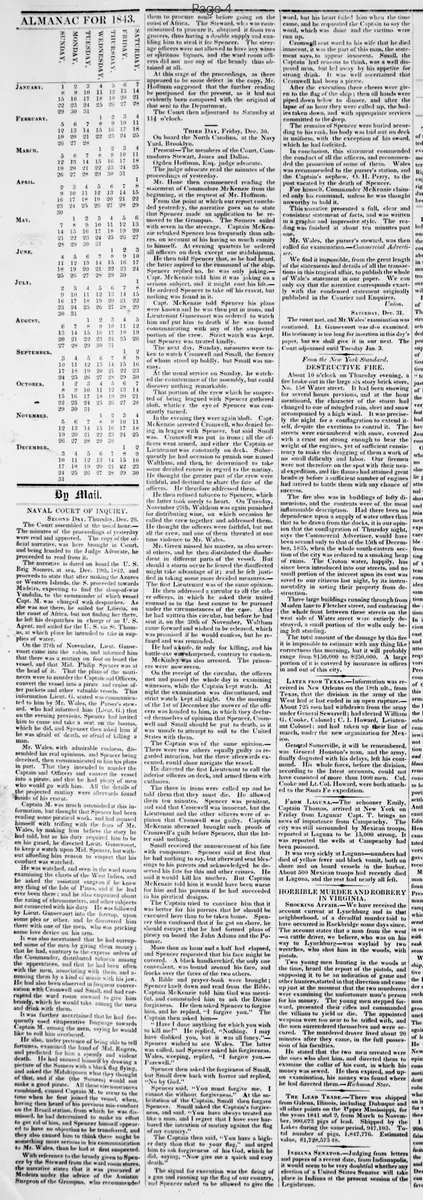
NAVAL COURT OF INQUIRY.
SECOND DAY. Thursday, Dec. 29.
The Court assembled at the usual hour.
The minutes of the proceedings of yesterday were read and approved. The copy of the official narrative was here brought in Court, and being handed to the Judge Advocate, he proceeded to read from it.
The narrative is dated on board the U. S. Brig Somers, at sea, Dec. 19th, 1842, and proceeds to state that after making the Azores or Western Islands, the S. proceeded towards Madeira, expecting to find the sloop-of-war Vandalia, to the commander of which vessel Capt. M. was charged with despatches. As she was not there, he sailed for Liberia, on the coast of Africa, but not finding her there, he left his despatches in charge of an U. S. Agent, and sailed for the U. S. via St. Thomas, at which place he intended to take in supplies of water.
On the 27th of November, Lieut. Gansevoort came into the cabin, and informed him that there was a mutiny on foot on board the vessel, and that Mid. Philip Spencer was at the head of it. That the plans of the mutineers were to murder the Captain and Officers, convert the vessel into a pirate and cruise after packets and other valuable vessels. This information Lieut. G. stated was communicated to him by Mr. Wales, the Purser's steward, who had informed him (Lieut. G.) that on the evening previous, Spencer had invited him to come and take a seat, on the booms, which he did, and Spencer then asked him if he was afraid of death, or afraid of killing a man.
Mr. Wales, with admirable coolness, dissembled his real opinions, and Spencer being deceived, then communicated to him his plans in part. That they intended to murder the Captain and Officers and convert the vessel into a pirate, and that he had plenty of men who would go with him. All the details of the projected mutiny were afterwards found inside of his cravat.
Captain M. was much astonished at this information, but thought that Spencer had been reading some piratical work, and had amused himself with trifling with the fears of Mr. Wales, by making him believe the story he had told, but as his duty required him to be on his guard, he directed Lieut. Gansevoort, to keep a watch upon Mid. Spencer, but without affording him reason to suspect that his conduct was watched.
He was watched, and seen in the ward room examining the charts of the West Indies, and he asked the assistant surgeon if he knew any thing of the Isle of Pines, and if he had ever been there; and he also enquired about the rating of chronometers, and other subjects not connected with his duty. He was followed by Lieut. Gansevoort into the foretop, upon some plea or other, and he discovered him there with one of the men, who was pricking some love device on his arm.
It was also ascertained that he had corrupted some of the men by giving them money; that he had, contrary to the express orders of the Commander, distributed tobacco among the apprentices, and that he had been often with the men, associating with them, and amusing them by a kind of music with his jaw. He had also been observed in frequent conversation with Cromwell and Small, and had corrupted the ward room steward to give him brandy, which he would take among the men and drink with them.
It was further ascertained that he had frequently used vituperative language towards Captain M. among the men, saying he would like to roll him overboard.
He also, under pretence of being able to tell fortunes, examined the hand of Mid. Rogers, and predicted for him a speedy and violent death. He had amused himself by drawing a picture of the Somers with a black flag flying, and asked the Midshipmen what they thought of that, and if she (the Somers) would not make a good pirate. All these circumstances combined, caused Captain M. to recur to the time when he first joined the vessel, when, having then heard of his previous mis-conduct on the Brazil station, from which he was dismissed, he had determined to make an effort to get rid of him, and Spencer himself appeared to have no objection to be transferred, and they also caused him to think there might be something more serious in his communication to Mr. Wales, than he had at first suspected.
With reference to the brandy given to Spencer by the Steward from the ward room stores, the narrative states that it was procured at Madeira under the advice of the Assistant Surgeon of the Grampus, who recommended them to procure some before going on the coast of Africa. The Steward, who was commissioned to procure it, obtained it from two grocers, thus having a double supply and enabling him to steal it for Spencer. "The steerage officers were not allowed to have any wines or spirituous liquors, and the ward room officers did not use any of the brandy thus obtained at all."
At this stage of the proceedings, as there appeared to be some defect in the copy, Mr. Hoffman suggested that the further reading be postponed for the present, as it had not evidently been compared with the original of that sent to the Department.
The Court then adjourned to Saturday at 11 o'clock.
THIRD DAY, Friday, Dec. 30.
On board the North Carolina, at the Navy Yard, Brooklyn.
Present—The members of the Court, Commodores Stewart, Jones and Dallas. Ogden Hoffman, Esq. judge advocate.
The judge advocate read the minutes of the proceedings of yesterday.
Mr. Hone then commenced reading the statement of Commodore McKenzie from the beginning, at the request of Mr. Hoffman.
From the point at which our report concluded yesterday, the narrative goes on to state that Spencer made an application to be removed to the Grampus. The Somers sailed with seven in the steerage. Captain McKenzie rebuked Spencer less frequently than others, on account of his having so much enmity to himself. At evening quarters he ordered all officers on deck except one midshipman.
He then told Spencer that, as he had heard, the latter aspired to the command of the ship. Spencer replied no, he was only joking.— Capt. McKenzie told him it was joking on a serious subject, and it might cost his life.— He ordered Spencer to take off his cravat, but nothing was found in it.
Capt. McKenzie told Spencer his plans were known and he was then put in irons, and Lieutenant Gansevoort was ordered to watch him and put him to death if he was found communicating with any of the suspected portion of the crew. Strict watch was kept but Spencer was treated kindly.
The next day, Sunday, measures were taken to watch Cromwell and Small, the former of whom stood up boldly, but Small was uneasy.
At the usual service on Sunday, he watched the countenance of the assembly, but could discover nothing remarkable.
That portion of the crew which he suspected of being leagued with Spencer gathered aloft, whither the eye of Spencer was constantly turned.
In the evening they were again aloft. Capt. McKenzie arrested Cromwell, who denied being in league with Spencer, but said Small was. Cromwell was put in irons: all the officers went armed, and either the Captain or Lieutenant was constantly on deck. Subsequently he had occasion to punish one named Waltham, and then, he determined to take some decided course in regard to the mutiny.
He thought the greater part of the crew were faithful, and destined to share the fate of the officers. He therefore addressed them.
He then refused tobacco to Spencer, which the latter took sorely to heart. On Tuesday, November 29th, Waltham was again punished for distributing wine, on which occasion he called the crew together and addressed them.
He thought the officers were faithful, but not all the crew, and one of them threatened at one time violence to Mr. Wales.
Mr. Green missed his muster, as also several others, and he then distributed the disobedient in different parts of the vessel. But should a storm occur he feared the disaffected might take advantage of it: and he felt justified in taking some more decided measures.— The first Lieutenant was of the same opinion.
He then addressed a circular to all the other officers, in which he asked their united counsel as to the best course to be pursued under the circumstances of the case. After he had written this circular, but before he had sent it, on the 30th of November, Waltham came forward and wished to be released, which was promised if he would confess, but he refused and was remanded.
He had a knife, fit only for killing, and his battle-axe was sharpened, contrary to custom. McKinley was also arrested. The prisoners were now seven.
On the receipt of the circular, the officers met and passed the whole day in examining witnesses, while the Captain kept watch. At night the examination was discontinued, and strict watch kept all night. On the morning of the 1st of December the answer of the officers was handed to him, in which they declared themselves of opinion that Spencer, Cromwell and Small should be put to death, as it was unsafe to attempt to sail to the United States with them.
The Captain was of the same opinion.— There were two others equally guilty as regarded intention, but the three afterwards executed, could alone navigate the vessel.
He directed the first Lieutenant to call the inferior officers on deck, and armed them with cutlasses.
The three in irons were called up and he told them that they must die. He allowed them ten minutes. Spencer was penitent, and said that Cromwell was innocent, but the Lieutenant and the other officers were of opinion that Cromwell was guilty. Captain McKenzie afterward brought such proofs of Cromwell's guilt before Spencer, that the latter said nothing.
Small received the announcement of his fate with composure. Spencer said at first that he had nothing to say, but afterward sent blessings to his parents and acknowledged he deserved his fate for this and other crimes. He said it would kill his mother. But Captain McKenzie told him it would have been worse for him and his parents if he had succeeded in his piratical designs.
The Captain tried to convince him that it was better for his parents that he should be executed here than to be taken home. Spencer then confessed that if he got on shore, he should escape; that he had formed plans of piracy on board the John Adams and the Potomac.
More than an hour and a half had elapsed, and Spencer requested that his face might be covered. A black handkerchief, the only one convenient, was bound around his face, and frocks over the faces of the two others.
A Bible and prayer-book were brought; Spencer knelt down and read from the Bible. Captain McKenzie told him God was merciful, and commended him to ask the Divine forgiveness. He then asked Spencer to forgive him, and he replied, "I forgive you." The Captain then asked him—
"Have I done anything for which you wish to kill me?" He replied, "Nothing. I may have disliked you, but it was all fancy."
Spencer wished to see Wales. The latter was called, and Spencer asked his forgiveness. Wales, weeping, replied, "I forgive you.— Farewell."
Spencer then asked the forgiveness of Small, but Small drew back with horror and replied, "No by God."
Spencer said, "You must forgive me. I cannot die without forgiveness." At the solicitation of the Captain, Small then forgave Spencer. Small asked the Captain's forgiveness, and said, "You have always treated me like a man, and I regret that I have ever harbored the intention of mutiny against the flag of my country."
The Captain then said, "You have a higher duty than that to your flag," and urged him to ask forgiveness of his God, which he did, saying, "Now give me a quick and easy death."
The signal for execution was the firing of a gun and running up the flag of our country, and Spencer asked to be allowed to give the word, but his heart failed him when the time came, and he requested the Captain to say the word, which was done and the victims were run up.
Cromwell sent word to his wife that he died innocent, it was the part of this man, the statement says, to appear innocent. Small, the Captain had reasons to think, was a well disposed man, but led away by his appetite for strong drink. It was well ascertained that Cromwell had been a pirate.
After the execution three cheers were given to the flag of the ship: then all hands were piped down below to dinner, and after the lapse of an hour they were called up, the bodies taken down, and with appropriate services committed to the deep.
The remains of Spencer were buried according to his rank, his body was laid out on deck in uniform, with the exception of his sword, which he had forfeited.
In conclusion, this statement commended the conduct of all the officers, and recommended the promotion of some of them. Wales was recommended to the purser's station, and the Captain's nephew, O. H. Perry, to the post vacated by the death of Spencer.
For himself, Commander McKenzie claimed only his command, unless he was thought unworthy to hold it.
This narrative presented a full, clear and consistent statement of facts, and was written in a graphic and impressive style. The reading was finished at about ten minutes past one.
Mr. Wales, the purser's steward, was then called for examination.—Commercial Advertiser.
We find it impossible, from the great length of the statements and details of all the transactions in this tragical affair, to publish the whole of Wales' statement in our paper. We can only say that the narrative corresponds exactly with the condensed statement originally published in the Courier and Enquirer.
Union.
SATURDAY, Dec. 31.
The court met, and Mr. Wales' examination was continued. Lt. Gansevoort was also examined. His testimony is too long for insertion in this day's paper, but we shall give it in our next. The Court adjourned until Tuesday Jan. 3.
What sub-type of article is it?
What themes does it cover?
What keywords are associated?
What entities or persons were involved?
Where did it happen?
Story Details
Key Persons
Location
At Sea On The U. S. Brig Somers; Brooklyn Navy Yard
Event Date
November December 1842
Story Details
Captain Mackenzie learns of a mutiny plot led by Midshipman Philip Spencer to murder officers and pirate the ship. After investigation, Spencer, Cromwell, and Small are arrested and executed at sea on December 1, 1842, following officers' counsel. Court of inquiry reviews the narrative in late December 1842.