Thank you for visiting SNEWPapers!
Sign up free
Pioneer And Democrat
Olympia, Thurston County, Washington
What is this article about?
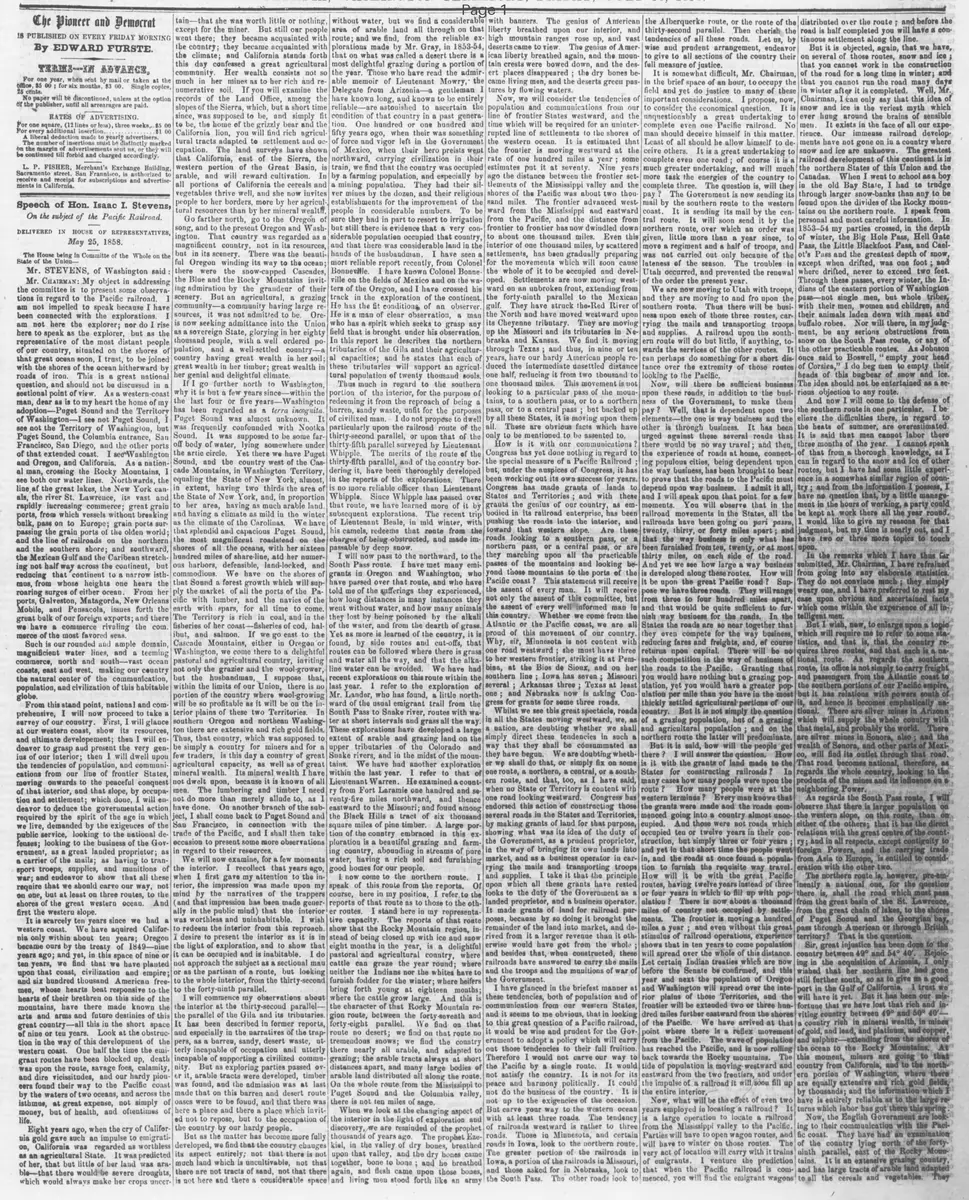
In a speech to the House of Representatives on May 25, 1858, Hon. Isaac I. Stevens advocates for at least three Pacific Railroad routes to connect the eastern U.S. to the western coast, emphasizing the resources, agricultural potential, and strategic importance of the western territories and interior regions for national development, commerce, and defense.
Merged-components note: Continuation of Hon. Isaac I. Stevens' speech on the Pacific Railroad across pages 1 and 2.
Clippings
1 of 2
OCR Quality
Full Text
On the subject of the Pacific Railroad.
DELIVERED IN HOUSE OF REPRESENTATIVES,
May 25, 1858.
The House being in Committee of the Whole on the State of the Union
Mr. STEVENS, of Washington said:
Mr. CHAIRMAN: My object in addressing the committee is to present some observations in regard to the Pacific railroad. I am not impelled to speak because I have been connected with the explorations. I am not here the explorer; nor do I rise here to speak as the explorer, but as the representative of the most distant people of our country, situated on the shores of that great ocean soon, I trust, to be joined with the shores of the ocean hitherward by roads of iron. This is a great national question, and should not be discussed in a sectional point of view. As a western-coast man, dear as is to my heart the home of my adoption—Puget Sound and the Territory of Washington—I see not Puget Sound, I see not the Territory of Washington, but Puget Sound, the Columbia entrance, San Francisco, San Diego, and the other ports of that extended coast. I see Washington and Oregon, and California. As a national man, crossing the Rocky Mountains, I see both our water lines. Northwards, the line of the great lakes, the New York canals, the river St. Lawrence, its vast and rapidly increasing commerce; great grain ports, from which vessels without breaking bulk, pass on to Europe; grain ports surpassing the grain ports of the olden world; and the line of railroads on the northern and the southern shore; and southward, the Mexican Gulf and the Caribbean stretching not half way across the continent, but reducing that continent to a narrow isthmus, from whose heights one hears the roaring surges of either ocean. From her ports, Galveston, Matagorda, New Orleans, Mobile, and Pensacola, issues forth the great bulk of our foreign exports; and there we have a commerce rivaling the commerce of the most favored seas.
Such is our rounded and ample domain, magnificent water lines, and a teeming commerce, north and south—vast ocean coasts, east and west, making our country the natural center of the communication, population, and civilization of this habitable globe.
From this stand point, national and comprehensive, I will now proceed to take a survey of our country. First, I will glance at our western coast, show its resources, and ultimate development; then I will endeavor to grasp and present the very genius of our interior; then I will dwell upon the tendencies of population, and communications from our line of frontier States, moving onwards to the peaceful conquest of that interior, and that slope, by occupation and settlement; which done, I will endeavor to deduce the governmental action required by the spirit of the age in which we live, demanded by the exigencies of the public service, looking to the national defenses; looking to the business of the Government, as a great landed proprietor; as a carrier of the mails; as having to transport troops, supplies, and munitions of war; and endeavor to show that all these require that we should carve our way, not on one, but at least on three routes, to the shores of the great western ocean. And first the western slope.
It is scarcely ten years since we had a western coast. We have acquired California only within about ten years; Oregon became ours by the treaty of 1849—nine years ago; and yet, in this space of nine or ten years, we find that we have planted upon that coast, civilization and empire; and six hundred thousand American freemen, whose hearts beat responsive to the hearts of their brethren on this side of the mountains, have there made known the arts and arms and future destinies of this great country—all this in the short space of nine or ten years. Look at the obstruction in the way of this development of the western coast. One half the time the emigrant routes have been blocked up, death was upon the route, savage foes, calamity, and dire vicissitudes, and our hardy pioneers found their way to the Pacific coast by the waters of two oceans, and across the isthmus, at great expense, not simply of money, but of health, and oftentimes of life.
Eight years ago, when the cry of California gold gave such an impulse to emigration, California was regarded as worthless as an agricultural State. It was predicted of her, that but little of her land was arable—that there would be severe droughts, which would always make her crops uncertain—that she was worth little or nothing except for the miner. But still our people went there; they became acquainted with the country; they became acquainted with the climate; and California stands forth this day confessed a great agricultural community. Her wealth consists not so much in her mines as in her rich and remunerative soil. If you will examine the records of the Land Office, among the slopes of the Sierra, which, but a short time since, was supposed to be, and simply fit to be, the home of the grizzly bear and the California lion, you will find rich agricultural tracts adapted to settlement and occupation. The land surveys have shown that California, east of the Sierra, the western portion of the Great Basin, is arable, and will reward cultivation. In all portions of California the cereals and vegetables thrive well, and she now invites people to her borders, more by her agricultural resources than by her mineral wealth.
Go farther north, go to the Oregon of song, and to the present Oregon and Washington. That country was regarded as a magnificent country, not in its resources, but in its scenery. There was the beautiful Oregon winding its way to the ocean; there were the snow-capped Cascades, the Blue and the Rocky Mountains inviting admiration by the grandeur of their scenery. But an agricultural, a grazing community—a community having large resources, it was not admitted to be. Oregon is now seeking admittance into the Union as a sovereign State, glorying in her eighty thousand people, with a well ordered population, and a well-settled country—a country having great wealth in her soil; great wealth in her timber; great wealth in her genial and delightful climate.
If I go further north to Washington, why it is but a few years since—within the last four or five years—Washington has been regarded as a terra incognita. Puget Sound was almost unknown. It was frequently confounded with Nootka Sound. It was supposed to be some far-off body of water, lying somewhere under the arctic circle. Yet there we have Puget Sound, and the country west of the Cascade Mountains, in Washington Territory, equaling the State of New York, almost, in extent, having two thirds the area of the State of New York, and, in proportion to her area, having as much arable land, and having a climate as mild in the winter as the climate of the Carolinas. We have that splendid and capacious Puget Sound, the most magnificent roadstead on the shores of all the oceans, with her sixteen hundred miles of shore-line, and her numerous harbors, defensible, land-locked, and commodious. We have on the shores of that Sound a forest growth which will supply the market of all the ports of the Pacific with lumber, and the navies of the earth with spars, for all time to come. The Territory is rich in coal, and in the fisheries of her coast—fisheries of cod, halibut, and salmon. If we go east to the Cascade Mountains, either in Oregon or Washington, we come there to a delightful pastoral and agricultural country, inviting not only the grazier and the wool-grower, but the husbandman. I suppose that, within the limits of our Union, there is no portion of the country where wool-growing will be so profitable as it will be on the interior plains of these two Territories. In southern Oregon and northern Washington there are extensive and rich gold fields.
Thus, that country, which was supposed to be simply a country for miners and for a few traders, is this day a country of great agricultural capacity, as well as of great mineral wealth. Its mineral wealth I have not dwelt upon, because it is known of all men. The lumbering and timber I need not do more than merely allude to, as I have done. On another branch of the subject, I shall come back to Puget Sound and San Francisco, in connection with the trade of the Pacific, and I shall then take occasion to present some more observations in regard to their resources.
We will now examine, for a few moments the interior. I recollect that years ago, when I first gave my attention to the interior, the impression was made upon my mind by the narratives of the trappers (and that impression has been made generally in the public mind) that the interior was worthless and uninhabitable. I wish to redeem the interior from this reproach. I desire to present the interior as it is in the light of exploration, and to show that it can be occupied and is inhabitable. I do not approach the subject as a sectional man or as the partisan of a route, but looking to the whole interior, from the thirty-second to the forty-ninth parallel.
I will commence my observations about the interior at the thirty-second parallel—the parallel of the Gila and its tributaries. It has been described in former reports, and especially in the narratives of the trappers, as a barren, sandy, desert waste, utterly incapable of occupation and utterly incapable of supporting a civilized community. But as exploring parties passed over it, arable tracts were developed, timber was found, and the admission was at last made that on this barren and desert route oases were to be found, and that there was here a place and there a place which invited not to repose, but to the occupation of the country by our hardy people.
But as the matter has become more fully developed, we find that the country changes its aspect entirely; not that there is not much land which is uncultivable, not that there are not tracts of sand, not that there is not here and there a considerable space without water, but we find a considerable area of arable land all through on that route; and we find, from the reliable explorations made by Mr. Gray, in 1853-54, that on what was called a desert there is most delightful grazing during a portion of the year. Those who have read the admirable memoir of Lieutenant Mowry, the Delegate from Arizona—a gentleman I have known long, and known to be entirely reliable—are astonished to ascertain the condition of that country in a past generation. One hundred or one hundred and fifty years ago, when there was something of force and vigor left in the Government of Mexico, when their hero priests went northward, carrying civilization in their train, we find that the country was occupied by a farming population, and especially by a mining population. They had their silver mines by the dozen, and their religious establishments for the improvement of the people in considerable numbers. To be sure they had in part to resort to irrigation but still there is evidence that a very considerable population occupied that country, and that there was considerable land in the hands of the husbandman. I have seen a most reliable report recently, from Colonel Bonneville. I have known Colonel Bonneville on the fields of Mexico and on the waters of the Oregon, and I have crossed his track in the exploration of the continent. He has the fit conditions of an observer. He is a man of clear observation, a man who has a spirit which seeks to grasp any field that is brought under his observation. In this report he describes the northern tributaries of the Gila and their agricultural capacities; and he states that each of these tributaries will support an agricultural population of twenty thousand souls.
Thus much in regard to the southern portion of the interior, for the purpose of redeeming it from the reproach of being a barren, sandy waste, unfit for the purposes of civilized man. I do not propose to dwell particularly upon the railroad route of the thirty-second parallel, or upon that of the thirty-fifth parallel surveyed by Lieutenant Whipple. The merits of the route of the thirty-fifth parallel, and of the country bordering it, have been thoroughly developed in the reports of the explorations. There is no more reliable officer than Lieutenant Whipple. Since Whipple has passed over that route, we have learned more of it by subsequent explorations. The recent trip of Lieutenant Beale, in mid winter, with his camels, redeems that route from the charges of being obstructed, and made impassable by deep snow.
I will now pass to the northward, to the South Pass route. I have met many emigrants in Oregon and Washington, who have passed over that route, and who have told me of the sufferings they experienced, how long distances in many instances they went without water, and how many animals they lost by being poisoned by the alkali of the water, and from the dearth of grass. Yet as more is learned of the country, it is found, by side routes and cut-offs, that routes can be followed where there is grass and water all the way, and that the alkaline water can be avoided. We have had recent explorations on this route within the last year. I refer to the exploration of Mr. Lander, who has found, a little northward of the usual emigrant trail from the South Pass to Snake river, routes with water at short intervals and grass all the way. These explorations have developed a large extent of arable and grazing land on the upper tributaries of the Colorado and Snake rivers, and in the midst of the mountains. We have had another exploration within the last year. I refer to that of Lieutenant Warren. He examined a country from Fort Laramie one hundred and seventy-five miles northward, and thence eastward to the Missouri; and found among the Black Hills a tract of six thousand square miles of pine timber. A large portion of the country embraced in this exploration is a beautiful grazing and farming country, abounding in streams of pure water, having a rich soil and furnishing good homes for our people.
I now come to the northern route. I speak of this route from the reports. Of course, here in my position, I refer to the reports of that route as to those to the other routes. I stand here in my representative capacity. The reports of that route show that the Rocky Mountain region, instead of being closed up with ice and snow eight months in the year, is a delightful pastoral and agricultural country, where cattle can graze the year round; where neither the Indians nor the whites have to furnish fodder for the winter; where heifers bring forth young at eighteen months; where the cattle grow large. And this is the character of that Rocky Mountain region route, between the forty-seventh and forty-eighth parallel. We find on that route no desert; we find on that route no tremendous snows; we find the country there nearly all arable, and adapted to grazing; the arable tracts always at short distances apart, and many large bodies of arable land distributed all along the route. On the whole route from the Mississippi to Puget Sound and the Columbia valley, there is not ten miles of sage.
When we look at the changing aspect of the interior in the light of exploration and discovery, we are reminded of the prophet thousands of years ago. The prophet Ezekiel, in the valley of dry bones, breathed upon that valley, and the dry bones came together, bone to bone; and he breathed again, and flesh came upon those bones, and living men stood forth like an army with banners. The genius of American liberty breathed upon our interior, and high mountain ranges rose up, and vast deserts came to view. The genius of American liberty breathed again, and the mountain crests were bowed down, and the desert places disappeared: the dry bones became living men, and the deserts green pastures by flowing waters.
Now, we will consider the tendencies of population and communications from our line of frontier States westward, and the time which will be required for an uninterrupted line of settlements to the shores of the western ocean. It is estimated that the frontier is moving westward at the rate of one hundred miles a year; some estimates put it at seventy. Nine years ago the distance between the frontier settlements of the Mississippi valley and the shores of the Pacific was about two thousand miles. The frontier advanced westward from the Mississippi and eastward from the Pacific, and the distance from frontier to frontier has now dwindled down to about one thousand miles. Even this interior of one thousand miles, by scattered settlements, has been gradually preparing for the movements which will soon cause the whole of it to be occupied and developed. Settlements are now moving westward on an unbroken front, extending from the forty-ninth parallel to the Mexican gulf. They have struck the Red River of the North and have moved westward upon its Cheyenne tributary. They are moving up the Missouri and its tributaries in Nebraska and Kansas. We find it moving through Texas; and thus, in nine or ten years, have our hardy American people reduced the intermediate unsettled distance one half, reducing it from two thousand to one thousand miles. This movement is not looking to a particular pass of the mountains, to a southern pass, or to a northern pass, or to a central pass; but backed up by all these States, it is moving upon them all. These are obvious facts which have only to be mentioned to be assented to.
How is it with our communications? Congress has yet done nothing in regard to the special measure of a Pacific Railroad; but, under the auspices of Congress, it has been working out its own success for years. Congress has made grants of lands to States and Territories; and with these grants the genius of our country, as embodied in its railroad enterprise, has been pushing the roads into the interior, and toward that western slope. Are these roads looking to a southern pass, or a northern pass, or a central pass, or are they marching upon all the practicable passes of the mountains and looking beyond those mountains to the ports of the Pacific coast? This statement will receive the assent of every man. It will receive not only the assent of this committee, but the assent of every well informed man in this country. Whether we come from the Atlantic or the Pacific coast, we are all proud of this movement of our country. Why, sir, Minnesota is not content with one road westward; she must have three to her western frontier, striking it at Pembina, at the Bois de Sioux, and on her southern line; Iowa has seven; Missouri several; Arkansas three; Texas at least one: and Nebraska now is asking Congress for grants for some three roads.
Whilst we see this great spectacle, roads in all the States moving westward, we, as a nation, are doubting whether we shall simply direct these tendencies in such a way that they shall be consummated as they have begun. We are doubting whether we shall do that, or simply fix on some one route, a northern, a central, or a southern route, and that, too, as I have said, when no State or Territory is content with one road looking westward. Congress has endorsed this action of constructing those several roads in the States and Territories, by making grants of land for that purpose, showing what was its idea of the duty of the Government, as a prudent proprietor, in the way of bringing its own lands into market, and as a business operator in carrying the mails and transporting troops and supplies. I take it that the principle upon which all these grants have rested looks to the duty of the Government as a landed proprietor, and a business operator. It made grants of land for railroad purposes, because by so doing it brought the remainder of the land into market, and derived from it a larger revenue than it otherwise would have got from the whole; and besides that, when constructed, these railroads have answered to carry the mails and the troops and the munitions of war of the Government.
I have glanced in the briefest manner at these tendencies, both of population and of communication from our western States, and it seems to me obvious, that in looking to this great question of a Pacific railroad, it would be wise and prudent for the Government to adopt a policy which will carry out those tendencies to their full fruition. Therefore I would not carve our way to the Pacific by a single route. It would not satisfy the country. It is not for its peace and harmony politically. It could not do the business of the country. It is not up to the exigencies of the occasion. But carve your way to the western ocean with at least three roads. The tendency of railroads westward is rather to three roads. Those in Minnesota, and certain roads in Iowa, look to the northern route. The greater portion of the railroads in Iowa, a portion of the railroads in Missouri, and those asked for in Nebraska, look to the South Pass. The other roads look to the Albuquerque route, or the route of the thirty-second parallel. Then cherish the tendencies of all these roads. Let us, by wise and prudent arrangement, endeavor to give to all sections of the country their full measure of justice.
It is somewhat difficult, Mr. Chairman, in the brief space of an hour, to occupy the field and yet do justice to many of these important considerations. I propose, now, to consider the economical question. It is unquestionably a great undertaking to complete even one Pacific railroad. No man should deceive himself in this matter. Least of all should he allow himself to deceive others. It is a great undertaking to complete even one road; of course it is a much greater undertaking, and will much more task the energies of the country to complete three. The question is, will they pay? The Government is now sending its mail by the southern route to the western coast. It is sending its mail by the central route. It will soon send it by the northern route, over which an order was given, little more than a year since, to move a regiment and a half of troops, and was not carried out only because of the lateness of the season. The troubles in Utah occurred, and prevented the renewal of the order the present year.
We are now moving to Utah with troops, and they are moving to and fro upon the southern route. Thus there will be business upon each of those three routes, carrying the mails and transporting troops and supplies. A railroad upon the southern route will do but little, if anything, towards the services of the other routes. It can perhaps do something for a short distance over the extremity of those routes looking to the Pacific.
Now, will there be sufficient business upon these roads, in addition to the business of the Government, to make them pay? Well, that is dependent upon two elements—the one is way business and the other is through business. It has been urged against these several roads that there would be no way travel; and then, the experience of roads at home, connecting populous cities, being dependent upon the way business, has been brought to bear to prove that the roads to the Pacific must depend upon way business. I admit it all, and I will speak upon that point for a few moments. You will observe that in the railroad movements in the States, all the railroads have been going on pari passu, twenty, thirty, or forty miles apart; and that the way business is only what has been furnished from ten, twenty, or at most thirty miles, on each side of the road. And yet we see how large a way business is developed along these routes. How will it be upon the great Pacific road? Suppose we have three roads. They will range from three to four hundred miles apart, and that would be quite sufficient to furnish way business for the roads. In the States the roads are so near together that they even compete for the way business, reducing fares and freights, and, of course returns upon capital. There will be no such competition in the way of business of the roads to the Pacific. Granting that you would have nothing but a grazing population, yet you would have a greater population per mile than you have in the most thickly settled agricultural portions of our country. But it is not simply the question of a grazing population, but of a grazing and agricultural population; and on the northern route the latter will predominate.
But it is said, how will the people get there? I will answer the question, How is it with the grants of land made to the States for constructing railroads? In many cases how many people were upon the route? How many people were at the western terminus? Every man knows that the grants were made and the roads commenced going into a country almost unoccupied. And those were not roads which occupied ten or twelve years in their construction, but simply three or four years; and yet in that short time the people went in, and the roads at once found a population to furnish the requisite way travel.
How will it be with the great Pacific routes, having twelve years instead of three or four years in which to fill up with population? There is now about a thousand miles of country not occupied by settlements. The frontier is moving a hundred miles a year; and even without this great stimulus of railroad operations, experience shows that in ten years to come population will spread over the whole of this distance. Let certain Indian treaties which are now before the Senate be confirmed, and this year and next the population of Oregon and Washington will spread over the interior plains of those Territories, and the frontier will be extended two or three hundred miles further eastward from the shores of the Pacific. We have arrived at that point where there is a reflex movement from the Pacific. The wave of population has reached the Pacific, and is now rolling back towards the Rocky mountains. The tide of population is moving westward and eastward from the two frontiers, and under
Now, what will be the effect of even two years employed in locating a railroad? It is a large operation to locate a railroad from the Mississippi valley to the Pacific. Parties will have to open wagon routes, and will have to winter on those routes. The very act of location will carry with it trains of emigrants. I venture the prediction that when the Pacific railroad is commenced, you will find the emigrant wagons
distributed over the route: and before the road is half completed you will have a continuous settlement along the line.
But it is objected, again, that we have, on several of those routes, snow and ice; that you cannot work in the construction of the road for a long time in winter; and that you cannot run the road many days in winter after it is completed. Well, Mr. Chairman, I can only say that this idea of snow and ice is the veriest myth which ever hung around the brains of sensible men. It exists in the face of all our experience. Our immense railroad developments have not gone on in a country where snow and ice are unknown. The greatest railroad development of this continent is in the northern States of this Union and the Canadas. When I went to school as a boy in the old Bay State, I had to trudge through larger snow-banks than any to be found upon the divides of the Rocky mountains on the northern route. I speak from personal and most careful information. In 1853-54 my parties crossed, in the depth of winter, the Big Hole Pass, Hell Gate Pass, the Little Blackfoot Pass, and Clark's Pass and the greatest depth of snow except when drifted, was one foot; and where drifted, never to exceed two feet. Through these passes, every winter, the Indians of the eastern portion of Washington pass—not single men, but whole tribes, with their men, women and children, and their animals laden down with meat and buffalo robes. Nor will there, in my judgment, be any serious obstructions from snow on the South Pass route, or any of the other practicable routes. As Johnson once said to Boswell, "empty your head of Corisca," I do beg men to empty their heads of this bugbear of snow and ice. The idea should not be entertained as a serious objection to any route.
And now I will come to the defense of the southern route in one particular. I believe the difficulties there, in regard to the heats of summer, are overestimated. It is said that men cannot labor there three months of the year. I cannot speak of that from a thorough knowledge, as I can in regard to the snow and ice of other routes, but I have had some little experience in a somewhat similar region of country; and from the information I possess, I have no question that, by a little management in the hours of working, a party could be kept at work there all the year round. I would like to give my reasons for that judgment, but my time is nearly out, and I have two or three more topics to touch upon.
In the remarks which I have thus far submitted, Mr. Chairman, I have refrained from going into any elaborate statistics. They do not convince much; they simply weary one, and I have preferred to rest my case upon obvious and ascertained facts which come within the experience of all intelligent men.
But I wish, now, to enlarge upon a topic which will require me to refer to some statistics, and that is, that the country requires three routes, and that each is a national route. As regards the southern route, its office is not simply to carry freight and passengers from the Atlantic coast to the southern portions of our Pacific empire, but it has relations with powers south of it, and hence it becomes emphatically national. There are silver mines in Arizona which will supply the whole country with that metal, and probably the world. There are silver mines in Sonora, also; and the wealth of Sonora, and other parts of Mexico, will find its outlet through that road. That road becomes national, therefore, as regards the whole country, looking to the products of the mines and its influence on a neighboring Power.
As regards the South Pass route, I will observe that there is larger population on the western slope, on this route, than on either of the others; that it has the direct relations with the great centre of the country; and in all respects, except contiguity to foreign Powers, and the carrying trade from Asia to Europe, is entitled to consideration with the other two.
The northern route is, however, pre-eminently a national one, for the question there is, shall the road which must pass from the great basin of the St. Lawrence, from the great chain of lakes, to the shores of Puget Sound and the Georgian bay, pass through American or through British territory? That is the question.
Sir, great injustice has been done to the country between 49° and 54° 40'. Rejoicing in the acquisition of Arizona, I only wished that her southern line had gone still further south, so as to give us a good port in the Gulf of California. I trust we will have it yet. But it has been our misfortune that we have lost that rich and inviting country between 49° and 54° 40', a country rich in mineral wealth, in mines of gold, and lead, and platinum, and copper, and sulphur—extending from the shores of the ocean to the Rocky Mountains. At this moment, miners are going to that country from California, and to the northern portion of Washington, where there are equally extensive and rich gold fields, by thousands; and the information which I have is entirely reliable as to the large returns which labor has got there this spring.
Now, the English Government are looking to their communication with the Pacific coast. They have had an examination of the country lying north of the forty-ninth parallel, east of the Rocky Mountains. It is an extensive grazing country, and has large tracts of arable land adapted to all the cereals and vegetables. They
know the wealth of the western coast itself. in its fisheries, in coal, and in all the elements of national prosperity. The question simply is, shall the great line of communication go through American or British territory? I propose to give some figures relative to the question. I have put them in round numbers; but they are very near the mark. The distance from Puget Sound or Vancouver, on the Columbia, to St. Paul, or the western end of Lake Superior, is eighteen hundred miles; from Benicia to Rock Island, in the Mississippi, by the route of the South Pass, twenty-three hundred miles; from San Francisco to Memphis, by the route of the thirty-fifth parallel, twenty-three hundred miles; from San Francisco to Gaines, by the route of the thirty-second parallel, twenty-two hundred miles. And the distance from Benicia, via the valleys of the Sacramento and Willamette, Vancouver, and the northern route, to St. Paul, is twenty-five hundred miles. If we take the equatic distance, allowing for grade, which, though not important as regards passengers, is an indispensable element as regards freight, we find that the distance from Benicia to St. Paul and the western end of Lake Superior by the northern route, is twenty-nine hundred and fifty miles; from San Francisco to Gaines, by the route of the thirty-second parallel, three thousand miles: from San Francisco to Memphis, by the route of the thirty-fifth parallel, thirty-three hundred miles; and from Benicia to Rock Island, by the South Pass route, twenty-eight hundred and fifty miles. I have made the comparison to the Mississippi river, because this river will be the great artery on which to distribute freights coming from the ports of the Pacific by rail throughout the Mississippi valley.
Thus you see, that looking to the present great commercial depot on the Pacific, San Francisco, the northern route gives her the shortest and best connection with the Northwest and the country lying upon the great lakes, and that this connection is absolutely shorter than her connection with the Mississippi, by the routes of the thirty-fifth and thirty-second parallels. Looking however to Puget Sound, and taking the equatic distances, you find that the equatic distance from the Sound to the Upper Mississippi and the great lakes is two thousand two hundred; whereas, from San Francisco to the Mississippi it is two thousand eight hundred and fifty, three thousand three hundred, and three thousand miles, by the routes respectively of the South Pass, the thirty-fifth, and the thirty-second parallels.
But besides the other advantages of the route, Puget Sound is nearest to Asia. The mouth of the straits leading to Puget Sound is on the line of sailing vessels from San Francisco to the Ports of China, Japan and Russia, on the Pacific, and therefore Puget Sound is as much nearer to those countries as is the distance from the entrance of the Straits de Fuca to San Francisco, some seven or eight hundred miles. Considering, therefore, the greater shortness of the northern route, and its nearer connections with both Asia and Europe, it must become the great route of freight and passengers from Asia to Europe, and even of freight from Asia to the whole valley of the Mississippi.
I have adverted to the views of the English Government in regard to an overland communication through its own possessions. We are contiguous on the forty-ninth parallel to that powerful foreign sovereignty. Which will give us the most strength? which will most add to our defense? which will most stimulate our own genius and force? which will most spread population through our borders and best evoke the resources of our country? which will give us the best footing in the Northwest, and enable us best to hold in our hands the key of the Pacific? a railroad on our own soil, and a great port on our own ocean coast, or a road passing over the soil of that powerful foreign sovereignty, and a great port on its ocean coast? The question of the control of the commerce of the Pacific, and of the ascendancy of American genius and enterprise there, is involved in the solution of this question; and therefore I claim for the northern route the friendly consideration of gentlemen from all quarters of the Union, as not a sectional, but as pre-eminently a national route.
I am of opinion there will be a great freight business on all the routes of Asiatic supplies. By the time the roads are completed, there will be, unquestionably, a population of nearly one million of souls on the line of each route, furnishing the basis of way business, in addition to a vastly larger population resting on the present western line of States, and in the general vicinity of the eastern termini, which will receive their supplies of Asiatic goods by the rail. On the Pacific railroads a great variety of Asiatic products will be distributed to all quarters of the country, and even on these roads pass to Europe. No costly or perishable article, or article which deteriorates by crossing the tropics, will reach our Atlantic ports or the ports of Europe by either cape. Silks, spices, and teas, will go to our depots in the Pacific, and will be taken over the great overland routes to all the States of the Union, to the Canadas, and to Europe.
The imagination of man can scarcely set bounds to the future grandeur of our Pacific empire, and the magnitude of our interests throughout that great sea. Already a commerce is springing up between us and the Russian possessions on the Pacific, by the line of the Amoor, navigable two thousand miles for steamers, whose mouth is but about four thousand miles from Puget Sound, and which will early bring us into connection with thirty millions of people. Lines of sailing vessels now run from our Pacific ports to the Amoor, Japan, China, and the islands of the sea. Fabrics and merchandise of various kinds from San Francisco, but lumber and spars mainly from Puget Sound. San Francisco and Puget Sound are the two great natural centers of commerce on the western coast, and both are essential to its development and control by us, American freemen, having a great destiny before us. San Francisco, more developed than Puget Sound, having a much larger immediate population backing it up, is the natural port of California and of our southern States; Puget Sound of our Northwest and our North, and it will be the great port of all the carrying trade by rail from Asia to Europe.
For these reasons, Mr. Chairman, I urge moving to the Pacific on at least three roads. I deem them all national, and required by the exigences of the age. I beseech American statesmen to take an enlarged and comprehensive view of this great subject; to endeavor to realize our future growth; and, by firmness and wisdom in the policy which they will now inaugurate, to make us, one compact and continuous nationality, to make us, in truth, the ocean-bound Republic, controlling the commerce of the world.
What sub-type of article is it?
What themes does it cover?
What keywords are associated?
What entities or persons were involved?
Where did it happen?
Story Details
Key Persons
Location
House Of Representatives; Pacific Coast; Washington Territory; Oregon; California; Rocky Mountains; Interior U.S.
Event Date
May 25, 1858
Story Details
Hon. Isaac I. Stevens delivers a speech advocating for at least three Pacific Railroad routes (northern, central South Pass, southern 32nd parallel) to facilitate national development, commerce with Asia and Europe, defense against British interests, and exploitation of western resources including agriculture, minerals, timber, and fisheries, countering myths of uninhabitable interiors through exploration reports.