Thank you for visiting SNEWPapers!
Sign up free
Toledo Union Journal
Toledo, Lucas County, Ohio
What is this article about?
Labor Sec. James P. Mitchell endorses tough federal bill for pension plan registration and disclosure, backing AFL-CIO against NAM. Proposes amendments for full coverage, penalties; aligns with Sen. Douglas amid opposition from business groups in Senate subcommittee.
Clipping
OCR Quality
Full Text
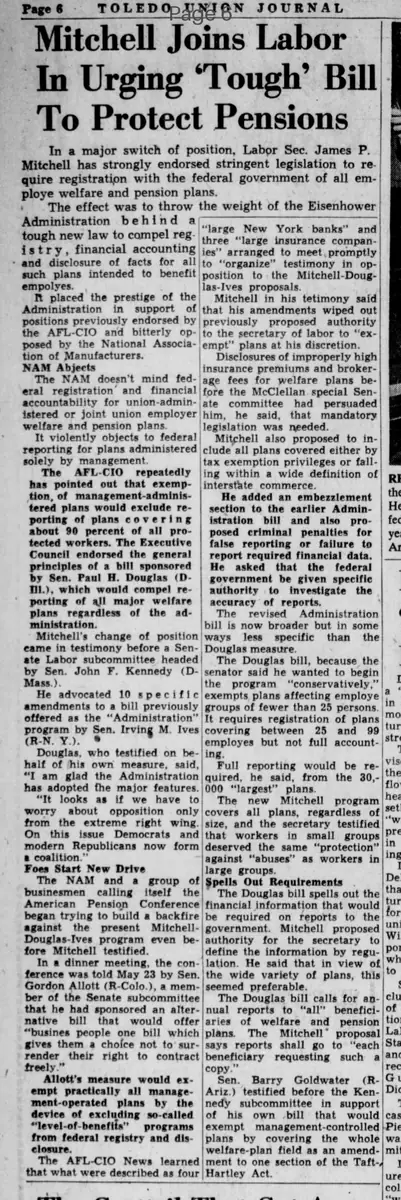
In a major switch of position, Labor Sec. James P. Mitchell has strongly endorsed stringent legislation to require registration with the federal government of all employee welfare and pension plans.
The effect was to throw the Administration behind a tough new law to compel registry, financial accounting and disclosure of facts for all such plans intended to benefit employees.
It placed the prestige of the Administration in support of positions previously endorsed by the AFL-CIO and bitterly opposed by the National Association of Manufacturers.
NAM Objects
The NAM doesn't mind federal registration and financial accountability for union-administered or joint union-employer welfare and pension plans. It violently objects to federal reporting for plans administered solely by management.
The AFL-CIO repeatedly has pointed out that exemption of management-administered plans would exclude reporting of plans covering about 90 percent of all protected workers. The Executive Council endorsed the general principles of a bill sponsored by Sen. Paul H. Douglas (D-Ill.), which would compel reporting of all major welfare plans regardless of the administration.
Mitchell's change of position came in testimony before a Senate Labor subcommittee headed by Sen. John F. Kennedy (D-Mass.).
He advocated 10 specific amendments to a bill previously offered as the "Administration" program by Sen. Irving M. Ives (R-N.Y.).
Douglas, who testified on behalf of his own measure, said, "I am glad the Administration has adopted the major features."
"It looks as if we have to worry about opposition only from the extreme right wing. On this issue Democrats and modern Republicans now form a coalition."
Foes Start New Drive
The NAM and a group of businessmen calling itself the American Pension Conference began trying to build a backfire against the present Mitchell-Douglas-Ives program even before Mitchell testified.
In a dinner meeting, the conference was told May 23 by Sen. Gordon Allott (R-Colo.), a member of the Senate subcommittee, that he had sponsored an alternative bill that would offer "business people one bill which gives them a choice not to surrender their right to contract freely."
Allott's measure would exempt practically all management-operated plans by the device of excluding so-called "level-of-benefits" programs from federal registry and disclosure.
The AFL-CIO News learned that what were described as four "large New York banks" and three "large insurance companies" arranged to meet promptly to "organize" testimony in opposition to the Mitchell-Douglas-Ives proposals.
Mitchell in his testimony said that his amendments wiped out previously proposed authority to the secretary of labor to "exempt" plans at his discretion.
Disclosures of improperly high insurance premiums and brokerage fees for welfare plans before the McClellan special Senate committee had persuaded him, he said, that mandatory legislation was needed.
Mitchell also proposed to include all plans covered either by tax exemption privileges or falling within a wide definition of interstate commerce.
He added an embezzlement section to the earlier Administration bill and also proposed criminal penalties for false reporting or failure to report required financial data.
He asked that the federal government be given specific authority to investigate the accuracy of reports.
The revised Administration bill is now broader but in some ways less specific than the Douglas measure.
The Douglas bill, because the senator said he wanted to begin the program "conservatively," exempts plans affecting employee groups of fewer than 25 persons.
It requires registration of plans covering between 25 and 99 employees but not full accounting.
Full reporting would be required, he said, from the 30,000 "largest" plans.
The new Mitchell program covers all plans, regardless of size, and the secretary testified that workers in small groups deserved the same "protection" against "abuses" as workers in large groups.
Spells Out Requirements
The Douglas bill spells out the financial information that would be required on reports to the government. Mitchell proposed authority for the secretary to define the information by regulation. He said that in view of the wide variety of plans, this seemed preferable.
The Douglas bill calls for annual reports to "all" beneficiaries of welfare and pension plans.
The Mitchell proposal says reports shall go to "each beneficiary requesting such a copy."
Sen. Barry Goldwater (R-Ariz.) testified before the Kennedy subcommittee in support of his own bill that would exempt management-controlled plans by covering the whole welfare-plan field as an amendment to one section of the Taft-Hartley Act.
What sub-type of article is it?
What themes does it cover?
What keywords are associated?
What entities or persons were involved?
Story Details
Key Persons
Story Details
Labor Secretary James P. Mitchell switches position to endorse stringent federal registration and disclosure for all employee welfare and pension plans, aligning the Administration with AFL-CIO against NAM opposition. He proposes amendments to the Ives bill, including coverage of all plans regardless of size, embezzlement provisions, and criminal penalties. Senators Douglas and others support similar measures, while NAM and allies push alternatives exempting management plans.