Thank you for visiting SNEWPapers!
Sign up free
The Massachusetts Spy
Boston, Suffolk County, Massachusetts
What is this article about?
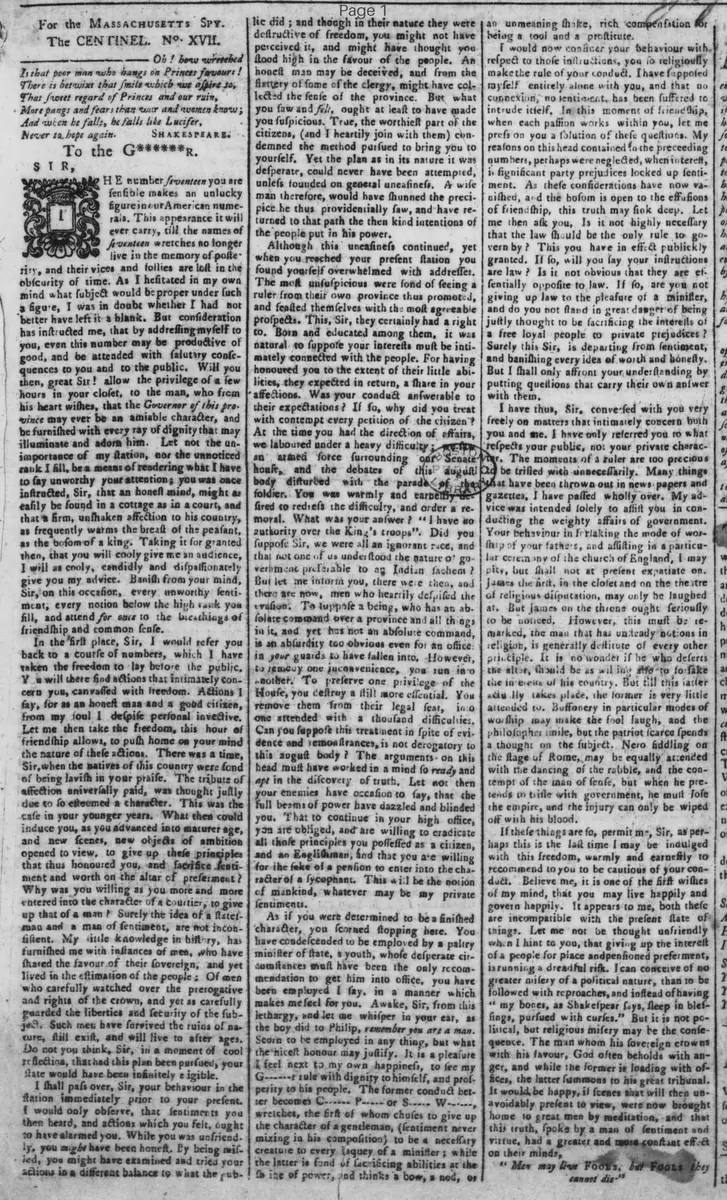
The Centinel No. XVII editorial critiques the Massachusetts Governor for abandoning principles for court favor, mishandling troops and petitions, prioritizing ministerial instructions over law, and urges him to govern with dignity and prioritize public interests over personal gain.
Merged-components note: The small image on page 1 overlaps spatially with the editorial text bbox (y-range 1640-1896 within 1138-4766), and given sequential reading order (1 and 2), it is likely an illustration for this editorial piece; merged accordingly.
Clipping
OCR Quality
Full Text
The Centinel. No. XVII.
Oh! for wretched
Is that poor man who hangs on Princes' favours!
There is betwixt that smile which we aspire to,
That sweet regard of Princes and our ruin,
More pangs and fears than wars and women know:
And when he falls, he falls like Lucifer,
Never to hope again.
SHAKESPEARE.
To the G******r.
SIR,
The number seventeen you are sensible makes an unlucky figure in our American numeral. This appearance it will ever carry, till the names of seventeen wretches no longer live in the memory of posterity, and their vices and follies are lost in the obscurity of time. As I hesitated in my own mind what subject would be proper under such a figure, I was in doubt whether I had not better have left it a blank. But consideration has instructed me, that by addressing myself to you, even this number may be productive of good, and be attended with salutary consequences to you and to the public. Will you then, great Sir! allow the privilege of a few hours in your closet, to the man, who from his heart wishes, that the Governor of this province may ever be an amiable character, and be furnished with every ray of dignity that may illuminate and adorn him. Let not the unimportance of my station, nor the unnoticed rank I fill, be a means of rendering what I have to say unworthy your attention; you was once instructed, Sir, that an honest mind, might as easily be found in a cottage as in a court, and that a firm, unshaken affection to his country, as frequently warms the breast of the peasant, as the bosom of a king. Taking it for granted then, that you will cooly give me an audience. I will as cooly, candidly and dispassionately give you my advice. Banish from your mind, Sir, on this occasion, every unworthy sentiment, every notion below the high rank you fill, and attend for once to the breathings of friendship and common sense.
In the first place, Sir, I would refer you back to a course of numbers, which I have taken the freedom to lay before the public. You will there find actions that intimately concern you, canvassed with freedom. Actions I say, for as an honest man and a good citizen, from my soul I despise personal invective. Let me then take the freedom, this hour of friendship allows, to push home on your mind the nature of these actions. There was a time, Sir, when the natives of this country were fond of being lavish in your praise. The tributes of affection universally paid, was thought justly due to so esteemed a character. This was the case in your younger years. What then could induce you, as you advanced into maturer age, and new scenes, new objects of ambition opened to view, to give up these principles that thus honoured you, and sacrifice sentiment and worth on the altar of preferment? Why was you willing as you more and more entered into the character of a courtier, to give up that of a man? Surely the idea of a statesman and a man of sentiment, are not inconsistent. My little knowledge in history, has furnished me with instances of men, who have shared the favour of their sovereign, and yet lived in the estimation of the people: Of men who carefully watched over the prerogative and rights of the crown, and yet as carefully guarded the liberties and security of the subject. Such men have survived the ruins of nature, till extinct, and will live to after ages. Do not you think, Sir, in a moment of cool reflection, that had this plan been pursued, your state would have been infinitely more eligible.
I shall pass over, Sir, your behaviour in the station immediately prior to your present. I would only observe, that sentiments you then heard, and actions which you felt, ought to have alarmed you. While you was unfriendly, you might have been honest. By being misled, you might have examined and tried your actions in a different balance to what the sub-lieutenant did: and though in their nature they were destructive of freedom, you might not have perceived it, and might have thought you stood high in the favour of the people. An honest man may be deceived. and from the flattery of some of the clergy, might have collected the sense of the province. But what you saw and felt, ought at least to have made you suspicious. True, the worthiest part of the citizens, (and I heartily join with them) condemned the method pursued to bring you to yourself. Yet the plan as in its nature it was desperate, could never have been attempted, unless founded on general uneasiness. A wise man therefore, would have shunned the precipice he thus providentially saw, and have returned to that path the then kind intentions of the people put in his power. Although this uneasiness continued, yet when you reached your present station you found yourself overwhelmed with addresses. The most unsuspicious were fond of seeing a ruler from their own province thus promoted, and feasted themselves with the most agreeable prospects. This, Sir, they certainly had a right to. Born and educated among them, it was natural, to suppose your interests must be intimately connected with the people. For having honoured you to the extent of their little abilities, they expected in return, a share in your affections. Was your conduct answerable to their expectations? If so, why did you treat with contempt every petition of the citizen? At the time you had the direction of affairs, we laboured under a heavy difficulty in general, an armed force surrounding our Senate house, and the debates of this august body disturbed with the parade of the soldiers. You was warmly and earnestly desired to redress the difficulty, and order a removal. What was your answer? "I have no authority over the King's troops". Did you suppose Sir, we were all an ignorant race, and that not one of us understood the nature of government preferable to an Indian sachem? But let me inform you, there were then, and there are now, men who heartily despised the evasion. To suppose a being, who has an absolute command over a province and all things in it, and yet has not an absolute command, is an absurdity too obvious even for an office: in your guards to have fallen into. However, to remedy one inconvenience, you run into another. To preserve one privilege of the House, you destroy a still more essential. You remove them from their legal seat, into one attended with a thousand difficulties. Can you suppose this treatment in spite of evidence and remonstrances, is not derogatory to this august body? The arguments on this head must have worked in a mind so ready and apt in the discovery of truth. Let not then your enemies have occasion to say, that the full beams of power have dazzled and blinded you. That to continue in your high office, you are obliged, and are willing to eradicate all those principles you possessed as a citizen, and an Englishman, and that you are willing for the sake of a pension to enter into the character of a sycophant. This at least will be the notion of mankind, whatever may be my private sentiments.
As if you were determined to be a finished character, you scorned stopping here. You have condescended to be employed by a paltry minister of state, a youth, whose desperate circumstances must have been the only recommendation to get him into office, you have been employed I say, in a manner which makes ample for you. Awake, Sir, from this lethargy, and let me whisper in your ear, as the boy did to Philip, remember you are a man. Scorn to be employed in any thing, but what the highest honour may justify. It is a pleasure I feel next to my own happiness, to see my G--n--r rule with dignity to himself, and prosperity to his people. The former conduct better becomes C-..... P-----or S--... W-o--.-, wretches, the best of whom chooses to give up the character of a gentleman, (Sentiment never mixing in his composition) to be a necessary creature to every lackey of a minister; while the latter is fond of sacrificing abilities at the shrine of power, and thinks a bow, a nod, or an unmeaning shake, rich compensation for being a tool and a prostitute.
I would now consider your behaviour with respect to those instructions, you so religiously make the rule of your conduct. I have supposed myself entirely alone with you, and that no connexion, no sentiment, has been suffered to intrude itself. In this moment of friendship, when each passion works within you, let me press on you a solution of these questions. My reasons on this head contained in the preceding numbers, perhaps were neglected, when interest, insignificant party prejudices locked up sentiment. As these considerations have now vanished, and the bosom is open to the effusions of friendship, this truth may sink deep. Let me then ask you, Is it not highly necessary that the law should be the only rule to govern by? This you have in effect publicly granted. If so, will you say your instructions are law? Is it not obvious that they are essentially opposite to law. If so, are you not giving up law to the pleasure of a minister, and do you not stand in great danger of being justly thought to be sacrificing the interests of a free loyal people to private prejudices? Surely this Sir, is departing from sentiment, and banishing every idea of worth and honesty. But I shall only affront your understanding by putting questions that carry their own answer with them.
I have thus, Sir, conversed with you very freely on matters that intimately concern both you and me. I have only referred you to what respects your public, not your private character. The moments of a ruler are too precious to be trifled with unnecessarily. Many things that have been thrown out in news papers and gazettes, I have passed wholly over. My advice was intended solely to assist you in conducting the weighty affairs of government. Your behaviour in forsaking the mode of worship of your fathers, and assisting in a particular ceremony of the church of England, I may pity, but shall not at present expatiate on. James the first, in the closet and on the theatre of religious disputation, may only be laughed at. But James on the throne ought equally to be noticed, however, this must be remarked, the man that has unsteady notions in religion, is generally destitute of every other principle. It is no wonder if he who deserts the altar, should be as willing also to forsake the interests of his country. But till this latter actually takes place, the former is very little attended to. Buffoonery in particular modes of worship may make the fools laugh, and the philosopher smile, but the patriot scarce spends a thought on the subject. Nero fiddling on the stage of Rome, may be equally attended with the dancing of the rabble, and the contempt of the man of sense, but when he pretends to trifle with government, he must lose the empire, and the injury can only be wiped off with his blood.
If these things are so, permit me, Sir, as perhaps this is the last time I may be indulged with this freedom, warmly and earnestly to recommend to you to be cautious of your conduct. Believe me, it is one of the first wishes of my mind, that you may live happily and govern happily. It appears to me, both these are incompatible with the present state of things. Let me not be thought unfriendly when I hint to you, that giving up the interest of a people for place and pensioned preferment, is running a dreadful risk. I can conceive of no greater misery of a political nature, than to be followed with reproaches, and instead of having "my bones, as Shakespeare says, sleep in blessings, pursued with curses." But it is not political, but religious misery may be the consequence. The man whom his sovereign crowns with his favour, God often beholds with anger, and while the former is loading with offices, the latter summons to his great tribunal. It would be happy, if scenes that will then unavoidably present to view, were now brought home to great men by meditation, and that this truth, spoke by a man of sentiment and virtue, had a greater and more constant effect on their minds,
"Men may live Fools, but Fools they cannot die."
What sub-type of article is it?
What keywords are associated?
What entities or persons were involved?
Editorial Details
Primary Topic
Critique Of The Governor's Abandonment Of Principles For Court Favor And Advice To Uphold Law And Public Interest
Stance / Tone
Critical Advisory Urging Principled Governance
Key Figures
Key Arguments