Thank you for visiting SNEWPapers!
Sign up free
Richmond Enquirer
Richmond, Richmond County, Virginia
What is this article about?
Report from Richmond Enquirer on U.S. House of Representatives sessions from Feb. 16 to March 5, covering debate on Bankrupt Bill with Mr. Tyler's critique on ethics and equity; various committee reports; adjournment discussions; Georgia claims rejection; Expatriation Bill failure; and revolutionary pensions amendments. Key themes include justice, fraud prevention, and legislative equity.
Merged-components note: Merged sequential components across pages 1 and 2 forming a continuous narrative report on House of Representatives proceedings, including debates and adjournments.
Clippings
1 of 2
OCR Quality
Full Text
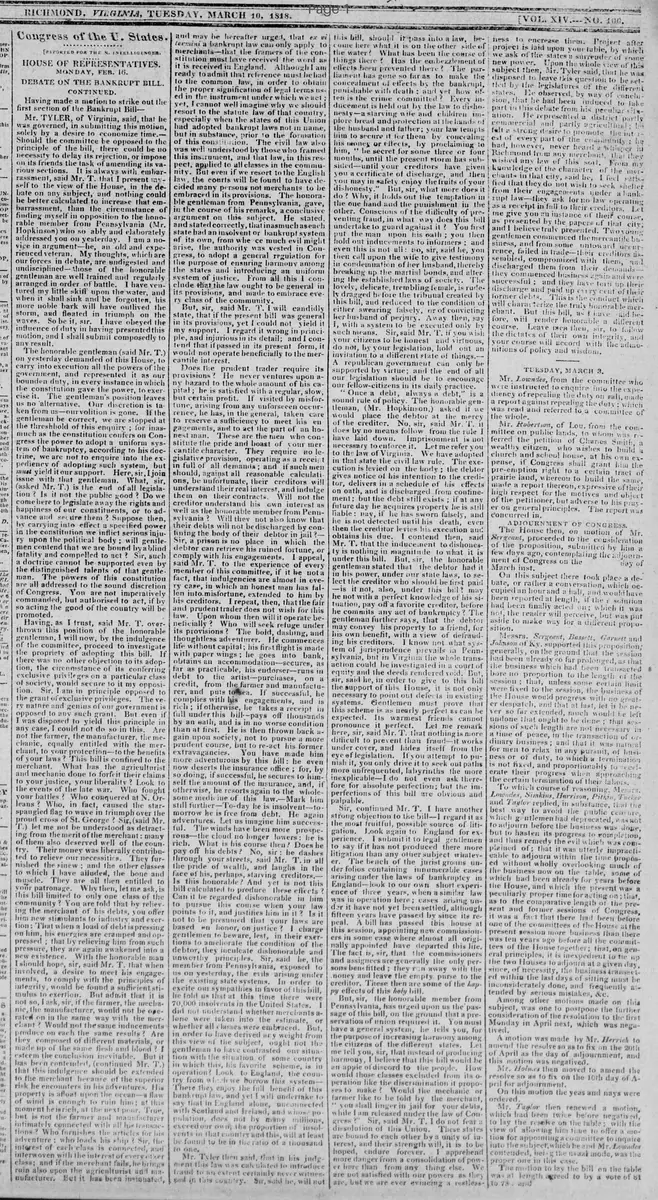
Extracted for the RICHMOND ENQUIRER.
HOUSE OF REPRESENTATIVES
MONDAY, FEB. 16.
DEBATE ON THE BANKRUPT BILL.
CONTINUED.
Having made a motion to strike out the first section of the Bankrupt Bill—
Mr. TYLER, of Virginia, said, that he was governed, in submitting this motion, solely by a desire to economize time.—Should the committee be opposed to the principle of the bill, there could be no necessity to delay its rejection, or impose on its friends the task of amending its various sections. It is always with embarrassment, said Mr. T. that I present myself to the view of the House, in the debate on any subject, and nothing could be better calculated to increase that embarrassment, than the circumstance of finding myself in opposition to the honorable member from Pennsylvania (Mr. Hopkinson) who so ably and elaborately addressed you on yesterday. I am a novice in argument—he, an old and experienced veteran. My thoughts, which are our forces in debate, are undigested and undisciplined—those of the honorable gentleman are well trained and regularly arranged in order of battle. I have ventured my little skiff upon the water, and when it shall sink and be forgotten, his more noble bark will have outlived the storm, and floated in triumph on the waves.
So be it, sir. I have obeyed the influence of duty in having presented this motion, and I shall submit composedly to any result.
The honorable gentleman (said Mr. T.) on yesterday demanded of this House, to carry into execution all the powers of the government, and represented it as our bounden duty, in every instance in which the constitution gave the power, to exercise it. The gentleman's position leaves us no alternative. Our discretion is taken from us—our volition is gone. If the gentleman be correct, we are stopped at the threshold of this enquiry; for inasmuch as the constitution confers on Congress the power to adopt a uniform system of bankruptcy, according to his doctrine, we are not to enquire into the expediency of adopting such system, but must yield it our support. Here, sir, I join issue with that gentleman. What, sir, (asked Mr. T.) is the end of all legislation? Is it not the public good? Do we come here to legislate away the rights and happiness of our constituents, or to advance and secure them? Suppose then, by carrying into effect a specified power in the constitution we inflict serious injury upon the political body: will gentlemen contend that we are bound by a blind fatality and compelled to act? Sir, such a doctrine cannot be supported even by the distinguished talents of that gentleman. The powers of this constitution are all addressed to the sound discretion of Congress. You are not imperatively commanded, but authorised to act, if by so acting the good of the country will be promoted.
Having, as I trust, said Mr. T. overthrown this position of the honorable gentleman, I will now, by the indulgence of the committee, proceed to investigate the propriety of adopting this bill. If there was no other objection to its adoption, the circumstance of its conferring exclusive privileges on a particular class of society, would secure to it my opposition. Sir, I am in principle opposed to the grant of exclusive privileges. The very nature and genius of our government is opposed to any such grant. But even if I was disposed to yield this principle in any case, I could not do so in this. Are not the farmer, the manufacturer, the mechanic, equally entitled with the merchant, to your protection to the benefits of your laws? This bill is confined to the merchant. What has the agriculturist and mechanic done to forfeit their claims to your justice, your liberality? Look to the events of the late war. Who fought your battles? Who conquered at N. Orleans? Who, in fact, caused the star-spangled flag to wave in triumph over the proud cross of St. George? Sir, (said Mr. T.) let me not be understood as detracting from the merit of the merchant: many of them also deserved well of the country. Their money was liberally contributed to relieve our necessities. They furnished the sinews: and the other classes to which I have alluded, the bone and muscle. They are all then entitled to your patronage. Why then, let me ask, is this bill limited to only one class of the community? You are told that by relieving the merchant of his debts, you offer him new stimulants to industry and exertion: That when a load of debt is pressing on him, his energies are cramped and oppressed; that by relieving him from such pressure, they are again awakened into a new existence. With the honorable man I should hope, sir, said Mr. T. that when involved, a desire to meet his engagements, to comply with the principles of integrity, would be found a sufficient stimulus to exertion. But admit that it is not so, I ask, sir, if the farmer, the mechanic, the manufacturer, would not be operated on in the same way with the merchant? Would not the same inducements produce on each the same results? Are they composed of different materials, or made up of the same flesh and blood? I esteem the conclusion inevitable. But it has been contended, (continued Mr. T.) that this indulgence should be extended to the merchant because of the superior risk he encounters in his adventures. His property is afloat upon the ocean—a flaw of wind is enough to ruin him: at the moment he is rich, at the next poor. True, but is not the farmer and manufacturer intimately connected with all his transactions? Who furnishes the articles for his adventure: who loads his ship? Sir, the interest of each class is connected, and interwoven with the interest of every other class; and if the merchant fails, he brings ruin also upon the agriculturist and manufacturer. But it has been insinuated, and may be hereafter urged, that ex vi termini a bankrupt law can only apply to merchants—that the framers of the constitution must have received the word as it is received in England. Although I am ready to admit that reference must be had to the common law, in order to obtain the proper signification of legal terms used in the instrument under which we act; yet, I cannot well imagine why we should resort to the statute law of that country, especially when the states of this Union had adopted bankrupt laws not in name, but in substance, prior to the formation of this constitution. The civil law also was well understood by those who framed this instrument, and that law, in this respect, applied to all classes in the community. But even if we resort to the English law, the courts will be found to have decided many persons not merchants to be embraced in its provisions. The honorable gentleman from Pennsylvania, gave, in the course of his remarks, a conclusive argument on this subject. He stated, and stated correctly, that inasmuch as each state had an insolvent or bankrupt system of its own, from whence much evil might arise, the authority was vested in Congress, to adopt a general regulation for the purpose of ensuring harmony among the states and introducing an uniform system of justice. From all this I conclude that the law ought to be general in its provisions, and made to embrace every class of the community.
But, sir, said Mr. T. I will candidly state, that if the present bill was general in its provisions, yet I could not yield it my support. I regard it wrong in principle, and injurious in its detail; and I contend that if passed in its present form, it would not operate beneficially to the mercantile interest.
Does the prudent trader require its provisions? He never ventures upon any hazard to the whole amount of his capital; he is satisfied with a regular, slow, but certain profit. If visited by misfortune, arising from any unforeseen occurrence, he has, in the general, taken care to reserve a sufficiency to meet his engagements, and to act the part of an honest man. These are the men who constitute the pride and boast of your mercantile character. They require no legislative provision, operating as a receipt in full of all demands; and if such men should, against all reasonable calculations, be unfortunate, their creditors will understand their real interest, and indulge them on their contracts. Will not the creditor understand his own interest as well as the honorable member from Pennsylvania? Will they not also know that their debts will not be discharged by confining the body of their debtor in jail?— Sir, a prison is no place in which the debtor can retrieve his ruined fortune, or comply with his engagements. I appeal, said Mr. T. to the experience of every member of this committee, if it be not a fact, that indulgences are almost in every case, in which an honest man has fallen into misfortune, extended to him by his creditors. I repeat, then, that the fair and prudent trader does not wish for this law. Upon whom then will it operate beneficially? Who will seek refuge under its provisions? The bold, dashing, and thoughtless adventurer. He commences life without capital: his first flight is made with paper wings; he goes into bank, obtains an accommodation—secures, as far as practicable, his endorser—runs in debt to the artisan—purchases, on a credit, from the farmer and manufacturer, and puts to sea. If successful, he complies with his engagements, and is rich; if otherwise, he takes a receipt in full under this bill—pays off thousands by an oath, and is in no worse condition than at first. He is then thrown back again upon society, not to pursue a more prudent course, but to re-act his former extravagancies. You have made him more adventurous by this bill: he even now deserts the insurance office; for, by so doing, if successful, he secures to himself the amount of the insurance, and, if otherwise, he resorts again to the wholesome medicine of this law.—Mark him still further—To-day he is insolvent—to-morrow he is free from debt. He again adventures. Let us imagine him successful. The winds have been more prosperous—the cloud no longer lowers: he is rich. What is his course then? Does he pay off his debts? No, sir: he dashes through your streets, said Mr. T. in all the pride of wealth, and laughs in the face of his, perhaps, starving creditors.— Is this honorable? And yet is not this bill calculated to produce these effects? Can it be regarded dishonorable in him to pursue this course when your law points to it, and justifies him in it? Is it not to be presumed that your laws are based on honor, on justice? I charge gentlemen to beware, lest, in their exertions to ameliorate the condition of the debtor, they inculcate dishonorable and unworthy principles. Sir, said he, the member from Pennsylvania, exposed to us on yesterday, the evils arising under the existing state systems. In order to excite our sympathies in favor of this bill, he told us that at this time there were 70,000 insolvents in the United States. I did not understand whether merchants alone were taken into the estimate, or whether all classes were embraced. But, in order to have derived any weight from this view of the subject, ought not the gentleman to have contrasted our situation with the situation of some country in which this, his favorite scheme, is in operation? Look to England, the country from which we borrow this system— There they enjoy the full benefit of this bankrupt law, and yet I will undertake to say that in England alone, unconnected with Scotland and Ireland, and whose population, does not by many millions, exceed our own, the proportion of insolvents in that country and this, will at least be found to be in the ratio of a thousand to one.
Mr. Tyler then said, that in his judgment this law was calculated to introduce fraud to an extent certainly never witnessed in this country. Sir, said he, will not this bill, should it pass into a law, become here what it is on the other side of the water? What has been the course of things there? Has the embezzlement of effects been prevented there? The parliament has gone so far as to make the concealment of effects by the bankrupt, punishable with death: and yet how often is the crime committed? Every inducement is held out by the law to dishonesty—a starving wife and children implore bread and protection at the hands of the husband and father; your law tempts him to secure it for them by concealing his money or effects, by proclaiming to him, "be secret for some three or four months, until the present storm has subsided—until your creditors have given you a certificate of discharge, and then you may in safety enjoy the fruits of your dishonesty." But, sir, what more does it do? Why, it holds out the temptation in the one hand and the punishment in the other. Conscious of the difficulty of preventing fraud, in what way does this bill undertake to guard against it? You first put the man upon his oath; you then hold out inducements to informers: and even this is not all: no, sir, said he, you then call upon the wife to give testimony in condemnation of her husband, thereby breaking up the martial bonds, and altering the established laws of society. The lovely, delicate, trembling female, is rudely dragged before the tribunal created by this bill, and reduced to the condition of either swearing falsely, or of convicting her husband of perjury. Away then, say I, with a system to be executed only by such means. Sir, said Mr. T. if you wish your citizens to be honest and virtuous, do not, by your legislation, hold out an invitation to a different state of things.— A republican government can only be supported by virtue; and the end of all our legislation should be to encourage our fellow-citizens in its daily practice.
"Once a debt, always a debt," is a sound rule of policy. The honorable gentleman, (Mr. Hopkinson,) asked if we would place the debtor at the mercy of the creditor. No, sir, said Mr. T. it does by no means follow from the rule I have laid down. Imprisonment is not necessary to enforce it. Let me refer you to the law of Virginia. We have adopted in that state the civil law rule. The execution is levied on the body: the debtor gives notice of his intention to the creditor, delivers in a schedule of his effects on oath, and is discharged from confinement; but the debt still exists; if at any future day he acquires property he is still liable: nay, if he has sworn falsely, and he is not detected until his death, even then the creditor levies his execution and obtains his due. I contend then, said Mr. T. that the inducement to dishonesty is nothing in magnitude to what it is under this bill. But, sir, the honorable gentleman stated that the debtor had it in his power, under our state laws, to select the creditor who should be first paid—is it not, also, under this bill? may he not with a perfect knowledge of his situation, pay off a favorite creditor, before he commits any act of bankruptcy? The gentleman further says, that the debtor may convey his property to a friend, for his own benefit, with a view of defrauding his creditors. I know not what system of jurisprudence prevails in Pennsylvania, but in Virginia the whole transaction could be investigated in a court of equity and the deeds rendered void. But, sir, said he, in order to give to this bill the support of this House, it is not only necessary to point out defects in existing systems. Gentlemen must prove that this scheme is as nearly perfect as can be expected. Its warmest friends cannot pronounce it perfect. Let me remark here, sir, said Mr. T. that nothing is more difficult to prevent than fraud—it works under cover, and hides itself from the eye of legislation. If you attempt to punish it, you only drive it to seek out paths more unfrequented, labyrinths the more inexplicable—I do not even ask therefore for absolute perfection; but the imperfections of this bill are obvious and palpable.
Sir, continued Mr. T. I have another strong objection to the bill—I regard it as the most fruitful, possible source of litigation. Look again to England for experience. I submit it to legal gentlemen to say if it has not produced there more litigation than any other subject whatever. The bench of the jurist groans under folios containing innumerable cases arising under the laws of bankruptcy in England—look to our own short experience of three years, when a similar law was in operation here; cases arising under it have not yet been settled, although fifteen years have passed by since its repeal. A bill has passed this house at this session, appointing new commissioners in some case where almost all originally appointed have departed this life. The fact is, sir, that the commissioners and assignees are generally the only persons benefitted; they run away with the money and leave the empty purse to the creditor. These then are some of the happy effects of this holy bill.
But, sir, the honorable member from Pennsylvania, has urged upon us the passage of this bill, on the ground that a preservation of union required it. You must have a general system, he tells you, for the purpose of increasing harmony among the citizens of the different states. Let me tell you, sir, that instead of producing harmony, I believe that this bill would be an apple of discord to the people. How would those classes excluded from its operation like the discrimination it proposes to make? Would the mechanic or farmer like to be told by the merchant, "you shall linger in jail for your debts, while I am released under the law of Congress?" Sir, said Mr. T. I do not fear a dissolution of this Union. These states are bound to each other by a unity of interest, and their strength will, it is to be hoped, endure forever. I apprehend more danger from a consolidation of power here than from any thing else. We are not satisfied with our powers as they are, but we are ever evincing a restlessness to increase them. Project after project is laid upon your table, by which we ask of the states a surrender of some new power. Upon the whole view of this subject then, Mr. Tyler said, that he was disposed to leave this question to be settled by the legislatures of the different states. He observed, by way of conclusion, that he had been induced to take part in this debate from his peculiar situation. He represented a district partly commercial and partly agricultural: but a strong desire to promote the interest of every part of the community: he had, however, never heard a whisper in Richmond from any merchant, that they wished any law of this sort. From my knowledge of the character of the merchants in that city, said he, I feel satisfied that they do not wish to seek shelter from their engagements under a bankrupt law—they ask for no law operating as a receipt in full to their creditors. Let me give you an instance of their course, as presented by the papers of that city; and I believe truly presented. Two young gentlemen commenced the mercantile business, and from some untoward occurrence, failed in trade—their creditors assembled, compromized with them, and discharged them from their demands— they commenced business again and were successful: and they have torn up their discharge and paid up every cent of their former debts. This is the conduct which will characterize the truly honorable merchant. But this bill, as I have said before, will render honorable a different course. Leave men then, sir, to follow the dictates of their own integrity, and your course will accord with the admonitions of policy and wisdom.
TUESDAY, MARCH 3.
Mr. Lowndes, from the committee who were instructed to enquire into the expediency of repealing the duty on salt, made a report against repealing the duty: which was read and referred to a committee of the whole.
Mr. Robertson, of La. from the committee on public lands, to whom was referred the petition of Charles Smith, a wealthy citizen, who wishes to build a church and school house, at his own expense, if Congress shall grant him the pre-emption right to a certain tract of prairie land, whereon to build the same, made a report thereon, expressive of their high respect for the motives and object of the petitioner, but adverse to his prayer on general principles. The report was concurred in.
ADJOURNMENT OF CONGRESS.
The House then, on motion of Mr. Sergeant, proceeded to the consideration of the proposition, submitted by him a few days ago, contemplating the adjournment of Congress on the 21st March inst.
On this subject there took place a debate, or rather a conversation, which occupied an hour and a half, and would have been reported at length, if the resolution had been finally acted on; which it was not, the reader will perceive, but was put aside to make way for a different proposition.
Messrs. Sergeant, Bassett, Garnett and Johnson of Ky. supported this proposition; generally, on the ground that the session had been already so far prolonged, as that the business which had been transacted bore no proportion to the length of the session; that, unless some certain limit were fixed to the session, the business of the House would progress with no greater despatch, and that at last, let it be never so far extended, much would be left undone that ought to be done; that sessions of such length are not necessary in a time of peace, in the transaction of ordinary business; and that it was natural for men to relax in any pursuit, of business or of duty, to which a termination is not fixed, and proportionably to accelerate their progress when approaching the certain termination of their labors.
To which course of reasoning, Messrs. Lowndes, Simkins, Harrison, Pithin, Tucker and Taylor replied, in substance, that the best way to avoid the public censure, which gentlemen had deprecated, was not to adjourn before the business was done, but to hasten its progress to completion, and thus remedy the evil which was complained of: that it was utterly impracticable to adjourn within the time proposed without wholly overlooking much of the business now on the table, some of which had been already for years before the House, and which the present was a peculiarly proper time for acting on; that, as to the comparative length of the present and former sessions of Congress, it was a fact that there had been before one of the committees of the House at the present session more business than there was ten years ago before all the committees of the House together; that, on general principles, it is inexpedient to tie up the two Houses to adjourn at a given day, since, of necessity, the business transacted within the last days of sitting must be inconsiderately done, and frequently attended by serious mistakes, &c.
Among other motions made on this subject, was one to postpone the further consideration of the resolution to the first Monday in April next, which was negatived.
A motion was made by Mr. Herrich to amend the resolve so as to fix on the 20th of April as the day of adjournment, and this motion was negatived.
Mr. Holmes then moved to amend the resolve so as to fix on the 15th day of April for adjournment.
On this motion the yeas and nays were ordered.
Mr. Taylor then renewed a motion, which had been twice before negatived, to lay the resolve on the table; with the view of allowing him time to offer a motion for appointing a committee to inquire into the subject, which he and Mr. Lowndes contended, being the usual mode, was the proper one in this case.
The motion to lay the bill on the table was at length agreed to by a vote of 81 to 73, and Mr. Taylor of N. Y. offered for consideration the following resolution:
"Resolved, That a joint committee of both Houses be appointed to consider and report when the present session of Congress may be terminated."
The resolution was read once, twice, thrice, passed and sent to the Senate for concurrence.
Mr. Reed, of Maryland, submitted for consideration the following resolution:
Whereas a resolution was passed by the Congress of the United States on the 11th day of October, 1780, in the following words, to wit:
"Resolved, That a monument be erected to the memory of the late Major General the Baron de Kalb, in the city of Annapolis, in the state of Maryland, with the following inscription:" [Here followed the inscription.]
Resolved, Therefore, that the aforesaid resolution be referred to a select committee, with instruction to report a bill to carry the same into effect.
And the question having been put from the chair, that the House do now proceed to consider the resolution, it was decided in the negative.
GEORGIA CLAIMS.
The House then resolved itself into a committee of the whole, Mr. Bassett in the chair, on the bill authorizing the payment of certain claims of Georgia militia for services rendered during the years 1793-6.
Mr. Cobb spoke at some length, recalling the attention of the House to the observations he had made at an early period of the session in support of this claim, and adducing some further arguments, drawn from facts not in his possession when he first expressed his views of the subject.
Mr. A. Mitchell also addressed the House in behalf of this claim, and enforced its merits, by a variety of cogent arguments.
After some amendments had been made to the details of the bill, a motion was made to strike out the first section of the bill.
Mr. Tallmadge rose in support of the motion, the merits of which he examined with reference to the documents on which it had been sustained, as well as to the old age of the claim, and its repeated rejections in former days, and during the administration of Washington, when the real nature of the claim was better understood, he said, than it possibly could be at the present day. He also took the ground against this claim, that it was intended and understood, by some of the Commissioners at least, and so reported by a committee of the House, to have been merged in the amount of 1,250,000 dollars, which the United States agreed to pay to Georgia for the territory ceded by that state to the United States.
Mr. Forsyth replied to Mr. Tallmadge, point by point. He denied that long denial of justice ought to constitute an obstacle to its final award, or that repeated refusals ought to be plead in bar to a just claim. He went into a full examination of the grounds of the claim which he sustained with earnestness. In regard to Mr. Attorney General Lincoln's unsupported impressions respecting the liquidation of this claim by the convention between Georgia and the United States, which had been quoted by Mr. Tallmadge, he denied them any weight whatever, particularly where there was direct testimony by two others of the commissioners, positively denying Mr. Lincoln's impression. Mr. F. concluded his comprehensive views of this question, by expressing his earnest hope, that justice would at length be done to these claimants.
The question was then taken on striking out the first section of the bill, and decided in the negative—60 to 59.
The committee then rose and reported the bill to the House, but, before coming to any decision thereon,
The House adjourned.
WEDNESDAY, MARCH 4.
Mr. Pleasants, from the naval committee, made a report on the petition of Capt. Samuel C. Reid, on behalf of the officers and crew of the late private armed brig Gen. Armstrong, accompanied by a bill, authorizing the distribution of a sum of money among those officers and crew of the said brig; which was twice read and committed.
The Speaker laid before the House a letter from the Secretary of the Navy, transmitting, in obedience to a resolution of the House, the proceedings of a court martial, held in the Mediterranean during the last year, for the trial of Captain John O. Creighton, charged with striking a midshipman under his command.
The House then proceeded to the consideration of the remaining section of the EXPATRIATION BILL.
The question under consideration being on the adoption of the following substitute offered by Mr. Robertson, of Lou. as an amendment to the remaining section of the bill:
"That in all prosecutions which may hereafter be instituted against any person for having engaged in military or naval service, for or against any foreign power, when without the jurisdiction of the United States, who, before the commission of the fact with which he may stand charged, shall have been a citizen of the United States, but shall have exercised his right of expatriation by becoming a citizen or subject of any foreign state or community by adoption, it shall be lawful for such person to give such fact of expatriation in evidence upon the general issue, and if, upon the trial of such person so charged as aforesaid, he shall prove such fact to the satisfaction of the jury, he shall be discharged from such prosecution."
Mr. Forsyth made an unsuccessful motion to amend the substitute so as to require that the citizen desiring to expatriate himself should cause to be recorded in the office of the clerk of a district court twelve months previous notice of his intention.
Mr. Terry moved to strike out of the third line of the substitute the words "for or," which motion was supported by the mover, and by Mr. Colston, and opposed by Messrs. Edwards, Robertson, of Louisiana, and Lowndes, and negatived by a large majority.
Mr. Livermore moved to strike out of the 12th line the words "give such fact of expatriation," and insert "give the fact that he has been naturalized in some foreign state:" which motion was supported by the mover in a few remarks and agreed to.
On motion of Mr. Livermore the words "or community" were stricken from the 10th line; and,
On motion of Mr. Crawford, the words "by adoption," following in the same line, were also stricken out.
Mr. Mercer, after briefly explaining and supporting the proposition he rose to offer, moved to strike out after the word "have," in the 7th line, the words "been a citizen of the United States, but shall have exercised his right of expatriation by becoming," in the 8th line, and inserting the word "become," to accommodate the sense: which motion was agreed to.
Mr. Lowndes, after remarking that the act of naturalization, to be valid, ought to be made within the jurisdiction of the government of which the person becomes a subject, moved to insert after the word "state" in the 10th line, the words "while within its jurisdiction," which was agreed to without a division.
Mr. Mercer next moved to insert after "United States," in the 8th line, the words "and not in hostility against the said states,"
which was agreed to, 65 to 59.
The next amendment proposed was by Mr. Tallmadge, to insert after "have" in the 5th line, the words "bona fide and voluntarily," which motion prevailed; when,
No other amendment being offered, the question was stated on adopting the amendment, as amended.
Mr. Pitkin submitted some arguments against the amendment, and was replied to by Mr. Robertson of Lou.
Mr. Trimble then read an amendment which for reasons which he offered at large, he wished incorporated into the bill, the object of which, substantially, was to recognize the right of a citizen to enter into the service of any foreign government, with which his country may be at peace, without thereby forfeiting his right of citizenship at home, &c.
Mr. Forsyth replied to some of the arguments used by Mr. Trimble in support of the principle he had proposed to introduce into the bill.
Mr. Trimble, then, after observing that the discussion of this principle might be referred with more propriety, perhaps, to the consideration of the neutrality bill reported by Mr. Forsyth, when it should come up for consideration, and not wishing to press a proposition now, of the success of which he was not sanguine, withdrew his motion.
Mr. Rhea offered his reasons at some length, against the substitute under consideration: after which,
The question was taken on Mr. Robertson's substitute for the second section, and carried, by Yeas and Nays, as follows:
For the amendment 93
Against it 61
Mr. Williams, of North Carolina, after entering briefly into an explanation of his reasons, offered, as an additional section to the bill; a provision in substance, that no person availing himself of the bill, and becoming expatriated, should ever after be permitted to be again naturalized a citizen of the United States.
Mr. Rich moved that the whole subject be indefinitely postponed, declaring that the bill had assumed a character which, however disposed to vote for the original bill, he thought would answer no good purpose, and to which he was therefore opposed.
Mr. Tallmadge submitted, much at length, his reasons for disapproving the bill and for supporting its indefinite postponement.
Mr. Robertson replied to some of Mr. T's arguments, and stated the reasons which placed him in opposition to the bill as it had been amended—his main objection being the principle included in the second amendment offered by Mr. Mercer, denying the right of a citizen to fight in defence of his adopted country, even against the country from which he might have expatriated himself.
Mr. Johnson of Kentucky spoke a short time in support and illustration of the opinions he had previously submitted in the debate.
Mr. Lowndes, after stating his belief that Mr. Mercer's second amendment was adopted by the House without being aware of its full effect, and declaring, that for one, he had given his assent to it without fully apprehending, from the part of the substitute in which it had been inserted, the extent of the principle it involved—moved (Messrs. Williams and Rich having withdrawn their motion to give an opportunity therefor) to re-consider the vote on that amendment.
On this motion Mr. Mercer entered into a general justification of the amendment in question; after which
The motion to re-consider was agreed to; and,
The question then recurring on the second amendment offered by Mr. Mercer, thus reconsidered, it was decided in the negative.
Mr. Lowndes then moved to insert after the word "state" in the 9th line, the words "and whilst the said foreign state shall not be in hostility against the said United States."
This motion was opposed by Mr. Robertson, and negatived, without a division.
Mr. Williams then renewed his motion to add the section which he had just before offered and withdrawn; which motion was also negatived without a division.
The question was then taken on ordering the bill to be engrossed for a third reading, and decided in the negative—ayes 64, noes 75.
So the bill was finally rejected.
The House then took up the report of the committee of the whole, on the bill providing for the payment of certain claims from the state of Georgia for militia services rendered in 1793-4.
The committee had reported the bill filled up with the sum of $45,000 ; which amendment the House refused to concur in.
Mr. Cobb then moved to fill the blank with $10,000, and spoke at some length, and earnestly in favor of the bill and his motion; which, however, was negatived.
Mr. Taylor, thinking the House had clearly indicated its hostility to the bill, moved its indefinite postponement.
This motion brought on a long and animated debate—in which Messrs. Forsyth, Cobb, Baldwin, and Mercer, strenuously advocated the bill; and Messrs. Livermore and Tallmadge opposed it—the latter gentlemen very earnestly and at much length.
The question, on postponing the bill indefinitely, was ultimately, about half past 5 o'clock, decided in the negative—ayes 54, noes 64; and
The House adjourned.
THURSDAY, MARCH 5.
Mr. Lowndes, from the committee of ways and means, reported a bill supplementary to the several acts relative to direct taxes and internal duties; which was twice read and committed.
Mr. Bloomfield, from the committee to whom the subject was referred, having made a report on the amendments of the Senate to the bill concerning certain surviving officers and soldiers of the revolution—
A motion was made by Mr. Edwards, in order to enlarge the provisions of the bill, and make them as comprehensive as he could, to strike out of the Senate's amendment the words "on the continental establishment." This amendment would have the effect to embrace all who served for nine months in the military service, and were in service at the end of the war, thus including the militia as well as the regulars.
This motion gave rise to considerable debate, in which Messrs. Edwards, Linn and Steriger urgently supported the motion, and Messrs. Palmer and Bloomfield opposed it.
In favor of the motion was adduced the important services of the militia during the revolution, frequently of the highest importance, and always more meritorious than those of the regulars, because not under the impulse of professional inducements and obligations.
Against the motion, the main argument was, the impolicy of the amendment, as likely to lead to defeat the bill on its return to the Senate, whose disposition on the subject had been sufficiently indicated by the amendments it had already made to the bill. The merit of the services of the militia was not denied, but the difficulty of discriminating between those who served occasionally, and those who served for a particular term of time, was mentioned as constituting an obstacle to any provision on the subject.
The question on this motion was decided in the negative—Yeas 60, Nays 91.
Mr. Bayly moved to amend that part of the Senate's amendment which provides that the relief contemplated should not be allowed to any of those officers and soldiers who are already on the pension list of the United States or of any individual state, by striking thereout the words "or of any individual state." This motion was supported by Mr. Bayly, and opposed by Mr. Edwards and Mr. Bloomfield, as going to destroy the principle of the bill, which was to relieve only the indigent.
This motion prevailed, by a vote of 79 to 61.
Mr. McCoy moved further to amend, by striking out "nine months," the term of service required to have been performed to constitute a claim to the bounty of Congress, and inserting in lieu thereof "three years."—This motion was decided in the negative.
After some other amendments of detail proposed by Mr. J. S. Smith Mr. Austin, and others, the question was taken on agreeing to the amendments of the Senate as amended, and agreed to: and the bill was returned to the Senate for concurrence in the amendments to the amendments of that body.
GEORGIA MILITIA CLAIMS.
The House resumed the unfinished business of yesterday, being the bill for the payment for services rendered by certain Georgia Militia in 1793-4.
Mr. Cobb moved an amendment to the bill, with a view to obviate the objection which had been thrown against the bill, and which he feared might defeat it, requiring that the sums claimed and proved to be due, to the satisfaction of the Secretary of War, should be paid "to the person or persons who performed such services, or his or their legal representatives;" thus preventing the payment of these claims to assignees, or persons who may have bought up the claims.
The motion was agreed to,
Mr. C. then moved to fill the blank in the bill with the sum of $109,130 64, being the sum which, according to the report of Secretary Dearborn in 1803, was due for services performed up to the end of the year 1793, and also the same sum as was embraced in the bill which last year passed the Senate, and failed in this house only from the lateness of the session. Mr. C. then proceeded to reply to the remarks of Mr. Tallmadge yesterday, and particularly to the argument against the claim which was founded on the policy of that day, as contradicting the calling out such a force as 1200 men for the frontier defence—an argument which he replied to with great force and feeling.
Mr. Spencer then rose in opposition to the bill, on the ground that the services proposed by the bill to be compensated were not rendered under the authority of the United States, as he contended from the documents; and, not being so authorized, ought on no pretence to be compensated by the United States—if for no other reason, because it would establish a dangerous precedent. He also objected to the incompleteness of the documents which had been brought to the view of the house relative to this claim.
Mr. Forsyth replied to Mr. Spencer, controverting his positions, and vindicating the claim from the doubtful character which he had imputed to it, at some length.
Mr. Spencer rejoined.
Mr. Adams, of Massachusetts, spoke at some length in support of the claim, on the ground of the evidence in favor of it, which he critically examined.
Mr. Rich delivered his views of the claim, which were rather doubtful than adverse; but after lending an attentive ear to the discussion, he yet doubted; and, doubting, could not vote for the claim.
Mr. Tucker of Va. advocated the admission of this claim on the ground of the duty of the general government to afford protection to every one of the United States, that it does to any one of them; and that in pursuance of this principle, the claim ought to be paid, on the evidence by which it is sustained.
Mr. Livermore, assigned some further reasons in opposition to the claim, because of the defect of authority from the United States for the employment of this force.
Mr. Forsyth quoted the case of the recent payment for the militia of Maryland, employed without express authority from the United States, because the urgency of the case did not allow time for it.
Mr. Williams, of North Carolina, stated the same fact in regard to the late services of the militia of North Carolina.
Mr. Reed confirmed substantially the fact stated by Mr. Forsyth, and stated the circumstances under which the militia had been called out, particularly on the eastern shore of Maryland,
Mr. Claiborne stated the circumstances of the payment of militia employed in Tennessee during the late war, without authority from the General Government, against the Indians in two cases, who had been promptly paid by the government of the United States.
The question was at length taken on filling the blank in the bill, as moved by Mr. Cobb, and decided thus:
For the motion 74
Against the motion 71
The Speaker (Mr. H. Nelson then acting as Speaker) voted in the affirmative; and the motion was agreed to.
The question was then taken "Shall the bill be engrossed for a third reading?" and decided, by Yeas and Nays as follows:
For the bill 70
Against it 90
So the bill was REJECTED: and
The House adjourned.
What sub-type of article is it?
What themes does it cover?
What keywords are associated?
What entities or persons were involved?
Where did it happen?
Story Details
Key Persons
Location
House Of Representatives, United States
Event Date
Feb. 16 To March 5
Story Details
Detailed report of U.S. House proceedings including Mr. Tyler's opposition to the Bankrupt Bill emphasizing moral integrity and opposition to class privileges; reports on salt duty repeal and land petition; debates on congressional adjournment date; resolution for Baron de Kalb monument; extended debates and rejection of Georgia militia claims bill; naval petitions and court martial report; amendments and rejection of Expatriation Bill; amendments to revolutionary officers relief bill; supplementary tax bill introduction.