Thank you for visiting SNEWPapers!
Sign up free
The New Hampshire Gazette And General Advertiser
Portsmouth, Rockingham County, New Hampshire
What is this article about?
A gentleman from Montgomery County, Pennsylvania, describes a method using brimstone to protect peach trees from worms and caterpillars, effective for up to 200 trees per pound, reported from Middletown on June 5.
Clipping
OCR Quality
Full Text
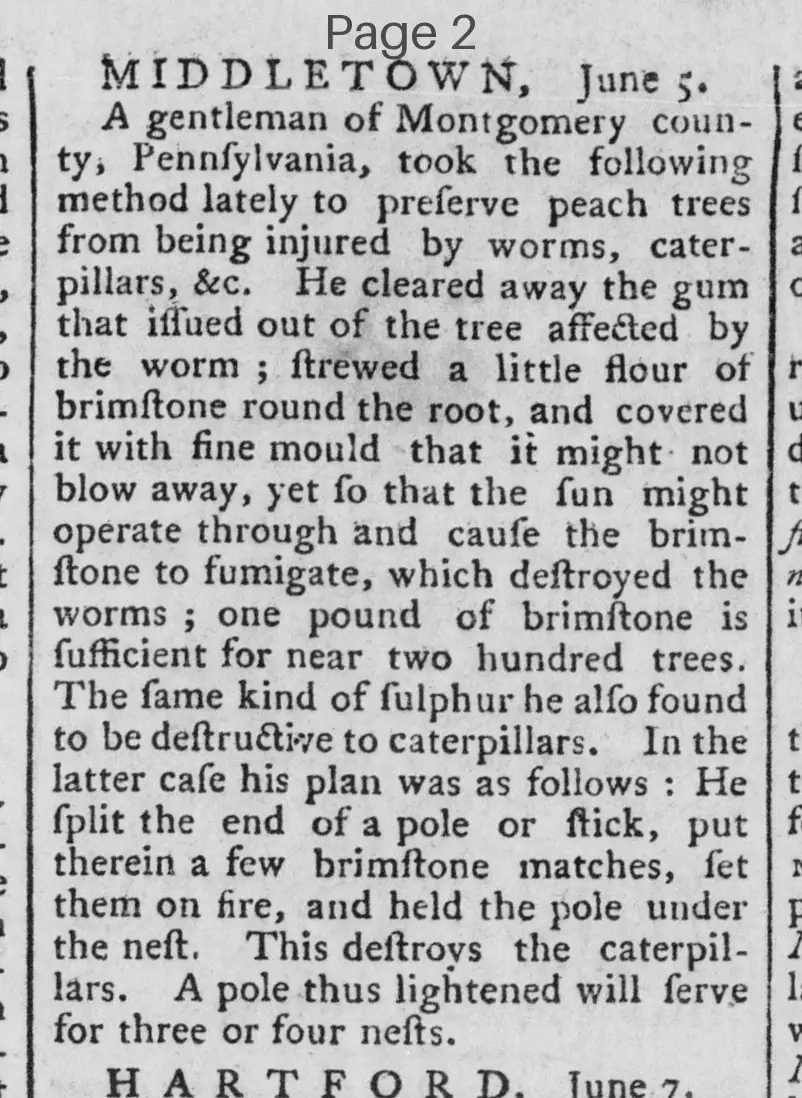
A gentleman of Montgomery county, Pennsylvania, took the following method lately to preserve peach trees from being injured by worms, caterpillars, &c. He cleared away the gum that issued out of the tree affected by the worm; strewed a little flour of brimstone round the root, and covered it with fine mould that it might not blow away, yet so that the sun might operate through and cause the brimstone to fumigate, which destroyed the worms; one pound of brimstone is sufficient for near two hundred trees.
The same kind of sulphur he also found to be destructive to caterpillars. In the latter case his plan was as follows: He split the end of a pole or stick, put therein a few brimstone matches, set them on fire, and held the pole under the nest. This destroys the caterpillars. A pole thus lightened will serve for three or four nests.
What sub-type of article is it?
What keywords are associated?
Where did it happen?
Domestic News Details
Primary Location
Montgomery County, Pennsylvania
Event Date
June 5
Outcome
method destroys worms in peach trees and caterpillars in nests using brimstone; one pound sufficient for nearly 200 trees, one pole for 3-4 nests.
Event Details
Gentleman cleared gum from affected trees, applied brimstone flour around roots covered with mould for sun-activated fumigation to kill worms. For caterpillars, used burning brimstone matches on a split pole held under nests.