Thank you for visiting SNEWPapers!
Sign up free
Letter to Editor
February 24, 1859
Marshall County Republican
Plymouth, Marshall County, Indiana
What is this article about?
Correspondent from Indianapolis reports on Indiana legislature actions as of Feb. 21, 1859: passage of bills consolidating township offices to one trustee, liquor licensing, suppressing unauthorized shinplasters; pending treasury reforms, defeat of hard money tax proposal, and debates on education funding and school taxes.
Clipping
OCR Quality
95%
Excellent
Full Text
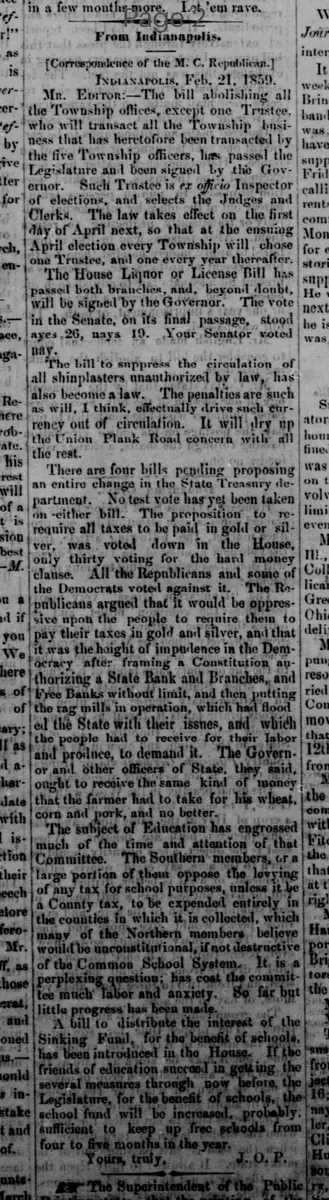
From Indianapolis.
[Correspondence of the M. C. Republican.]
INDIANAPOLIS, Feb. 21, 1859.
Mr. Editor:—The bill abolishing all the Township offices, except one Trustee, who will transact all the Township business that has heretofore been transacted by the five Township officers, has passed the Legislature and been signed by the Governor. Such Trustee is ex officio Inspector of elections, and selects the Judges and Clerks. The law takes effect on the first day of April next, so that at the ensuing April election every Township will choose one Trustee, and one every year thereafter.
The House Liquor or License Bill has passed both branches, and, beyond doubt, will be signed by the Governor. The vote in the Senate, on its final passage, stood ayes 26, nays 19. Your Senator voted nay.
The bill to suppress the circulation of all shinplasters unauthorized by law, has also become a law. The penalties are such as will, I think, effectually drive such currency out of circulation. It will dry up the Union Plank Road concern with all the rest.
There are four bills pending proposing an entire change in the State Treasury department. No test vote has yet been taken on either bill. The proposition to require all taxes to be paid in gold or silver, was voted down in the House, only thirty voting for the hard money clause. All the Republicans and some of the Democrats voted against it. The Republicans argued that it would be oppressive upon the people to require them to pay their taxes in gold and silver, and that it was the height of impudence in the Democracy after framing a Constitution authorizing a State Bank and Branches, and Free Banks without limit, and then putting the rag mills in operation, which had flooded the State with their issues, and which the people had to receive for their labor and produce, to demand it. The Governor and other officers of State, they said, ought to receive the same kind of money that the farmer had to take for his wheat, corn and pork, and no better.
The subject of Education has engrossed much of the time and attention of that Committee. The Southern members, or a large portion of them oppose the levying of any tax for school purposes, unless it be a County tax, to be expended entirely in the counties in which it is collected, which many of the Northern members believe would be unconstitutional, if not destructive of the Common School System. It is a perplexing question; has cost the committee much labor and anxiety. So far but little progress has been made.
A bill to distribute the interest of the Sinking Fund, for the benefit of schools, has been introduced in the House. If the friends of education succeed in getting the several measures through now before the Legislature, for the benefit of schools, the school fund will be increased, probably sufficient to keep up free schools from four to five months in the year.
Yours, truly,
J. O. P.
[Correspondence of the M. C. Republican.]
INDIANAPOLIS, Feb. 21, 1859.
Mr. Editor:—The bill abolishing all the Township offices, except one Trustee, who will transact all the Township business that has heretofore been transacted by the five Township officers, has passed the Legislature and been signed by the Governor. Such Trustee is ex officio Inspector of elections, and selects the Judges and Clerks. The law takes effect on the first day of April next, so that at the ensuing April election every Township will choose one Trustee, and one every year thereafter.
The House Liquor or License Bill has passed both branches, and, beyond doubt, will be signed by the Governor. The vote in the Senate, on its final passage, stood ayes 26, nays 19. Your Senator voted nay.
The bill to suppress the circulation of all shinplasters unauthorized by law, has also become a law. The penalties are such as will, I think, effectually drive such currency out of circulation. It will dry up the Union Plank Road concern with all the rest.
There are four bills pending proposing an entire change in the State Treasury department. No test vote has yet been taken on either bill. The proposition to require all taxes to be paid in gold or silver, was voted down in the House, only thirty voting for the hard money clause. All the Republicans and some of the Democrats voted against it. The Republicans argued that it would be oppressive upon the people to require them to pay their taxes in gold and silver, and that it was the height of impudence in the Democracy after framing a Constitution authorizing a State Bank and Branches, and Free Banks without limit, and then putting the rag mills in operation, which had flooded the State with their issues, and which the people had to receive for their labor and produce, to demand it. The Governor and other officers of State, they said, ought to receive the same kind of money that the farmer had to take for his wheat, corn and pork, and no better.
The subject of Education has engrossed much of the time and attention of that Committee. The Southern members, or a large portion of them oppose the levying of any tax for school purposes, unless it be a County tax, to be expended entirely in the counties in which it is collected, which many of the Northern members believe would be unconstitutional, if not destructive of the Common School System. It is a perplexing question; has cost the committee much labor and anxiety. So far but little progress has been made.
A bill to distribute the interest of the Sinking Fund, for the benefit of schools, has been introduced in the House. If the friends of education succeed in getting the several measures through now before the Legislature, for the benefit of schools, the school fund will be increased, probably sufficient to keep up free schools from four to five months in the year.
Yours, truly,
J. O. P.
What sub-type of article is it?
Informative
Political
What themes does it cover?
Politics
Education
Economic Policy
What keywords are associated?
Indiana Legislature
Township Trustee
Liquor License Bill
Shinplasters
Education Funding
Hard Money Taxes
What entities or persons were involved?
J. O. P.
Mr. Editor
Letter to Editor Details
Author
J. O. P.
Recipient
Mr. Editor
Main Argument
reports on the passage and status of various indiana legislative bills concerning township governance, liquor licensing, currency regulation, treasury reforms, taxation, and education funding.
Notable Details
Senate Vote On Liquor Bill: Ayes 26, Nays 19
Hard Money Tax Proposal Defeated In House With Only 30 Votes
Debate On School Taxes Between Southern And Northern Members
Potential Increase In School Fund To Support 4 5 Months Of Free Schools