Thank you for visiting SNEWPapers!
Sign up free
Literary
June 11, 1825
The Ladies' Garland
Harpers Ferry, Jefferson County, West Virginia
What is this article about?
Napoleon Bonaparte recounts the tale of Giulio, a young Roman who consults a mysterious Sybil foretelling love, sacrilege, and murder. Fleeing destiny, Giulio becomes a monk in Naples but falls passionately in love with Theresa, the wife of an old man, during confession, torn between vows and desire.
Merged-components note: Continuation of the serialized tale 'GIULIO, A TALE' across pages 1 and 2, sequential reading order.
Clippings
1 of 2
OCR Quality
95%
Excellent
Full Text
REPOSITORY.
FROM THE NEW MONTHLY MAGAZINE.
GIULIO, A TALE.
An Improvisation of Bonaparte.
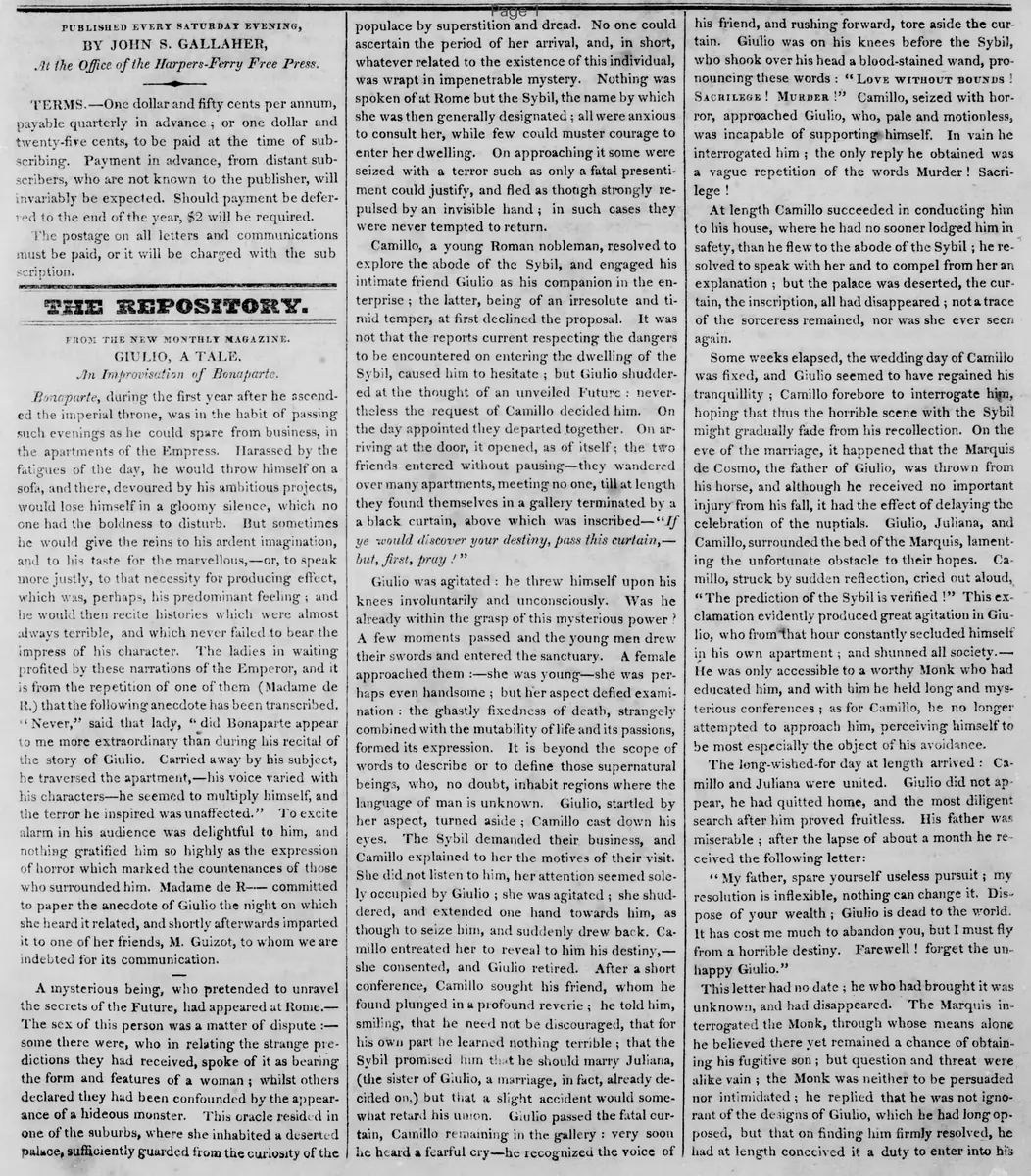
Bonaparte, during the first year after he ascended
the imperial throne, was in the habit of passing
such evenings as he could spare from business, in
the apartments of the Empress. Harassed by the
fatigues of the day, he would throw himself on a
sofa, and there, devoured by his ambitious projects,
would lose himself in a gloomy silence, which no
one had the boldness to disturb. But sometimes
he would give the reins to his ardent imagination,
and to his taste for the marvellous,-or, to speak
more justly, to that necessity for producing effect,
which was, perhaps, his predominant feeling ; and
he would then recite histories which were almost
always terrible, and which never failed to bear the
impress of his character. The ladies in waiting
profited by these narrations of the Emperor, and it
is from the repetition of one of them (Madame de
R.) that the following anecdote has been transcribed.
" Never," said that lady, " did Bonaparte appear
to me more extraordinary than during his recital of
the story of Giulio. Carried away by his subject,
he traversed the apartment,-his voice varied with
his characters--he seemed to multiply himself, and
the terror he inspired was unaffected." To excite
alarm in his audience was delightful to him, and
nothing gratified him so highly as the expression
of horror which marked the countenances of those
who surrounded him. Madame de R-.- committed
to paper the anecdote of Giulio the night on which
she heard it related, and shortly afterwards imparted
it to one of her friends, M. Guizot, to whom we are
indebted for its communication.
A mysterious being, who pretended to unravel
the secrets of the Future, had appeared at Rome.-
The sex of this person was a matter of dispute :-
some there were, who in relating the strange pre-
dictions they had received, spoke of it as bearing
the form and features of a woman ; whilst others
declared they had been confounded by the appear-
ance of a hideous monster. This oracle resided in
one of the suburbs, where she inhabited a deserted
palace, sufficiently guarded from the curiosity of the
populace by superstition and dread. No one could
ascertain the period of her arrival, and, in short,
whatever related to the existence of this individual,
was wrapt in impenetrable mystery. Nothing was
spoken of at Rome but the Sybil, the name by which
she was then generally designated ; all were anxious
to consult her, while few could muster courage to
enter her dwelling. On approaching it some were
seized with a terror such as only a fatal presenti-
ment could justify, and fled as though strongly re-
pulsed by an invisible hand; in such cases they
were never tempted to return.
Camillo, a young Roman nobleman, resolved to
explore the abode of the Sybil, and engaged his
intimate friend Giulio as his companion in the en-
terprise; the latter, being of an irresolute and ti-
mid temper, at first declined the proposal. It was
not that the reports current respecting the dangers
to be encountered on entering the dwelling of the
Sybil, caused him to hesitate ; but Giulio shudder-
ed at the thought of an unveiled Future : never-
theless the request of Camillo decided him. On
the day appointed they departed together. On ar-
riving at the door, it opened, as of itself; the two
friends entered without pausing-they wandered
over many apartments, meeting no one, till at length
they found themselves in a gallery terminated by a
black curtain, above which was inscribed-"If
ye would discover your destiny, pass this curtain,-
but, first, pray ! "
Giulio was agitated : he threw himself upon his
knees involuntarily and unconsciously. Was he
already within the grasp of this mysterious power ?
A few moments passed and the young men drew
their swords and entered the sanctuary. A female
approached them :--she was young-she was per-
haps even handsome ; but her aspect defied exami-
nation : the ghastly fixedness of death, strangely
combined with the mutability of life and its passions,
formed its expression. It is beyond the scope of
words to describe or to define those supernatural
beings, who, no doubt, inhabit regions where the
language of man is unknown. Giulio, startled by
her aspect, turned aside ; Camillo cast down his
eyes. The Sybil demanded their business, and
Camillo explained to her the motives of their visit.
She did not listen to him, her attention seemed sole-
ly occupied by Giulio ; she was agitated ; she shud-
dered, and extended one hand towards him, as
though to seize him, and suddenly drew back. Ca-
millo entreated her to reveal to him his destiny,-
she consented, and Giulio retired. After a short
conference, Camillo sought his friend, whom he
found plunged in a profound reverie ; he told him,
smiling, that he need not be discouraged, that for
his own part he learned nothing terrible ; that the
Sybil promised him that be should marry Juliana,
(the sister of Giulio, a marriage, in fact, already de-
cided on,) but that a slight accident would some-
what retard his union. Giulio passed the fatal cur-
tain, Camillo remaining in the gallery : very soon
he heard a fearful cry -he recognized the voice of
his friend, and rushing forward, tore aside the cur-
tain. Giulio was on his knees before the Sybil,
who shook over his head a blood-stained wand, pro-
nouncing these words : "Love without Bounds !
Sacrilege ! Murder !" Camillo, seized with hor-
ror, approached Giulio, who, pale and motionless,
was incapable of supporting himself. In vain he
interrogated him ; the only reply he obtained was
a vague repetition of the words Murder! Sacri-
lege !
At length Camillo succeeded in conducting him
to his house, where he had no sooner lodged him in
safety, than he flew to the abode of the Sybil ; he re-
solved to speak with her and to compel from her an
explanation ; but the palace was deserted, the cur-
tain, the inscription, all had disappeared ; no trace
of the sorceress remained, nor was she ever seen
again.
Some weeks elapsed, the wedding day of Camillo
was fixed, and Giulio seemed to have regained his
tranquillity ; Camillo forebore to interrogate him,
hoping that thus the horrible scene with the Sybil
might gradually fade from his recollection. On the
eve of the marriage, it happened that the Marquis
de Cosmo, the father of Giulio, was thrown from
his horse, and although he received no important
injury from his fall, it had the effect of delaying the
celebration of the nuptials. Giulio, Juliana, and
Camillo, surrounded the bed of the Marquis, lament-
ing the unfortunate obstacle to their hopes. Ca-
millo, struck by sudden reflection, cried out aloud,
" The prediction of the Sybil is verified !" This ex-
clamation evidently produced great agitation in Giu-
l io, who from that hour constantly secluded himself
in his own apartment ; and shunned all society.-
He was only accessible to a worthy Monk who had
educated him, and with him he held long and mys-
terious conferences; as for Camillo, he no longer
attempted to approach him, perceiving himself to
be most especially the object of his avoidance.
The long-wished-for day at length arrived : Ca-
millo and Juliana were united. Giulio did not ap-
pear, he had quitted home, and the most diligent
search after him proved fruitless. His father was
miserable ; after the lapse of about a month he re-
ceived the following letter:
" My father, spare yourself useless pursuit; my
resolution is inflexible, nothing can change it. Dis-
pose of your wealth ; Giulio is dead to the world.
It has cost me much to abandon you, but I must fly
from a horrible destiny. Farewell ! forget the un-
happy Giulio."
This letter had no date ; he who had brought it was
unknown, and had disappeared. The Marquis in-
terrogated the Monk, through whose means alone
he believed there yet remained a chance of obtain-
ing his fugitive son; but question and threat were
alike vain ; the Monk was neither to be persuaded
nor intimidated; he replied that he was not igno-
rant of the designs of Giulio, which he had long op-
posed, but that on finding him firmly resolved, he
had at length conceived it a duty to enter into his
views; that he knew the place of his retreat, but that no earthly power should induce him to betray secrets confided to him under the seal of his confession.
Giulio had gone to Naples, from whence he had embarked for Messina, purposing there to enter a Dominican convent which his confessor had recommended to him. Father Ambrosio, the superior of this convent, was a man of too much real piety and too enlightened views to take advantage of the disturbed imagination of a young man, and Giulio vainly besought him to dispense with the novitiate; he would by no means consent to it. Giulio was compelled to submit; his resolution nevertheless remained immoveable: a strange superstition governed him, and he believed he could only find refuge from his fate in embracing a monastic life.
He was persecuted by the recollection of the Sybil, incessantly haunted by the words she had pronounced over him-- "Love without bounds! Sacrilege! Murder!" The cloister seemed to him the only asylum whither he might escape from passion and from crime. Poor wretch! as if walls, rules, and vows, could rescue man from destiny.
The year of the novitiate expired. Giulio pronounced his vows, he believed himself happy, and felt as if at length delivered from the torments he had suffered: not once did an idea of the sacrifice he had made sadden his thoughts; but on the very evening of that solemn day, at the moment of retiring to his cell, he met one of the monks of the convent, who took his hand, pressed it affectionately, and said: "Brother, it is forever!" The words "for ever" struck Giulio. The power of a word over a weak mind is wonderful; those now uttered, seemed to reveal to him his whole existence: he beheld himself as one already dead, and for whom time was no more; he fell from thenceforth into a sombre habit, and appeared to support the weight of life wearily.
Father Ambrosio beheld with compassion the situation of this young man: his sole knowledge of him was that he was unhappy, and took an interest in him: it occurred to him that occupation might dissipate his melancholy. Giulio had much eloquence, and Ambrosio appointed him to preach:-- his reputation was of rapid growth, multitudes flocked from all quarters to hear him, he became the subject of a variety of vague rumors, he was young and handsome, and it is probable that the mystery which surrounded him lent an added charm to his words.
The time drew nigh for the celebration of the feast of the Convent, at which the King of Naples and his whole court were to assist; Giulio was selected to pronounce the panegyric of St. Thomas, the patron of the convent, and great preparations were made for the occasion. The day arrived, an immense crowd filled the church, Giulio was with difficulty pressing through it to go to his pulpit, when, in consequence of his efforts, his cowl fell back, leaving his face exposed: at that moment he heard the exclamation, "Heavens, how handsome he is!" Surprised and agitated, he turned involuntarily, and beheld a female whose eyes were fixed on him with the most penetrating expression. A few moments were sufficient to revolutionize the existence of these two beings. Giulio pronounced his discourse, and immediately on finding himself at liberty, immured himself in his cell, but he was no longer free to deliver himself up to his ordinary meditations: pursued by the image of the unknown female, experiencing sentiments which were completely new to him, troubled, disquieted, repose seemed to have abandoned him; nevertheless, it seemed to him as though he had only begun to exist from the moment when he heard the voice the accent of which had so penetrated his heart. He dares not hazard a glance towards the future: alas! he cannot, his destiny is irrevocable! Every morning he goes to perform mass, every morning he remarks a veiled female on the same spot; he recognizes her, and has not even a wish to see her face, for then he must avoid her: but he dares allow himself to gaze intently on the veil: he follows all her movements, he feels, as it were, the pulsations of her heart, and replies to them; too weak to tear himself from his danger, he trembles to examine himself, he starts from the truth; his life is compressed into a few rapid moments--during these he exists, the rest of his days is annihilation. He would fain fly: he promises himself, "If she be there to-morrow, I will not return;" and armed with this resolution he believes himself safe, and feels something like a return of tranquillity. The next day he went to the church somewhat earlier than he was accustomed; she was not there; when every one had retired, he approached her seat, and perceiving her prayer-book, he seized it, opened it, and saw written on the first page the name of Theresa--now, then, he could repeat, he could call upon her name: "Theresa! Theresa!" he murmured, in accents as low as though he feared to be heard, yet he was quite alone. Since she did not appear, he had no scruple to return: days and weeks rolled away and Theresa was absent.
Theresa, the wife of an old man, whom she loved as a father, was happy in the fulfilment of her duties, and suspected no other species of happiness than that which was her portion; she saw Giulio, and her peace of mind was gone. So ardent was the soul of Theresa, that her first real sentiment was doomed to form the destiny of her life:--she adored Giulio. Until this crisis her husband had been the confidant of her every thought, but she never mentioned Giulio to him; this mystery was painful to her, and seemed to accuse her of her fault; she perceived there was danger to be shunned, and had the courage to abstain from attending mass. In the hope of calming her feelings, she had recourse to confession, and resolved, for that purpose, to return to the church of the Dominicans:-- she chose the hour when she knew Giulio to be engaged; she approached the confessional, and on her knees acknowledged all she had experienced since the day of the festival of the convent, the happiness which the daily sight of Giulio had caused her, her subsequent remorse, and the courage she had exerted in avoiding him; but confessed that she feared her strength would soon abandon her.-- "What must I do?" she cried: "have pity, my father, on a poor sinner!" Her tears flowed in torrents, her agitation was violent. Scarcely had she concluded, when a threatening voice pronounced the words, "Unhappy wretch! what sacrilege!" Giulio, for it was he whom destiny had led thither, rushed from the confessional. Theresa, still kneeling, arrested his steps; she seized his robe, she supplicated him to withhold his malediction, she implored him for her salvation, she implored him for her love. He repulsed her, though very feebly.-- "Theresa, Theresa," he cried at last, "quit this place!--very soon my resolution will fail me." At these words Theresa threw herself into his arms, enveloping him, as it were, with the atmosphere of her love. "Say," she cried--"Oh say that I am beloved before I quit thee!" Giulio, terrified, beside himself, shuddering with fear of a surprise, replied for a moment to her caresses, and pressed her to his heart; but on a sudden, struck by the recollection of the prediction, he swore to fly from her forever; and without any explanation, he exacted from her that she would bind herself to the same engagement. Theresa, abandoned to her passion, scarcely comprehends his words, she consents to whatever he dictates.--- What, indeed, did they signify to her?--it is enough that he loves her. She feels assured that she shall see him again. At length they separate.
[TO BE CONTINUED.]
FROM THE NEW MONTHLY MAGAZINE.
GIULIO, A TALE.
An Improvisation of Bonaparte.
Bonaparte, during the first year after he ascended
the imperial throne, was in the habit of passing
such evenings as he could spare from business, in
the apartments of the Empress. Harassed by the
fatigues of the day, he would throw himself on a
sofa, and there, devoured by his ambitious projects,
would lose himself in a gloomy silence, which no
one had the boldness to disturb. But sometimes
he would give the reins to his ardent imagination,
and to his taste for the marvellous,-or, to speak
more justly, to that necessity for producing effect,
which was, perhaps, his predominant feeling ; and
he would then recite histories which were almost
always terrible, and which never failed to bear the
impress of his character. The ladies in waiting
profited by these narrations of the Emperor, and it
is from the repetition of one of them (Madame de
R.) that the following anecdote has been transcribed.
" Never," said that lady, " did Bonaparte appear
to me more extraordinary than during his recital of
the story of Giulio. Carried away by his subject,
he traversed the apartment,-his voice varied with
his characters--he seemed to multiply himself, and
the terror he inspired was unaffected." To excite
alarm in his audience was delightful to him, and
nothing gratified him so highly as the expression
of horror which marked the countenances of those
who surrounded him. Madame de R-.- committed
to paper the anecdote of Giulio the night on which
she heard it related, and shortly afterwards imparted
it to one of her friends, M. Guizot, to whom we are
indebted for its communication.
A mysterious being, who pretended to unravel
the secrets of the Future, had appeared at Rome.-
The sex of this person was a matter of dispute :-
some there were, who in relating the strange pre-
dictions they had received, spoke of it as bearing
the form and features of a woman ; whilst others
declared they had been confounded by the appear-
ance of a hideous monster. This oracle resided in
one of the suburbs, where she inhabited a deserted
palace, sufficiently guarded from the curiosity of the
populace by superstition and dread. No one could
ascertain the period of her arrival, and, in short,
whatever related to the existence of this individual,
was wrapt in impenetrable mystery. Nothing was
spoken of at Rome but the Sybil, the name by which
she was then generally designated ; all were anxious
to consult her, while few could muster courage to
enter her dwelling. On approaching it some were
seized with a terror such as only a fatal presenti-
ment could justify, and fled as though strongly re-
pulsed by an invisible hand; in such cases they
were never tempted to return.
Camillo, a young Roman nobleman, resolved to
explore the abode of the Sybil, and engaged his
intimate friend Giulio as his companion in the en-
terprise; the latter, being of an irresolute and ti-
mid temper, at first declined the proposal. It was
not that the reports current respecting the dangers
to be encountered on entering the dwelling of the
Sybil, caused him to hesitate ; but Giulio shudder-
ed at the thought of an unveiled Future : never-
theless the request of Camillo decided him. On
the day appointed they departed together. On ar-
riving at the door, it opened, as of itself; the two
friends entered without pausing-they wandered
over many apartments, meeting no one, till at length
they found themselves in a gallery terminated by a
black curtain, above which was inscribed-"If
ye would discover your destiny, pass this curtain,-
but, first, pray ! "
Giulio was agitated : he threw himself upon his
knees involuntarily and unconsciously. Was he
already within the grasp of this mysterious power ?
A few moments passed and the young men drew
their swords and entered the sanctuary. A female
approached them :--she was young-she was per-
haps even handsome ; but her aspect defied exami-
nation : the ghastly fixedness of death, strangely
combined with the mutability of life and its passions,
formed its expression. It is beyond the scope of
words to describe or to define those supernatural
beings, who, no doubt, inhabit regions where the
language of man is unknown. Giulio, startled by
her aspect, turned aside ; Camillo cast down his
eyes. The Sybil demanded their business, and
Camillo explained to her the motives of their visit.
She did not listen to him, her attention seemed sole-
ly occupied by Giulio ; she was agitated ; she shud-
dered, and extended one hand towards him, as
though to seize him, and suddenly drew back. Ca-
millo entreated her to reveal to him his destiny,-
she consented, and Giulio retired. After a short
conference, Camillo sought his friend, whom he
found plunged in a profound reverie ; he told him,
smiling, that he need not be discouraged, that for
his own part he learned nothing terrible ; that the
Sybil promised him that be should marry Juliana,
(the sister of Giulio, a marriage, in fact, already de-
cided on,) but that a slight accident would some-
what retard his union. Giulio passed the fatal cur-
tain, Camillo remaining in the gallery : very soon
he heard a fearful cry -he recognized the voice of
his friend, and rushing forward, tore aside the cur-
tain. Giulio was on his knees before the Sybil,
who shook over his head a blood-stained wand, pro-
nouncing these words : "Love without Bounds !
Sacrilege ! Murder !" Camillo, seized with hor-
ror, approached Giulio, who, pale and motionless,
was incapable of supporting himself. In vain he
interrogated him ; the only reply he obtained was
a vague repetition of the words Murder! Sacri-
lege !
At length Camillo succeeded in conducting him
to his house, where he had no sooner lodged him in
safety, than he flew to the abode of the Sybil ; he re-
solved to speak with her and to compel from her an
explanation ; but the palace was deserted, the cur-
tain, the inscription, all had disappeared ; no trace
of the sorceress remained, nor was she ever seen
again.
Some weeks elapsed, the wedding day of Camillo
was fixed, and Giulio seemed to have regained his
tranquillity ; Camillo forebore to interrogate him,
hoping that thus the horrible scene with the Sybil
might gradually fade from his recollection. On the
eve of the marriage, it happened that the Marquis
de Cosmo, the father of Giulio, was thrown from
his horse, and although he received no important
injury from his fall, it had the effect of delaying the
celebration of the nuptials. Giulio, Juliana, and
Camillo, surrounded the bed of the Marquis, lament-
ing the unfortunate obstacle to their hopes. Ca-
millo, struck by sudden reflection, cried out aloud,
" The prediction of the Sybil is verified !" This ex-
clamation evidently produced great agitation in Giu-
l io, who from that hour constantly secluded himself
in his own apartment ; and shunned all society.-
He was only accessible to a worthy Monk who had
educated him, and with him he held long and mys-
terious conferences; as for Camillo, he no longer
attempted to approach him, perceiving himself to
be most especially the object of his avoidance.
The long-wished-for day at length arrived : Ca-
millo and Juliana were united. Giulio did not ap-
pear, he had quitted home, and the most diligent
search after him proved fruitless. His father was
miserable ; after the lapse of about a month he re-
ceived the following letter:
" My father, spare yourself useless pursuit; my
resolution is inflexible, nothing can change it. Dis-
pose of your wealth ; Giulio is dead to the world.
It has cost me much to abandon you, but I must fly
from a horrible destiny. Farewell ! forget the un-
happy Giulio."
This letter had no date ; he who had brought it was
unknown, and had disappeared. The Marquis in-
terrogated the Monk, through whose means alone
he believed there yet remained a chance of obtain-
ing his fugitive son; but question and threat were
alike vain ; the Monk was neither to be persuaded
nor intimidated; he replied that he was not igno-
rant of the designs of Giulio, which he had long op-
posed, but that on finding him firmly resolved, he
had at length conceived it a duty to enter into his
views; that he knew the place of his retreat, but that no earthly power should induce him to betray secrets confided to him under the seal of his confession.
Giulio had gone to Naples, from whence he had embarked for Messina, purposing there to enter a Dominican convent which his confessor had recommended to him. Father Ambrosio, the superior of this convent, was a man of too much real piety and too enlightened views to take advantage of the disturbed imagination of a young man, and Giulio vainly besought him to dispense with the novitiate; he would by no means consent to it. Giulio was compelled to submit; his resolution nevertheless remained immoveable: a strange superstition governed him, and he believed he could only find refuge from his fate in embracing a monastic life.
He was persecuted by the recollection of the Sybil, incessantly haunted by the words she had pronounced over him-- "Love without bounds! Sacrilege! Murder!" The cloister seemed to him the only asylum whither he might escape from passion and from crime. Poor wretch! as if walls, rules, and vows, could rescue man from destiny.
The year of the novitiate expired. Giulio pronounced his vows, he believed himself happy, and felt as if at length delivered from the torments he had suffered: not once did an idea of the sacrifice he had made sadden his thoughts; but on the very evening of that solemn day, at the moment of retiring to his cell, he met one of the monks of the convent, who took his hand, pressed it affectionately, and said: "Brother, it is forever!" The words "for ever" struck Giulio. The power of a word over a weak mind is wonderful; those now uttered, seemed to reveal to him his whole existence: he beheld himself as one already dead, and for whom time was no more; he fell from thenceforth into a sombre habit, and appeared to support the weight of life wearily.
Father Ambrosio beheld with compassion the situation of this young man: his sole knowledge of him was that he was unhappy, and took an interest in him: it occurred to him that occupation might dissipate his melancholy. Giulio had much eloquence, and Ambrosio appointed him to preach:-- his reputation was of rapid growth, multitudes flocked from all quarters to hear him, he became the subject of a variety of vague rumors, he was young and handsome, and it is probable that the mystery which surrounded him lent an added charm to his words.
The time drew nigh for the celebration of the feast of the Convent, at which the King of Naples and his whole court were to assist; Giulio was selected to pronounce the panegyric of St. Thomas, the patron of the convent, and great preparations were made for the occasion. The day arrived, an immense crowd filled the church, Giulio was with difficulty pressing through it to go to his pulpit, when, in consequence of his efforts, his cowl fell back, leaving his face exposed: at that moment he heard the exclamation, "Heavens, how handsome he is!" Surprised and agitated, he turned involuntarily, and beheld a female whose eyes were fixed on him with the most penetrating expression. A few moments were sufficient to revolutionize the existence of these two beings. Giulio pronounced his discourse, and immediately on finding himself at liberty, immured himself in his cell, but he was no longer free to deliver himself up to his ordinary meditations: pursued by the image of the unknown female, experiencing sentiments which were completely new to him, troubled, disquieted, repose seemed to have abandoned him; nevertheless, it seemed to him as though he had only begun to exist from the moment when he heard the voice the accent of which had so penetrated his heart. He dares not hazard a glance towards the future: alas! he cannot, his destiny is irrevocable! Every morning he goes to perform mass, every morning he remarks a veiled female on the same spot; he recognizes her, and has not even a wish to see her face, for then he must avoid her: but he dares allow himself to gaze intently on the veil: he follows all her movements, he feels, as it were, the pulsations of her heart, and replies to them; too weak to tear himself from his danger, he trembles to examine himself, he starts from the truth; his life is compressed into a few rapid moments--during these he exists, the rest of his days is annihilation. He would fain fly: he promises himself, "If she be there to-morrow, I will not return;" and armed with this resolution he believes himself safe, and feels something like a return of tranquillity. The next day he went to the church somewhat earlier than he was accustomed; she was not there; when every one had retired, he approached her seat, and perceiving her prayer-book, he seized it, opened it, and saw written on the first page the name of Theresa--now, then, he could repeat, he could call upon her name: "Theresa! Theresa!" he murmured, in accents as low as though he feared to be heard, yet he was quite alone. Since she did not appear, he had no scruple to return: days and weeks rolled away and Theresa was absent.
Theresa, the wife of an old man, whom she loved as a father, was happy in the fulfilment of her duties, and suspected no other species of happiness than that which was her portion; she saw Giulio, and her peace of mind was gone. So ardent was the soul of Theresa, that her first real sentiment was doomed to form the destiny of her life:--she adored Giulio. Until this crisis her husband had been the confidant of her every thought, but she never mentioned Giulio to him; this mystery was painful to her, and seemed to accuse her of her fault; she perceived there was danger to be shunned, and had the courage to abstain from attending mass. In the hope of calming her feelings, she had recourse to confession, and resolved, for that purpose, to return to the church of the Dominicans:-- she chose the hour when she knew Giulio to be engaged; she approached the confessional, and on her knees acknowledged all she had experienced since the day of the festival of the convent, the happiness which the daily sight of Giulio had caused her, her subsequent remorse, and the courage she had exerted in avoiding him; but confessed that she feared her strength would soon abandon her.-- "What must I do?" she cried: "have pity, my father, on a poor sinner!" Her tears flowed in torrents, her agitation was violent. Scarcely had she concluded, when a threatening voice pronounced the words, "Unhappy wretch! what sacrilege!" Giulio, for it was he whom destiny had led thither, rushed from the confessional. Theresa, still kneeling, arrested his steps; she seized his robe, she supplicated him to withhold his malediction, she implored him for her salvation, she implored him for her love. He repulsed her, though very feebly.-- "Theresa, Theresa," he cried at last, "quit this place!--very soon my resolution will fail me." At these words Theresa threw herself into his arms, enveloping him, as it were, with the atmosphere of her love. "Say," she cried--"Oh say that I am beloved before I quit thee!" Giulio, terrified, beside himself, shuddering with fear of a surprise, replied for a moment to her caresses, and pressed her to his heart; but on a sudden, struck by the recollection of the prediction, he swore to fly from her forever; and without any explanation, he exacted from her that she would bind herself to the same engagement. Theresa, abandoned to her passion, scarcely comprehends his words, she consents to whatever he dictates.--- What, indeed, did they signify to her?--it is enough that he loves her. She feels assured that she shall see him again. At length they separate.
[TO BE CONTINUED.]
What sub-type of article is it?
Prose Fiction
What themes does it cover?
Love Romance
Religious
Moral Virtue
What keywords are associated?
Sybil
Prophecy
Monastic Life
Forbidden Love
Confession
Destiny
Naples
Rome
What entities or persons were involved?
An Improvisation Of Bonaparte
Literary Details
Title
Giulio, A Tale.
Author
An Improvisation Of Bonaparte
Subject
A Mysterious Sybil's Prophecy Of Love, Sacrilege, And Murder
Key Lines
"Love Without Bounds ! Sacrilege ! Murder !"
"Unhappy Wretch! What Sacrilege!"
"Theresa! Theresa!" He Murmured