Thank you for visiting SNEWPapers!
Sign up free
The Pensacola Journal
Pensacola, Escambia County, Florida
What is this article about?
Article details the construction of the Victory Bridge in West Florida, defending state funding against criticism. Costs totaled over $554,000, shared by state, counties, and federal sources. Named in 1919 for World War soldiers, it spans 2,048 feet with plans for expansion.
Clipping
OCR Quality
Full Text
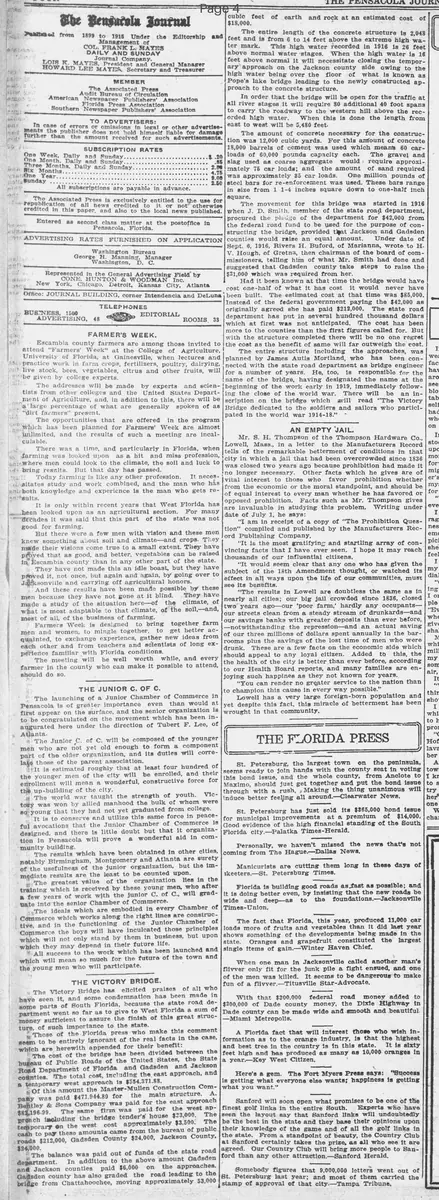
The Victory Bridge has elicited praises of all who have seen it, and some condemnation has been made in some parts of South Florida, because the state road department went so far as to give to West Florida a sum of money sufficient to assure the finish of this great structure, of such importance to the state.
Those of the Florida press who make this comment seem to be entirely ignorant of the real facts in the case, which are herewith appended for their benefit:
The cost of the bridge has been divided between the State Road Department of Florida and Gadsden and Jackson counties. The total cost, including the east approach, and a temporary west approach is $554,371.88.
Of this amount the Master-Mullen Construction Company was paid $471,944.89 for the main structure. A. Bentley & Sons Company was paid for the east approach $82,196.99. The same firm was paid for the west approach including the bridge tender's house $23,000. The temporary on the west cost approximately $3,500.
The balance was paid out of funds of the state road department. In addition to the above amount Gadsden county roads $212,000, Gadsden County $24,000, Jackson County, $24,000.
The cash to pay these amounts came from the bureau of public roads department. Gadsden and Jackson counties paid $6,000 on the approaches.
Gadsden county has also graded the road leading to the bridge from Chattahoochee, moving approximately 53,000 cubic feet of earth and rock at an estimated cost of $18,000.
The entire length of the concrete structure is 2,048 feet and is from 6 to 14 feet above the extreme high water mark. This high water recorded in 1916 is 26 feet above normal water stages. When the high water is 16 feet above normal it will necessitate closing the temporary approach on the Jackson county side owing to the high water being over the floor of what is known as Pope's lake bridge leading to the newly constructed approach to the concrete structure.
In order that the bridge will be open for the traffic at all river stages it will require 80 additional 40 foot spans to carry the roadway to the western hill above the recorded high water. When this is done the length from east to west will be 5,480 feet.
The amount of concrete necessary for the construction was 12,000 cubic yards. For this amount of concrete 18,000 barrels of cement was used which means 60 carloads of 60,000 pounds capacity each. The gravel and slag used as coarse aggregate would require approximately 75 car loads; and the amount of sand required was approximately 85 car loads.
One million pounds of steel bars for re-enforcement was used. These bars range in size from 1 1-4 inches square down to one-half inch square.
The movement for this bridge was started in 1916 when J. D. Smith, member of the state road department, procured the pledge of the department for $42,000 from the federal road fund to be used for the purpose of constructing the bridge, provided that Jackson and Gadsden counties would raise an equal amount.
Under date of Sept. 6, 1916, Rivers H. Buford, of Marianna, wrote to H. V. Hough, of Gretna, then chairman of the board of commissioners, telling him of what Mr. Smith had done and suggested that Gadsden county take steps to raise the $21,000 which was required from her.
Had it been known at that time the bridge would have cost one-half of what it has cost it would never have been built. The estimated cost at that time was $85,000.
Instead of the federal government paying the $42,000 as originally agreed she has paid $212,000. The state road department has put in several hundred thousand dollars which at first was not anticipated. The cost has been more to the counties than the first figures called for. But with the structure completed there will be no one regret the cost as the benefit of same will far outweigh the cost.
The entire structure including the approaches, was planned by James Autis Mortland, who has been connected with the state road department as bridge engineer for a number of years. He, too, is responsible for the name of the bridge, having designated the name at the beginning of the work early in 1919, immediately following the close of the world war.
There will be an inscription on the bridge which will read "The Victory Bridge dedicated to the soldiers and sailors who participated in the world war 1914-18."
What sub-type of article is it?
What themes does it cover?
What keywords are associated?
What entities or persons were involved?
Where did it happen?
Story Details
Key Persons
Location
Gadsden And Jackson Counties, West Florida
Event Date
1916 1919
Story Details
The Victory Bridge was constructed over the river between Gadsden and Jackson counties in Florida, with costs shared by the state road department, counties, and federal funds. Initiated in 1916 with an initial estimate of $85,000, the final cost exceeded $554,000 due to expanded scope. The bridge, named in 1919 to honor World War participants, spans 2,048 feet of concrete structure, with plans for additional approaches to handle high water.