Thank you for visiting SNEWPapers!
Sign up free
The Augusta Courier
Augusta, Richmond County, Georgia
What is this article about?
Roy V. Harris analyzes Tennessee's recent primary elections, critiquing Prentice Cooper's Senate loss to Albert Gore due to strategic errors and TVA opposition, while hailing Buford Ellington's gubernatorial win as a pro-segregation victory, urging Southern states to resist school integration.
Merged-components note: Merged multi-page continuation of the 'STRICTLY PERSONAL' editorial column by Roy V. Harris; one segment was originally labeled as story.
Clippings
1 of 3
OCR Quality
Full Text
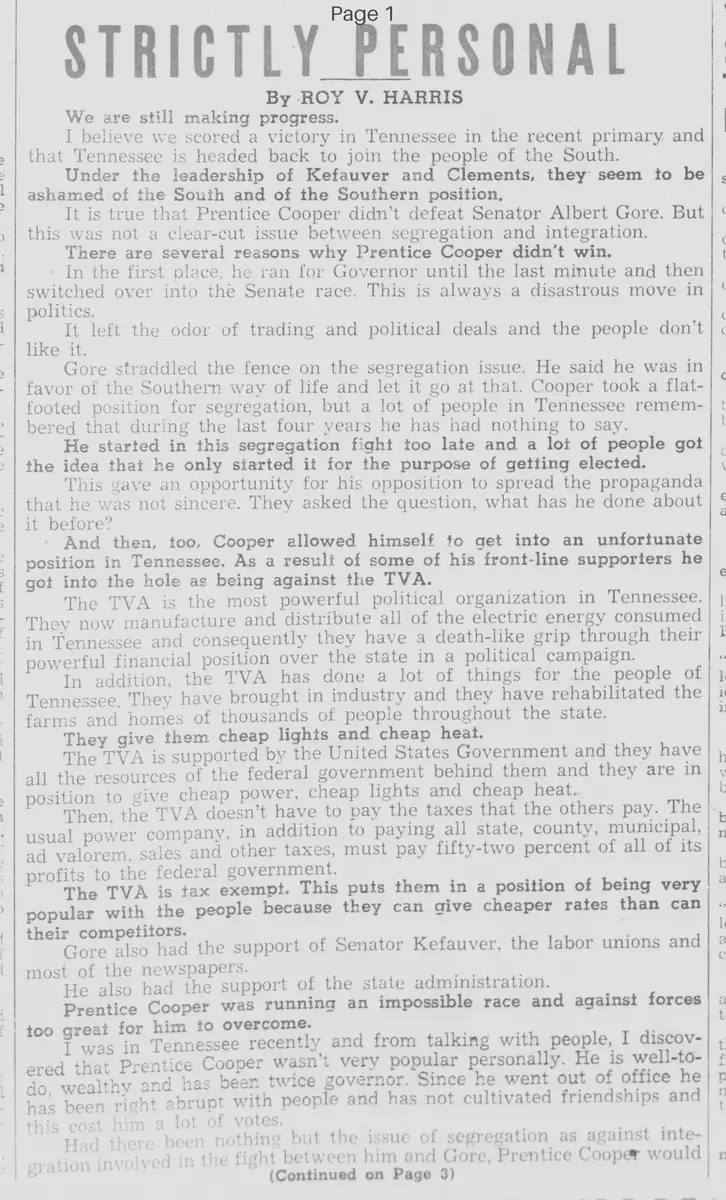
By ROY V. HARRIS
We are still making progress.
I believe we scored a victory in Tennessee in the recent primary and that Tennessee is headed back to join the people of the South.
Under the leadership of Kefauver and Clements, they seem to be ashamed of the South and of the Southern position.
It is true that Prentice Cooper didn't defeat Senator Albert Gore. But this was not a clear-cut issue between segregation and integration.
There are several reasons why Prentice Cooper didn't win.
In the first place, he ran for Governor until the last minute and then switched over into the Senate race. This is always a disastrous move in politics.
It left the odor of trading and political deals and the people don't like it.
Gore straddled the fence on the segregation issue. He said he was in favor of the Southern way of life and let it go at that. Cooper took a flat-footed position for segregation, but a lot of people in Tennessee remembered that during the last four years he has had nothing to say.
He started in this segregation fight too late and a lot of people got the idea that he only started it for the purpose of getting elected.
This gave an opportunity for his opposition to spread the propaganda that he was not sincere. They asked the question, what has he done about it before?
And then, too, Cooper allowed himself to get into an unfortunate position in Tennessee. As a result of some of his front-line supporters he got into the hole as being against the TVA.
The TVA is the most powerful political organization in Tennessee.
They now manufacture and distribute all of the electric energy consumed in Tennessee and consequently they have a death-like grip through their powerful financial position over the state in a political campaign.
In addition, the TVA has done a lot of things for the people of Tennessee. They have brought in industry and they have rehabilitated the farms and homes of thousands of people throughout the state.
The TVA is supported by the United States Government and they have all the resources of the federal government behind them and they are in position to give cheap power, cheap lights and cheap heat.
They give them cheap lights and cheap heat.
Then, the TVA doesn't have to pay the taxes that the others pay. The usual power company, in addition to paying all state, county, municipal, ad valorem, sales and other taxes, must pay fifty-two percent of all of its profits to the federal government.
The TVA is tax exempt. This puts them in a position of being very popular with the people because they can give cheaper rates than can their competitors.
Gore also had the support of Senator Kefauver, the labor unions and most of the newspapers.
He also had the support of the state administration.
Prentice Cooper was running an impossible race and against forces too great for him to overcome.
I was in Tennessee recently and from talking with people, I discovered that Prentice Cooper wasn't very popular personally. He is well-to-do, wealthy and has been twice governor. Since he went out of office he has been right abrupt with people and has not cultivated friendships and this cost him a lot of votes.
Had there been nothing but the issue of segregation as against integration involved in the fight between him and Gore, Prentice Cooper would have been elected.
We say that because of the results in the governor's race.
The governor's race was won by Buford Ellington.
Ellington is a former commissioner of agriculture in Tennessee. He also managed Governor Frank Clements' campaign when he was elected governor.
Ellington ran as "an old-fashioned segregationist" with Clements' support.
There were several candidates for governor, but there were four that were in the running.
He promised to close any integrated school.
There were only ten thousand votes between the top man and the third man and it was an awfully close race. Edmond Orgill, Mayor of Memphis, was Kefauver's candidate on a Kefauver-type of platform. Ellington ran with Clements' blessing. Judge Tip Taylor ran on his own and he ran on a segregation ticket.
So, there were two out-spoken segregation candidates in the race.
These two received more than sixty percent of the votes cast. And the segregationists were divided between the two.
Ellington and Taylor received approximately thirty percent of the vote each and Kefauver's man received about thirty percent. The balance of the votes were spread between the other candidates.
It is my opinion that if the issue had been made squarely between one good candidate on the segregation side and against the Memphis Mayor on the other, that the vote in Tennessee would have been approximately two to one for the segregation candidate.
Frank Clements was a handicap to Ellington and Ellington had an awful time being elected with Frank Clements hung around his neck.
On a recent trip to Tennessee since the election, I interviewed several people who were strong in the segregation fight. Most of the segregationists in the Nashville area voted for Ellington.
I asked them why they chose Ellington over Taylor. They stated to me that they liked the way Ellington talked. He seemed more sincere and
they had confidence that he would go the limit to keep race mixing out of the schools in Tennessee.
He carried the same appeal to a lot of segregationists.
They tell me, privately, that Ellington has promised them to go the limit to keep segregation in Tennessee.
They believe he is going to do so.
Ellington has some good friends in Georgia. Some of them are very close to Ellington. These close friends are friends of mine and they have assured me all during the campaign that Ellington will stand pat and fight it out to the last ditch.
I have talked with them again since the election and they are absolutely confident that Ellington, when he becomes Governor, will do everything in his power to preserve segregation and that he will work with the governors in the rest of the states who are determined to keep the evil influence of race mixing out of our schools.
They tell me that Ellington has assured them that he will do so.
From talking with his friends in Tennessee, and in Georgia, I am confident that he will do so.
I am convinced that he will be different from Frank Clements. Instead of using the National Guard and the Highway Patrol to put Negroes in white schools as Clements did at Clinton, Tennessee, and at Nashville, I believe that Ellington will use them to keep them out.
In some of his speeches, Ellington made the statement that he will close any integrated school in case of violence. You and I know there will be violence in any integrated school unless the school is protected by the police, the highway patrol or the national guard.
If he stands by this statement it will be necessary for him to either protect the schools and keep the Negroes out or to close them after they get in. Of course, it would be much better if Ellington would keep them out instead of closing the school after they get in.
It looks as if we have won a victory in the governor's race in Tennessee. It looks as if we have a governor on whom we can depend.
It is beginning to look as if Tennessee has once again decided to be a part of the South and to join in the Southern crusade to keep the evils of race mixing out of our public schools.
The people of Tennessee are anxious to keep integration out. They know the evils of race mixing. They have been reading the newspapers about the rapes, the murders and the beatings in the schoolhouses and on the schoolgrounds in Brooklyn.
They know that the same conditions would exist here. They know that race mixing in the City of Nashville or any other city in Tennessee would destroy that city and destroy the greatness of a great state.
It is going to take courageous action to save this situation.
Our ultimate aim is to sell our cause to the people of the nation and convince them that the segregated way of life is the Christian way, that it is the American way and that it is constitutional.
It is going to take time to do this. Public sentiment doesn't change overnight and it takes a long time for the truth to seep into the minds of the people.
People are very gullible and they usually fall for some high-sounding scheme that travels under such names as brotherhood and Christianity.
More frauds have been worked under the guise of great movements than any other way.
In the meantime, we have got to hold the line. In the meantime, we must resist race mixing.
To do this, we must have governors in every state who are willing to resist and who are willing to keep race mixing out of our public schools.
In 1954 we started off with only two governors in the South who would stand pat.
Next year, we will have Governors in Virginia, South Carolina, Alabama, Arkansas and Tennessee who will stand pat.
We have got to elect similar governors in North Carolina, Florida, Mississippi and Louisiana.
This can be done in the next two years if the people of these states will get busy now and will run a good man on a segregation ticket and fight it out on this issue and this issue alone.
It is hoped that Governor Daniel, of Texas, will finally decide to join us wholeheartedly.
When this is done, we might even be able to have some success in states like Kentucky.
But it needs to be done and if the people of these states want to ward off the "blessings" of Brooklyn, they had better get busy.
These weasels that we have had in some of the states occupying the governor's office will lead them down the road of moderation to gradual race mixing.
But we are making progress. We are staving off the slimy evil of race mixing and some of these days we are going to reverse and set aside the Supreme Court decision.
What sub-type of article is it?
What keywords are associated?
What entities or persons were involved?
Editorial Details
Primary Topic
Tennessee Primaries And Segregation In Southern Politics
Stance / Tone
Pro Segregation Advocacy And Optimism For Southern Resistance To Integration
Key Figures
Key Arguments