Thank you for visiting SNEWPapers!
Sign up free
Editorial
February 6, 1959
Newport Navalog
Newport, Newport County, Rhode Island
What is this article about?
Chaplain Ross H. Trower reflects on a TV story by Ernie Kovacs about a man impersonating a doctor using a stethoscope as a symbol of authority. He questions the integrity of wearing rightful symbols of authority and urges examining ultimate authority in religion, suggesting a Lenten exercise to prioritize God over money, position, or fame, referencing Jesus' authoritative teaching.
Clipping
OCR Quality
98%
Excellent
Full Text
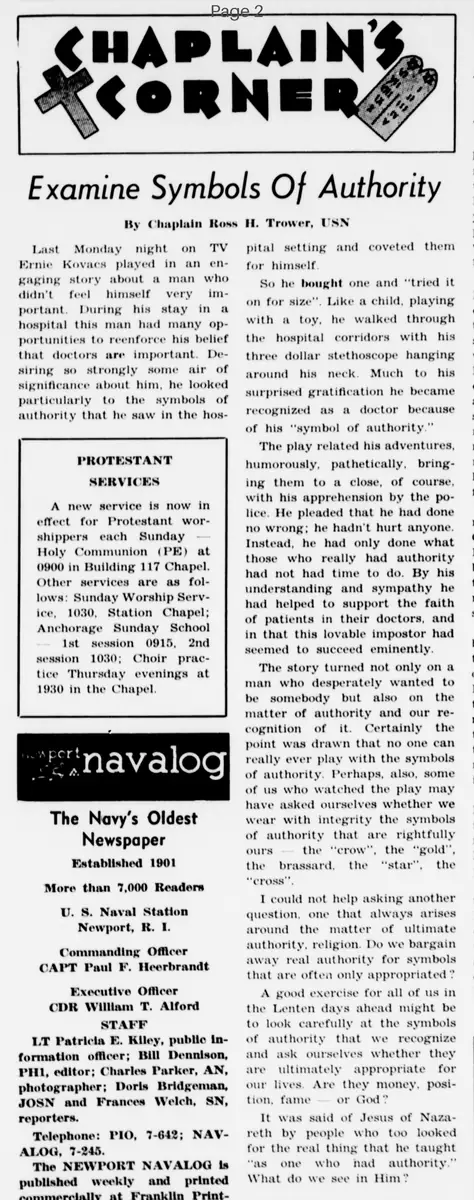
SHARLIN Examine Symbols Of Authority
By Chaplain Ross H. Trower, USN
Last Monday night on TV Ernie Kovacs played in an engaging story about a man who didn't feel himself very important. During his stay in a hospital this man had many opportunities to reenforce his belief that doctors are important. Desiring so strongly some air of significance about him, he looked particularly to the symbols of authority that he saw in the hospital setting and coveted them for himself.
So he bought one and "tried it on for size". Like a child, playing with a toy, he walked through the hospital corridors with his three dollar stethoscope hanging around his neck. Much to his surprised gratification he became recognized as a doctor because of his "symbol of authority."
The play related his adventures, humorously, pathetically, bringing them to a close, of course, with his apprehension by the police. He pleaded that he had done no wrong: he hadn't hurt anyone. Instead, he had only done what those who really had authority had not had time to do. By his understanding and sympathy he had helped to support the faith of patients in their doctors, and in that this lovable impostor had seemed to succeed eminently.
The story turned not only on a man who desperately wanted to be somebody but also on the matter of authority and our recognition of it. Certainly the point was drawn that no one can really ever play with the symbols of authority. Perhaps, also, some of us who watched the play may have asked ourselves whether we wear with integrity the symbols of authority that are rightfully ours the "crow", the "gold", the brassard, the "star", the "cross".
I could not help asking another question, one that always arises around the matter of ultimate authority, religion. Do we bargain away real authority for symbols that are often only appropriated?
A good exercise for all of us in the Lenten days ahead might be to look carefully at the symbols of authority that we recognize and ask ourselves whether they are ultimately appropriate for our lives. Are they money, position, fame or God?
It was said of Jesus of Nazareth by people who too looked for the real thing that he taught "as one who had authority."
What do we see in Him?
By Chaplain Ross H. Trower, USN
Last Monday night on TV Ernie Kovacs played in an engaging story about a man who didn't feel himself very important. During his stay in a hospital this man had many opportunities to reenforce his belief that doctors are important. Desiring so strongly some air of significance about him, he looked particularly to the symbols of authority that he saw in the hospital setting and coveted them for himself.
So he bought one and "tried it on for size". Like a child, playing with a toy, he walked through the hospital corridors with his three dollar stethoscope hanging around his neck. Much to his surprised gratification he became recognized as a doctor because of his "symbol of authority."
The play related his adventures, humorously, pathetically, bringing them to a close, of course, with his apprehension by the police. He pleaded that he had done no wrong: he hadn't hurt anyone. Instead, he had only done what those who really had authority had not had time to do. By his understanding and sympathy he had helped to support the faith of patients in their doctors, and in that this lovable impostor had seemed to succeed eminently.
The story turned not only on a man who desperately wanted to be somebody but also on the matter of authority and our recognition of it. Certainly the point was drawn that no one can really ever play with the symbols of authority. Perhaps, also, some of us who watched the play may have asked ourselves whether we wear with integrity the symbols of authority that are rightfully ours the "crow", the "gold", the brassard, the "star", the "cross".
I could not help asking another question, one that always arises around the matter of ultimate authority, religion. Do we bargain away real authority for symbols that are often only appropriated?
A good exercise for all of us in the Lenten days ahead might be to look carefully at the symbols of authority that we recognize and ask ourselves whether they are ultimately appropriate for our lives. Are they money, position, fame or God?
It was said of Jesus of Nazareth by people who too looked for the real thing that he taught "as one who had authority."
What do we see in Him?
What sub-type of article is it?
Moral Or Religious
What keywords are associated?
Symbols Of Authority
Ultimate Authority
Religion
Lent
Integrity
Jesus
Impersonation
What entities or persons were involved?
Ernie Kovacs
Jesus Of Nazareth
Chaplain Ross H. Trower
Editorial Details
Primary Topic
Examining Symbols Of Authority And Ultimate Religious Authority
Stance / Tone
Reflective Moral Exhortation
Key Figures
Ernie Kovacs
Jesus Of Nazareth
Chaplain Ross H. Trower
Key Arguments
No One Can Truly Play With Symbols Of Authority Without Consequences
Wear Symbols Of Authority With Integrity
Examine Ultimate Authority In Religion During Lent
Prioritize God Over Money, Position, Or Fame
Jesus Taught With Real Authority