Thank you for visiting SNEWPapers!
Sign up free
Story
May 17, 1842
The Daily Madisonian
Washington, District Of Columbia
What is this article about?
The Philadelphia American Sentinel responds to criticism from the United States Gazette regarding President Tyler's veto of the second Bank bill, defending him against charges of deception and noting how the Whig party feud has weakened their position while strengthening opponents.
Clipping
OCR Quality
98%
Excellent
Full Text
From the Philadelphia American Sentinel
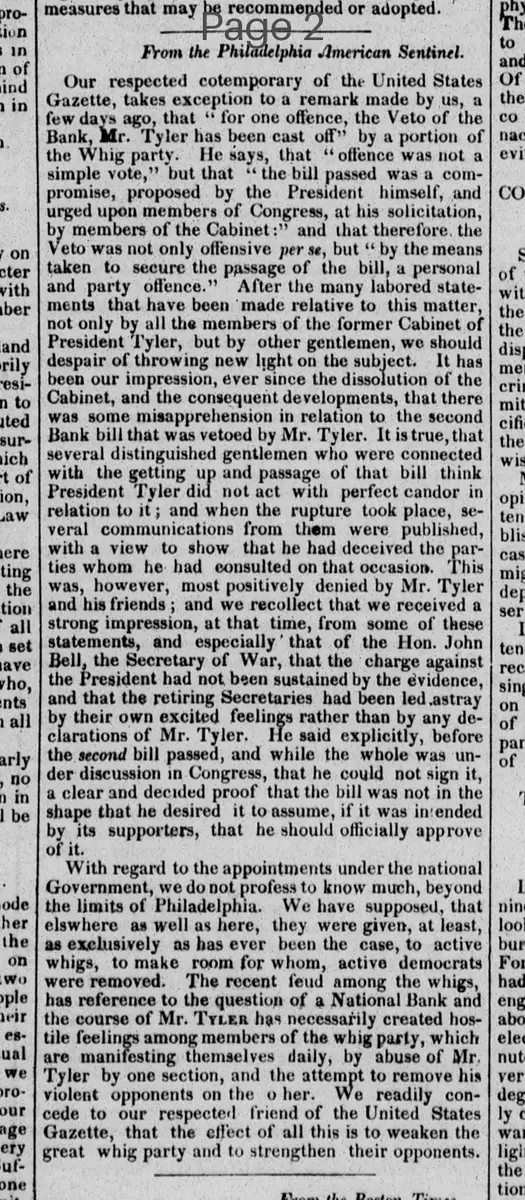
Our respected cotemporary of the United States Gazette, takes exception to a remark made by us, a few days ago, that "for one offence, the Veto of the Bank, Mr. Tyler has been cast off" by a portion of the Whig party. He says, that "offence was not a simple vote," but that "the bill passed was a compromise, proposed by the President himself, and urged upon members of Congress, at his solicitation, by members of the Cabinet:" and that therefore, the Veto was not only offensive per se, but "by the means taken to secure the passage of the bill, a personal and party offence." "After the many labored statements that have been made relative to this matter, not only by all the members of the former Cabinet of President Tyler, but by other gentlemen, we should despair of throwing new light on the subject. It has been our impression, ever since the dissolution of the Cabinet, and the consequent developments, that there was some misapprehension in relation to the second Bank bill that was vetoed by Mr. Tyler. It is true, that several distinguished gentlemen who were connected with the getting up and passage of that bill think President Tyler did not act with perfect candor in relation to it; and when the rupture took place, several communications from them were published, with a view to show that he had deceived the parties whom he had consulted on that occasion. This was, however, most positively denied by Mr. Tyler and his friends; and we recollect that we received a strong impression, at that time, from some of these statements, and especially that of the Hon. John Bell, the Secretary of War, that the charge against the President had not been sustained by the evidence, and that the retiring Secretaries had been led astray by their own excited feelings rather than by any declarations of Mr. Tyler. He said explicitly, before the second bill passed, and while the whole was under discussion in Congress, that he could not sign it, a clear and decided proof that the bill was not in the shape that he desired it to assume, if it was intended by its supporters, that he should officially approve of it.
With regard to the appointments under the national Government, we do not profess to know much, beyond the limits of Philadelphia. We have supposed, that elsewhere as well as here, they were given, at least, as exclusively as has ever been the case, to active whigs, to make room for whom, active democrats were removed. The recent feud among the whigs, has reference to the question of a National Bank and the course of Mr. Tyler has necessarily created hostile feelings among members of the whig party, which are manifesting themselves daily, by abuse of Mr. Tyler by one section, and the attempt to remove his violent opponents on the other. We readily concede to our respected friend of the United States Gazette, that the effect of all this is to weaken the great whig party and to strengthen their opponents.
Our respected cotemporary of the United States Gazette, takes exception to a remark made by us, a few days ago, that "for one offence, the Veto of the Bank, Mr. Tyler has been cast off" by a portion of the Whig party. He says, that "offence was not a simple vote," but that "the bill passed was a compromise, proposed by the President himself, and urged upon members of Congress, at his solicitation, by members of the Cabinet:" and that therefore, the Veto was not only offensive per se, but "by the means taken to secure the passage of the bill, a personal and party offence." "After the many labored statements that have been made relative to this matter, not only by all the members of the former Cabinet of President Tyler, but by other gentlemen, we should despair of throwing new light on the subject. It has been our impression, ever since the dissolution of the Cabinet, and the consequent developments, that there was some misapprehension in relation to the second Bank bill that was vetoed by Mr. Tyler. It is true, that several distinguished gentlemen who were connected with the getting up and passage of that bill think President Tyler did not act with perfect candor in relation to it; and when the rupture took place, several communications from them were published, with a view to show that he had deceived the parties whom he had consulted on that occasion. This was, however, most positively denied by Mr. Tyler and his friends; and we recollect that we received a strong impression, at that time, from some of these statements, and especially that of the Hon. John Bell, the Secretary of War, that the charge against the President had not been sustained by the evidence, and that the retiring Secretaries had been led astray by their own excited feelings rather than by any declarations of Mr. Tyler. He said explicitly, before the second bill passed, and while the whole was under discussion in Congress, that he could not sign it, a clear and decided proof that the bill was not in the shape that he desired it to assume, if it was intended by its supporters, that he should officially approve of it.
With regard to the appointments under the national Government, we do not profess to know much, beyond the limits of Philadelphia. We have supposed, that elsewhere as well as here, they were given, at least, as exclusively as has ever been the case, to active whigs, to make room for whom, active democrats were removed. The recent feud among the whigs, has reference to the question of a National Bank and the course of Mr. Tyler has necessarily created hostile feelings among members of the whig party, which are manifesting themselves daily, by abuse of Mr. Tyler by one section, and the attempt to remove his violent opponents on the other. We readily concede to our respected friend of the United States Gazette, that the effect of all this is to weaken the great whig party and to strengthen their opponents.
What sub-type of article is it?
Historical Event
What themes does it cover?
Deception
Betrayal
Fortune Reversal
What keywords are associated?
Tyler Veto
Bank Bill
Whig Party
Cabinet Dissolution
Political Deception
National Bank
What entities or persons were involved?
Mr. Tyler
Hon. John Bell
President Tyler
Where did it happen?
Philadelphia
Story Details
Key Persons
Mr. Tyler
Hon. John Bell
President Tyler
Location
Philadelphia
Story Details
The Sentinel defends Tyler's veto of the second Bank bill against claims of deception by former Cabinet members, citing statements from John Bell and arguing the veto was anticipated; discusses Whig party divisions over the bank and appointments weakening the party.