Thank you for visiting SNEWPapers!
Sign up free
Constitutional Whig
Richmond, Virginia
What is this article about?
Series of 1823 documents from engineers and commissioners discussing challenges and recommendations for the James and Jackson's River Canal project in Virginia, including issues with Tuckahoe Creek, river locking at Ball's Sluice, water supply needs, and insights from the New York Erie Canal experience on feeders, embankments, locks, and costs.
Clipping
OCR Quality
Full Text
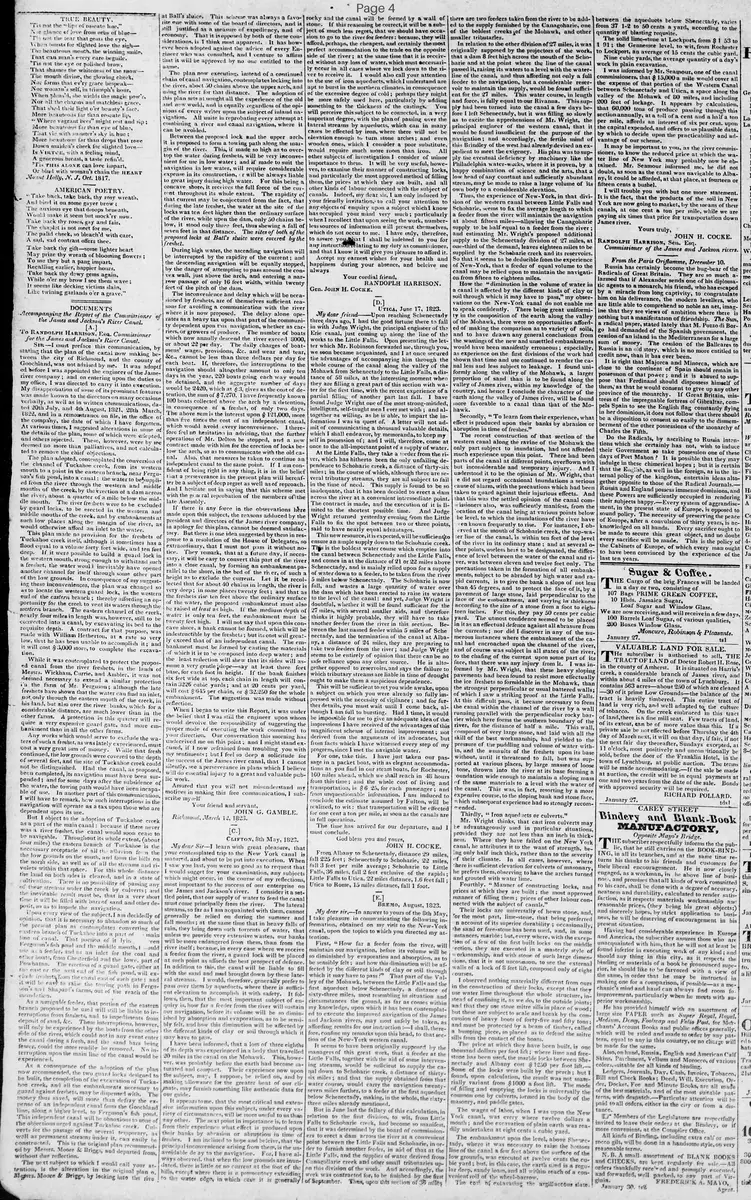
Accompanying the Report of the Commissioner of the James and Jackson's River Canal.
[A.]
To Randolph Harrison, Esq. Commissioner for the James and Jackson's River Canal.
SIR—I must preface this communication, by stating that the plan of the canal now making between the city of Richmond, and the county of Goochland, was not advised by me. It was adopted before I was appointed the engineer of the James River company; and on entering upon the duties of my office, I was directed to carry it into execution. My disapprobation of some of its prominent features was made known to the directors on many occasions verbally, as well as in written communications, dated 20th July, and 4th August, 1821, 28th March, 1822, and in a remonstrance on file, in the office of the company, the date of which I have forgotten. At various times, I suggested alterations in some of the details of the plan, some of which were adopted, and others rejected. These, however, were by no means deemed more than palliatives, and not calculated to remove the chief objections.
The plan adopted, contemplated the conversion of the channel of Tuckahoe creek, from its western mouth to a point in the eastern branch, near Ferguson's fish pond, into a canal : the water to be supplied from the river through the western and middle mouths of the creek, by the erection of a dam across the river, about a quarter of a mile below the middle mouth. The river freshets were to be excluded by guard locks, to be erected in the western and middle mouths of the creek, and by embankments at such low places along the margin of the river, as would otherwise afford an inlet to the water. This plan made no provision for the freshets of Tuckahoe creek itself, although it sometimes has a flood equal to a volume forty feet wide, and ten feet deep. If it were possible to build a guard lock in the western mouth, strong enough to withstand such a freshet, the water would inevitably have opened another channel for itself through some other part of the low grounds. In consequence of my suggesting these inconveniences, the plan was changed so as to locate the western guard lock, in the western end of the eastern branch; thereby affording an opportunity for the creek to vent its waters through the western branch. The eastern channel of the creek, nearly four miles in length was, however, still to be converted into a canal, by excavating its bed to the requisite depth. A contract for that purpose, was made with William Hetherton, at a rate so very low, that he has been unable to accomplish it; and it will cost $3,000 more, to complete the excavation.
While it was contemplated to protect the proposed canal from the river freshets, in the lands of Messrs. Wickham, Currie, and Ambler, it was not deemed necessary to extend a similar protection in the farm of Mr. Ferguson; although the late freshets have shown that the water can find an inlet, not only through the eastern mouth of the creek, in his land, but also over the river banks, which for a considerable distance, are much lower than in the other farms. A protection in this quarter will require a very expensive guard gate, and more embankment than in all the other farms. Any works which would serve to exclude the waters of such a freshet, as was lately experienced, must cost a very great sum of money. While that fresh continued, the low grounds were covered to the depth of several feet, and the site of Tuckahoe creek could not be distinguished. Had the canal, as proposed, been completed, its navigation must have been suspended; and for some days after the subsidence of the water, the towing path would have been incapable of use. In another part of this communication, I will have to remark, how such interruptions in the navigation will operate as a tax upon those who are dependent upon its use.
But I object to the adoption of Tuckahoe creek as a part of the main canal : because if there never was a river freshet, the canal would soon cease to be navigable. Throughout its whole extent, (about four miles) the eastern branch of Tuckahoe is the necessary receptacle of all the alluvion from the low grounds on the south, and from the hills on the north side, as well as of all the streams and rivulets within that space. For this whole distance the land on both sides is cleared, and in a state of cultivation. There is no possibility of passing any of these streams under the creek by culverts; and the inevitable result must be, that in a very short time it will be filled with bars of sand and other deposit, so as to impede the navigation.
Upon every view of the subject, I am decidedly of opinion, that it is necessary to abandon so much of the present plan as contemplates converting the eastern branch of Tuckahoe into a part of main line of canal. That portion of it lying between Ferguson's fish pond and the middle mouth, I should use as a feeder, and as an inlet for the coal and other boats, from Chesterfield and the lower part of Powhatan. The erection of a guard gate, either at the east or the west end of the fish pond, will exclude freshets from the canal east of such gate; and it will be easy to raise the towing path in Ferguson's and Shepard's farms, out of the reach of the inundation.
As a navigable feeder, that portion of the eastern branch proposed to be used will still be liable to interruptions from freshets, and to impediments from deposit of sand, &c. These interruptions, however, will only be experienced by the boats from the other side of the river, which could not in any event enter the canal during a fresh, and the sand bars being fewer, could the more readily be removed. No interruption upon the main line of the canal would be experienced.
As a consequence of the adoption of the plan now recommended, the two guard locks designed to be built, the completion of the excavation of Tuckahoe creek, and all the embankments necessary to guard against freshets, may be dispensed with. The money thus saved, will more than defray the expense of an independent canal from the Goochland line, along a higher level, to Ferguson's fish pond. This independent canal will be obnoxious to none of the objections urged against Tuckahoe creek. Culverts for the passage of the several temporary, as well as permanent streams under it, can easily be constructed. This is the original plan recommended by Messrs. Moore & Briggs, and departed from, without due reflection.
The next subject to which I would call your attention, is the alteration in the original plan of Messrs. Moore & Briggs, by locking into the river at Ball's sluice. This scheme was always a favorite one with some of the board of directors, and is still justified as a measure of expediency, and of economy. That it is opposed by both of these considerations, is I think most apparent. -It has however been adopted against the advice of every Engineer who was consulted, and I venture to affirm that it will be approved by no one entitled to the name.
The plan now executing, instead of a continued chain of canal navigation, contemplates locking into the river, about 50 chains above the upper arch, and using the river for that distance. The adoption of this plan sets at nought all the experience of the old and new world, and is equally regardless of the opinions of every writer upon the subject of inland navigation. All unite in reprobating every attempt at combining a river and canal navigation, where it can be avoided.
Between the proposed lock and the upper arch, it is proposed to form a towing path along the margin of the river. This, if made so high as to overtop the water during freshets, will be very inconvenient for use in low water; and if made to suit the navigation in low water, will require considerable expense in its construction, will be always liable to great injury during high water. For this being a concave shore, it receives the full force of the current throughout its whole extent. The rapidity of that current may be conjectured from the fact, that during the late freshet, the water at the site of the locks was ten feet higher than the ordinary surface of the river, while upon the dam, only 50 chains below, it stood only three feet, thus shewing a fall of seven feet in that distance. The sites of both of the proposed locks at Ball's sluice were covered by the freshet.
During high water, the ascending navigation will be interrupted by the rapidity of the current; and the descending navigation will be equally stopped, by the danger of attempting to pass around the convex wall, just above the arch, and entering a narrow passage of only 16 feet width, within twenty feet of the pitch of the dam.
The inconvenience and delay which will be occasioned by freshets, are of themselves sufficient reasons for avoiding a communication with the river where it is now proposed. The delay alone operates as a heavy tax upon that part of the community dependent upon this navigation, whether as carriers, or growers of produce. The number of boats which now annually descend the river exceed 5000, or about 22 per day. The daily charges of boatmen's wages, provisions, &c. and wear and tear, &c., cannot be less than three dollars per day for each boat. If, therefore, the interruptions to the navigation should altogether amount to only ten days in the year, 220 boats going each way would be detained, and the aggregate number of days would be 2420, which at $3, gives as the cost of detention, the sum of $ 7,260. I have frequently known 100 boats collected above the arch by a detention, in consequence of a freshet, of only two days. The above sum is the interest upon $121,000, more than five times the cost of an independent canal, which would avoid every inconvenience. I therefore feel no hesitation in advising, that the further operations of Mr. Dalton be stopped, and a new contract made with him for the erection of locks below the arch, so as to communicate with the old canal. Also, that measures be taken to continue an independent canal to the same point. If I am confident of being right in any thing, it is in the belief that a perseverance in the present plan will hereafter be a subject of deep regret as well as of reproach. And I hesitate not in saying that this scheme met with the general reprobation of the members of the late Assembly.
If there is any force in the observations here made upon this subject, the reasons adduced by the president and directors of the James river company, in apology for this plan, cannot be deemed satisfactory. But there is one idea suggested by them in response to a resolution of the House of Delegates, so extraordinary, that I must not pass it without notice. They remark, that at a future day, if necessary, it will be easy to convert this part of the river into a close canal, by forming an embankment parallel to the shore, in the bed of the river, of such a height as to exclude the current. Let it be recollected that for about 40 chains in length, the river is very deep; in some places twenty feet; and that as the freshets rise ten feet above the ordinary surface of the water, the proposed embankment must also be raised at least as high. If the medium depth of water is only ten feet, the embankment must be twenty feet high. I will not say that upon this concave shore, a bank cannot be formed, which will be indestructible by the freshets; but its cost will greatly exceed that of an independent canal. The embankment must be formed by casting the materials of which it is to be composed into deep water; and the least reflection will shew that its sides will assume a very gentle slope-say at least three feet base, or each foot in height. If the bank finishes six feet wide at top, each chain in length will contain 3226 cubic yards; and at 20 cents per yard, will cost $645 per chain, or $32,250 for the whole embankment.
The suggestion was made without reflection.
When I began to write this Report, it was under the belief that I was still the engineer upon whom would devolve the responsibility of suggesting the proper mode of executing the work committed to your direction. Our conversation this morning has undeceived me on this point; and I might stand excused, if I now refrained from troubling you with my sentiments; but I feel so deep a solicitude for the success of the James river canal, that I cannot silently, see a perseverance in plans which I believe will do essential injury to a great and valuable public work.
Assured that you will not misunderstand my motives in making this free communication, I subscribe myself
Your friend and servant,
JOHN G. GAMBLE.
Richmond, March 12, 1823.
[C.]
CLIFTON, 8th May, 1823.
My dear Sir—I learn with great pleasure, that your contemplated trip to the New York canal is matured, and about to be put into execution. When I saw you last, you were so good as to request that I would suggest for your examination, any subjects which might occur, in the course of my reflections, most important to the success of our enterprise on the James and Jackson's river. I consider it a settled point, that our supply of water to feed the canal must come principally from the river. The lateral streams, so far as I am acquainted with them, cannot generally be relied on during the summer and fall months; at the same time that in heavy falls of rain, they bring down such torrents of water, that unless we provide very extensive wastes, our banks will be more endangered from them, than from the river itself; because, in every case where we receive a feeder from the river, a guard lock will be placed at such point as affords the best prospect of defence. In addition to this, the canal will be liable to fill with the sand and mud brought down by these lateral streams. I would, therefore, generally prefer to pass over them by aqueducts, where there is sufficient elevation to accomplish it with safety. It follows, then, that the most important subject of enquiry is, how far a feeder from the river will sustain our navigation, before its volume will be so diminished by absorption and evaporation, as to be sensibly felt, and how this diminution will be affected by the different kinds of clay or soil through which it may have to pass.
I have been informed, that a loss of three eighths of its depth was experienced in a body that travelled 20 miles in the canal on the Mohawk. This, however, was probably before the earth had become saturated and compact. Their experience now upon the subject, may, I suppose, be relied on, and by making allowance for the greater heat of our climate, may furnish something like authentic data for our guide.
It appears to me, that the most critical and extensive information upon this subject, under every variety of circumstances, will be more useful to us than any other. The next point in importance is, to learn from their experience what effect is produced upon their banks by abrasion or abruption in time of freshes. I am inclined to hope and believe, that the principal inconvenience arising from them, is the unavoidable delay to the navigation. For, I have always observed, that when the low grounds are inundated, there is little or no current at the foot of the hills, except where there is a promontory extending to the water edge, in which case it is generally rocky and the canal will be formed by a wall of stone. If this reasoning be correct, it will be a subject of much less regret, that we should have occasion to go to the river for feeders: because, they will afford, perhaps, the cheapest, and certainly the most perfect accommodation to the trade on the opposite side of the river; at the same time that it is received without any loss of water, which must necessarily occur in all cases where we lock down to the river to receive it. I would also call your attention to the use of iron aqueducts, which I understand are apt to burst in the northern climates, in consequence of the excessive degree of cold; perhaps they might be more safely used here, particularly by adding something to the thickness of the castings. You will perceive this subject to be connected, in a very important degree, with the plan of passing over the lateral streams by aqueducts, which can in many cases be effected by iron, where there will not be elevation enough to turn stone arches; and even wooden ones, which I consider a poor substitute, would require much more room than iron. All other subjects of investigation I consider of minor importance to them. It will be very useful, however, to examine their manner of constructing locks, and particularly the most approved method of filling them, the prices at which they are built, and all other kinds of labour connected with the subject of canals. Indeed, my dear sir, I am only induced by your friendly invitation, to call your attention to any objects of enquiry upon a subject which I know has occupied your mind very much; particularly when I recollect that upon seeing the work, numberless sources of information will present themselves, which do not occur to me. I have only, therefore, to assure you, that I shall be indebted to you for any instruction relating to my duty as commissioner, and that I know it will give you pleasure to afford it.
Accept my earnest wishes for your health and happiness during your absence, and believe me always
Your cordial friend,
RANDOLPH HARRISON.
Gen. John H. Cocke.
[D.]
Utica, June 17, 1823.
My dear friend--Upon reaching Schenectady three days ago, I had the good fortune there to fall in with Judge Wright, the principal engineer of the Erie canal, just coming up along the line of the works to the Little Falls. Upon presenting the letter which Mr. Robinson forwarded me, through you, we soon became acquainted, and I at once secured the advantages of accompanying him through the whole course of the canal along the valley of the Mohawk from Schenectady to the Little Falls, a distance of 58 miles, at the interesting moment when they are filling a great part of this section with water for the first time, with the recent experience of a partial filling of another part last fall. I have found Judge Wright one of the most strong-minded, intelligent, self-taught men I ever met with; and altogether as willing, as he is able, to impart the information I was in quest of. A letter will not admit of communicating a thousand valuable details, which I shall endeavor, by memoranda, to keep my self in possession of; and I will, therefore, come at once to the all-important point of a supply of water.
At the Little Falls, they take a feeder from the river, which has hitherto been the only unfailing dependence to Schoharie creek, a distance of thirty-six miles; in the course of which, although there are several tributary streams, they are all subject to fail in the time of need. This supply is found to be so inadequate, that it has been decided to erect a dam across the river at a convenient intermediate point. The contract is made, and the execution of it is limited to the shortest possible time. And Judge Wright returned yesterday evening from the Little Falls to fix the spot between two or three points, said to have nearly equal advantages.
This new resource, it is expected, will be sufficient to ensure an ample supply down to the Schoharie creek. This is the boldest water course which empties into the canal between Schenectady and the Little Falls, and comes in at the distance of 21 or 22 miles above Schenectady, and is mainly relied upon for a supply of water down to a feeder, to be taken from the river 5 miles below Schenectady. The Schoharie is now full, and wastes a large quantity of water over the dam which has been erected to raise its waters to the level of the canal: and yet, Judge Wright is doubtful, whether it will be found sufficient for the 27 miles, with several smaller aids, and therefore thinks it highly probable, they will have to take another feeder from the river in this section. Between the last named feeder within 5 miles of Schenectady, and the termination of the canal at Albany, a distance of 24 miles, they are preparing to take two feeders from the river; and Judge Wright seems to be entirely of opinion that there can be no safe reliance upon any other source.
He is altogether opposed to reservoirs, and says the failure to which tributary streams are liable in time of drought ought to make them a suspicious dependence.
This will be sufficient to set you wide awake, upon a subject on which you were already so fully impressed with the necessity of vigilance; and for further details, you must wait until I come back, although I am full to bursting. Had I time, it would be impossible for me to give an adequate idea of the impressions I have received of the advantages of this magnificent scheme of internal improvement; not derived from the arguments of its advocates, but from facts which I have witnessed every step of my progress, since I met the navigable water.
For one, take this. I have just taken our passage in a packet boat, with as elegant accommodations as you find in our steam boats, for Rochester, 160 miles ahead, which we shall reach in 48 hours from this time; and the whole cost of living and transportation, is $6 25, for each passenger; and from unquestionable information, I am induced to conclude the estimate assumed by Fulton, will be realized, to wit: that transportation will be effected for one cent a ton per mile, as soon as the canals are in full operation.
The time has arrived for our departure, and I must conclude.
God bless you and yours,
JOHN H. COCKE.
From Albany to Schenectady, distance 29 miles, fall 225 feet; Schenectady to Schoharie, 22 miles, fall 3 feet per mile average; Schoharie to Little Falls, 36 miles, fall 2 feet exclusive of the rapids; Little Falls to Utica, 22 miles distance, 1.6 feet fall ; Utica to Rome, 15 miles distance, fall 1 foot.
[E.]
Bremo, August, 1823.
My dear sir,--In answer to yours of the 8th May, I take pleasure in communicating the following information, obtained on my visit to the New-York canal, upon the topics to which you directed my attention.
First, "How far a feeder from the river, will maintain our navigation, before its volume will be so diminished by evaporation and absorption, as to be sensibly felt ; and how this diminution will be affected by the different kinds of clay or soil through which it may have to pass?" That part of the Valley of the Mohawk, between the Little Falls and the first aqueduct below Schenectady, a distance of sixty-three miles, most resembling in situation and circumstances the ground, as far as comes within my knowledge, upon which it has been contemplated to execute the improved navigation of the James and Jackson rivers, may most safely be taken, as affording results for our instruction :-I shall, therefore, confine my remarks upon this head, to that section of the New-York western canal.
It seems to have been originally supposed by the managers of this great work, that a feeder at the Little Falls, together with the aid of some intervening streams, would be sufficient to supply the canal down to Schoharie creek, a distance of thirty-six miles; and that the supply obtained from that water course, would carry the navigation twenty-seven miles further, to a feeder at the first aqueduct below Schenectady, making, in the whole, the sixty-three miles already mentioned.
But in June last the fallacy of this calculation, in relation to the first division, to wit, from Little Falls to Schoharie creek, had become so manifest, that it was determined by the board of commissioners to erect a dam across the river at a convenient point between the Little Falls and Schoharie, in order to furnish another feeder, in aid of that at the Little Falls, and the supplies of water derived from Canagoharie creek and other small tributaries upon this division of the work. And accordingly, the work was contracted for, to be finished by the first of September. Thus, upon this section of 36 miles there are two feeders taken from the river to be added to the supply furnished by the Canagoharie, one of the boldest creeks of the Mohawk, and other smaller tributaries.
In relation to the other division of 27 miles, it was originally supposed by the projectors of the work, that a dam 8 feet high across the mouth of the Schoharie and at the point where the line of the canal passed it, raising its waters to a level with the water-line of the canal, and thus affording not only a full feeder to the navigation, but a considerable reservoir to maintain the supply, would be found sufficient for the 27 miles. This water course, in length and force, is fully equal to our Rivanna. This supply had been turned into the canal a few days before I left Schenectady, but it was filling so slowly as to excite the apprehensions of Mr. Wright, the principal engineer of the western canal, that it would be found insufficient for the purpose of the navigation: and accordingly, the fertile mind of this Brindley of the west had already devised an expedient to meet the exigency. His plan was to supply the eventual deficiency by machinery like the Philadelphia water-works, where it is proven, by a happy combination of science and the arts, that a low head of any constant and sufficiently abundant stream, may be made to raise a large volume of its own body to a considerable elevation.
Thus, the experience of New-York, in that division of the western canal between Little Falls and Schoharie, seems to fix the average length to which a feeder from the river will maintain the navigation at about fifteen miles-allowing the Canagoharie supply to be half equal to a feeder from the river; and estimating Mr. Wright's proposed additional supply to the Schenectady division of 27 miles, at one-third of the demand, leaves eighteen miles to be supplied by the Schoharie creek and its reservoirs. So that it seems to be deducible from the experience of New-York, that a feeder of equal volume to the canal may be relied upon to maintain the navigation from fifteen to eighteen miles.
How the "diminution in the volume of water in a canal is affected by the different kinds of clay or soil through which it may have to pass," my observations on the New-York canal do not enable me to speak confidently. There being great uniformity in the composition of the earth along the valley of the Mohawk, there were no opportunities afforded of making the comparison as to variety of soils, and to have drawn any general conclusions from the wastings of the new and unsettled embankments would have been manifestly erroneous; especially, as experience on the first divisions of the work had shown that time and use continued to render the canal less and less subject to leakage. I found uniformly along the valley of the Mohawk, a larger proportion of sand than is to be found along the valley of James river, within my knowledge of the country, and hence I conclude the character of the earth along the valley of James river, will be found more favorable to a canal than that of the Mohawk.
Secondly, " To learn from their experience, what effect is produced upon their banks by abrasion or abruption in time of freshes."
The recent construction of that section of the western canal along the ravine of the Mohawk the only part subject to inundation, had not afforded much experience upon this point. There had been parts of the canal at different points, overflown with but inconsiderable and temporary injury. And I understood it to be the opinion of Mr. Wright, that he did not regard occasional inundations a serious cause of alarm, with the precautions which had been taken to guard against their injurious effects. And that this was the settled opinion of the canal commissioners also, was sufficiently manifest, from the location of the canal being at various points below the level, to which the inundations of the river have been known frequently to rise. For instance, I observed at the mouth of Schoharie creek, the top-water line of the canal, is within ten feet of the level of the river in its ordinary state; and at several other points, useless here to be designated, the difference of level between the water of the canal and river, was between eleven and twelve feet only. The precautions taken in the formation of all embankments, subject to be abraded by high water and rapid currents, is to give the bank a slope of not less than 45 degrees, and to protect the face of it, by a pavement of large stone, laid perpendicular to the face of the embankment, and varying in thickness according to the size of a stone from a foot to eighteen inches. For this, they pay 50 cents per cubic yard. The utmost confidence seemed to be placed in it as an effectual defence against all abrasion from the currents; nor did I discover in any of the numerous instances where the embankment of the canal had encroached upon the channel of the river, and of course was subject in all states of the river, to the chafing of the current upon some part of its face, that there was any injury from it. I was informed by Mr. Wright, that these heavy sloping pavements had been found to resist more effectually the ice freshets so formidable in the Mohawk, than the strongest perpendicular or usual battered walls; of which I saw a striking proof at the Little Falls.
At this difficult pass, it became necessary to form the canal within the channel of the river by a wall running parallel with the perpendicular rocky barrier which here forms the southern boundary of the river, for the distance of half a mile. This wall, composed of very large stone, and laid with all the skill of the best workmanship, had yielded to the pressure of the puddling and volume of water within, and the assaults of the freshets upon its base without, until it threatened to fall, but was supported at various places, by large masses of loose stone, thrown into the river at its base forming a foundation wide enough to maintain a sloping mass of the same materials to a level with the water of the canal. This was, in fact, resorting by a more expensive course, to the sloping bank and stone face, which subsequent experience had so strongly recommended.
Thirdly, " Iron aqueducts or culverts."
Mr. Wright thinks, that cast iron culverts may be advantageously used in particular situations, provided they are not less than an inch in thickness. Where they have failed on the New York canal, he attributes it to the want of strength, being only half inch thick, rather than to the severity of their climate. In all cases, however, where there is sufficient elevation for culverts of masonry, he prefers them, observing to have the arches turned and grouted with water lime.
Fourthly. " Manner of constructing locks, and prices at which they are built; the most approved manner of filling them; prices of other labour connected with the subject of canals."
Their locks are universally of hewn stone, and, for the most part, lime-stone, that being preferred on account of its superior durability ; occasionally, the sand or free-stone has been used, and, in some instances, marble; but, every where, with the exception of a few of the first built locks on the middle section, they are executed in a masterly style of workmanship, and with stone of such large dimensions, that it is not uncommon, to see the external walls of a lock of 8 feet lift, composed only of eight courses.
I observed nothing materially different from ours in the construction of their locks, except that they use water lime throughout the whole structure, instead of confining it, as we do, to the outside joints; and that they use stone mitre sills in place of wood; but these are subject to scale and break by the concussion of heavy boats of forty-five and fifty tons: and must be protected by a beam of timber, called a bumping piece, so placed as to defend the mitre sills from the contact of the boats.
The price at which they have been built, is one thousand dollars per foot lift; where lime and free-stone has been used, the marble locks between Schenectady and Albany cost $ 1250 per foot lift.- Some of the locks were built by the perch; but I found, upon calculation, the result was not materially variant from $1000 a foot lift. The mode of filling and emptying the locks is universally the common one by culverts, formed in the body of the masonry, and paddle gates.
The wages of labor, when I was upon the New York canal, was every where twelve dollars a month ; and the excavation of plain earth was readily undertaken at eight cents a cubic yard.
The embankment upon the level, above Schenectady, where it was necessary to raise the bottom line of the canal a few feet above the surface of the low grounds, was executed at twelve cents the cubic yard; but, in this case, the earth used is a regular deep, sandy loam, and all within reach of a convenient roll of the wheel-barrow.
The cost of excavating the argillaceous slate between the aqueducts below Schenectady, varies from 37 1-2 to 50 cents a yard, according to the quantity of blasting requisite. The solid lime-stone at Lockport, from $ 1 53 to 1 91; the Genesee level, to wit, from Rochester to Lockport, an average of 15 cents the cubic yard. Nine cubic yards, the average quantity of a day's work in plain excavation.
I was informed by Mr. Seymour, one of the canal commissioners, that $ 15,000 a mile would cover all the expense of that portion of the Western Canal between Schenectady and Utica, a space along the valley of the Mohawk of 80 miles, and including 200 feet of lockage. It appears by calculation, that 60,000 tons of produce passing through this section annually, at a toll of a cent and a half a ton per mile, affords an interest of six per cent. upon the capital expended, and offers to us plausible data, by which to decide upon the practicability and advantage of our scheme.
It may be important to you, as the river commissioner, to know the reduced price at which the water line of New York may probably now be obtained. Mr. Seymour informed me, he did not doubt, as soon as the canal was navigable to Albany, it could be afforded, at that place, at fourteen or fifteen cents a bushel.
I will trouble you with but one more statement. It is the fact, that the products of the soil in New York are now going to market, by the means of their canals, at one cent a ton per mile, while we are paying six times that price for transportation down James river.
Yours truly,
JOHN H. COCKE.
Randolph Harrison, Sen. Esq.
Commissioner of the James and Jackson rivers.
What sub-type of article is it?
What keywords are associated?
What entities or persons were involved?
Where did it happen?
Domestic News Details
Primary Location
James River, Virginia
Event Date
1823
Key Persons
Outcome
recommendations to abandon tuckahoe creek plan, stop river locking at ball's sluice, build independent canal; insights from ny canal on water feeders sustaining 15-18 miles, embankment protections, lock costs at $1000 per foot lift, overall ny canal costs $15,000 per mile yielding 6% interest on tolls.
Event Details
Engineer John G. Gamble criticizes canal plan using Tuckahoe Creek due to freshet risks and sedimentation, recommends independent canal and feeder use. Harrison seeks NY canal advice on water supply, banks, aqueducts, locks. Cocke reports on Erie Canal: multiple river feeders needed, no reservoirs, sloping stone embankments effective, iron culverts viable if thick, lock construction details and costs, labor rates, transportation benefits at 1 cent/ton-mile.