Thank you for visiting SNEWPapers!
Sign up free
Story
April 28, 1873
Daily Kennebec Journal
Augusta, Kennebec County, Maine
What is this article about?
Practical advice for farmers on caring for cows approaching calving, including extra rations, monitoring health, diet recommendations, and post-calving care to prevent issues like garget and milk fever.
Clipping
OCR Quality
95%
Excellent
Full Text
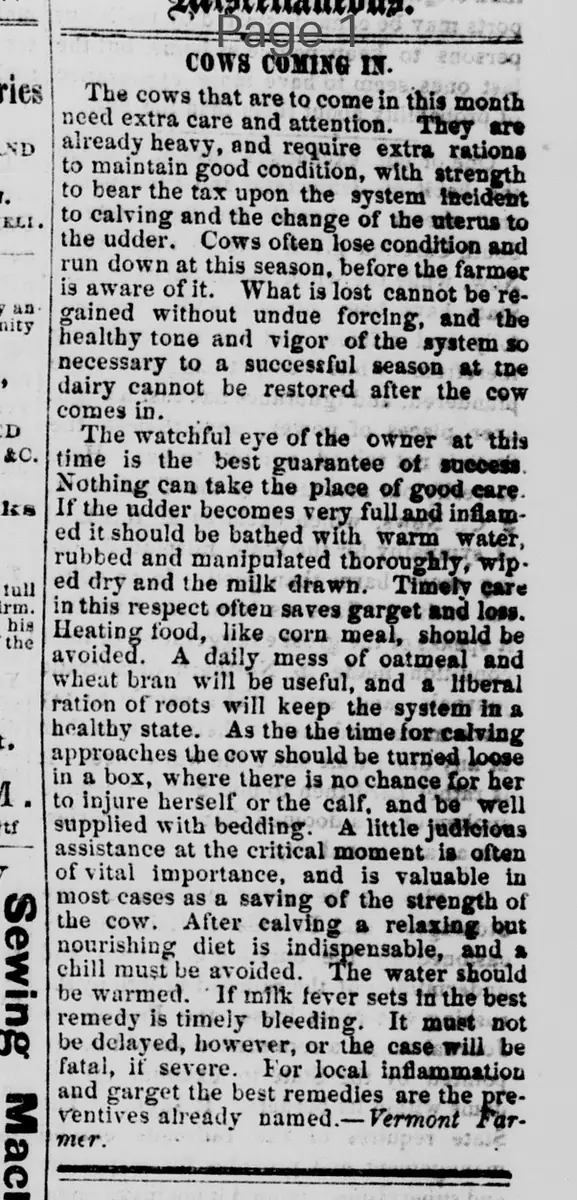
COWS COMING IN.
The cows that are to come in this month need extra care and attention. They are already heavy, and require extra rations to maintain good condition, with strength to bear the tax upon the system incident to calving and the change of the uterus to the udder. Cows often lose condition and run down at this season, before the farmer is aware of it. What is lost cannot be regained without undue forcing, and the healthy tone and vigor of the system so necessary to a successful season at the dairy cannot be restored after the cow comes in.
The watchful eye of the owner at this time is the best guarantee of success. Nothing can take the place of good care.
If the udder becomes very full and inflamed it should be bathed with warm water, rubbed and manipulated thoroughly, wiped dry and the milk drawn. Timely care in this respect often saves garget and loss.
Heating food, like corn meal, should be avoided. A daily mess of oatmeal and wheat bran will be useful, and a liberal ration of roots will keep the system in a healthy state. As the time for calving approaches the cow should be turned loose in a box, where there is no chance for her to injure herself or the calf, and be well supplied with bedding. A little judicious assistance at the critical moment is often of vital importance, and is valuable in most cases as a saving of the strength of the cow. After calving a relaxing but nourishing diet is indispensable, and a chill must be avoided. The water should be warmed. If milk fever sets in the best remedy is timely bleeding. It must not be delayed, however, or the case will be fatal, if severe. For local inflammation and garget the best remedies are the preventives already named. Vermont Farmer.
The cows that are to come in this month need extra care and attention. They are already heavy, and require extra rations to maintain good condition, with strength to bear the tax upon the system incident to calving and the change of the uterus to the udder. Cows often lose condition and run down at this season, before the farmer is aware of it. What is lost cannot be regained without undue forcing, and the healthy tone and vigor of the system so necessary to a successful season at the dairy cannot be restored after the cow comes in.
The watchful eye of the owner at this time is the best guarantee of success. Nothing can take the place of good care.
If the udder becomes very full and inflamed it should be bathed with warm water, rubbed and manipulated thoroughly, wiped dry and the milk drawn. Timely care in this respect often saves garget and loss.
Heating food, like corn meal, should be avoided. A daily mess of oatmeal and wheat bran will be useful, and a liberal ration of roots will keep the system in a healthy state. As the time for calving approaches the cow should be turned loose in a box, where there is no chance for her to injure herself or the calf, and be well supplied with bedding. A little judicious assistance at the critical moment is often of vital importance, and is valuable in most cases as a saving of the strength of the cow. After calving a relaxing but nourishing diet is indispensable, and a chill must be avoided. The water should be warmed. If milk fever sets in the best remedy is timely bleeding. It must not be delayed, however, or the case will be fatal, if severe. For local inflammation and garget the best remedies are the preventives already named. Vermont Farmer.
What sub-type of article is it?
Agricultural Advice
Livestock Care
What keywords are associated?
Cow Care
Calving
Dairy Farming
Milk Fever
Garget
Feeding Rations
Story Details
Story Details
Cows nearing calving require extra care, rations, and monitoring to maintain condition; avoid heating foods, use oatmeal and roots; provide safe space and assistance during birth; post-calving nourishing diet and remedies for milk fever or garget.