Thank you for visiting SNEWPapers!
Sign up free
Editorial
November 4, 1848
Weekly National Intelligencer
Washington, District Of Columbia
What is this article about?
This 1848 editorial urges Whig voters to support Zachary Taylor over Lewis Cass in the presidential election, praising Taylor's heroic military record, civic virtues, and opposition to expansionist policies, while criticizing the Democratic administration's overreach and unconstitutional war.
Clipping
OCR Quality
98%
Excellent
Full Text
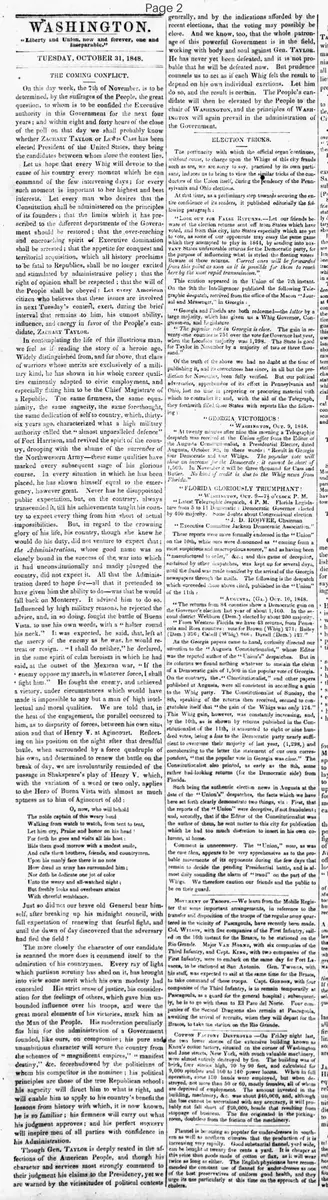
WASHINGTON.
"Liberty and Union, now and forever, one and inseparable."
TUESDAY, OCTOBER 31, 1848
THE COMING CONFLICT.
On this day week, the 7th of November, is to be determined, by the suffrages of the People, the great question, to whom is to be confided the Executive authority in this Government for the next four years; and within eight and forty hours of the close of the poll on that day we shall probably know whether Zachary Taylor or Lewis Cass has been elected President of the United States, they being the candidates between whom alone the contest lies.
Let us hope that every Whig will devote to the cause of his country every moment which he can command of the few intervening days; for every such moment is important to her highest and best interests. Let every man who desires that the Constitution shall be administered on the principles of its founders; that the limits which it has prescribed to the different departments of the Government should be restored; that the over-reaching and encroaching spirit of Executive domination shall be arrested; that the appetite for conquest and territorial acquisition, which all history proclaims to be fatal to Republics, shall be no longer excited and stimulated by administrative policy; that the right of opinion shall be respected; that the will of the People shall be obeyed: Let every American citizen who believes that these issues are involved in next Tuesday's contest, exert, during the brief interval that remains to him, his utmost ability, influence, and energy in favor of the People's candidate, Zachary Taylor.
In contemplating the life of this illustrious man, we feel as if reading the story of a heroic age. Widely distinguished from, and far above, that class of warriors whose merits are exclusively of a military kind, he has shown in his whole career qualities eminently adapted to civic employment, and especially fitting him to be the Chief Magistrate of a Republic. The same firmness, the same equanimity, the same sagacity, the same forethought, the same dedication of self to country, which, thirty-six years ago, characterized what a high military authority called the "almost unparalleled defence" of Fort Harrison, and revived the spirit of the country, drooping with the shame of the surrender of the Northwestern Army—these same qualities have marked every subsequent stage of his glorious course. In every situation in which he has been placed, he has shown himself equal to the emergency, however great. Never has he disappointed public expectation, but, on the contrary, always transcended it, till his achievements taught his country to expect every thing from him short of actual impossibilities. But, in regard to the crowning glory of his life, his country, though she knew he would do his duty, did not venture to expect that; the Administration, whose good name was so closely bound in the success of the war into which it had unconstitutionally and madly plunged the country, did not expect it. All that the Administration dared to hope for—all that it pretended to have given him the ability to do—was that he would fall back on Monterey. It advised him to do so. Influenced by high military reasons, he rejected the advice, and, in so doing, fought the battle of Buena Vista, to use his own words, with a "halter round his neck." It was expected, he said, that, left at the mercy of the enemy as he was, he would retreat or resign. "I shall do neither," he declared, in the same spirit of calm heroism in which he had said, at the outset of the Mexican war, "If the enemy oppose my march, in whatever force, I shall fight him." He fought the enemy, and achieved a victory, under circumstances which would have made it impossible to any but a man of high intellectual and moral qualities. We are told that, in the heat of the engagement, the parallel occurred to him, as to disparity of forces, between his own situation and that of Henry V. at Agincourt. Reflecting on his position on the night after that dreadful battle, when surrounded by a force quadruple of his own, and determined to renew the battle on the break of day, we are involuntarily reminded of the passage in Shakspeare's play of Henry V. which, with the variation of a word or two only, applies to the Hero of Buena Vista with almost as much aptness as to him of Agincourt of old:
O, now, who will behold
The noble captain of this weary band
Walking from watch to watch, from tent to tent,
Let him cry, Praise and honor on his head
For forth he goes and visits all his host;
Bids them good morrow with a modest smile,
And calls them brothers, friends, and countrymen.
Upon his manly face there is no note
How dread an army has surrounded him;
Nor doth he dedicate one jot of color
Unto the weary and all-watched night;
But freshly looks and overbears attaint
With cheerful semblance.
Just so did not our brave old General bear himself, after breaking up his midnight council, with full expectation of renewing that fearful fight, and until the dawn of day discovered that the adversary had fled the field?
The more closely the character of our candidate is scanned the more does it commend itself to the admiration of his countrymen. Every ray of light which partisan scrutiny has shed on it, has brought into view some merit which his own modesty had concealed. His strict sense of justice, his consideration for the feelings of others, which gave him unbounded influence over his troops, and were the great moral elements of his victories, mark him as the Man of the People. His moderation peculiarly fits him for the administration of a Government founded, like ours, on compromise; his pure and unambitious character will secure the country from the schemes of "magnificent empires," "manifest destiny," &c. foreshadowed by the politicians of whom his competitor is the nominee; his political principles are those of the true Republican school: his sagacity will direct him to what is right, and will enable him to apply to his country's benefit the lessons from history with which, it is now known, he is so familiar; his firmness will carry out what his judgment approves; and his perfect Honesty will inspire men of all parties with confidence in his Administration.
Though Gen. Taylor is deeply seated in the affections of the American People, and though his character and services most strongly commend to their judgment his claims to the Presidency, yet we are warned by the vicissitudes of political contests generally, and by the indications afforded by the recent elections, that the voting may possibly be close. And we know, too, that the whole patronage of this powerful Government is in the field, working with body and soul against Gen. Taylor. He has never yet been defeated, and it is not probable that he will be defeated now. But prudence counsels us to act as if each Whig felt the result to depend on his own individual exertions. Let him do so, and the result is certain. The People's candidate will then be elevated by the People to the chair of Washington, and the principles of Washington will again prevail in the administration of the Government.
"Liberty and Union, now and forever, one and inseparable."
TUESDAY, OCTOBER 31, 1848
THE COMING CONFLICT.
On this day week, the 7th of November, is to be determined, by the suffrages of the People, the great question, to whom is to be confided the Executive authority in this Government for the next four years; and within eight and forty hours of the close of the poll on that day we shall probably know whether Zachary Taylor or Lewis Cass has been elected President of the United States, they being the candidates between whom alone the contest lies.
Let us hope that every Whig will devote to the cause of his country every moment which he can command of the few intervening days; for every such moment is important to her highest and best interests. Let every man who desires that the Constitution shall be administered on the principles of its founders; that the limits which it has prescribed to the different departments of the Government should be restored; that the over-reaching and encroaching spirit of Executive domination shall be arrested; that the appetite for conquest and territorial acquisition, which all history proclaims to be fatal to Republics, shall be no longer excited and stimulated by administrative policy; that the right of opinion shall be respected; that the will of the People shall be obeyed: Let every American citizen who believes that these issues are involved in next Tuesday's contest, exert, during the brief interval that remains to him, his utmost ability, influence, and energy in favor of the People's candidate, Zachary Taylor.
In contemplating the life of this illustrious man, we feel as if reading the story of a heroic age. Widely distinguished from, and far above, that class of warriors whose merits are exclusively of a military kind, he has shown in his whole career qualities eminently adapted to civic employment, and especially fitting him to be the Chief Magistrate of a Republic. The same firmness, the same equanimity, the same sagacity, the same forethought, the same dedication of self to country, which, thirty-six years ago, characterized what a high military authority called the "almost unparalleled defence" of Fort Harrison, and revived the spirit of the country, drooping with the shame of the surrender of the Northwestern Army—these same qualities have marked every subsequent stage of his glorious course. In every situation in which he has been placed, he has shown himself equal to the emergency, however great. Never has he disappointed public expectation, but, on the contrary, always transcended it, till his achievements taught his country to expect every thing from him short of actual impossibilities. But, in regard to the crowning glory of his life, his country, though she knew he would do his duty, did not venture to expect that; the Administration, whose good name was so closely bound in the success of the war into which it had unconstitutionally and madly plunged the country, did not expect it. All that the Administration dared to hope for—all that it pretended to have given him the ability to do—was that he would fall back on Monterey. It advised him to do so. Influenced by high military reasons, he rejected the advice, and, in so doing, fought the battle of Buena Vista, to use his own words, with a "halter round his neck." It was expected, he said, that, left at the mercy of the enemy as he was, he would retreat or resign. "I shall do neither," he declared, in the same spirit of calm heroism in which he had said, at the outset of the Mexican war, "If the enemy oppose my march, in whatever force, I shall fight him." He fought the enemy, and achieved a victory, under circumstances which would have made it impossible to any but a man of high intellectual and moral qualities. We are told that, in the heat of the engagement, the parallel occurred to him, as to disparity of forces, between his own situation and that of Henry V. at Agincourt. Reflecting on his position on the night after that dreadful battle, when surrounded by a force quadruple of his own, and determined to renew the battle on the break of day, we are involuntarily reminded of the passage in Shakspeare's play of Henry V. which, with the variation of a word or two only, applies to the Hero of Buena Vista with almost as much aptness as to him of Agincourt of old:
O, now, who will behold
The noble captain of this weary band
Walking from watch to watch, from tent to tent,
Let him cry, Praise and honor on his head
For forth he goes and visits all his host;
Bids them good morrow with a modest smile,
And calls them brothers, friends, and countrymen.
Upon his manly face there is no note
How dread an army has surrounded him;
Nor doth he dedicate one jot of color
Unto the weary and all-watched night;
But freshly looks and overbears attaint
With cheerful semblance.
Just so did not our brave old General bear himself, after breaking up his midnight council, with full expectation of renewing that fearful fight, and until the dawn of day discovered that the adversary had fled the field?
The more closely the character of our candidate is scanned the more does it commend itself to the admiration of his countrymen. Every ray of light which partisan scrutiny has shed on it, has brought into view some merit which his own modesty had concealed. His strict sense of justice, his consideration for the feelings of others, which gave him unbounded influence over his troops, and were the great moral elements of his victories, mark him as the Man of the People. His moderation peculiarly fits him for the administration of a Government founded, like ours, on compromise; his pure and unambitious character will secure the country from the schemes of "magnificent empires," "manifest destiny," &c. foreshadowed by the politicians of whom his competitor is the nominee; his political principles are those of the true Republican school: his sagacity will direct him to what is right, and will enable him to apply to his country's benefit the lessons from history with which, it is now known, he is so familiar; his firmness will carry out what his judgment approves; and his perfect Honesty will inspire men of all parties with confidence in his Administration.
Though Gen. Taylor is deeply seated in the affections of the American People, and though his character and services most strongly commend to their judgment his claims to the Presidency, yet we are warned by the vicissitudes of political contests generally, and by the indications afforded by the recent elections, that the voting may possibly be close. And we know, too, that the whole patronage of this powerful Government is in the field, working with body and soul against Gen. Taylor. He has never yet been defeated, and it is not probable that he will be defeated now. But prudence counsels us to act as if each Whig felt the result to depend on his own individual exertions. Let him do so, and the result is certain. The People's candidate will then be elevated by the People to the chair of Washington, and the principles of Washington will again prevail in the administration of the Government.
What sub-type of article is it?
Partisan Politics
Constitutional
Imperialism
What keywords are associated?
1848 Election
Zachary Taylor
Lewis Cass
Whig Support
Mexican War
Buena Vista
Executive Domination
Territorial Acquisition
Republican Principles
What entities or persons were involved?
Zachary Taylor
Lewis Cass
Whig Party
American People
Administration
Editorial Details
Primary Topic
Support For Zachary Taylor In The 1848 Presidential Election
Stance / Tone
Strongly Supportive Of Zachary Taylor And Whig Principles, Critical Of Democratic Expansionism And Executive Overreach
Key Figures
Zachary Taylor
Lewis Cass
Whig Party
American People
Administration
Key Arguments
The Election On November 7 Will Decide Between Taylor And Cass For President.
Urge Whigs To Exert Maximum Effort In The Remaining Days To Support Taylor.
Taylor's Military And Civic Qualities Make Him Ideal For Chief Magistrate.
Criticize Administration's Unconstitutional War And Advice To Retreat From Buena Vista.
Taylor's Victory At Buena Vista Demonstrated Heroism Despite Risks.
Taylor's Justice, Moderation, And Honesty Fit Republican Government.
Warn Of Close Election And Government Patronage Against Taylor.
Prudence Requires Individual Whig Exertions To Ensure Taylor's Victory.