Thank you for visiting SNEWPapers!
Sign up free
New Hampshire Statesman And Concord Register
Concord, Merrimack County, New Hampshire
What is this article about?
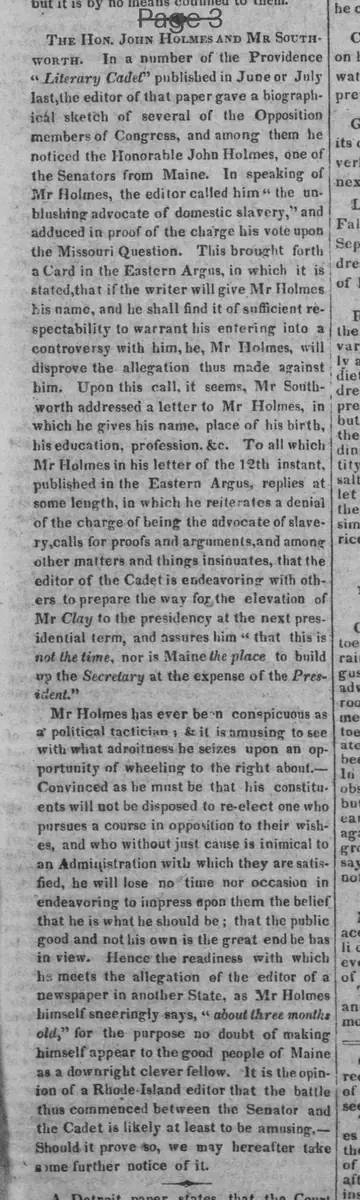
In a Providence Literary Cadet article from June or July, editor Mr. Southworth accused Maine Senator John Holmes of being an 'unblushing advocate of domestic slavery' based on his Missouri Question vote. Holmes denied the charge in the Eastern Argus, challenging Southworth and insinuating political motives to elevate Henry Clay over the President. The exchange highlights Holmes's political tactics amid constituent pressures.
Clipping
OCR Quality
Full Text
Mr. Holmes has ever been conspicuous as a political tactician; & it is amusing to see with what adroitness he seizes upon an opportunity of wheeling to the right about.—Convinced as he must be that his constituents will not be disposed to re-elect one who pursues a course in opposition to their wishes, and who without just cause is inimical to an Administration with which they are satisfied, he will lose no time nor occasion in endeavoring to impress upon them the belief that he is what he should be; that the public good and not his own is the great end he has in view. Hence the readiness with which he meets the allegation of the editor of a newspaper in another State, as Mr. Holmes himself sneeringly says, "about three months old," for the purpose no doubt of making himself appear to the good people of Maine as a downright clever fellow. It is the opinion of a Rhode-Island editor that the battle thus commenced between the Senator and the Cadet is likely at least to be amusing.—Should it prove so, we may hereafter take some further notice of it.
What sub-type of article is it?
What themes does it cover?
What keywords are associated?
What entities or persons were involved?
Where did it happen?
Story Details
Key Persons
Location
Maine, Providence Rhode Island
Event Date
June Or July Last; 12th Instant
Story Details
Editor Southworth's biographical sketch in Literary Cadet accuses Senator Holmes of advocating slavery via Missouri vote; Holmes denies in Eastern Argus, challenges proofs, and accuses political maneuvering for Clay's presidency, showcasing his tactical response to constituents.