Thank you for visiting SNEWPapers!
Sign up free
Literary
July 17, 1818
Richmond Enquirer
Richmond, Richmond County, Virginia
What is this article about?
Ram Mohun Roy, a Brahmin reformer, critiques Hindu idolatry, superstitions, and caste practices from his pamphlets, advocating monotheistic worship of one Supreme Being and pure morality as per scriptures, exposing misconceptions and calling for rational faith.
Clipping
OCR Quality
75%
Good
Full Text
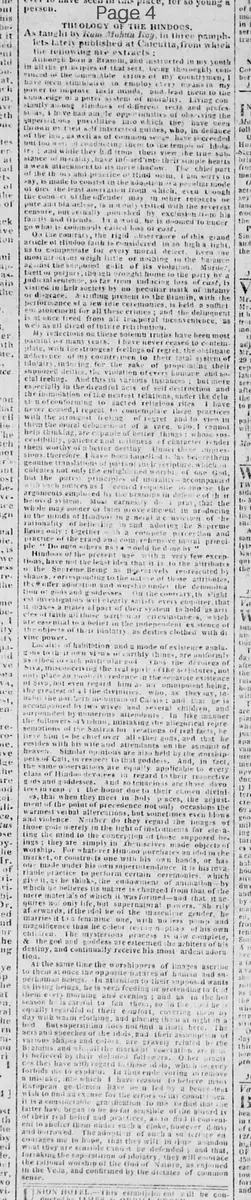
THEOLOGY OF THE HINDOOS.
As taught by Ram Mohun Roy, in three pamphlets lately published at Calcutta, from which the following are extracts:
Although born a Brahmin, and instructed in my youth in all the principles of that sect, being thoroughly convinced of the detestable errors of my countrymen, I have been stimulated to employ every means in my power to improve their minds, and lead them to the knowledge of a purer system of morality. Living constantly among Hindoos of different sects and professions, I have had an opportunity of observing the superstitious peculiarities to which they have been thrown by their interested guides, who, in defiance of the law, as well as of common sense, have succeeded but too well in conducting them to the temple of idolatry; and while they hid from their view the true substance of morality, have infused into their simple hearts a weak attachment to its mere shadow. The chief part of the theory and practice of Hindooism, I am sorry to say, is made to consist in the adopting a peculiar mode of diet, the transgression of which, even though the conduct of the offender may in other respects be prudent and his desires, is not only visited with the severest censure, but actually punished by exclusion from his family and friends. In a word, he is doomed to undergo what is commonly called loss of caste.
On the contrary, the rigid observance of this grand article of Hindoo faith is considered in so high a light, as to compensate for every moral defect, even the most atrocious crimes weigh little or nothing in the balance against the supposed merit of its observance. Murder, theft or perjury, though brought home to the party by a judicial sentence, so far from inducing loss of caste, is visited in their society by no peculiar mark of infamy or disgrace. A trifling present to the Brahmin, with the performance of a few idle ceremonies, is held a sufficient atonement for all these crimes; and the delinquent is at once freed from all temporal inconvenience, as well as all dread of future retribution.
My reflections on these solemn truths have been most painful for many years. I have never ceased to contemplate, with the strongest feelings of regret, the obstinate adherence of my countrymen to their fatal system of idolatry, making for the sake of propitiating their supposed deities, the violation of every humane and social feeling. And this in various instances; but more especially in the dreadful acts of self-destruction and the immolation of the nearest relations, under the delusion of conforming to sacred religious rites. I have never ceased, I repeat, to contemplate these practices with the strongest feeling of regret and to view in them the moral debasement of a race, who, I cannot help thinking, are capable of better things: whose susceptibility, patience and fitness of character indicate them worthy of a better destiny. Under these impressions therefore I have been impelled, as before them genuine translations of parts of their scriptures which inculcate not only the enlightened worship of one God, but the purest principles of morality—accompanied with such nuances as I deemed requisite, to expose the arguments employed by the Brahmins in defence of their beloved system. Most earnestly do I pray, that the whole may sooner or later prove efficacious in producing in the minds of Hindoos a general conviction of the rationality of believing in and adoring the Supreme Being only: together with a complete adoption and practice of the grand and comprehensive moral principle "Do unto others as you would be done by."
Hindoos of the present age, with a very few exceptions, have not the least idea that it is to the attributes of the Supreme Being as negatively revealed by the Shastras, corresponding to the nature of those attributes, the offer of adoration and worship is made under the denomination of gods and goddesses. On the contrary, the slightest investigation will clearly satisfy every enquirer, that it makes a material part of their system to hold as articles of faith those particular circumstances, which are essential to a belief in the independent existence of the objects of their idolatry as deities clothed with divine power.
Location of habitation and a mode of existence analogous to their own views of earthly things, are uniformly ascribed to each particular god.
Thus the devotees of Siva, misconceiving the real spirit of the scriptures, not only place his residence in the separate existence of Siva, but even regard him as an omnipotent being, the greatest of all the deities, who, as they say, inhabits Mount Kailash; and that he is accompanied by two wives and several children, and surrounded by numerous attendants. In like manner the followers of Vishnu, mistaking the allegorical representations of the Shastras for relations of real facts, believe him to be chief over all their gods, and that he resides with his wife and attendants on the summit of heaven. Similar opinions are also held by the worshippers of Kali, in respect to that goddess. And, in fact, the same observations are equally applicable to every class of Hindoo devotees in regard to their respective gods and goddesses. And so tenacious are these devotees in respect to the honor due to their chosen divinities, that when they meet in holy places, the adjustment of the point of precedence not only occasions the warmest verbal altercations, but sometimes even blows and violence. Neither do they regard the images of those gods merely in the light of instruments for elevating the mind to the conception of those supposed beings; they are simply in themselves made objects of worship. For whatever Hindoo purchases an idol in the market, or constructs one with his own hands, or has one made under his own superintendence, it is his invariable practice to perform certain ceremonies, which give it, as he thinks, the endowment of animation—by which he believes its nature is changed from that of the mere materials of which it was formed—and that it acquires not only life, but supernatural powers. Shortly afterwards, if the idol be of the masculine gender, he marries it to a female one, with no less pomp and magnificence than he celebrates the nuptials of his own children. The mysterious process is now complete, & the god and goddess are esteemed the arbiters of his destiny, and continually receive his most ardent adoration.
At the same time the worshippers of images ascribe to them at once the opposite natures of material and supernatural beings. In attending to their supposed wants as living beings, he is seen feeding or pretending to feed them every morning and evening; and as in the hot season he is careful to fan them, so in the cold he is equally regardful of their comfort, covering them by day with warm clothing, and placing them at night in a bed. But superstition does not end here. The acts and speeches of the idols and their assumption of various shapes and colors are gravely related by the Brahmins and shilpins of Varanasi, I am told, and believed by their deluded followers. Other facts which I have with regard to these deities, what they be, etc., forbid me to explain. In this endeavor to remove a mistake, in which I have reason to believe many European gentlemen have been involved by a benevolent fear or wish to find an excuse for the errors of my countrymen, it is a considerable gratification to me to find that they have begun to be so far sensible of the absurdity of their real belief and practices, as to find it convenient to shelter them under such a cloak, however disingenuous the adoption of such a subterfuge may be. It allows me to hope that they will in time abandon what they are sensible cannot be defended, and that, forsaking the superstition of idolatry, they will embrace the rational worship of the God of Nature, as enjoined in the Vedas, and confirmed by the dictates of common sense.
As taught by Ram Mohun Roy, in three pamphlets lately published at Calcutta, from which the following are extracts:
Although born a Brahmin, and instructed in my youth in all the principles of that sect, being thoroughly convinced of the detestable errors of my countrymen, I have been stimulated to employ every means in my power to improve their minds, and lead them to the knowledge of a purer system of morality. Living constantly among Hindoos of different sects and professions, I have had an opportunity of observing the superstitious peculiarities to which they have been thrown by their interested guides, who, in defiance of the law, as well as of common sense, have succeeded but too well in conducting them to the temple of idolatry; and while they hid from their view the true substance of morality, have infused into their simple hearts a weak attachment to its mere shadow. The chief part of the theory and practice of Hindooism, I am sorry to say, is made to consist in the adopting a peculiar mode of diet, the transgression of which, even though the conduct of the offender may in other respects be prudent and his desires, is not only visited with the severest censure, but actually punished by exclusion from his family and friends. In a word, he is doomed to undergo what is commonly called loss of caste.
On the contrary, the rigid observance of this grand article of Hindoo faith is considered in so high a light, as to compensate for every moral defect, even the most atrocious crimes weigh little or nothing in the balance against the supposed merit of its observance. Murder, theft or perjury, though brought home to the party by a judicial sentence, so far from inducing loss of caste, is visited in their society by no peculiar mark of infamy or disgrace. A trifling present to the Brahmin, with the performance of a few idle ceremonies, is held a sufficient atonement for all these crimes; and the delinquent is at once freed from all temporal inconvenience, as well as all dread of future retribution.
My reflections on these solemn truths have been most painful for many years. I have never ceased to contemplate, with the strongest feelings of regret, the obstinate adherence of my countrymen to their fatal system of idolatry, making for the sake of propitiating their supposed deities, the violation of every humane and social feeling. And this in various instances; but more especially in the dreadful acts of self-destruction and the immolation of the nearest relations, under the delusion of conforming to sacred religious rites. I have never ceased, I repeat, to contemplate these practices with the strongest feeling of regret and to view in them the moral debasement of a race, who, I cannot help thinking, are capable of better things: whose susceptibility, patience and fitness of character indicate them worthy of a better destiny. Under these impressions therefore I have been impelled, as before them genuine translations of parts of their scriptures which inculcate not only the enlightened worship of one God, but the purest principles of morality—accompanied with such nuances as I deemed requisite, to expose the arguments employed by the Brahmins in defence of their beloved system. Most earnestly do I pray, that the whole may sooner or later prove efficacious in producing in the minds of Hindoos a general conviction of the rationality of believing in and adoring the Supreme Being only: together with a complete adoption and practice of the grand and comprehensive moral principle "Do unto others as you would be done by."
Hindoos of the present age, with a very few exceptions, have not the least idea that it is to the attributes of the Supreme Being as negatively revealed by the Shastras, corresponding to the nature of those attributes, the offer of adoration and worship is made under the denomination of gods and goddesses. On the contrary, the slightest investigation will clearly satisfy every enquirer, that it makes a material part of their system to hold as articles of faith those particular circumstances, which are essential to a belief in the independent existence of the objects of their idolatry as deities clothed with divine power.
Location of habitation and a mode of existence analogous to their own views of earthly things, are uniformly ascribed to each particular god.
Thus the devotees of Siva, misconceiving the real spirit of the scriptures, not only place his residence in the separate existence of Siva, but even regard him as an omnipotent being, the greatest of all the deities, who, as they say, inhabits Mount Kailash; and that he is accompanied by two wives and several children, and surrounded by numerous attendants. In like manner the followers of Vishnu, mistaking the allegorical representations of the Shastras for relations of real facts, believe him to be chief over all their gods, and that he resides with his wife and attendants on the summit of heaven. Similar opinions are also held by the worshippers of Kali, in respect to that goddess. And, in fact, the same observations are equally applicable to every class of Hindoo devotees in regard to their respective gods and goddesses. And so tenacious are these devotees in respect to the honor due to their chosen divinities, that when they meet in holy places, the adjustment of the point of precedence not only occasions the warmest verbal altercations, but sometimes even blows and violence. Neither do they regard the images of those gods merely in the light of instruments for elevating the mind to the conception of those supposed beings; they are simply in themselves made objects of worship. For whatever Hindoo purchases an idol in the market, or constructs one with his own hands, or has one made under his own superintendence, it is his invariable practice to perform certain ceremonies, which give it, as he thinks, the endowment of animation—by which he believes its nature is changed from that of the mere materials of which it was formed—and that it acquires not only life, but supernatural powers. Shortly afterwards, if the idol be of the masculine gender, he marries it to a female one, with no less pomp and magnificence than he celebrates the nuptials of his own children. The mysterious process is now complete, & the god and goddess are esteemed the arbiters of his destiny, and continually receive his most ardent adoration.
At the same time the worshippers of images ascribe to them at once the opposite natures of material and supernatural beings. In attending to their supposed wants as living beings, he is seen feeding or pretending to feed them every morning and evening; and as in the hot season he is careful to fan them, so in the cold he is equally regardful of their comfort, covering them by day with warm clothing, and placing them at night in a bed. But superstition does not end here. The acts and speeches of the idols and their assumption of various shapes and colors are gravely related by the Brahmins and shilpins of Varanasi, I am told, and believed by their deluded followers. Other facts which I have with regard to these deities, what they be, etc., forbid me to explain. In this endeavor to remove a mistake, in which I have reason to believe many European gentlemen have been involved by a benevolent fear or wish to find an excuse for the errors of my countrymen, it is a considerable gratification to me to find that they have begun to be so far sensible of the absurdity of their real belief and practices, as to find it convenient to shelter them under such a cloak, however disingenuous the adoption of such a subterfuge may be. It allows me to hope that they will in time abandon what they are sensible cannot be defended, and that, forsaking the superstition of idolatry, they will embrace the rational worship of the God of Nature, as enjoined in the Vedas, and confirmed by the dictates of common sense.
What sub-type of article is it?
Essay
Satire
What themes does it cover?
Religious
Moral Virtue
What keywords are associated?
Hindu Theology
Idolatry
Ram Mohun Roy
Hindu Superstition
Monotheism
Moral Reform
Caste System
Brahmin Influence
Vedas
Shastras
What entities or persons were involved?
As Taught By Ram Mohun Roy.
Literary Details
Title
Theology Of The Hindoos.
Author
As Taught By Ram Mohun Roy.
Subject
Critique Of Hindu Idolatry And Advocacy For Monotheism And Morality.
Form / Style
Extracts From Argumentative Pamphlets In Prose.
Key Lines
Although Born A Bramln, And Instructed In My Youth In All The Principles Of That Sect. Being Thoroughly Convinced Of The Tenable Errors Of My Countrymen, I Have Been Stimulated To Employ Every Means In My Power To Improve Their Minds. And Lead Them To The Knowledge Of A Purer System Of Morality.
Most Earnestly Do Pray, That The Whole May Sooner Or Later Prove Efficacious In Producing In The Minds Of Hindoos A General Conviction Of The Rationality Of Believing In And Adoring The Supreme Being Only : Together Th A Complete Adoption And Practice Of The Grand And Comprehensive Moral Principle " Do Unto Others As You Would Be Done By "
Hindoos Of The Present Age With A Very Few Exceptions, Have Not The Least Idea That U Is To The Attributes Of The Supreme Being As Negatively Reoteached By Shaves, Corresponding To The Nature Of Those Attributes. The Offer Adoption And Worship Is Made' Under The Denomination Of Gods And Goddesses