Thank you for visiting SNEWPapers!
Sign up free
Editorial
January 8, 1875
The Worthington Advance
Worthington, Nobles County, Minnesota
What is this article about?
Leonard B. Hodges' editorial from St. Paul, Jan. 1, 1875, urges prairie landowners to dedicate land for growing forest timber, offering detailed advice on site selection, planting in dense rows like corn, cultivation, thinning, and expected yields of fence poles, firewood, and valuable trees within years.
Clipping
OCR Quality
98%
Excellent
Full Text
St. Paul, Jan. 1, 1875
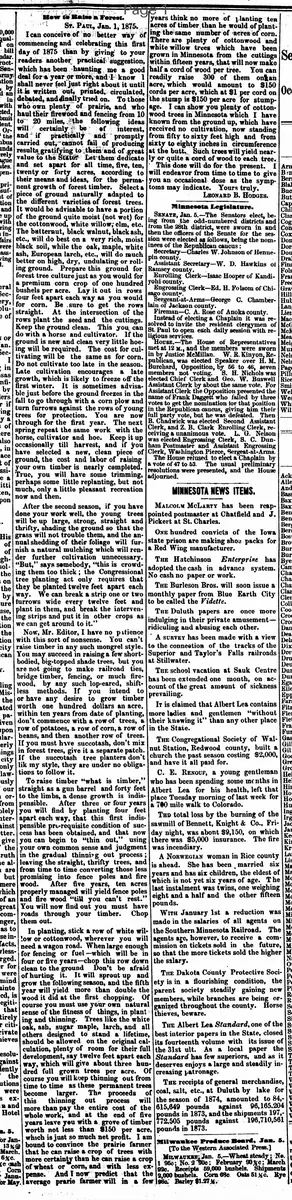
I can conceive of no better way of commencing and celebrating this first day of 1875 than by giving to your readers another practical suggestion; which has been haunting me a good deal for a year or more, and I know shall never feel just right about it until it is written out, printed, circulated, debated, and finally tried on. To those who own plenty of prairie, and who haul their firewood and fencing from 10 to 20 miles, the following ideas will certainly be of interest, and if practically and promptly carried out, cannot fail of producing results gratifying to them and of great value to the State.—Let them dedicate and set apart for all time, five, ten, twenty or forty acres, according to their means and ideas, for the permanent growth of forest timber. Select a piece of ground naturally adapted to the different varieties of forest trees. It would be advisable to have a portion of the ground quite moist (not wet) for the cottonwood, white willow, elm, etc. The butternut, black walnut, black ash, etc., will do best on a very rich, moist black soil, while the oak, maple, white ash, European larch, etc., will do much better on high, dry, undulating or rolling ground. Prepare this ground for forest tree culture just as you would for a premium corn crop of one hundred bushels per acre. Lay it out in rows four feet apart each way as you would for corn. Be sure to get the rows straight. At the intersection of the rows plant the seed and the cuttings. Keep the ground clean. This you can do with a horse and cultivator. If the ground is new and clean very little hoeing will be required. The cost for cultivating will be the same as for corn. Do not cultivate too late in the season. Late cultivation encourages a late growth, which is likely to freeze off the first winter. It is sometimes advisable just before the ground freezes in the fall to go through with a corn plow and turn furrows against the rows of young trees for protection. You are now through for the first year. The next spring repeat the same work with the horse, cultivator and hoe. Keep it up occasionally till harvest, and if you have selected a new, clean piece of ground, the cost and labor of raising your own timber is nearly completed. True, you will have some trimming, perhaps some little replanting, but not much, only a little pleasant recreation now and then. After the second season, if you have done your work well, the young trees will be up large, strong, straight and thrifty, shading the ground so that the grass will not trouble them, and the annual shedding of their foliage will furnish a natural mulching which will render further cultivation unnecessary. "But," says somebody, "this is crowding them too thick; the Congressional tree planting act only requires that they be planted twelve feet apart each way. We can break a strip one or two furrows wide every twelve feet and plant in them, and break the intervening strips and put it in other crops as we can get around to it." Now, Mr. Editor, I have no patience with this sort of nonsense. You can't raise timber in any such mongrel style. You may succeed in raising a few short-bodied, big-topped shade trees, but you are not going to make railroad ties, bridge timber, fencing, or much firewood, by any such lop-eared, shiftless methods. If you intend to or have any desire to grow timber worth one hundred dollars an acre, within ten years from date of planting: don't commence with a row of trees, a row of potatoes, a row of corn, a row of beans, and then another row of trees. If you must have succotash, don't mix in forest trees, give it a separate patch. If the succotash tree planters don't like my style, they are under no obligations to follow it. To raise timber "what is timber," straight as a gun barrel and forty feet to the limbs, a dense growth is indispensable. After three or four years you will find by planting four feet apart each way, that this first indispensable pre-requisite condition of success has been obtained, and that now you can begin to "thin out," using your own common sense and judgment in the gradual thinning out process; leaving the straight, thrifty trees, and from time to time converting those less promising into fence poles and firewood. After five years, ten acres properly managed will yield fence poles and fire wood "till you can't rest." You will now find out you must have roads through your timber. Chop them out. In planting, stick a row of white willow or cottonwood, wherever you will need a wagon road. When large enough for fencing or fuel—which will be in four or five years—chop this row down clean to the ground. Don't be afraid of hurting it. It will sprout up and grow the following season, and the fifth year will yield more than double the wood it did at the first chopping. Of course you must use your own natural sense of the fitness of things, in planting and thinning. Trees like the white oak, ash, sugar maple, larch, and all others designed to stand a lifetime, should be allowed on the original calculation, plenty of room for their full development, say twelve feet apart each way, which will give about three hundred full grown trees per acre. Of course you will keep thinning out from time to time as these permanent trees become larger. The proceeds of this thinning out process will more than pay the entire cost of the whole work, and at the end of five years leave you with a grove of timber worth not less than $150 per acre, which is just so much net profit. I am bound to convince the prairie farmer that he can raise a crop of trees with more certainty than he can raise a crop of wheat or corn, and with less expense. And I now predict that the average prairie farmer will in a few years think no more of planting ten acres of timber than he would of planting the same number of acres of corn. There are plenty of cottonwood and white willow trees which have been grown in Minnesota from the cuttings within fifteen years, that will now make half a cord of wood per tree. You can readily raise 300 of them on an acre, which would amount to 150 cords per acre, which at $1 per cord on the stump is $150 per acre for stumpage. I can show you plenty of cottonwood trees in Minnesota which I have known from the ground up, which have received no cultivation, now standing from fifty to sixty feet high and from sixty to eighty inches in circumference at the butt. Such trees will yield nearly or quite a cord of wood to each tree. This dose will do for the present. I will endeavor from time to time to give you an occasional dose as the symptoms may indicate. Yours truly,
LEONARD B. HODGES.
I can conceive of no better way of commencing and celebrating this first day of 1875 than by giving to your readers another practical suggestion; which has been haunting me a good deal for a year or more, and I know shall never feel just right about it until it is written out, printed, circulated, debated, and finally tried on. To those who own plenty of prairie, and who haul their firewood and fencing from 10 to 20 miles, the following ideas will certainly be of interest, and if practically and promptly carried out, cannot fail of producing results gratifying to them and of great value to the State.—Let them dedicate and set apart for all time, five, ten, twenty or forty acres, according to their means and ideas, for the permanent growth of forest timber. Select a piece of ground naturally adapted to the different varieties of forest trees. It would be advisable to have a portion of the ground quite moist (not wet) for the cottonwood, white willow, elm, etc. The butternut, black walnut, black ash, etc., will do best on a very rich, moist black soil, while the oak, maple, white ash, European larch, etc., will do much better on high, dry, undulating or rolling ground. Prepare this ground for forest tree culture just as you would for a premium corn crop of one hundred bushels per acre. Lay it out in rows four feet apart each way as you would for corn. Be sure to get the rows straight. At the intersection of the rows plant the seed and the cuttings. Keep the ground clean. This you can do with a horse and cultivator. If the ground is new and clean very little hoeing will be required. The cost for cultivating will be the same as for corn. Do not cultivate too late in the season. Late cultivation encourages a late growth, which is likely to freeze off the first winter. It is sometimes advisable just before the ground freezes in the fall to go through with a corn plow and turn furrows against the rows of young trees for protection. You are now through for the first year. The next spring repeat the same work with the horse, cultivator and hoe. Keep it up occasionally till harvest, and if you have selected a new, clean piece of ground, the cost and labor of raising your own timber is nearly completed. True, you will have some trimming, perhaps some little replanting, but not much, only a little pleasant recreation now and then. After the second season, if you have done your work well, the young trees will be up large, strong, straight and thrifty, shading the ground so that the grass will not trouble them, and the annual shedding of their foliage will furnish a natural mulching which will render further cultivation unnecessary. "But," says somebody, "this is crowding them too thick; the Congressional tree planting act only requires that they be planted twelve feet apart each way. We can break a strip one or two furrows wide every twelve feet and plant in them, and break the intervening strips and put it in other crops as we can get around to it." Now, Mr. Editor, I have no patience with this sort of nonsense. You can't raise timber in any such mongrel style. You may succeed in raising a few short-bodied, big-topped shade trees, but you are not going to make railroad ties, bridge timber, fencing, or much firewood, by any such lop-eared, shiftless methods. If you intend to or have any desire to grow timber worth one hundred dollars an acre, within ten years from date of planting: don't commence with a row of trees, a row of potatoes, a row of corn, a row of beans, and then another row of trees. If you must have succotash, don't mix in forest trees, give it a separate patch. If the succotash tree planters don't like my style, they are under no obligations to follow it. To raise timber "what is timber," straight as a gun barrel and forty feet to the limbs, a dense growth is indispensable. After three or four years you will find by planting four feet apart each way, that this first indispensable pre-requisite condition of success has been obtained, and that now you can begin to "thin out," using your own common sense and judgment in the gradual thinning out process; leaving the straight, thrifty trees, and from time to time converting those less promising into fence poles and firewood. After five years, ten acres properly managed will yield fence poles and fire wood "till you can't rest." You will now find out you must have roads through your timber. Chop them out. In planting, stick a row of white willow or cottonwood, wherever you will need a wagon road. When large enough for fencing or fuel—which will be in four or five years—chop this row down clean to the ground. Don't be afraid of hurting it. It will sprout up and grow the following season, and the fifth year will yield more than double the wood it did at the first chopping. Of course you must use your own natural sense of the fitness of things, in planting and thinning. Trees like the white oak, ash, sugar maple, larch, and all others designed to stand a lifetime, should be allowed on the original calculation, plenty of room for their full development, say twelve feet apart each way, which will give about three hundred full grown trees per acre. Of course you will keep thinning out from time to time as these permanent trees become larger. The proceeds of this thinning out process will more than pay the entire cost of the whole work, and at the end of five years leave you with a grove of timber worth not less than $150 per acre, which is just so much net profit. I am bound to convince the prairie farmer that he can raise a crop of trees with more certainty than he can raise a crop of wheat or corn, and with less expense. And I now predict that the average prairie farmer will in a few years think no more of planting ten acres of timber than he would of planting the same number of acres of corn. There are plenty of cottonwood and white willow trees which have been grown in Minnesota from the cuttings within fifteen years, that will now make half a cord of wood per tree. You can readily raise 300 of them on an acre, which would amount to 150 cords per acre, which at $1 per cord on the stump is $150 per acre for stumpage. I can show you plenty of cottonwood trees in Minnesota which I have known from the ground up, which have received no cultivation, now standing from fifty to sixty feet high and from sixty to eighty inches in circumference at the butt. Such trees will yield nearly or quite a cord of wood to each tree. This dose will do for the present. I will endeavor from time to time to give you an occasional dose as the symptoms may indicate. Yours truly,
LEONARD B. HODGES.
What sub-type of article is it?
Agriculture
What keywords are associated?
Tree Planting
Forest Timber
Prairie Agriculture
Timber Cultivation
Dense Planting
Thinning Process
Minnesota Farming
What entities or persons were involved?
Leonard B. Hodges
Prairie Farmers
Minnesota
Editorial Details
Primary Topic
Practical Suggestions For Planting And Cultivating Forest Timber On Prairie Land
Stance / Tone
Enthusiastic Practical Advice Promoting Dense Tree Planting
Key Figures
Leonard B. Hodges
Prairie Farmers
Minnesota
Key Arguments
Dedicate 5 40 Acres For Permanent Forest Timber Growth
Select Ground Adapted To Tree Varieties Like Cottonwood, Oak, Maple
Prepare And Plant In Rows 4 Feet Apart Like Corn Crop
Cultivate First Two Years, Then Thin Out For Poles And Firewood
Dense Planting Ensures Straight Timber; Avoid Mixing With Other Crops
After 5 Years, Yields Worth $150 Per Acre With Low Cost
Tree Planting More Certain And Cheaper Than Wheat Or Corn