Thank you for visiting SNEWPapers!
Sign up free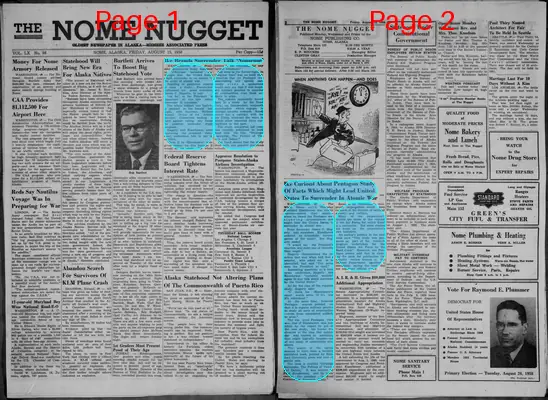
The Nome Nugget
Nome, Nome County, Alaska
What is this article about?
President Eisenhower dismissed rumors of a Pentagon study on U.S. surrender in atomic war as nonsense, reacting with curiosity rather than anger. The controversy stemmed from a Rand Corporation book on strategic surrender, debated in the Senate.
Merged-components note: Continuation of the same article about President Eisenhower's reaction to the Pentagon surrender study across pages.
Clippings
1 of 2
OCR Quality
Full Text
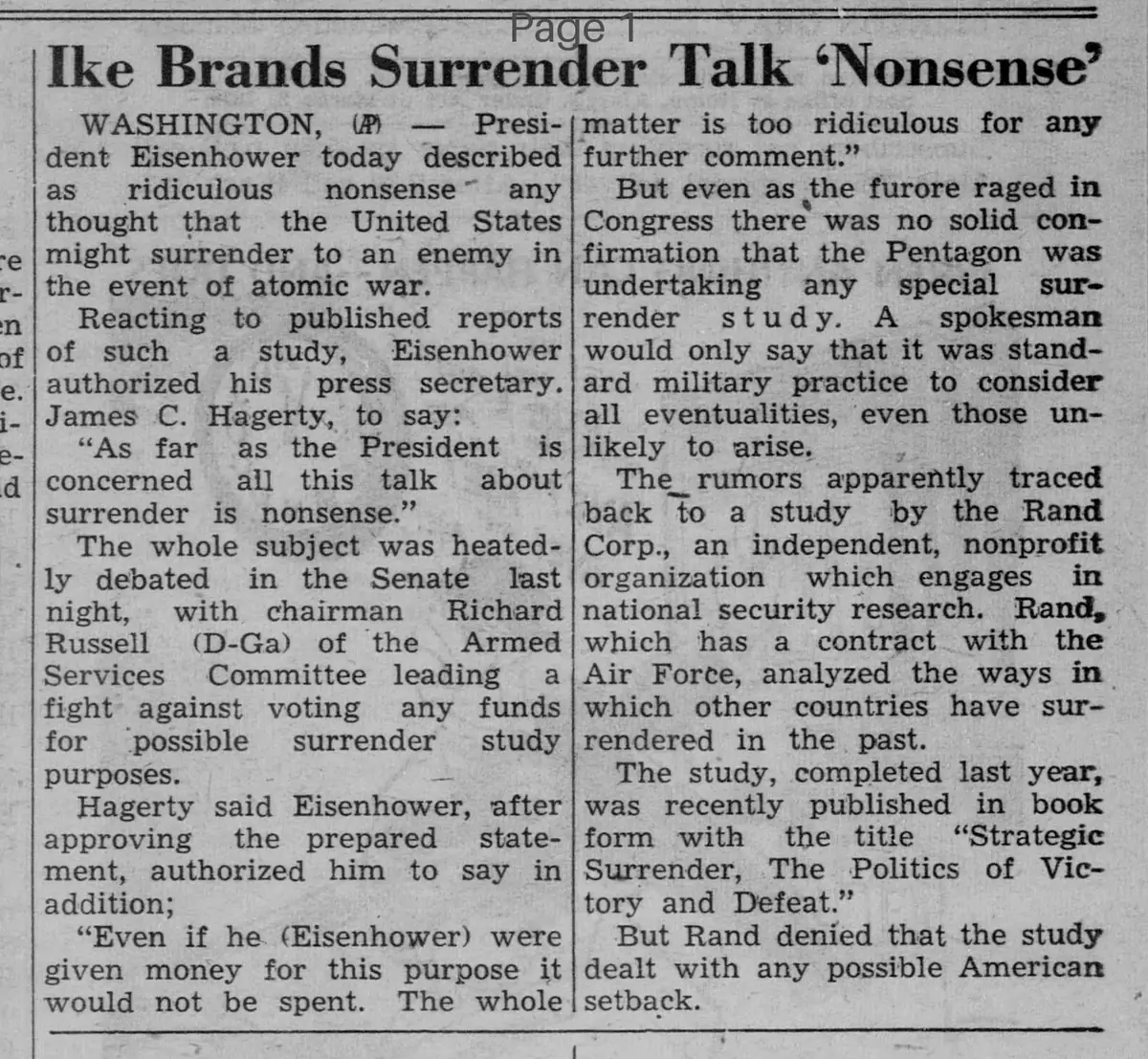
WASHINGTON, (AP) President Eisenhower today described as ridiculous nonsense any thought that the United States might surrender to an enemy in the event of atomic war.
Reacting to published reports of such a study, Eisenhower authorized his press secretary, James C. Hagerty, to say:
"As far as the President is concerned all this talk about surrender is nonsense."
The whole subject was heatedly debated in the Senate last night, with chairman Richard Russell (D-Ga) of the Armed Services Committee leading a fight against voting any funds for possible surrender study purposes.
Hagerty said Eisenhower, after approving the prepared statement, authorized him to say in addition;
"Even if he (Eisenhower) were given money for this purpose it would not be spent. The whole matter is too ridiculous for any further comment."
But even as the furore raged in Congress there was no solid confirmation that the Pentagon was undertaking any special surrender study. A spokesman would only say that it was standard military practice to consider all eventualities, even those unlikely to arise.
The rumors apparently traced back to a study by the Rand Corp., an independent, nonprofit organization which engages in national security research. Rand which has a contract with the Air Force, analyzed the ways in which other countries have surrendered in the past.
The study, completed last year, was recently published in book form with the title "Strategic Surrender, The Politics of Victory and Defeat."
But Rand denied that the study dealt with any possible American setback.
Ike Curious About Pentagon Study
Of Facts Which Might Lead United
States To Surrender In Atomic War
WASHINGTON, (AP) The White House said Thursday President Eisenhower was mostly curious-rather than angry-- when he heard the Pentagon was studying circumstances that might lead the United States to surrender in atomic war.
Press Secretary James C. Hagerty told newsmen Eisenhower ordered an immediate investigation of the report. But Hagerty added:
"I would say the President's reaction was more one of curiosity than anger."
Hagerty characterized the reaction that way when told that a senator, who asked not to be identified, had said "I've never seen the President so mad."
Answering questions at a later news conference, Hagerty said Eisenhower "certainly wouldn't agree to any talk about surrender by the United States."
As for the idea of the reported study, Hagerty said:
"I think his (Eisenhower's) exact words were, If it's true it's ridiculous'."
At the same time, however, Pentagon sources pointed out that it is regular military practice to study all sorts of eventualities -even those considered unlikely to arise."
The top level Pentagon view was that if Eisenhower was horrified by the report he got on the new study, his horror was directed at the idea that surrender was treated as something that might logically happen--not at any study of conceivable situations.
The source of the uproar seemed to have been a recently published book, printed by Stanford University press and now on public sale.
The book is entitled "Strategic Surrender, The Politics of Victory and Defeat." It was written by Paul Kecskemeti, and its cover carries the notation "A Rand Corporation Research Study."
Rand is an independent, non-profit organization which does research in the interest of national security and welfare.
Many of the corporation's studies are made at the request of the Air Force, for which Rand is a contractor.
But some studies are made on the corporation's own initiative.
An author's preface in the new book says "This study was prepared as part of the research program undertaken for the United States Air Force by the Rand Corp.
However, one Pentagon source said that in clearing the book for publication the security review branch of the Defense Department specified a disclaimer, saying the book did not represent official views.
What sub-type of article is it?
What keywords are associated?
What entities or persons were involved?
Where did it happen?
Domestic News Details
Primary Location
Washington
Event Date
Thursday
Key Persons
Outcome
eisenhower authorized statements calling the surrender talk nonsense and ridiculous; senate debated against funding such studies; pentagon confirmed standard practice to consider eventualities; rand denied the study applied to american setbacks.
Event Details
President Eisenhower reacted to reports of a Pentagon study on circumstances leading to U.S. surrender in atomic war, describing it as ridiculous nonsense. Press secretary James C. Hagerty conveyed Eisenhower's curiosity and dismissal. Senate Armed Services Committee chairman Richard Russell led opposition to funding. Rumors originated from a Rand Corporation book 'Strategic Surrender, The Politics of Victory and Defeat' by Paul Kecskemeti, analyzing historical surrenders but not U.S. scenarios.