Thank you for visiting SNEWPapers!
Sign up free
Story
July 2, 1878
The Canton Advocate
Canton, Lincoln County, South Dakota
What is this article about?
Detailed description of the shared tomb beneath the Unitarian church in Quincy, Massachusetts, where Presidents John Adams and John Quincy Adams are buried, including inscriptions on their memorial tablets honoring their lives, patriotism, and virtues.
Clipping
OCR Quality
98%
Excellent
Full Text
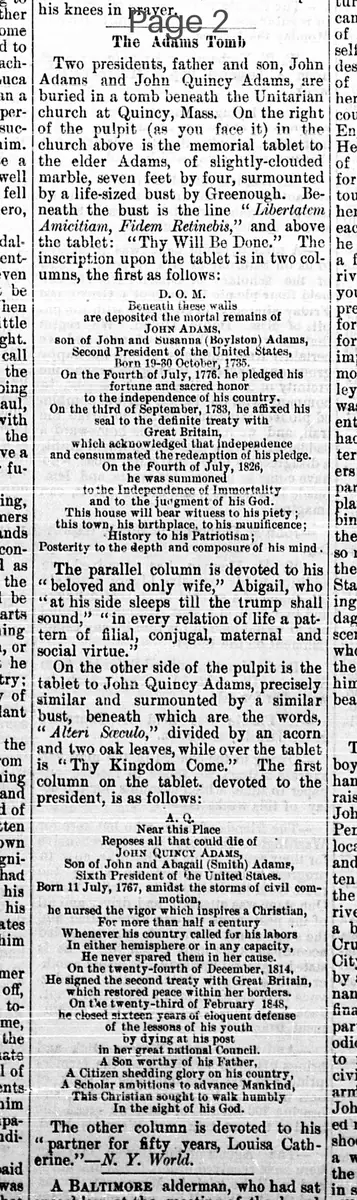
The Adams Tomb
Two presidents, father and son, John Adams and John Quincy Adams, are buried in a tomb beneath the Unitarian church at Quincy, Mass. On the right of the pulpit (as you face it) in the church above is the memorial tablet to the elder Adams, of slightly-clouded marble, seven feet by four, surmounted by a life-sized bust by Greenough. Beneath the bust is the line "Libertatem Amicitiam, Fidem Retinebis," and above the tablet: "Thy Will Be Done." The inscription upon the tablet is in two columns, the first as follows:
D.O.M.
Beneath these walls are deposited the mortal remains of John Adams, son of John and Susanna (Boylston) Adams, Second President of the United States, Born 19-30 October, 1735.
On the Fourth of July, 1776, he pledged his fortune and sacred honor to the independence of his country.
On the third of September, 1783, he affixed his seal to the definite treaty with Great Britain, which acknowledged that independence and consummated the redemption of his pledge.
On the Fourth of July, 1826, he was summoned to the Independence of Immortality and to the judgment of his God.
This house will bear witness to his piety; this town, his birthplace, to his munificence; History to his Patriotism; Posterity to the depth and composure of his mind.
The parallel column is devoted to his "beloved and only wife," Abigail, who "at his side sleeps till the trump shall sound," "in every relation of life a pattern of filial, conjugal, maternal and social virtue."
On the other side of the pulpit is the tablet to John Quincy Adams, precisely similar and surmounted by a similar bust, beneath which are the words, "Alteri Saeculo," divided by an acorn and two oak leaves, while over the tablet is "Thy Kingdom Come." The first column on the tablet, devoted to the president, is as follows:
Near this Place Reposes all that could die of John Quincy Adams,
Son of John and Abigail (Smith) Adams, Sixth President of the United States.
Born 11 July, 1767, amidst the storms of civil commotion, he nursed the vigor which inspires a Christian,
For more than half a century Whenever his country called for his labors In either hemisphere or in any capacity, He never spared them in her cause.
On the twenty-fourth of December, 1814, He signed the second treaty with Great Britain, which restored peace within her borders.
On the twenty-third of February 1848, he closed sixteen years of eloquent defense of the lessons of his youth by dying at his post in her great national Council.
A Son worthy of his Father, A Citizen shedding glory on his country, A Scholar ambitious to advance Mankind This Christian sought to walk humbly In the sight of his God.
The other column is devoted to his "partner for fifty years, Louisa Catherine." N. Y. World.
Two presidents, father and son, John Adams and John Quincy Adams, are buried in a tomb beneath the Unitarian church at Quincy, Mass. On the right of the pulpit (as you face it) in the church above is the memorial tablet to the elder Adams, of slightly-clouded marble, seven feet by four, surmounted by a life-sized bust by Greenough. Beneath the bust is the line "Libertatem Amicitiam, Fidem Retinebis," and above the tablet: "Thy Will Be Done." The inscription upon the tablet is in two columns, the first as follows:
D.O.M.
Beneath these walls are deposited the mortal remains of John Adams, son of John and Susanna (Boylston) Adams, Second President of the United States, Born 19-30 October, 1735.
On the Fourth of July, 1776, he pledged his fortune and sacred honor to the independence of his country.
On the third of September, 1783, he affixed his seal to the definite treaty with Great Britain, which acknowledged that independence and consummated the redemption of his pledge.
On the Fourth of July, 1826, he was summoned to the Independence of Immortality and to the judgment of his God.
This house will bear witness to his piety; this town, his birthplace, to his munificence; History to his Patriotism; Posterity to the depth and composure of his mind.
The parallel column is devoted to his "beloved and only wife," Abigail, who "at his side sleeps till the trump shall sound," "in every relation of life a pattern of filial, conjugal, maternal and social virtue."
On the other side of the pulpit is the tablet to John Quincy Adams, precisely similar and surmounted by a similar bust, beneath which are the words, "Alteri Saeculo," divided by an acorn and two oak leaves, while over the tablet is "Thy Kingdom Come." The first column on the tablet, devoted to the president, is as follows:
Near this Place Reposes all that could die of John Quincy Adams,
Son of John and Abigail (Smith) Adams, Sixth President of the United States.
Born 11 July, 1767, amidst the storms of civil commotion, he nursed the vigor which inspires a Christian,
For more than half a century Whenever his country called for his labors In either hemisphere or in any capacity, He never spared them in her cause.
On the twenty-fourth of December, 1814, He signed the second treaty with Great Britain, which restored peace within her borders.
On the twenty-third of February 1848, he closed sixteen years of eloquent defense of the lessons of his youth by dying at his post in her great national Council.
A Son worthy of his Father, A Citizen shedding glory on his country, A Scholar ambitious to advance Mankind This Christian sought to walk humbly In the sight of his God.
The other column is devoted to his "partner for fifty years, Louisa Catherine." N. Y. World.
What sub-type of article is it?
Biography
Historical Event
What themes does it cover?
Family
Moral Virtue
Providence Divine
What keywords are associated?
Adams Tomb
John Adams
John Quincy Adams
Quincy Massachusetts
Presidential Memorial
Unitarian Church
What entities or persons were involved?
John Adams
John Quincy Adams
Abigail Adams
Louisa Catherine Adams
Where did it happen?
Unitarian Church At Quincy, Mass.
Story Details
Key Persons
John Adams
John Quincy Adams
Abigail Adams
Louisa Catherine Adams
Location
Unitarian Church At Quincy, Mass.
Event Date
Born 19 30 October, 1735; Born 11 July, 1767; Died 4 July, 1826; Died 23 February 1848
Story Details
Description of the tomb and memorial tablets for Presidents John Adams and John Quincy Adams and their wives, highlighting their patriotic service, virtues, and Christian faith.