Thank you for visiting SNEWPapers!
Sign up free
Herald Of The United States
Warren, Bristol County, Rhode Island
What is this article about?
In February 1806, U.S. Major M. Porter ordered Capt. Edward D. Turner to remove Spanish troops from east of the Sabine River near Adais. Turner confronted the Spanish post, negotiated with commandant Joseph Maria Gonzalez, who agreed to withdraw within five or six days.
Merged-components note: Continuation of domestic news report across pages, text flows directly from 'Sa-' to 'be on your guard'.
Clippings
1 of 2
OCR Quality
Full Text
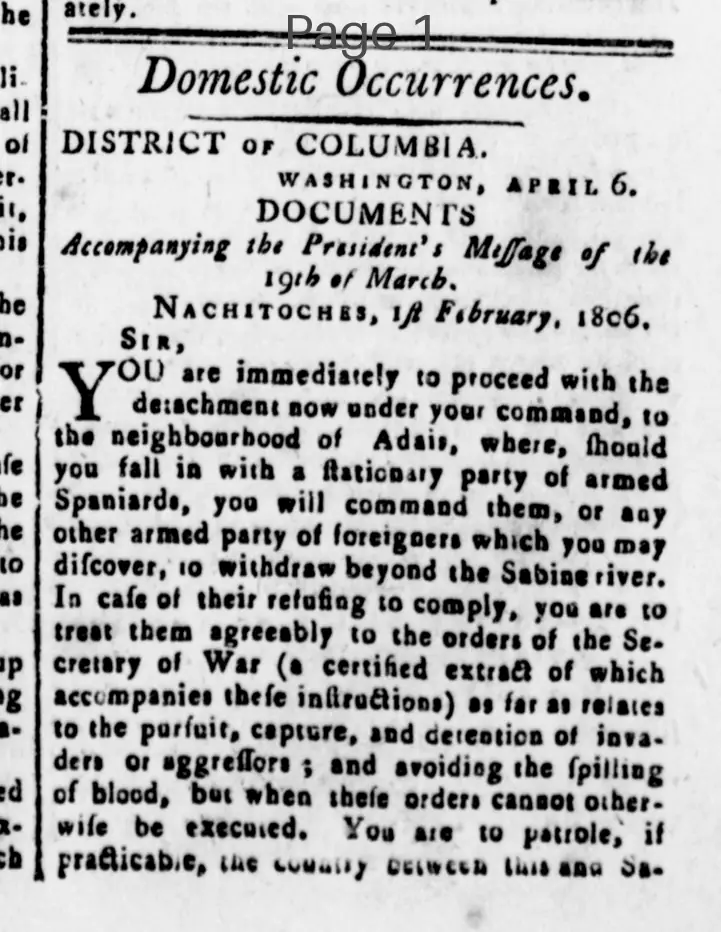
DISTRICT of COLUMBIA.
WASHINGTON, APRIL 6.
DOCUMENTS
Accompanying the President's Message of the
19th of March.
Natchitoches, 1 February, 1806.
SIR,
You are immediately to proceed with the
detachment now under your command, to
the neighbourhood of Adais, where, should
you fall in with a stationary party of armed
Spaniards, you will command them, or any
other armed party of foreigners which you may
discover, to withdraw beyond the Sabine river.
In case of their refusing to comply, you are to
treat them agreeably to the orders of the Secretary of War (a certified extract of which
accompanies these instructions) as far as relates to the pursuit, capture, and detention of invaders or aggressors; and avoiding the spilling of blood, but when these orders cannot otherwise be executed. You are to patrol; if
practicable, the country between this and Sa-
bine on your guard against surprise, and communicate to me, by express from time to time, any occurrence worthy of note.
(Signed)
M. PORTER,
Major Artillery, Commanding.
Capt. Edward D. Turner,
2d regiment Infantry.
Adais, Feb. 6, 1806.
After a tedious march we arrived in front of the Spanish post yesterday morning about half past eleven o'clock. Found the Dons in some confusion, in consequence of their patrols having discovered us an hour before, (owing to our pilot bringing us in sight of the road) I took a position which would have carried their camp, if there had been ten times their number, which was twenty.
They saddled, mounted and formed. At the bayou Le Glaize, their patrol or picket, halted our vanguard, and demanded the reason we were violating or invading his majesty's territory, and requested him to withdraw with his guard inside his camp, where I would presently be, and inform his officers of my business. He implicitly obeyed. Upon my arrival at my position, I sent Mr. Daforest to tell the officer I wished a conference. Mr. Daforest was informed, in consequence of some information the corporal of the advanced guard had given, the officer had gone down the road to meet me. I waited some time his return, but not seeing him, I suspected he had purposely put himself out of the way to gain time. I, therefore, after sending another message to the camp, formed my men, and marched through a thicket which in forty yards, where I halted, and told the non-commissioned officer commanding that I should wait fifteen minutes for his officer, provided he made no movements in the interim.
The officer soon after appeared, when I delivered him my commands. He readily agreed to abandon his position, but said he could go no further than a creek, San Jose. After a good deal of altercation, he consented to move to the other side Sabine, and I gave him three hours to prepare to march. He begged I would not insist upon his crossing the Sabine, within five days, alleging that in the miserable condition of his horses, it would be impossible, without losing them, and requested that he might be allowed to look up some that were missing. I replied, that after reaching the other side Sabine, he might send in two or three men, without arms, to hunt them; and that he must get them as soon as possible. He replied he would, but it would necessarily take him four or five days.
This morning I commenced my march for La Tranche, and fell in with him in three miles. I signified my surprise at his being no further, he made the old excuse of the impossibility of his horses to travel faster, and observed that he had been detained in trying to find some of his horses, two of which he had got, and four were missing. Not thinking it proper to rely exactly again on his word, after finishing with him, I made him subscribe to the enclosed terms, (which I hope may meet your approbation) and shall follow his footsteps till my provisions are out.
Respectfully yours,
(Signed)
E. D. TURNER.
To Major Moses Porter.
At the Adais, Feb. 6, 1806.
I Joseph Maria Gonzalez, enigo, commandant of his Most Catholic Majesty's troops on this side of the river Sabinas, have agreed with Captain Edward D. Turner, Captain in the United States army, to return all said troops of his Catholic Majesty to the other side of the said river Sabinas, as soon as my horses will permit it, or in five days, or at furthest six, and to take my march this day. And I also oblige myself not to send any patrols on this side the river Sabinas.
(Signed)
Enigo Joseph Maria Gonzalez.
Witness,
(Signed) John V. Duforest.
What sub-type of article is it?
What keywords are associated?
What entities or persons were involved?
Where did it happen?
Domestic News Details
Primary Location
Adais
Event Date
February 1806
Key Persons
Outcome
spanish troops agreed to withdraw beyond the sabine river within five or six days; no bloodshed occurred.
Event Details
U.S. forces under Capt. Turner confronted a Spanish post of 20 men at Adais, ordered them to withdraw east of the Sabine River per Major Porter's instructions. After negotiation, Spanish commandant Gonzalez signed an agreement to retreat and cease patrols on the U.S. side.