Thank you for visiting SNEWPapers!
Sign up free
The Massachusetts Spy, Or, Thomas's Boston Journal
Boston, Suffolk County, Massachusetts
What is this article about?
London intelligence from May 4-14, 1774, reports on lottery compensation for American merchants affected by Boston Bills, military musters in Britain, French-Spanish naval superiority in Mediterranean, Duke and Duchess of Cumberland's visit to France, political rumors on American taxes and commands, parliamentary proceedings, administration changes, and European diplomatic speculations amid potential royal successions.
Merged-components note: These components continue the same article on intelligence from London, with sequential reading order across pages 1 and 2.
Clippings
1 of 2
OCR Quality
Full Text
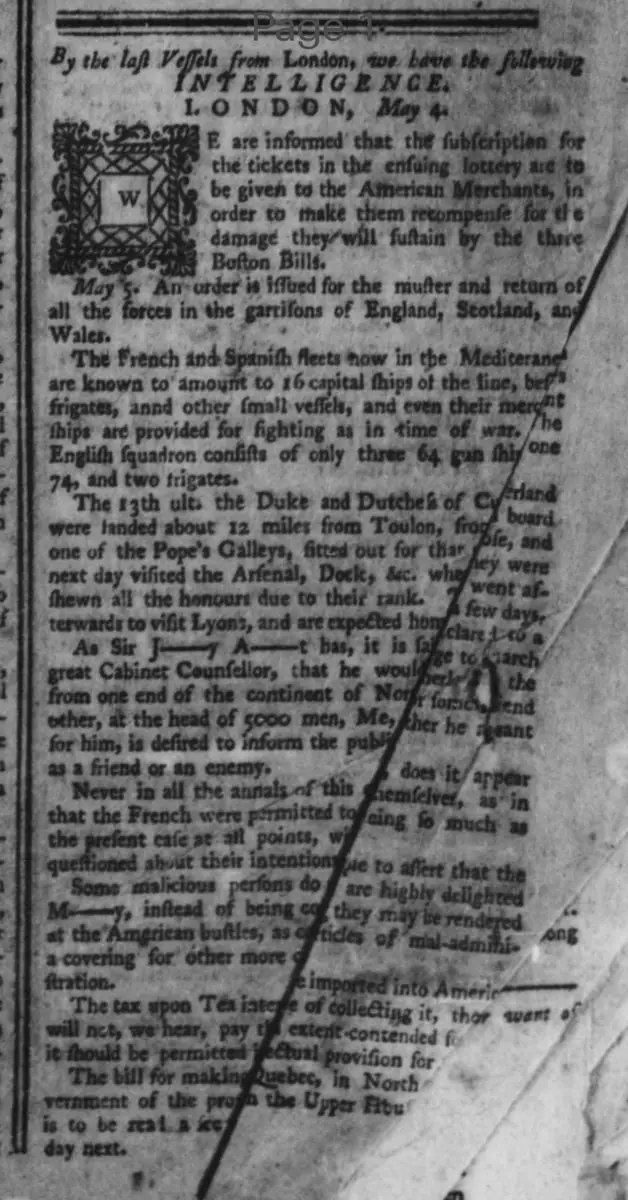
INTELLIGENCE
LONDON, May 4
We are informed that the subscription for
the tickets in the ensuing lottery are to
be given to the American Merchants, in
order to make them recompense for the
damage they will sustain by the
Boston Bills.
May 5. An order is issued for the muster and return of
all the forces in the garrisons of England, Scotland, and
Wales.
The French and Spanish Fleets now in the Mediterranean
are known to amount to 16 capital ships of the line, besides
frigates, and other small vessels, and even their merchant
ships are provided for fighting as in time of war.
The
English squadron consists of only three 64 gun ships,
one 74, and two frigates.
The 13th ult. the Duke and Duchess of Cumberland
were landed about 12 miles from Toulon, from on board
one of the Pope's Galleys, fitted out for their
use, and
next day visited the Arsenal, Dock, &c. where they were
shown all the honours due to their rank.
Afterwards to visit Lyons, and are expected home in a
few days.
As Sir Iy A-t has, it is said,
resigned his place as
great Cabinet Counsellor, that he would hear from
one end of the continent of North America to the
other, at the head of 20000 men, whether he came as a friend or an enemy.
Some malicious persons are highly delighted
at the American bustles, as they serve
as articles of mal-administration,
long a covering for other more
of the administration.
The tax upon Tea, instead
of collecting it, through want
will not, we hear, pay the expense; it is contended
it should be permitted with equal provision for
: ; The bill for making Purbeck, in North
Devon, for the improvement of the growth
of corn,
is to be brought in next day.
The rejoicing contempt with which the Petitioners re-
cevied all the offers of the Rockingham and Shelburne gangs,
is never to be forgotten; hence, says our correspondent, the
malignity of Polypheme, the hungry turbulence of Edmund,
S--ge, the omniferous ditties of D--l, and the
pert nothingness of B--g, the Oliverian bronze of
the cadaverous blasts of an old Dog-Rose:
We hear that Lord Chatham will be in his place at the
House of Peers to-morrow, when the American bill is to
be taken into consideration; but few doubt its passing, as
in the other House:
From. After he was raised to the above dignity, he paid a
pay a visit to Paris, it is supposed it is not a mere visit of
As the Emperor of Germany is this month expected to
visit to the King of Prussia, and had some private conferences
with that Monarch, from which a lasting friendship seemed
to be cemented, and by the late acquisitions in Poland he
appears to have profited by it. What the issue of his pre-
sent intended visit to France may be, time will discover;
but as dominions are so easily dealt out of late, some states
are not quite easy on the subject.
What is the intention of taxing America, only to parti-
cularly bring into the Treasury a certain sum for the use of the
K-g and the Minister—while at the same time the nation
loses three millions annually?
May 6. A motion was made for leave to bring in a Bill
relative to subscription to the 39 Articles. Rejected
without a division.
May 7. It is whispered that the Duke of Grafton is
again coming into Administration; and that a resignation
will very shortly take place, in order to make way for him.
It is also said, that Lord Camden will be again at the head
of the law before the general election. If these facts should
happen, it is evident they are intended only to serve some
private purposes, and therefore are not likely to be of a very
late debate.
May 14. There is no doubt but the death of a great
monarch will make a great and sudden revolution in the po-
litical world, especially if that event should be succeeded by
another in the north, the ambition of the one, and the suc-
cessful operations of the other, for some years past, have
been the great springs of the political machine; France has
long been convulsed and influenced by gallantry, which has
so much enervated the government of that vast empire, that
the French have been in a state of the most inglorious in-
activity. A young monarch, inspired with manly sentiments,
and animated for his own glory and the happiness of his
subjects, will necessarily endeavour, by an opposite conduct,
to rouse the nation from that inactivity to which it has been
reduced from the intrigues of female favourites; whilst a
successor to the northern hero will entirely change the face
of politics in that part of the globe, and it will be a very
arduous task for the able politicians of Europe to bear the
shock, which two such events, whenever they happen, will
give to the balance of power in Europe.
The same correspondent observes, that if the events talk-
ed of should happen, it will greatly convulse this nation,
and destroy the minister's plan of conduct for America.
Then, as a noble Duke has justly observed, the ministry
will have so much to attend to from abroad, that it will be
highly impolitic to disagree with the Americans, with
whom they will be under the necessity of immediate recon-
ciliation, as it is probable we shall have a war soon after the
accession of new sovereigns to the thrones alluded to.
After the breaking up of the council at St. James's on
Thursday, three messengers were sent off with expresses:
one to the Hague, Madrid, and Lisbon, one to Vienna,
after which he is to proceed to Berlin and Petersburg; and
the last to Constantinople. Expresses were likewise sent off
yesterday to Copenhagen and Stockholm.
A full call of the two houses is issuing out for the 6th
of June, when the Lords of the Admiralty and commis-
sioners of the navy are to attend them with their separate ac-
counts. The committees also for enquiring into American
affairs are to attend the house of lords
with their report.
A certain great personage seems greatly disconcerted at the
reports of the day, as he has great reason to think that his
pacific plan will be destroyed, and a revolution take place in
the political world. The premier is often consulted, and
he is not without his fears that he will prove a false prophet,
with regard to a ten years peace. A little time will give
vigour to the conduct of every European power, that has
any regard for its own safety, and Great-Britain will have
enough to do from the conduct of other states, without
quarrelling with her colonies, and losing her time and sub-
stance after moonshine plans in the east.
From Lloyd's Evening Post, May 14, 1774.
What sub-type of article is it?
What keywords are associated?
What entities or persons were involved?
Where did it happen?
Foreign News Details
Primary Location
London
Event Date
May 4 14, 1774
Key Persons
Event Details
Reports from London detail a lottery subscription allocated to American merchants as recompense for damages from Boston Bills; an order for mustering forces across England, Scotland, and Wales; French and Spanish fleets in the Mediterranean totaling 16 ships of the line plus others prepared for war, contrasting with the smaller English squadron of three 64-gun ships, one 74-gun ship, and two frigates; the Duke and Duchess of Cumberland landing near Toulon on the 13th ult., visiting the arsenal and receiving honors, then proceeding to Lyons before returning home; rumors of Sir Iy A-t resigning his position and potentially leading 20,000 men across North America; malicious delight among some at American unrest as cover for administration malpractices; debates on tea tax collection expenses and permissions; a bill for improving corn growth in North Devon; contemptuous rejection of offers by petitioners from Rockingham and Shelburne factions, criticizing various political figures; Lord Chatham's expected attendance for consideration of the American bill; the Emperor of Germany's recent conferences with the King of Prussia and impending visit to France amid concerns over territorial dealings; questions on the purpose of taxing America benefiting the King and Minister at national loss; rejection of a motion for a bill on subscription to the 39 Articles; whispers of the Duke of Grafton re-entering administration and Lord Camden heading the law; speculations on revolutions following the death of a great monarch and a northern successor altering European politics, potentially disrupting British plans for America and necessitating reconciliation; dispatch of messengers to The Hague, Madrid, Lisbon, Vienna, Berlin, Petersburg, Constantinople, Copenhagen, and Stockholm; a call of both houses for June 6 to review Admiralty and navy accounts and American inquiry reports; a great personage's discomfiture over threats to pacific plans.