Thank you for visiting SNEWPapers!
Sign up free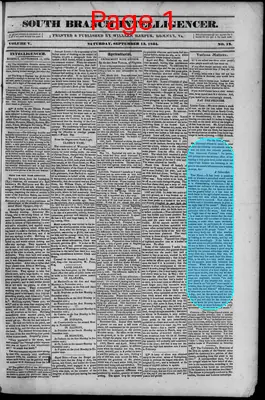
Letter to Editor
September 13, 1834
South Branch Intelligencer
Romney, Hampshire County, West Virginia
What is this article about?
A subscriber to the Intelligencer submits an excerpt from 'The American Farmer' debunking the superstition of the moon's influence on weather, crops, and farming activities like planting and harvesting. It argues that such beliefs harm agriculture and advises farmers to act based on actual conditions rather than lunar phases.
Clipping
OCR Quality
98%
Excellent
Full Text
For the Intelligencer.
MR. HARPER—Please to insert in your columns the following very sensible article. It was cut from that valuable periodical, "The American Farmer." Its perusal will perhaps have the salutary effect of dissipating a very gross error, under which too many of our farmers are labouring, in regard to the moon's influence on the weather, on crops, &c.
A Subscriber.
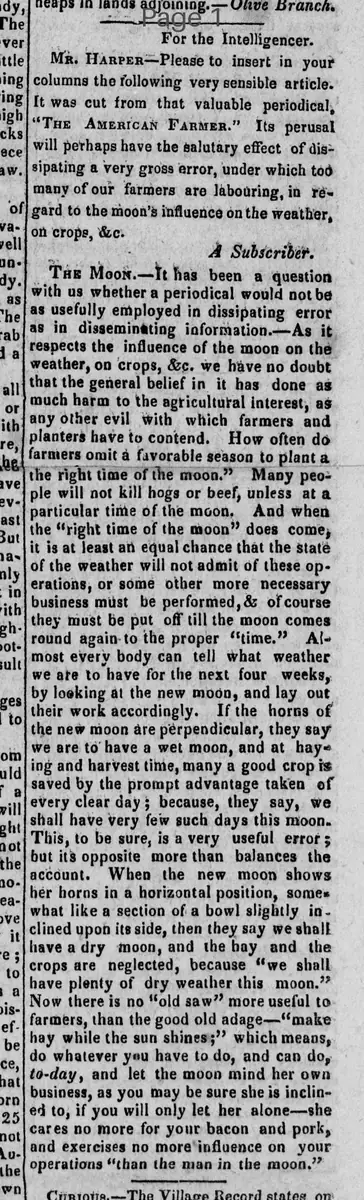
The Moon.—It has been a question with us whether a periodical would not be as usefully employed in dissipating error as in disseminating information.—As it respects the influence of the moon on the weather, on crops, &c. we have no doubt that the general belief in it has done as much harm to the agricultural interest, as any other evil with which farmers and planters have to contend. How often do farmers omit a favorable season to plant a crop, because it is not "the right time of the moon." Many people will not kill hogs or beef, unless at a particular time of the moon. And when the "right time of the moon" does come, it is at least an equal chance that the state of the weather will not admit of these operations, or some other more necessary business must be performed, & of course they must be put off till the moon comes round again—to the proper "time." Almost every body can tell what weather we are to have for the next four weeks, by looking at the new moon, and lay out their work accordingly. If the horns of the new moon are perpendicular, they say we are to have a wet moon, and at haying and harvest time, many a good crop is saved by the prompt advantage taken of every clear day; because, they say, we shall have very few such days this moon. This, to be sure, is a very useful error; but its opposite more than balances the account. When the new moon shows her horns in a horizontal position, somewhat like a section of a bowl slightly inclined upon its side, then they say we shall have a dry moon, and the hay and the crops are neglected, because "we shall have plenty of dry weather this moon." Now there is no "old saw" more useful to farmers, than the good old adage—"make hay while the sun shines;" which means, do whatever you have to do, and can do, to-day, and let the moon mind her own business, as you may be sure she is inclined to, if you will only let her alone—she cares no more for your bacon and pork, and exercises no more influence on your operations "than the man in the moon."
MR. HARPER—Please to insert in your columns the following very sensible article. It was cut from that valuable periodical, "The American Farmer." Its perusal will perhaps have the salutary effect of dissipating a very gross error, under which too many of our farmers are labouring, in regard to the moon's influence on the weather, on crops, &c.
A Subscriber.
The Moon.—It has been a question with us whether a periodical would not be as usefully employed in dissipating error as in disseminating information.—As it respects the influence of the moon on the weather, on crops, &c. we have no doubt that the general belief in it has done as much harm to the agricultural interest, as any other evil with which farmers and planters have to contend. How often do farmers omit a favorable season to plant a crop, because it is not "the right time of the moon." Many people will not kill hogs or beef, unless at a particular time of the moon. And when the "right time of the moon" does come, it is at least an equal chance that the state of the weather will not admit of these operations, or some other more necessary business must be performed, & of course they must be put off till the moon comes round again—to the proper "time." Almost every body can tell what weather we are to have for the next four weeks, by looking at the new moon, and lay out their work accordingly. If the horns of the new moon are perpendicular, they say we are to have a wet moon, and at haying and harvest time, many a good crop is saved by the prompt advantage taken of every clear day; because, they say, we shall have very few such days this moon. This, to be sure, is a very useful error; but its opposite more than balances the account. When the new moon shows her horns in a horizontal position, somewhat like a section of a bowl slightly inclined upon its side, then they say we shall have a dry moon, and the hay and the crops are neglected, because "we shall have plenty of dry weather this moon." Now there is no "old saw" more useful to farmers, than the good old adage—"make hay while the sun shines;" which means, do whatever you have to do, and can do, to-day, and let the moon mind her own business, as you may be sure she is inclined to, if you will only let her alone—she cares no more for your bacon and pork, and exercises no more influence on your operations "than the man in the moon."
What sub-type of article is it?
Informative
Persuasive
What themes does it cover?
Agriculture
What keywords are associated?
Moon Influence
Agricultural Superstitions
Weather Myths
Farming Errors
Lunar Phases
Crop Neglect
What entities or persons were involved?
A Subscriber
Mr. Harper
Letter to Editor Details
Author
A Subscriber
Recipient
Mr. Harper
Main Argument
the belief in the moon's influence on weather and crops is a harmful superstition that causes farmers to miss opportunities; they should ignore it and act based on actual conditions, as the moon has no real effect on agricultural operations.
Notable Details
Excerpt From 'The American Farmer'
Examples Of Superstitions: Planting At 'Right Time Of The Moon', Killing Hogs Or Beef At Specific Lunar Phases
Weather Predictions Based On New Moon's Horns: Perpendicular For Wet, Horizontal For Dry
Adage: 'Make Hay While The Sun Shines'