Thank you for visiting SNEWPapers!
Sign up free
Gazette Of The United States, & Philadelphia Daily Advertiser
Philadelphia, Philadelphia County, Pennsylvania
What is this article about?
President's message to Congress on May 8, 1798, defending the Jay Treaty against French objections. Argues US treaties with Britain do not expand contraband beyond law of nations, uphold neutrality, and promote commerce without harming allies. Addresses provisions, blockades, and negotiation transparency.
Merged-components note: This is the full text of the President's message to Congress, continued across pages; relabeled the second part from foreign_news to domestic_news as it pertains to U.S. policy and treaties.
Clippings
1 of 2
OCR Quality
Full Text
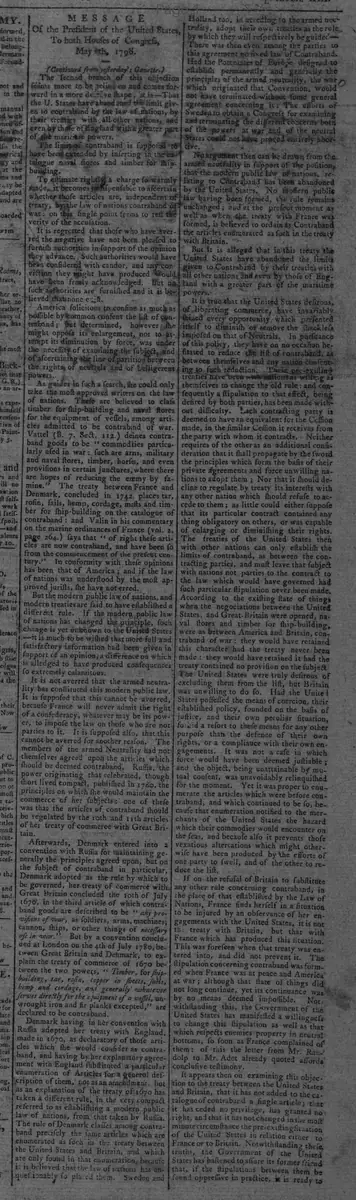
Of the President of the United States
To both Houses of Congress,
May 8th, 1798.
(Continued from yesterday's Gazette.)
The second branch of this objection
seems more to be relied on and comes forward
in a more decisive shape, it is-That the
U. States have abandoned the limit given
to contraband by the law of nations, by
their treaties with all other nations, and
even by those of England with a greater part
of the maritime powers.
The limit of contraband is supposed to
have been extended by inserting in the catalogue
naval stores and timber for ship-building.
To estimate rightly a charge so warmly
made, it becomes indispensable to ascertain
whether those articles are, independent of
treaty, by the law of nations contraband of
war: on this single point seems to rest the
verity of the accusation.
It is regretted that those who have averred
the negative have not been pleased to furnish
authorities in support of the opinion they
advance. Such authorities would have been
considered with candor, and any conviction
they might have produced would have been
freely acknowledged. But no such authorities
are furnished and it is believed that none exist.
America solicitous to confine as much as
possible by common consent the list of contraband;
but determined, however She might oppose its
enlargement, not to attempt its diminution by
force, was under the necessity of examining
the subject, and of ascertaining the line of
partition between the rights of neutrals and
of belligerent powers.
As guides in such a search, she could only
take the most approved writers on the law
of nations. These are believed to class timber
for ship-building and naval stores for the
equipment of vessels, among articles admitted
to be contraband of war.
Vattel (B. 3. Sect. 112.) defines contraband
goods to be "commodities particularly used
in war: such are arms, military and naval
stores, timber, horses, and even provisions in
certain junctures, where there are hopes of
reducing the enemy by famine." The treaty
between France and Denmark, concluded in
1742, places tar, resin, sails, hemp, cordage,
masts and timber for ship-building on the
catalogue of contraband: and Valin in his
commentary on the marine ordinances of
France (vol. 3, page 264.) says that "of right
these articles are now contraband, and have
been so from the commencement of the present
century."* In conformity with these opinions
has been that of America; and if the law of
nations was understood by the most approved
jurists, she have not erred.
But the modern public law of nations, and
modern treaties are said, to have established a
different rule. If the modern public law of
nations has changed the principle, such change
is yet unknown to the United States--it is
much to be wished that more full and satisfactory
information had been given in support of an
opinion, a difference on which is alleged to
have produced consequences so extremely
calamitous.
It is not averred that the armed neutrality
has constituted this modern public law. It is
supposed that this cannot be averred, because
France will never admit the right of a
confederacy, whatever may be its power, to
impose the law on those who are not parties
to it. It is supposed also, that this cannot be
averred for another reason. The members of
the armed Neutrality had not themselves
agreed upon the articles which should be
deemed contraband. Russia, the power
originating that celebrated, though short lived
compact, published in 1780, the principles on
which she would maintain the commerce of
her subjects: one of these was that the articles
of contraband should be regulated by the 20th
and 21st articles of her treaty of commerce
with Great Britain.
Afterwards, Denmark entered into a
convention with Russia for maintaining generally
the principles agreed upon, but on the subject
of contraband in particular, Denmark adopted
as the rule by which to be governed, her treaty
of commerce with Great Britain concluded
the 10th of July 1670, in the third article of
which contraband goods are described to be
"any provisions of war, as soldiers, arms,
machines, cannon, ships, or other things of
necessary use in war." But by a convention
concluded at London on the 4th of July 1780,
between Great Britain and Denmark, to explain
the treaty of commerce of 1670 between the
two powers, "Timber, for ship-building, tar,
resin, copper in sheets, sails, hemp and
cordage, and generally such whatever serves
directly for the equipment of a vessel, unwrought
iron and fir planks excepted," are declared to
be contraband.
Denmark having in her convention with
Russia adopted her treaty with England, made
in 1670, as declaratory of those articles which
she would consider as contraband, and having
by her explanatory agreement with England
substituted a particular enumeration of Articles
for a general description of them, not as an
amendment, but as an explanation of the treaty
of 1670 has taken a different rule, in the very
compact referred to as establishing a modern
public law of nations, from that taken by
Russia.
The rule of Denmark classes among contraband
precisely the same articles which are enumerated
as such in the treaty between the United States
and Britain, and which are only found in that
enumeration, because it is believed that the law
of nations has unquestionably so placed them.
Sweden and Holland too, in acceding to the
armed neutrality, adopt their own treaties as
the rule by which they will respectively be
guided. There was then even among the parties
to this agreement no fixed law of Contraband.
Had the Potentates of Europe deigned to
establish permanently and generally the principles
of the armed neutrality, the war which originated
that Convention, would not have terminated
without some general agreement concerning it;
The efforts of Sweden to obtain a Congress for
examining and terminating the different concerns
both of the powers at war and of the neutral
States could not have proved entirely abortive.
No argument then can be drawn from the
armed neutrality in support of the position that
the modern public law of nations relating to
Contraband has been abandoned by the United
States. No modern public law having been
formed, the rule remains unchanged; and at the
present moment as well as when the treaty with
France was formed, is believed to ordain as
Contraband the articles enumerated as such in
the treaty with Britain.
But it is alleged that in this treaty the United
States have abandoned the limits given to
Contraband by their treaties with all other
nations and even by those of England with a
greater part of the maritime powers.
It is true that the United States desirous of
liberating commerce, have invariably seized
every opportunity, which presented itself to
diminish or remove the shackles imposed on
that of Neutrals. In pursuance of this policy,
they have on no occasion hesitated to reduce
the list of contraband, as between themselves
and any nation consenting to such reduction.
Their pre-existing treaties have been with
nations as willing as themselves to change the
old rule: and consequently a stipulation to that
effect, being desired by both parties, has been
made without difficulty. Each contracting party
is deemed to have an equivalent for the Cession
made, in the similar Cession it receives from the
party with whom it contracts. Neither requires
of the other as an additional consideration that
it shall propagate by the sword the principles
which form the basis of their private agreements
and force unwilling nations to adopt them; Nor
that it should decline to regulate by treaty its
interests with any other nation which should
refuse to accede to them; as little could either
suppose that its particular contract contained
anything obligatory on others, or was capable of
enlarging or diminishing their rights.
The treaties of the United States then with
other nations can only establish the limits of
contraband, as between the contracting parties,
and must leave that subject with nations not
parties to the contract to the law which would
have governed had such particular stipulation
never been made.
According to the existing state of things when
the negociations between the United States, and
Great-Britain were opened, naval stores and
timber or ship-building, were as between
America and Britain, contraband of war: they
would have retained this character had the
treaty never been made: they would have
retained it had the treaty contained no provision
on the subject. The United States were truly
desirous of excluding them from the list, but
Britain was unwilling to do so. Had the United
States possessed the means of coercion, their
established policy, founded on the basis of
justice, and their own peculiar situation, forbid
a resort to these means for any other purpose
than the defence of their own rights, or a
compliance with their own engagements. It was
not a case in which force would have been
deemed justifiable; and the object, being
unattainable by mutual consent, was unavoidably
relinquished for the moment. Yet it was proper
to enumerate the articles which were before
contraband, and which continued to be so,
because that enumeration notified to the merchants
of the United States the hazard which their
commodities would encounter on the seas, and
because also it prevents those vexatious
altercations which might otherwise have been
produced by the efforts of one party to swell,
and of the other to reduce the list.
If on the refusal of Britain to substitute any
other rule concerning contraband, in the place
of that established by the Law of Nations,
France finds herself in a situation to be injured
by an observance of her engagements with the
United States, it is not the treaty with Britain,
but that with France which has produced this
situation. This was foreseen when that treaty
was entered into, and did not prevent it. The
stipulation concerning contraband was formed
when France was at peace and America at war;
although that state of things did not long
continue, yet its continuance was by no means
deemed impossible. Notwithstanding this, the
Government of the United States has manifested
a willingness to change this stipulation as well
as that which respects enemies property in
neutral bottoms, so soon as France complained
of them: of this the letter from Mr. Randolph
to Mr. Adet already quoted affords conclusive
testimony.
It appears then on examining this objection
to the treaty between the United States and
Britain, that it has not added to the catalogue
of contraband a single article; that it has ceded
no privilege, has granted no right, and that it
has not changed in the most minute circumstance
the pre-existing situation of the United States in
relation either to France or to Britain.
Notwithstanding these truths, the Government of
the United States has hastened to assure its
former friend that, if the stipulations between
them be found oppressive in practice, it is ready
to offer up these stipulations a willing sacrifice
at the shrine of friendship.
In vain will you search in this procedure for
"a known and evident sacrifice on the part of
the United States of their connections with this
Republic, and of the most essential and least
contested prerogatives of neutrality." In vain
will you search for evidence of their "having
given to England, to the detriment of their first
allies, the most striking mark of an unbounded
condescension, by abandoning the limits given
to contraband by the law of nations, by their
treaties with all other nations, and even by
those of England with the greater part of the
maritime powers."
The United States feel these reproaches as
conscious innocence feels the imputation of
guilt.
Secondly. It is also alleged, that "the United
States have consented to extend the denomination
of contraband even to provisions. Instead of
pointing out particularly, as all treaties do, the
cases of the effective blockade of a place, as
alone forming an exception to the freedom of
this article, they have tacitly acknowledged the
pretensions raised by England to create
blockades in our colonies, and even in France,
by the force of a bare proclamation."
The objections to this article shall be considered
according to its letter, and according to its
operations.
The objectionable words are, "and whereas
the difficulty of agreeing on the precise cases in
which alone provisions and other articles not
generally contraband may be regarded as such,
renders it expedient to provide against the
inconveniences and misunderstandings which
might thence arise. It is further agreed that
whenever any such article, so becoming
contraband according to the existing laws of
nations, shall for that reason be seized, the same
shall not be confiscated; but the owners thereof
shall be speedily and completely indemnified;
and the captors, or, in their default, the Government
under whose authority they act, shall pay to the
masters or owners of such vessels the full value
of all such articles, with a reasonable mercantile
profit thereon, together with the freight and also
the demurrage incident to such detention."
The admissions contained in this case are
First, That provisions are not generally contraband,
and that
Secondly, They are sometimes contraband.
An effort was made to establish the precise cases
in which alone they should be subject to seizure;
but America would only consent to consider them
as contraband in the case of an effective blockade,
siege, or investment of a place; while on the part
of England this strict interpretation of the rule
was not admitted:- but it was contended that
provisions became contraband when there were
reasonable hopes of reducing the enemy by
famine. In this opposition of sentiment to what
have the United States consented? "To extend
the denomination of contraband even to
provisions," "to acknowledge tacitly the
pretensions raised by England to create
blockades in your colonies, and even in France,
by the force of a bare proclamation?" "In a
word, to have commerce only with England?"
Reconsider the words themselves and it will
require no comment to prove how inapplicable
to them are these assertions. The clause
complained of, having stated the admission of
the difficulty already mentioned, proceeds to say:
"It is further agreed that whenever any such
articles, so becoming contraband according to
the laws of nations, shall for that reason be
seized, the same shall not be confiscated, but the
owners thereof shall be speedily and completely
indemnified."
It is too clear to admit of contestation that this
clause does not declare provisions to be contraband,
or admit of their seizure in any other case than
when, "according to the existing law of nations,
they should become contraband;" in such case
the right to seize them is not given by this article,
but it is admitted by France and by all the world
to exist independent of treaty. In such case they
would have been seized had this stipulation never
been entered into; and would have been
confiscated also. The only alteration, which is by
the letter of the clause produced in the law of
nations, is to exempt from confiscation goods
which under that law would have been subject to
it.
But it has been suspected to have an object and
an operation in practice different from its letter. It
has been suspected to cover a design to admit
substantially certain principles with respect to
blockades which in theory are denied.
Incapable of duplicity, America, with the pride
of conscious integrity, repels this insinuation, and
courts an investigation of the facts on which it is
founded.
The government of the United States and that of
Britain, having construed the law of nations
differently in this respect, each would have acted
upon its own opinion of that law: the privateers
of England would have seized as contraband any
goods deemed such in their courts of admiralty;
and the government of the United States would
have reclaimed such goods, and would have
supported the demand in such a manner as its
own judgment dictated. This procedure is not
changed. The right to make such reclamations
has not been relinquished, nor has the legality of
the seizure in any other case than that of an
attempt to enter a place actually invested, been in
any degree admitted.
It is true, that the British government renewed
the order concerning provisions about the time of
the ratification of this treaty; but it is not less true,
that the government of the United States
manifested a firm resolution to submit to no such
construction, and remonstrated so seriously
against it as to produce a revocation of the order.
Nor is this all: claims for provisions seized in
cases of a mere proclamation-blockade have been
actually made, and have been actually decided in
favor of the claimants. The British government
has acquiesced under such decisions by paying
the sums awarded. These sums were not limited
to a reasonable profit on the price of the commodity
seized, but were regulated by its price at the port
of destination, and consequently the actual as well
as avowed principle of such decisions was, that
the goods seized had not become contraband
"according to the existing law of nations."
The intention of the government then, and the
practice under the article, are in direct opposition
to these injurious suspicions, the indulgence of
which has produced such pernicious effects. It is
even believed that the decision on this subject will
be one step towards the establishment of that
principle for which America has never ceased to
contend. It is also believed, and has ever been
believed that the article objected to would have a
necessary tendency to increase, and did in fact
increase the quantity of provisions imported from
America into France and her colonies. The
American commerce, being entirely in the hands
of individuals, is consequently conducted by them
according to their own views of particular
advantage, they will unquestionably endeavor to
supply the highest market, unless restrained from
doing so by other considerations which render it
unadvisable to attempt such reducing the market
is too important an item to be paled over or
forgotten. Every diminution of this risk adds to
the number of those who will attempt the supply;
and consequently a knowledge that the voyage,
should it even fail by the seizure of the vessel,
would yet be profitable, must increase the number
of those who would make it.
It is plain then, that this article admits the
seizure of provisions in no situation where they
were not before seizable; and encourages their
transportation to France and her colonies, by
diminishing the risk of such transportation.
It is also complained of, that this treaty has not,
"as all treaties do, pointed out particularly the
cases of the effective blockade of a place," as
alone forming an exception to the freedom of
provisions.
Articles in a treaty can only be inserted by consent.
The United States therefore can never be
responsible for not having inserted an article to
which the other contracting party would not
assent. They may refuse to make any change in the
existing state of things prejudicial to themselves or
to other powers; and they have refused to make
any such change. But it is not in their power to
insert, as by common consent, an article, though
merely declaratory of a principle which they
considered as certainly existing, and which they
mean to support if such common consent be
unattainable. All that can be done in such a case,
is to leave the principle unimpaired, reserving
entirely the right to assert it. This has been done;
the principle was left unimpaired, and has been
since successfully asserted.
The United States are at all times truly solicitous
to diminish as much as possible the list of
contraband. It is their interest, in common with
all other nations whose policy is peace, to enlarge,
so far as they can be enlarged, the rights of
neutrals. This interest is a sure guarantee for their
using those means which they think calculated to
effect the object, and which a just regard to their
situation will permit. But they must be allowed to
pursue the object in such a manner as may comport
with that situation.- While they surrender no
actual right, in preserving which there is a common
interest; while they violate no pre-existing
engagement, and these they have not surrendered
or violated, they must judge exclusively for
themselves how far they will or ought to go in their
efforts to acquire new rights, or establish new
principles.
When they surrender this privilege, they cease to
be independent, and they will no longer deserve to
be free. They will have surrendered it to other
hands the most sacred of deposits-the right of
self-government; and instead of the approbation
they will merit the contempt of the world.
Those parts of the treaty between the United
States and Britain, which have been selected by
France as injurious to her, have now been examined.
The undersigned are too well convincing that they
in no degree justify the enmity they are alleged to
have produced, not to rely on a candid
reconsideration of them as a sure means of removing
the impressions they are supposed to have made.
Before this subject is entirely closed, one other
objection will be noticed. The very formation of a
commercial treaty with England seems to be
reprobated as furnishing just cause of offence to
France; and Mr. Adet has permitted himself to say,
"It was a little matter only to allow the English to
avail themselves of the advantages of our treaty· it
was necessary to assure those to them by the aid of
a contract which might serve at once as a reply to
the claims of France, and as peremptory motives
for refusals; the true cause of which it was requisite
incessantly to disguise to her under specious
pretexts. Such was the object of Mr. Jay's mission
to London; such was the object of a negotiation
enveloped from its origin in the shadow of mystery,
and covered with the veil of dissimulation."
Passing over this extraordinary language, the
undersigned, being only desirous of producing
accommodation by the exhibition of truth, will
consider the opinion which is obliquely hinted, and
the fact which is directly averred.
The practice of forming commercial treaties is so
universal among other nations, having any
commercial intercourse with each other, that it
seems unnecessary to discuss their utility. The right
to form those treaties has been so universally
asserted and admitted, that it seems to be the
inseparable attribute of sovereignty, to be questioned
only by those who question the right of a nation to
govern itself, and to be ceded only by those who are
prepared to cede their independence.
But the prosperity of the United States is, in a
peculiar degree, promoted by external commerce.
A people almost exclusively agricultural have not
within themselves a market for the surplus produce
of their labor, or a sufficient number and variety of
articles of exchange to supply the wants of the
cultivations they cannot have an internal, which
will compensate for the loss of an external commerce:
they must search abroad for manufactures, for many
other articles which contribute to the comfort and
convenience of life, and they must search abroad
also for a market for that large portion of the
productions of their soil, which cannot be consumed
at home.
The policy of a nation thus circumstanced, must
ever be to encourage external commerce, and to
open to itself every possible market for the
disposition of its superfluities, and the supply of its
wants. The commercial and manufacturing
character and capacities of England must turn into
that channel a considerable portion of the commerce
of any nation under the circumstances of the United
States. It is a market too important and too
valuable to be voluntarily closed; in consequence a
considerable portion of their commerce has taken
that direction, and a continual solicitude has been
manifested to regulate and secure it by contract. To
abolish this commerce, or to refuse to give it
permanence and security by fair and equal
stipulations would be a sacrifice which no nation
ought to require, and which no nation ought to
make. In forming her treaty of amity and commerce
with the United States, France claimed no such
prerogative. That treaty declares the intention of
the parties to be, "to fix in an equitable and
permanent manner the rules which ought to be
followed relative to the correspondence and
commerce, which the two parties desire to establish
between their respective countries, states and
subjects;" and that "they have judged that the said
end could not be better obtained than by taking for
the basis of their agreement the most perfect
equality and reciprocity; and by carefully avoiding
all those burthensome preferences, which are usually
sources of debate, embarrassment and discontent; by
leaving also each party at liberty to make interior
regulations which it shall find respecting commerce
and navigation, those most convenient to itself. and
by founding the advantages of commerce solely upon
re-intercourse, reserving withal to each party the
liberty of admitting at its pleasure - other nations to
a participation of the same advantages." The treaty
itself contains no stipulation in any degree
contradictory to those declarations of the preamble,
or which would suggest a suspicion that under these
declarations was concealed a wish to abridge the
sovereignty of the United States interests in regard
to commerce. In forming a commercial treaty with
Britain the United States, therefore, in which no
peculiar privilege is granted to none, and which no
other nation on earth would consider itself as having
a right to interfere in. There existed consequently
no motive for concealing from France, or any other
power, that the negotiation of Mr. Jay might or
might not terminate in a commercial treaty. The
declaration therefore was not made; nor is it usual
for nations about to enter into negotiations, to
proclaim to others the various objects to which those
negotiations may possibly be directed. Such is not,
nor has it ever been the practice of France. To
suppose a necessity or a duty on the part of one
government thus to proclaim all its views, or to
consult another with respect to its arrangement of its
own affairs, is to imply a dependence to which no
government ought willingly to submit. So far as the
interests of France might be involved in the
negotiation; the instructions given to the negotiator
were promptly communicated. The minister of this
republic was informed officially that Mr. Jay was
instructed not to weaken the engagements of the
United States to France. Further information was
neither to have been required or expected: indeed
that, which was given furnished reason to suppose
that one of the objects of the negotiation with Great
Britain was a commercial treaty. Why then such
unnecessary and unmerited arcains against a cautious
and unoffending ally? Those objects which she
pursued were such as an independent nation might
legitimately pursue, and such as America never had
dissembled, and never deemed it necessary to
dissemble her wish to obtain. Why should an effort
be made to impress France with an opinion, that Mr.
Jay was not authorized to negotiate a commercial
treaty with Britain, when the fixed opinion of
America had ever been that France could not be and
ought not to be dissatisfied with the formation of
such a treaty? Why should the minister of France
have been informed officially that Mr. Jay was
especially instructed not to weaken the engagements
of the United States to France, if it was intended to
convince that minister that his powers did not extend
to subjects in any degree connected with those
engagements? To what purpose should the
government of the United States have practiced a
deception deemed by itself totally unnecessary, and
which its utmost efforts could not long continue? It
requires an equal degree of folly and vice to practice
an useless fraud which must inevitably and
immediately be detected, and the detection of which
must expose its author to general infamy, as well as
the enmity of those on whom the fraud had been
practiced. These considerations ought to have
produced some hesitation concerning the fact. The
testimony in support of it ought to have been very
positive and very unexceptionable before it received
implicit faith. It should have been very clear that
there was no mistake, no misunderstanding
concerning the information communicated, before
the charge was made in such terms as the minister
of France has been pleased to employ; but the
testimony is believed to be satisfactory, that the
government of the United States has not endeavored
to impress in France any opinion on this subject
which the fact of the case did not warrant. The
declaration of Mr. Randolph, made July 8th, 1795,
is full on this point. It is in these words: "I never
could with truth have informed the French minister,
that the mission, as set forth in the President's
message to the senate, contemplated only an
adjustment of our complaints; if by this phrase it be
intended to exclude commercial arrangements. I
could have no reason for saying so, since the French
republic could have had nothing to do with, our
commercial arrangements, if they did not derogate
from her rights: it could have answered no purpose
when so short a time would develope the contrary-I
never did inform the French minister as is above
stated.
"The only official conversation which I recollect
with Mr. Fauchet upon this subject was when I
communicated to him, with the President's
permission, that Mr. Jay was instructed not to
weaken our engagements to France, neither then
nor at any other time in official, or unofficial
conversation, did I ever say to him that nothing of a
commercial nature was contemplated, or that nothing
but the controversies under the old treaty and the
spoliations were contemplated.
"Mr. Fauchet sometime ago said to me that he
understood from what I said that Mr. Jay was not
authorized to treat of commercial matters. I told
him that he misunderstood me, no letter has ever
passed upon this subject."
If then Mr. Randolph did give Mr. Fauchet the
information contended for, it is plain that he never
was authorized to do so; but the considerations
already detailed render it infinitely more probable
that Mr. Fauchet has misunderstood Mr. Randolph,
than that Mr. Randolph has misinformed Mr.
Fauchet.
The undersigned have taken, they trust, a correct
view of the leading and influential measures adopted
by the government of the United States: they have
endeavored to state with plainness and with candor
the motives which have occasioned the adoption of
those measures, and the operation they are believed
to have. They have shewn that if America is to be
reproached with partialities, irreconcilable with her
neutral situation, it is not by France that those
reproaches ought to made. They have been induced
to take this review by a hope which they cannot
relinquish without regret, that it may contribute to
erase impressions which misrepresentation may
have made, and to take from the assertion and
conduct of the government they represent that false
colouring which unfriendly pencils have so profusely
bestowed upon them They are anxious frankly and
sincerely, the sentiments which still to cherish an
hopes that by exposing have hitherto guided their
nation, they may compatible with the continuance of
those sentiments.
Complaints have been made that in the application
in particular cases of those general principles, which
the neutral station of the United States rendered
indispensable, inconveniences and vexations which
were unavoidable have been sometimes sustained.
These complaints have been separately and fully
discussed.
The undersigned persuade themselves, that the
explanations which have been given respecting
them, if not entirely satisfactory, have yet been such
as to prove the good faith and upright intentions
which never ceased to direct the conduct of the
United States.
If notwithstanding this good faith and the purity
of these intentions, the difficulty of their situation
has, in any case produced even an involuntary
departure from those principles by which they
profess to be guided, they are ready to consider that
case and to repair any fault which may inadvertently
have been committed. With these dispositions on
their part, with this consciousness of having never
ceased to merit the friendship and esteem of the
French nation, with a conviction that a temperate
and thorough view of the past cannot fail to remove
prejudices not warranted by, facts, the United States
have relied confidently on the justice of France for a
discontinuance and reparation of those serious and
heavy injuries, which have been accumulated on
them.
(To be continued.)
What sub-type of article is it?
What keywords are associated?
What entities or persons were involved?
Where did it happen?
Domestic News Details
Primary Location
United States
Event Date
May 8th, 1798
Key Persons
Outcome
diplomatic defense of us neutrality and treaties; offers to revise stipulations if oppressive to france; asserts no change in contraband or blockade principles beyond law of nations.
Event Details
The President's message defends the US-Britain treaty (Jay Treaty) against French criticisms, arguing it does not expand contraband articles beyond the law of nations, upholds neutral rights, addresses provisions and blockades, and justifies commercial negotiations without secrecy or detriment to France.