Thank you for visiting SNEWPapers!
Sign up free
Literary
September 2, 1846
Morning Star
Limerick, York County, Maine
What is this article about?
An essay arguing that self-denial, rooted in benevolence, opposes selfishness and is essential for Christian love, missionary work, and personal happiness. It critiques luxuries like tea and tobacco, urging sacrifices for the gospel and the heathen, illustrated by examples like Paul, Howard, and a frugal philanthropist.
Clipping
OCR Quality
95%
Excellent
Full Text
For the Morning Star.
SELF-DENIAL.
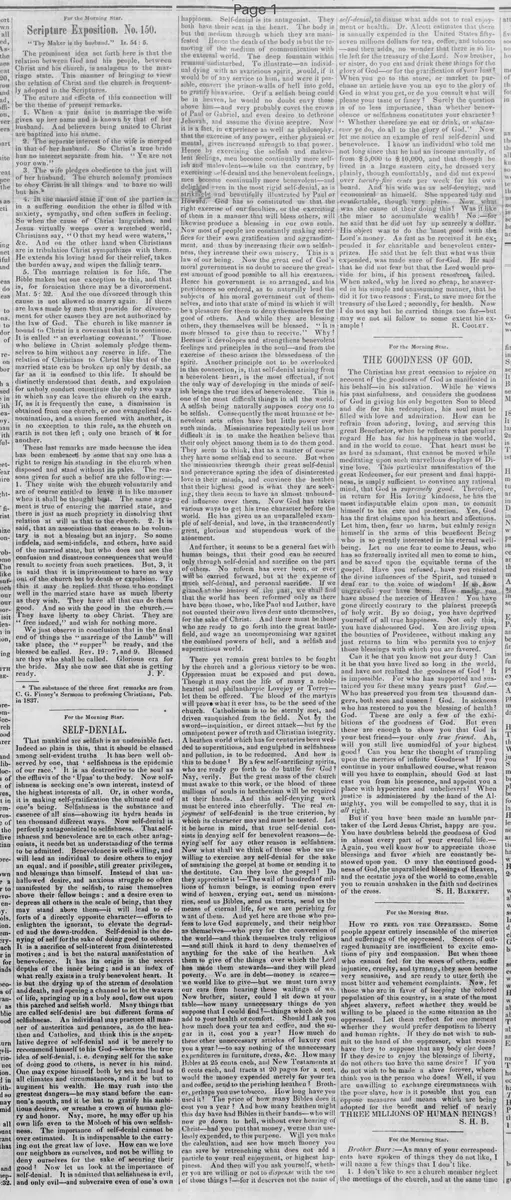
That mankind are selfish is an undeniable fact. Indeed so plain is this, that it should be classed among self-evident truths It has been well observed by one, that ' selfishness is the epidemic of our race.' It is as destructive to the soul as the effluvia of the 'Upas' to the body. Now selfishness is seeking one's own interest, instead of the highest interests of all. Or, in other words, it is making self-gratification the ultimate end of one's being. Selfishness is the substance and essence of all sins—showing its hydra heads in ten thousand different ways. Now self-denial is perfectly antagonistical to selfishness. That selfishness and benevolence are to each other antagonists, it needs but an understanding of the terms to be admitted. Benevolence is well-willing, and will lead an individual to desire others to enjoy an equal, and if possible, still greater privileges, and blessings than himself. Instead of that unhallowed desire, and anxious struggle so often manifested by the selfish, to raise themselves above their fellow beings ; and a desire even to depress all others in the scale of being, that they may stand above them—it will lead to efforts of a directly opposite character—efforts to enlighten the ignorant, to elevate the degraded and the down-trodden. Self-denial is the denying of self for the sake of doing good to others. It is a sacrifice of self-interest from disinterested motives ; and is but the natural manifestation of benevolence. It has its origin in the secret depths of the inner being; and is an index of what really exists in a truly benevolent heart. It is but the drying up of the stream of desolation and death, and opening a channel to let the waters of life, springing up in a holy soul, flow out upon this parched and selfish world. Many things that are called self-denial are but different forms of selfishness. An individual may practice all manner of austerities and penances, as do the heathen and Catholics, and think this is the superlative degree of self-denial and it be merely to recommend himself to his God—whereas the true idea of self-denial, i. e. denying self for the sake of doing good to others, is never in his mind. One may expose himself both by sea and land to all climates and circumstances, and it be but to augment his wealth. He may rush into the greatest dangers—he may stand before the cannon's mouth, and it be but to gratify his ambitious desires, or wreathe a crown of human glory and honor. Nay, more, he may offer up his own life even to the Moloch of his own selfishness. The importance of self-denial cannot be over estimated.' It is indispensable to the carrying out the great law of love. How can we love our neighbors as ourselves, and not be willing to deny ourselves for the sake of securing their good? Now let us look at the importance of self-denial. It is admitted that selfishness is evil, and only evil—and subversive even of one's own happiness. Self-denial is its antagonist. They both have their seat in the heart. The body is but the medium through which they are manifested Hence the death of the body is but the removing of the medium of communication with the external world. The deep fountain within remains undisturbed. To illustrate— an individual dying with an avaricious spirit, would, if it would be of any service to him, and were it possible, convert the prison-walls of hell into gold, to gratify his avarice. Or if a selfish being could be in heaven, he would no doubt envy those above him—and very probably covet the crown of Paul or Gabriel, and even desire to dethrone Jehovah, and assume the divine sceptre. Now it is a fact, in experience as well as philosophy. that the exercise of any power, either physical or mental, gives increased strength to that power. Hence by exercising the selfish and malevolent feelings, men become continually more selfish and malevolent—while on the contrary, by exercising self-denial and the benevolent feelings, men become continually more benevolent— and delighted even in the most rigid self-denial, as is strikingly and beautifully illustrated by Paul or Howard. God has so constituted us that the right exercise of our faculties, or the exercising of them in a manner that will bless others, will likewise produce a blessing in our own souls.
Now most of people are constantly making sacrifices for their own gratification and aggrandizement, and thus by increasing their own selfishness, they increase their own misery. This is a law of our being. Now the great end of God's moral government is no doubt to secure the greatest amount of good possible to all his creatures. Hence his government is so arranged, and his providences so ordered, as to naturally lead the subjects of his moral government out of themselves, and into that state of mind in which it will be a pleasure for them to deny themselves for the good of others. And while they are blessing others, they themselves will be blessed. " It is more blessed to give than to receive." Why? Because it develops and strengthens benevolent feelings and principles in the soul—and from the exercise of these arises the blessedness of the spirit. Another principle not to be overlooked in this connection, is, that self-denial arising from a benevolent heart, is the most effectual. if not the only way of developing in the minds of selfish beings the true idea of benevolence. This is one of the most difficult things in all the world. A selfish being naturally supposes every one to be selfish. Consequently the most humane or benevolent acts often have but little power over such minds. Missionaries repeatedly tell us how difficult it is to make the heathen believe that their only object among them is to do them good. They seem to think, that as a matter of course they have some selfish end to secure. But when the missionaries through their great self-denial and perseverance spring the idea of disinterested love in their minds, and convince the heathen that their highest good is what they are seeking, they then seem to have an almost unbounded influence over them. Now God has taken various ways to get his true character before the world. He has given us an unparalleled example of self-denial, and love, in the transcendently great, glorious and stupendous work of the atonement.
And further. it seems to be a general fact with human beings, that their good can be secured only through self-denial and sacrifice on the part of others. No reform has ever been, or ever will be carried forward, but at the expense of much self-denial. and personal sacrifice. If we glance at the history of the past, we shall find that the world has been reformed only as there have been those, who, like Paul and Luther, have not counted their own lives dear unto themselves, for the sake of Christ. And there must be those who are ready to go forth into the great battlefield, and wage an uncompromising war against the combined powers of hell, and a selfish and superstitious world.
There yet remain great battles to be fought by the church and a glorious victory to be won. Oppression must be exposed and put down. Though it may cost the life of many a noble-hearted and philanthropic Lovejoy or Torrey— let them be offered. The blood of the martyrs will prove what it ever has, to be the seed of the church. Catholicism is to be sternly met, and driven vanquished from the field. Not by the sword-inquisition, or direct attack— but by the omnipotent power of truth and Christian integrity. A heathen world which has for centuries been wedded to superstitions, and engulfed in selfishness and pollution, is to be redeemed. And how is this to be done? By a few self-sacrificing spirits. who are ready go forth to do battle for God? Nay, verily." But the great mass of the church must awake to this work, or the blood of those millions of souls in heathenism will be required at their hands. And this self-denying work must be entered into cheerfully. The real enjoyment of self-denial is the true criterion, by which its character may and must be tested. Let it be borne in mind, that true self-denial consists in denying self for benevolent reasons— denying self for any other reason is selfishness.
Now what shall we think of those who are unwilling to exercise any self-denial for the sake of sustaining the gospel at home or sending it to the destitute. Can they love the gospel? Do they appreciate it ?The wail of hundreds of millions of human beings, is coming upon every wind of heaven, crying out, send us missionaries, send us Bibles, send us tracts, send us the means of eternal life, for we are perishing for want of them. And yet here are those who profess to love God supremely, and their neighbor as themselves—who pray for the conversion of the world—and think themselves truly religious -and still think it hard to deny themselves of anything for the sake of the heathen. Ask them to give of the things over which the Lord has made them stewards—and they will plead poverty. We are in debt—money is scarce— we would like to give—but we must turn away our ears from hearing these wailings of wo.
Now brother, sister, could I sit down at your table—how many unnecessary things do you suppose that I could find?—things which do not add to your health or comfort. Should I ask you how much does your tea and coffee, and the sugar in it, cost you a year? How much do these other unnecessary articles of luxury cost you a year?—to say nothing of the unnecessary expenditures in furniture, dress, &c. How many Bibles at 25 cents each, and New Testaments at 6 cents each, and tracts at 20 pages for a cent, would the money expended merely for your tea and coffee, send to the perishing heathen? Brother, perhaps you use tobacco. How long have you used it? "The price of how many Bibles does it cost you a year ? And how many heathen might this day have had Bibles in their hands—who will now go down to hell, without ever hearing of Christ—had you put that money, worse than uselessly expended, to this purpose. Will you make the calculation, and see how much money you can save by retrenching what does not add a particle to your real enjoyment, or highest happiness. And then will you ask yourself, whether you are willing or not to dispense with the use of those things ?—for it deserves not to name it luxury
self-denial, to disuse what adds not to real enjoyment or health. Dr. Alcott estimates that there is annually expended in the United States fifty-seven millions dollars for tea, coffee, and tobacco -and then adds, no wonder that there is so little left for the treasury of the Lord. Now brother. or sister, do you eat and drink these things for the glory of God—or for the gratification of your lust? When you go to the store, or market to purchase an article have you an eye to the glory of God in what you get, or do you consult what will please your taste or fancy? Surely the question is of no less importance, than whether benevolence or selfishness constitutes your character? . Whether therefore ye eat or drink. or whatsoever ye do, do all to the glory of God." Now let me notice an example of real self-denial and benevolence. I know an individual who told me not long since that he had an income annually, of from $5,000 to $ 10,000. and that though he lived in a large eastern city, he dressed very plainly, though comfortably, and did not expend over twenty-five cents per week for his own board. And his wife was as self-denying, and economical as himself. She appeared tidy and comfortable, though very plain. Now what was the cause of their doing this? Was it like the miser to accumulate wealth? No:—for he said that he did not lay up scarcely a dollar. His object was to do the most good with the Lord's money. As fast as he received it he expended it for charitable and benevolent enterprises. He said that he felt that what was thus expended, was made sure of for—God. He said that he did not fear but that the Lord would provide for him, if his present resources failed. When asked, why he lived so cheap, he answered in his simple and unassuming manner, that he did it for two reasons : First, to save more for the treasury of the Lord ; secondly, for health. Now I do not say but he carried things too far but may we not all follow to some extent his example?
R. COOLEY.
SELF-DENIAL.
That mankind are selfish is an undeniable fact. Indeed so plain is this, that it should be classed among self-evident truths It has been well observed by one, that ' selfishness is the epidemic of our race.' It is as destructive to the soul as the effluvia of the 'Upas' to the body. Now selfishness is seeking one's own interest, instead of the highest interests of all. Or, in other words, it is making self-gratification the ultimate end of one's being. Selfishness is the substance and essence of all sins—showing its hydra heads in ten thousand different ways. Now self-denial is perfectly antagonistical to selfishness. That selfishness and benevolence are to each other antagonists, it needs but an understanding of the terms to be admitted. Benevolence is well-willing, and will lead an individual to desire others to enjoy an equal, and if possible, still greater privileges, and blessings than himself. Instead of that unhallowed desire, and anxious struggle so often manifested by the selfish, to raise themselves above their fellow beings ; and a desire even to depress all others in the scale of being, that they may stand above them—it will lead to efforts of a directly opposite character—efforts to enlighten the ignorant, to elevate the degraded and the down-trodden. Self-denial is the denying of self for the sake of doing good to others. It is a sacrifice of self-interest from disinterested motives ; and is but the natural manifestation of benevolence. It has its origin in the secret depths of the inner being; and is an index of what really exists in a truly benevolent heart. It is but the drying up of the stream of desolation and death, and opening a channel to let the waters of life, springing up in a holy soul, flow out upon this parched and selfish world. Many things that are called self-denial are but different forms of selfishness. An individual may practice all manner of austerities and penances, as do the heathen and Catholics, and think this is the superlative degree of self-denial and it be merely to recommend himself to his God—whereas the true idea of self-denial, i. e. denying self for the sake of doing good to others, is never in his mind. One may expose himself both by sea and land to all climates and circumstances, and it be but to augment his wealth. He may rush into the greatest dangers—he may stand before the cannon's mouth, and it be but to gratify his ambitious desires, or wreathe a crown of human glory and honor. Nay, more, he may offer up his own life even to the Moloch of his own selfishness. The importance of self-denial cannot be over estimated.' It is indispensable to the carrying out the great law of love. How can we love our neighbors as ourselves, and not be willing to deny ourselves for the sake of securing their good? Now let us look at the importance of self-denial. It is admitted that selfishness is evil, and only evil—and subversive even of one's own happiness. Self-denial is its antagonist. They both have their seat in the heart. The body is but the medium through which they are manifested Hence the death of the body is but the removing of the medium of communication with the external world. The deep fountain within remains undisturbed. To illustrate— an individual dying with an avaricious spirit, would, if it would be of any service to him, and were it possible, convert the prison-walls of hell into gold, to gratify his avarice. Or if a selfish being could be in heaven, he would no doubt envy those above him—and very probably covet the crown of Paul or Gabriel, and even desire to dethrone Jehovah, and assume the divine sceptre. Now it is a fact, in experience as well as philosophy. that the exercise of any power, either physical or mental, gives increased strength to that power. Hence by exercising the selfish and malevolent feelings, men become continually more selfish and malevolent—while on the contrary, by exercising self-denial and the benevolent feelings, men become continually more benevolent— and delighted even in the most rigid self-denial, as is strikingly and beautifully illustrated by Paul or Howard. God has so constituted us that the right exercise of our faculties, or the exercising of them in a manner that will bless others, will likewise produce a blessing in our own souls.
Now most of people are constantly making sacrifices for their own gratification and aggrandizement, and thus by increasing their own selfishness, they increase their own misery. This is a law of our being. Now the great end of God's moral government is no doubt to secure the greatest amount of good possible to all his creatures. Hence his government is so arranged, and his providences so ordered, as to naturally lead the subjects of his moral government out of themselves, and into that state of mind in which it will be a pleasure for them to deny themselves for the good of others. And while they are blessing others, they themselves will be blessed. " It is more blessed to give than to receive." Why? Because it develops and strengthens benevolent feelings and principles in the soul—and from the exercise of these arises the blessedness of the spirit. Another principle not to be overlooked in this connection, is, that self-denial arising from a benevolent heart, is the most effectual. if not the only way of developing in the minds of selfish beings the true idea of benevolence. This is one of the most difficult things in all the world. A selfish being naturally supposes every one to be selfish. Consequently the most humane or benevolent acts often have but little power over such minds. Missionaries repeatedly tell us how difficult it is to make the heathen believe that their only object among them is to do them good. They seem to think, that as a matter of course they have some selfish end to secure. But when the missionaries through their great self-denial and perseverance spring the idea of disinterested love in their minds, and convince the heathen that their highest good is what they are seeking, they then seem to have an almost unbounded influence over them. Now God has taken various ways to get his true character before the world. He has given us an unparalleled example of self-denial, and love, in the transcendently great, glorious and stupendous work of the atonement.
And further. it seems to be a general fact with human beings, that their good can be secured only through self-denial and sacrifice on the part of others. No reform has ever been, or ever will be carried forward, but at the expense of much self-denial. and personal sacrifice. If we glance at the history of the past, we shall find that the world has been reformed only as there have been those, who, like Paul and Luther, have not counted their own lives dear unto themselves, for the sake of Christ. And there must be those who are ready to go forth into the great battlefield, and wage an uncompromising war against the combined powers of hell, and a selfish and superstitious world.
There yet remain great battles to be fought by the church and a glorious victory to be won. Oppression must be exposed and put down. Though it may cost the life of many a noble-hearted and philanthropic Lovejoy or Torrey— let them be offered. The blood of the martyrs will prove what it ever has, to be the seed of the church. Catholicism is to be sternly met, and driven vanquished from the field. Not by the sword-inquisition, or direct attack— but by the omnipotent power of truth and Christian integrity. A heathen world which has for centuries been wedded to superstitions, and engulfed in selfishness and pollution, is to be redeemed. And how is this to be done? By a few self-sacrificing spirits. who are ready go forth to do battle for God? Nay, verily." But the great mass of the church must awake to this work, or the blood of those millions of souls in heathenism will be required at their hands. And this self-denying work must be entered into cheerfully. The real enjoyment of self-denial is the true criterion, by which its character may and must be tested. Let it be borne in mind, that true self-denial consists in denying self for benevolent reasons— denying self for any other reason is selfishness.
Now what shall we think of those who are unwilling to exercise any self-denial for the sake of sustaining the gospel at home or sending it to the destitute. Can they love the gospel? Do they appreciate it ?The wail of hundreds of millions of human beings, is coming upon every wind of heaven, crying out, send us missionaries, send us Bibles, send us tracts, send us the means of eternal life, for we are perishing for want of them. And yet here are those who profess to love God supremely, and their neighbor as themselves—who pray for the conversion of the world—and think themselves truly religious -and still think it hard to deny themselves of anything for the sake of the heathen. Ask them to give of the things over which the Lord has made them stewards—and they will plead poverty. We are in debt—money is scarce— we would like to give—but we must turn away our ears from hearing these wailings of wo.
Now brother, sister, could I sit down at your table—how many unnecessary things do you suppose that I could find?—things which do not add to your health or comfort. Should I ask you how much does your tea and coffee, and the sugar in it, cost you a year? How much do these other unnecessary articles of luxury cost you a year?—to say nothing of the unnecessary expenditures in furniture, dress, &c. How many Bibles at 25 cents each, and New Testaments at 6 cents each, and tracts at 20 pages for a cent, would the money expended merely for your tea and coffee, send to the perishing heathen? Brother, perhaps you use tobacco. How long have you used it? "The price of how many Bibles does it cost you a year ? And how many heathen might this day have had Bibles in their hands—who will now go down to hell, without ever hearing of Christ—had you put that money, worse than uselessly expended, to this purpose. Will you make the calculation, and see how much money you can save by retrenching what does not add a particle to your real enjoyment, or highest happiness. And then will you ask yourself, whether you are willing or not to dispense with the use of those things ?—for it deserves not to name it luxury
self-denial, to disuse what adds not to real enjoyment or health. Dr. Alcott estimates that there is annually expended in the United States fifty-seven millions dollars for tea, coffee, and tobacco -and then adds, no wonder that there is so little left for the treasury of the Lord. Now brother. or sister, do you eat and drink these things for the glory of God—or for the gratification of your lust? When you go to the store, or market to purchase an article have you an eye to the glory of God in what you get, or do you consult what will please your taste or fancy? Surely the question is of no less importance, than whether benevolence or selfishness constitutes your character? . Whether therefore ye eat or drink. or whatsoever ye do, do all to the glory of God." Now let me notice an example of real self-denial and benevolence. I know an individual who told me not long since that he had an income annually, of from $5,000 to $ 10,000. and that though he lived in a large eastern city, he dressed very plainly, though comfortably, and did not expend over twenty-five cents per week for his own board. And his wife was as self-denying, and economical as himself. She appeared tidy and comfortable, though very plain. Now what was the cause of their doing this? Was it like the miser to accumulate wealth? No:—for he said that he did not lay up scarcely a dollar. His object was to do the most good with the Lord's money. As fast as he received it he expended it for charitable and benevolent enterprises. He said that he felt that what was thus expended, was made sure of for—God. He said that he did not fear but that the Lord would provide for him, if his present resources failed. When asked, why he lived so cheap, he answered in his simple and unassuming manner, that he did it for two reasons : First, to save more for the treasury of the Lord ; secondly, for health. Now I do not say but he carried things too far but may we not all follow to some extent his example?
R. COOLEY.
What sub-type of article is it?
Essay
What themes does it cover?
Moral Virtue
Religious
What keywords are associated?
Self Denial
Benevolence
Selfishness
Christian Duty
Missionaries
Atonement
Reform
Luxury Critique
What entities or persons were involved?
R. Cooley
Literary Details
Title
Self Denial
Author
R. Cooley
Subject
On Self Denial And Benevolence
Key Lines
That Mankind Are Selfish Is An Undeniable Fact.
Self Denial Is The Denying Of Self For The Sake Of Doing Good To Others.
It Is More Blessed To Give Than To Receive.
Whether Therefore Ye Eat Or Drink, Or Whatsoever Ye Do, Do All To The Glory Of God.
His Object Was To Do The Most Good With The Lord's Money.