Thank you for visiting SNEWPapers!
Sign up free
Editorial
December 4, 1798
Gazette Of The United States, & Philadelphia Daily Advertiser
Philadelphia, Philadelphia County, Pennsylvania
What is this article about?
An editorial defending the constitutionality of the Sedition Law against objections in a Virginia remonstrance, arguing that it addresses longstanding offenses like conspiracies and libels without abridging press freedom or creating vague new crimes.
Clipping
OCR Quality
95%
Excellent
Full Text
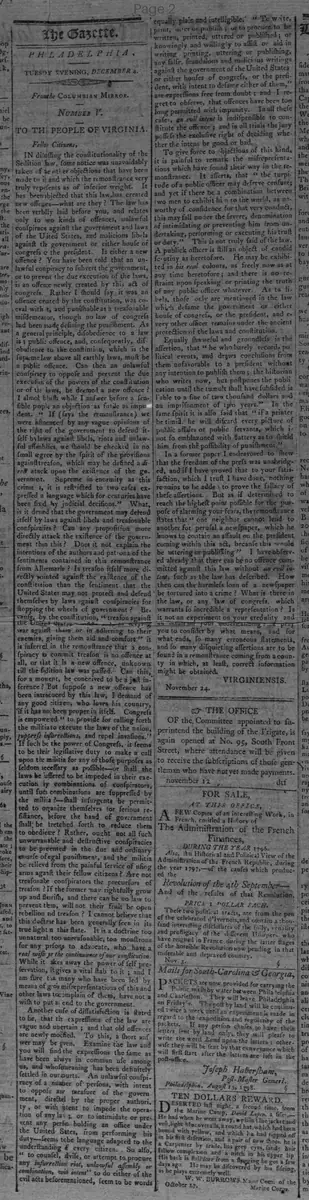
TO THE PEOPLE OF VIRGINIA.
Fellow Citizens,
IN discussing the constitutionality of the Sedition law, some notice was unavoidably taken of several other objections that have been made to it and which the remonstrance very truly represents as of inferior weight. It has been objected that this law has created new offences-what are they? The law has been verbally laid before you, and relates only to two kinds of offences, unlawful conspiracies against the government and laws of the United States, and malicious libels against the government or either house of congress or the president. Is either a new offence? You have been told that an unlawful conspiracy to subvert the government, or to prevent the due execution of the laws, is an offence newly created by this act of congress. Rather I should say it was an offence created by the constitution, coeval with it, and punishable as a treasonable misdemeanor, though no law of congress had been made defining the punishment. As a general principle, disobedience to a law is a public offence, and, consequently, disobedience to the constitution, which is the supreme law above all earthly laws, must be a public offence. Can then an unlawful conspiracy to oppose and prevent the due execution of the powers of the constitution or of the laws, be deemed a new offence? I almost blush while I answer before a sensible people an objection as futile as impudent. "If (says the remonstrance) we were influenced by any vague opinions of the right of the government to defend itself by laws against libels, riots and unlawful assemblies. we should be checked in no small degree by the spirit of the provisions against treason, which may be defined a directed attack upon the existence of the government. Supreme in enormity as this crime is, it is restricted to two cases expressed in language which for centuries have been fixed by judicial decisions." What, is it denied that the government may defend itself by laws against libels and treasonable conspiracies? Can any proposition more directly attack the existence of the government than this? Does it not explain the intentions of the authors and patrons of the sentiments contained in this remonstrance from Albemarle? Is treason itself more directly pointed against the existence of the constitution than the sentiment that the United States may not protect and defend themselves by laws against conspiracies for stopping the wheels of government? Because, by the constitution, "treason against the United States consists only in levying war against them or in adhering to their enemies, giving them aid and comfort." it is inferred in the remonstrance that a conspiracy to commit treason is no offence at all, or that it is a new offence, unknown till the sedition law was passed.. Can this, for a moment, be conceived to be a just inference? But suppose a new offence has been introduced by this law, I demand of any good citizen, who loves his country, if it has not been proper in itself. Congress is empowered "to provide for calling forth the militia to execute the laws of the union, suppress insurrections, and repel invasions." If such be the power of Congress, it seems to be their legislative duty to make a call upon the militia for any of those purposes as seldom necessary as possible-or shall the laws be suffered to be impeded in their execution by combinations. of conspirators, until such combinations are suppressed by the militia ?-shall insurgents be permitted to organize themselves for serious resistance, before the hand of government shall: be stretched forth to reduce them to obedience? Rather, ought not all such unwarrantable and destructive conspiracies to be prevented in the due and ordinary course of legal punishment, and the militia be relieved from the painful service of using arms against their fellow citizens? Are not treasonable conspirators the precursors of treason? If the former may rightfully grow up and flourish, and there can be no law to prevent them, will not their fruit be open rebellion and treason? I cannot believe that this doctrine has been generally seen in its true light in this state. It is a doctrine too unnatural, too unreasonable, too monstrous for any persons to advocate, who have a real wish for the continuance of our constitution. While it takes away the power of self preservation, it gives a vital stab to it ; and I am sure that many who have been led by means of gross misrepresentations of this and other laws to complain of them, have not a wish to put an end to the government.
Another case of dissatisfaction is stated to be, that the expressions of the law are vague and uncertain ; and that old offences are newly modified. To this, a Short answer may be given, Examine the law and you will find the expressions the same as have been always in common use among us, and whose meaning has been definitely settled in our courts. An unlawful conspiracy of a number of persons, with intent to oppose any measure of the government, directed by the proper authority, or with intent to impede the operation of any law ;. or to intimidate or prevent any person holding an office under the United States, from performing his duty-seems to be language adapted to the understanding & every citizen. So also, "to counsel, advise, or attempt to procure any insurrection riot, unlawful assembly or combination, with intent" to do either of the evil acts beforementioned, seem to be words equally plain and intelligible." "To write, print, utter or publish ; or to procure to be written, printed, uttered or published; or knowingly and willingly to aid or assist in writing printing, uttering or publishing, any false, scandalous and malicious writings against the government of the United States or either houses of congress, or the president, with intent to defame either of them," are expressions free from doubt ; and I regret to observe, that offences have been too long permitted with impunity. In all these cases, an evil intent is indispensable to constitute the offence ; and in all trials the jury possesses the exclusive right of deciding whether the intent be good or bad.
To give force to objections of this kind, it is painful to remark the misrepresentations which have found their way in the remonstrance. It asserts, that "the turpitude of a public officer may deserve censure; and yet if there be a combination between two men to exhibit him to the world, as unworthy of confidence for that very conduct. this may fall under the severe, denomination of intimidating or preventing him from undertaking, performing or executing his trust or duty." This is not truly said of the law. A public officer is still an object of candid scrutiny as heretofore. He may be exhibited in his real colours, as freely now as at any time heretofore; and there is no restraint upon speaking or printing the truth of any public officer whatever. As to libels, those only are mentioned in the law which defame the government or either house of congress, or the president, and every other officer remains under the ancient protection of the laws and constitution.
Equally shameful and groundless is the assertion, that "he who barely records. political events, and draws conclusions from them unfavorable to a president without any intention to publish them; the historian who writes now, but postpones the publication-until the tumult shall have subsided is liable to a fine of two thousand dollars and an imprisonment of two years." In the same spirit it is also said that "if a printer be timid. he will discard every picture of public affairs or public servants, which is not so emblazoned with flattery as to shield him from the possibility of punishment."
In a former paper I endeavored to show that the freedom of the press was unabridged, and if I have proved that to your satisfaction, which I trust I have done, nothing remains to be added to prove the fallacy of these assertions. But as if determined to reach the highest point possible for the purpose of alarming your fears, the remonstrance states that "one neighbor cannot. lend to another for perusal a newspaper, which he knows to contain an assault on the president coming within this act, because this would be uttering or publishing" I have observed already that there can be no offence committed against this law without an evil intent, such as the law has described. How then can the harmless loan of a newspaper be tortured into a crime? What is there in the law, or any law of congress. which warrants so incredible a representation? Is it not an experiment on your credulity and you to consider by what means, and for what ends, so many erroneous statements, and so many disquieting assertions are to be found in a remonstrance coming from a county in which, at least, correct information might be obtained.
VIRGINIENSIS.
November 24
Fellow Citizens,
IN discussing the constitutionality of the Sedition law, some notice was unavoidably taken of several other objections that have been made to it and which the remonstrance very truly represents as of inferior weight. It has been objected that this law has created new offences-what are they? The law has been verbally laid before you, and relates only to two kinds of offences, unlawful conspiracies against the government and laws of the United States, and malicious libels against the government or either house of congress or the president. Is either a new offence? You have been told that an unlawful conspiracy to subvert the government, or to prevent the due execution of the laws, is an offence newly created by this act of congress. Rather I should say it was an offence created by the constitution, coeval with it, and punishable as a treasonable misdemeanor, though no law of congress had been made defining the punishment. As a general principle, disobedience to a law is a public offence, and, consequently, disobedience to the constitution, which is the supreme law above all earthly laws, must be a public offence. Can then an unlawful conspiracy to oppose and prevent the due execution of the powers of the constitution or of the laws, be deemed a new offence? I almost blush while I answer before a sensible people an objection as futile as impudent. "If (says the remonstrance) we were influenced by any vague opinions of the right of the government to defend itself by laws against libels, riots and unlawful assemblies. we should be checked in no small degree by the spirit of the provisions against treason, which may be defined a directed attack upon the existence of the government. Supreme in enormity as this crime is, it is restricted to two cases expressed in language which for centuries have been fixed by judicial decisions." What, is it denied that the government may defend itself by laws against libels and treasonable conspiracies? Can any proposition more directly attack the existence of the government than this? Does it not explain the intentions of the authors and patrons of the sentiments contained in this remonstrance from Albemarle? Is treason itself more directly pointed against the existence of the constitution than the sentiment that the United States may not protect and defend themselves by laws against conspiracies for stopping the wheels of government? Because, by the constitution, "treason against the United States consists only in levying war against them or in adhering to their enemies, giving them aid and comfort." it is inferred in the remonstrance that a conspiracy to commit treason is no offence at all, or that it is a new offence, unknown till the sedition law was passed.. Can this, for a moment, be conceived to be a just inference? But suppose a new offence has been introduced by this law, I demand of any good citizen, who loves his country, if it has not been proper in itself. Congress is empowered "to provide for calling forth the militia to execute the laws of the union, suppress insurrections, and repel invasions." If such be the power of Congress, it seems to be their legislative duty to make a call upon the militia for any of those purposes as seldom necessary as possible-or shall the laws be suffered to be impeded in their execution by combinations. of conspirators, until such combinations are suppressed by the militia ?-shall insurgents be permitted to organize themselves for serious resistance, before the hand of government shall: be stretched forth to reduce them to obedience? Rather, ought not all such unwarrantable and destructive conspiracies to be prevented in the due and ordinary course of legal punishment, and the militia be relieved from the painful service of using arms against their fellow citizens? Are not treasonable conspirators the precursors of treason? If the former may rightfully grow up and flourish, and there can be no law to prevent them, will not their fruit be open rebellion and treason? I cannot believe that this doctrine has been generally seen in its true light in this state. It is a doctrine too unnatural, too unreasonable, too monstrous for any persons to advocate, who have a real wish for the continuance of our constitution. While it takes away the power of self preservation, it gives a vital stab to it ; and I am sure that many who have been led by means of gross misrepresentations of this and other laws to complain of them, have not a wish to put an end to the government.
Another case of dissatisfaction is stated to be, that the expressions of the law are vague and uncertain ; and that old offences are newly modified. To this, a Short answer may be given, Examine the law and you will find the expressions the same as have been always in common use among us, and whose meaning has been definitely settled in our courts. An unlawful conspiracy of a number of persons, with intent to oppose any measure of the government, directed by the proper authority, or with intent to impede the operation of any law ;. or to intimidate or prevent any person holding an office under the United States, from performing his duty-seems to be language adapted to the understanding & every citizen. So also, "to counsel, advise, or attempt to procure any insurrection riot, unlawful assembly or combination, with intent" to do either of the evil acts beforementioned, seem to be words equally plain and intelligible." "To write, print, utter or publish ; or to procure to be written, printed, uttered or published; or knowingly and willingly to aid or assist in writing printing, uttering or publishing, any false, scandalous and malicious writings against the government of the United States or either houses of congress, or the president, with intent to defame either of them," are expressions free from doubt ; and I regret to observe, that offences have been too long permitted with impunity. In all these cases, an evil intent is indispensable to constitute the offence ; and in all trials the jury possesses the exclusive right of deciding whether the intent be good or bad.
To give force to objections of this kind, it is painful to remark the misrepresentations which have found their way in the remonstrance. It asserts, that "the turpitude of a public officer may deserve censure; and yet if there be a combination between two men to exhibit him to the world, as unworthy of confidence for that very conduct. this may fall under the severe, denomination of intimidating or preventing him from undertaking, performing or executing his trust or duty." This is not truly said of the law. A public officer is still an object of candid scrutiny as heretofore. He may be exhibited in his real colours, as freely now as at any time heretofore; and there is no restraint upon speaking or printing the truth of any public officer whatever. As to libels, those only are mentioned in the law which defame the government or either house of congress, or the president, and every other officer remains under the ancient protection of the laws and constitution.
Equally shameful and groundless is the assertion, that "he who barely records. political events, and draws conclusions from them unfavorable to a president without any intention to publish them; the historian who writes now, but postpones the publication-until the tumult shall have subsided is liable to a fine of two thousand dollars and an imprisonment of two years." In the same spirit it is also said that "if a printer be timid. he will discard every picture of public affairs or public servants, which is not so emblazoned with flattery as to shield him from the possibility of punishment."
In a former paper I endeavored to show that the freedom of the press was unabridged, and if I have proved that to your satisfaction, which I trust I have done, nothing remains to be added to prove the fallacy of these assertions. But as if determined to reach the highest point possible for the purpose of alarming your fears, the remonstrance states that "one neighbor cannot. lend to another for perusal a newspaper, which he knows to contain an assault on the president coming within this act, because this would be uttering or publishing" I have observed already that there can be no offence committed against this law without an evil intent, such as the law has described. How then can the harmless loan of a newspaper be tortured into a crime? What is there in the law, or any law of congress. which warrants so incredible a representation? Is it not an experiment on your credulity and you to consider by what means, and for what ends, so many erroneous statements, and so many disquieting assertions are to be found in a remonstrance coming from a county in which, at least, correct information might be obtained.
VIRGINIENSIS.
November 24
What sub-type of article is it?
Constitutional
Press Freedom
Legal Reform
What keywords are associated?
Sedition Law
Constitutionality
Unlawful Conspiracies
Malicious Libels
Freedom Of Press
Treasonable Misdemeanor
Remonstrance Albemarle
What entities or persons were involved?
Government Of The United States
Congress
President
Remonstrance From Albemarle
Virginiensis
Editorial Details
Primary Topic
Defense Of The Sedition Law's Constitutionality
Stance / Tone
Strongly Supportive Of The Sedition Law, Refuting Objections
Key Figures
Government Of The United States
Congress
President
Remonstrance From Albemarle
Virginiensis
Key Arguments
Unlawful Conspiracies Against The Government Are Not New Offenses But Created By The Constitution
The Sedition Law Punishes Malicious Libels, Which Were Previously Permitted With Impunity
The Law's Language Is Clear And Uses Common Expressions Settled In Courts
Public Officers Can Still Be Scrutinized And Truth Spoken Freely
Freedom Of The Press Is Unabridged; Only Writings With Evil Intent Are Punishable
Harmless Actions Like Lending A Newspaper Are Not Crimes Without Malicious Intent
The Government Must Defend Itself Against Libels, Riots, And Conspiracies