Thank you for visiting SNEWPapers!
Sign up free
Editorial
February 27, 1845
The Hillsborough Recorder
Hillsboro, Orange County, North Carolina
What is this article about?
Elder W. R. Stowe's moral essay from the Christian Sun denounces slander as originating from corrupt hearts, envy, and malice, exploring its causes among superiors, equals, and inferiors, methods like secrecy and feigned regret, and devastating impacts on virtue, truth, and the church.
Clipping
OCR Quality
95%
Excellent
Full Text
From the Christian Sun.
SLANDER.
BY ELDER W. R. STOWE.
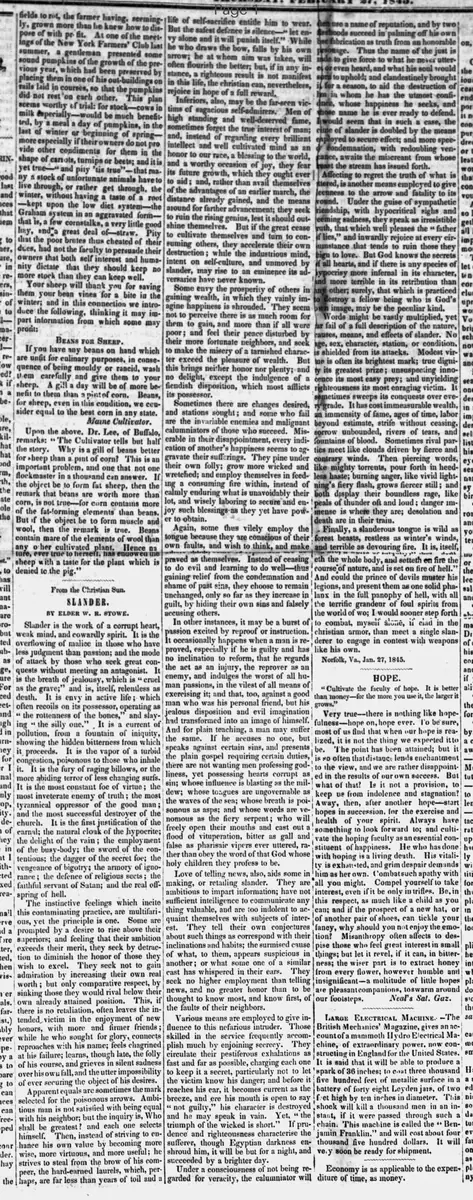
Slander is the work of a corrupt heart, weak mind, and cowardly spirit. It is the overflowing of malice in those who have less judgment than passion; and the mode of attack by those who seek great conquests without meeting an antagonist. It is the breath of jealousy, which is "cruel as the grave;" and is, itself, relentless as death. It is envy in active life; which often recoils on its possessor, operating as "the rottenness of the bones," and slaying "the silly one." It is a current of pollution, from a fountain of iniquity, showing the hidden bitterness from which it proceeds. It is the vapor of a turbid congestion, poisonous to those who inhale it. It is the fury of raging billows, or the more abiding terror of less changing surfs. It is the most constant foe of virtue; the most inveterate enemy of truth; the most tyrannical oppressor of the good man; and the most successful destroyer of the church. It is the first justification of the carnal; the natural cloak of the hypocrite; the delight of the vain; the employment of the busy-body; the sword of the contentious; the dagger of the secret foe; the vengeance of bigotry; the armory of ignorance; the defence of religious sects; the faithful servant of Satan; and the real offspring of hell.
The instinctive feelings which incite this contaminating practice, are multifarious, yet the principle is one. Some are prompted by a desire to rise above their superiors; and feeling that their ambition exceeds their merit, they seek by detraction to diminish the honor of those they wish to excel. They seek not to gain admiration by increasing their own real worth: but only comparative respect, by sinking those they would rival below their own already attained position. This, if there is no retaliation, often leaves the intended victim in the enjoyment of new honors, with more and firmer friends; while he who sought for glory, connects reproaches with his name; feels chagrined at his failure; learns, though late, the folly of his course, and grieves in silent sadness over his own fall, and the utter impossibility of ever securing the object of his desires.
Apparent equals are sometimes the mark selected for the poisonous arrows. Ambitious man is not satisfied with being equal with his neighbor; but the inquiry is, Who shall be greatest? and each one selects himself. Then, instead of striving to enhance his own value by becoming more wise, more virtuous, and more useful; he strives to steal from the brow of his compeer, the hard-earned laurels, which, perhaps, are far less than years of toil and a life of self-sacrifice entitle him to wear. But the safest defence is silence—"let envy alone and it will punish itself." While he who draws the bow, falls by his own arrow; he at whom aim was taken, will often flourish the better; but, if in any instance, a righteous result is not manifest in this life, the christian can, nevertheless, rejoice in hope of a full reward.
Inferiors, also, may be the far-seen victims of sagacious self-admirers. Men of high standing and well-deserved fame, sometimes forget the true interest of man; and, instead of regarding every brilliant intellect and well cultivated mind as an honor to our race, a blessing to the world, and a worthy occasion of joy, they fear its future growth, which they ought ever to aid; and, rather than avail themselves of the advantages of an earlier march, the distance already gained, and the means around for farther advancement; they seek to ruin the rising genius, lest it should outshine themselves. But if the great cease to cultivate themselves and turn to consuming others, they accelerate their own destruction; while the industrious mind, intent on self-culture, and unmoved by slander, may rise to an eminence its adversaries have never known.
Some envy the prosperity of others in gaining wealth, in which they vainly imagine happiness is shrouded. They seem not to perceive there is as much room for them to gain, and more than if all were poor; and feel their peace disturbed by their more fortunate neighbors, and seek to make the misery of a tarnished character exceed the pleasure of wealth. But this brings neither honor nor plenty; and no delight, except the indulgence of a fiendish disposition, which most afflicts its possessor.
Sometimes there are changes desired, and stations sought; and some who fail are the invariable enemies and malignant calumniators of those who succeed. Miserable in their disappointment, every indication of another's happiness seems to aggravate their sufferings. They pine under their own folly; grow more wicked and wretched; and employ themselves in feeding a consuming fire within, instead of calmly enduring what is unavoidably their lot, and wisely laboring to secure and enjoy such blessings as they yet have power to obtain.
Again, some thus vilely employ the tongue because they are conscious of their own faults, and wish to think, and make others depraved as themselves. Instead of ceasing to do evil and learning to do well—thus gaining relief from the condemnation and shame of past sins, they choose to remain unchanged, only so far as they increase in guilt, by hiding their own sins and falsely accusing others.
In other instances, it may be a burst of passion excited by reproof or instruction. It occasionally happens when a man is reproved, especially if he is guilty and has no inclination to reform, that he regards the act as an injury, the reprover as an enemy, and indulges the worst of all human passions, in the vilest of all means of exercising it; and that, too, against a good man who was his personal friend, but his jealous disposition and evil imagination had transformed into an image of himself. And for plain teaching, a man may suffer the same. If he accuses no one, but speaks against certain sins, and presents the plain gospel requiring certain duties, there are not wanting men professing godliness, yet possessing hearts corrupt as sin; whose influence is blasting as the mildew; whose tongues are ungovernable as the waves of the sea; whose breath is poisonous as asps; and whose words are venomous as the fiery serpent; who will freely open their mouths and cast out a flood of vituperation, bitter as gall and false as pharisaic vipers ever uttered, rather than obey the word of that God whose holy children they profess to be.
Love of telling news, also, aids some in making, or retailing slander. They are ambitious to impart information; have not sufficient intelligence to communicate any thing valuable, and are too indolent to acquaint themselves with subjects of interest. They tell their own conjectures about such things as correspond with their inclinations and habits; the surmised cause of what, to them, appears suspicious in another; or what some one of a similar cast has whispered in their ears. They seek no higher employment than telling news, and no greater honor than to be thought to know most, and know first, of the faults of their neighbors.
Various means are employed to give influence to this nefarious intruder. Those skilled in the service frequently accomplish much by enjoining secrecy. They circulate their pestiferous exhalations as fast and far as possible, charging each one to keep it a secret, particularly not to let the victim know his danger; and before it reaches his ear, it becomes current as the breeze, and ere his mouth is open to say "not guilty," his character is destroyed and he may speak in vain. Yet, "the triumph of the wicked is short." If prudence and righteousness characterise the sufferer, though Egyptian darkness enshroud him, it will be but for a night, and succeeded by a brighter day.
Under a consciousness of not being regarded for veracity, the calumniator will often assume a name of reputation, and by two falsehoods succeed in palming off his own base fabrication as truth from an honorable personage. Thus the name of the just is made to give force to what he never uttered or even heard, and what his soul would scorn to uphold; and clandestinely brought in for a season, to aid the destruction of him in whom he has the utmost confidence, whose happiness he seeks, and whose name he is ever ready to defend. It would seem that in such a case, the crime of slander is doubled by the means employed to secure effect; and more speedy condemnation, with redoubling vengeance, awaits the miscreant from whose breast the stream has issued forth.
Affecting to regret the truth of what is uttered, is another means employed to give keenness to the arrow and fatality to its wound. Under the guise of sympathetic friendship, with hypocritical sighs and seeming sadness, they speak as irresistible truth, that which well pleases the "father of lies," and inwardly rejoice at every circumstance that tends to ruin those they ought to love. But God knows the secrets of all hearts, and if there is any species of hypocrisy more infernal in its character, and more terrible in its retribution than any other; surely, that which is practiced to destroy a fellow being who is God's own image, may be the peculiar kind.
Words might be vastly multiplied, yet far fail of a full description of the nature, causes, means, and effects of slander. No age, sex, character, station, or condition, is shielded from its attacks. Modest virtue is often its brightest mark; true dignity its greatest prize; unsuspecting innocence its most easy prey; and unyielding righteousness its most enraging victim. It sometimes sweeps its conquests over every grade. It has cost immeasurable wealth, an immensity of fame, ages of time, labor beyond estimate, strife without ceasing, sorrow unbounded, rivers of tears, and fountains of blood. Sometimes rival parties meet like clouds driven by fierce and contrary winds. Then piercing words, like mighty torrents, pour forth in heedless haste; burning anger, like vivid lightning's fiery flash, grows fiercer still; and both display their boundless rage, like peals of thunder oft and loud; danger immense is where they are; desolation and death are in their train.
Finally, a slanderous tongue is wild as forest beasts, restless as winter's winds, and terrible as devouring fire. It is, itself, "a fire, a world of iniquity: the tongue is a fire... and it setteth on fire the whole body, and setteth on fire the course of nature, and is set on fire of hell." And could the prince of devils muster his legions, and present them as one solid phalanx in the full panoply of hell, with all the terrific grandeur of foul spirits from the world of woe; I would sooner step forth to combat, myself alone, clad in the christian armor, than meet a single slanderer to engage in contest with weapons like his own.
Norfolk, Va., Jan. 27, 1845.
SLANDER.
BY ELDER W. R. STOWE.
Slander is the work of a corrupt heart, weak mind, and cowardly spirit. It is the overflowing of malice in those who have less judgment than passion; and the mode of attack by those who seek great conquests without meeting an antagonist. It is the breath of jealousy, which is "cruel as the grave;" and is, itself, relentless as death. It is envy in active life; which often recoils on its possessor, operating as "the rottenness of the bones," and slaying "the silly one." It is a current of pollution, from a fountain of iniquity, showing the hidden bitterness from which it proceeds. It is the vapor of a turbid congestion, poisonous to those who inhale it. It is the fury of raging billows, or the more abiding terror of less changing surfs. It is the most constant foe of virtue; the most inveterate enemy of truth; the most tyrannical oppressor of the good man; and the most successful destroyer of the church. It is the first justification of the carnal; the natural cloak of the hypocrite; the delight of the vain; the employment of the busy-body; the sword of the contentious; the dagger of the secret foe; the vengeance of bigotry; the armory of ignorance; the defence of religious sects; the faithful servant of Satan; and the real offspring of hell.
The instinctive feelings which incite this contaminating practice, are multifarious, yet the principle is one. Some are prompted by a desire to rise above their superiors; and feeling that their ambition exceeds their merit, they seek by detraction to diminish the honor of those they wish to excel. They seek not to gain admiration by increasing their own real worth: but only comparative respect, by sinking those they would rival below their own already attained position. This, if there is no retaliation, often leaves the intended victim in the enjoyment of new honors, with more and firmer friends; while he who sought for glory, connects reproaches with his name; feels chagrined at his failure; learns, though late, the folly of his course, and grieves in silent sadness over his own fall, and the utter impossibility of ever securing the object of his desires.
Apparent equals are sometimes the mark selected for the poisonous arrows. Ambitious man is not satisfied with being equal with his neighbor; but the inquiry is, Who shall be greatest? and each one selects himself. Then, instead of striving to enhance his own value by becoming more wise, more virtuous, and more useful; he strives to steal from the brow of his compeer, the hard-earned laurels, which, perhaps, are far less than years of toil and a life of self-sacrifice entitle him to wear. But the safest defence is silence—"let envy alone and it will punish itself." While he who draws the bow, falls by his own arrow; he at whom aim was taken, will often flourish the better; but, if in any instance, a righteous result is not manifest in this life, the christian can, nevertheless, rejoice in hope of a full reward.
Inferiors, also, may be the far-seen victims of sagacious self-admirers. Men of high standing and well-deserved fame, sometimes forget the true interest of man; and, instead of regarding every brilliant intellect and well cultivated mind as an honor to our race, a blessing to the world, and a worthy occasion of joy, they fear its future growth, which they ought ever to aid; and, rather than avail themselves of the advantages of an earlier march, the distance already gained, and the means around for farther advancement; they seek to ruin the rising genius, lest it should outshine themselves. But if the great cease to cultivate themselves and turn to consuming others, they accelerate their own destruction; while the industrious mind, intent on self-culture, and unmoved by slander, may rise to an eminence its adversaries have never known.
Some envy the prosperity of others in gaining wealth, in which they vainly imagine happiness is shrouded. They seem not to perceive there is as much room for them to gain, and more than if all were poor; and feel their peace disturbed by their more fortunate neighbors, and seek to make the misery of a tarnished character exceed the pleasure of wealth. But this brings neither honor nor plenty; and no delight, except the indulgence of a fiendish disposition, which most afflicts its possessor.
Sometimes there are changes desired, and stations sought; and some who fail are the invariable enemies and malignant calumniators of those who succeed. Miserable in their disappointment, every indication of another's happiness seems to aggravate their sufferings. They pine under their own folly; grow more wicked and wretched; and employ themselves in feeding a consuming fire within, instead of calmly enduring what is unavoidably their lot, and wisely laboring to secure and enjoy such blessings as they yet have power to obtain.
Again, some thus vilely employ the tongue because they are conscious of their own faults, and wish to think, and make others depraved as themselves. Instead of ceasing to do evil and learning to do well—thus gaining relief from the condemnation and shame of past sins, they choose to remain unchanged, only so far as they increase in guilt, by hiding their own sins and falsely accusing others.
In other instances, it may be a burst of passion excited by reproof or instruction. It occasionally happens when a man is reproved, especially if he is guilty and has no inclination to reform, that he regards the act as an injury, the reprover as an enemy, and indulges the worst of all human passions, in the vilest of all means of exercising it; and that, too, against a good man who was his personal friend, but his jealous disposition and evil imagination had transformed into an image of himself. And for plain teaching, a man may suffer the same. If he accuses no one, but speaks against certain sins, and presents the plain gospel requiring certain duties, there are not wanting men professing godliness, yet possessing hearts corrupt as sin; whose influence is blasting as the mildew; whose tongues are ungovernable as the waves of the sea; whose breath is poisonous as asps; and whose words are venomous as the fiery serpent; who will freely open their mouths and cast out a flood of vituperation, bitter as gall and false as pharisaic vipers ever uttered, rather than obey the word of that God whose holy children they profess to be.
Love of telling news, also, aids some in making, or retailing slander. They are ambitious to impart information; have not sufficient intelligence to communicate any thing valuable, and are too indolent to acquaint themselves with subjects of interest. They tell their own conjectures about such things as correspond with their inclinations and habits; the surmised cause of what, to them, appears suspicious in another; or what some one of a similar cast has whispered in their ears. They seek no higher employment than telling news, and no greater honor than to be thought to know most, and know first, of the faults of their neighbors.
Various means are employed to give influence to this nefarious intruder. Those skilled in the service frequently accomplish much by enjoining secrecy. They circulate their pestiferous exhalations as fast and far as possible, charging each one to keep it a secret, particularly not to let the victim know his danger; and before it reaches his ear, it becomes current as the breeze, and ere his mouth is open to say "not guilty," his character is destroyed and he may speak in vain. Yet, "the triumph of the wicked is short." If prudence and righteousness characterise the sufferer, though Egyptian darkness enshroud him, it will be but for a night, and succeeded by a brighter day.
Under a consciousness of not being regarded for veracity, the calumniator will often assume a name of reputation, and by two falsehoods succeed in palming off his own base fabrication as truth from an honorable personage. Thus the name of the just is made to give force to what he never uttered or even heard, and what his soul would scorn to uphold; and clandestinely brought in for a season, to aid the destruction of him in whom he has the utmost confidence, whose happiness he seeks, and whose name he is ever ready to defend. It would seem that in such a case, the crime of slander is doubled by the means employed to secure effect; and more speedy condemnation, with redoubling vengeance, awaits the miscreant from whose breast the stream has issued forth.
Affecting to regret the truth of what is uttered, is another means employed to give keenness to the arrow and fatality to its wound. Under the guise of sympathetic friendship, with hypocritical sighs and seeming sadness, they speak as irresistible truth, that which well pleases the "father of lies," and inwardly rejoice at every circumstance that tends to ruin those they ought to love. But God knows the secrets of all hearts, and if there is any species of hypocrisy more infernal in its character, and more terrible in its retribution than any other; surely, that which is practiced to destroy a fellow being who is God's own image, may be the peculiar kind.
Words might be vastly multiplied, yet far fail of a full description of the nature, causes, means, and effects of slander. No age, sex, character, station, or condition, is shielded from its attacks. Modest virtue is often its brightest mark; true dignity its greatest prize; unsuspecting innocence its most easy prey; and unyielding righteousness its most enraging victim. It sometimes sweeps its conquests over every grade. It has cost immeasurable wealth, an immensity of fame, ages of time, labor beyond estimate, strife without ceasing, sorrow unbounded, rivers of tears, and fountains of blood. Sometimes rival parties meet like clouds driven by fierce and contrary winds. Then piercing words, like mighty torrents, pour forth in heedless haste; burning anger, like vivid lightning's fiery flash, grows fiercer still; and both display their boundless rage, like peals of thunder oft and loud; danger immense is where they are; desolation and death are in their train.
Finally, a slanderous tongue is wild as forest beasts, restless as winter's winds, and terrible as devouring fire. It is, itself, "a fire, a world of iniquity: the tongue is a fire... and it setteth on fire the whole body, and setteth on fire the course of nature, and is set on fire of hell." And could the prince of devils muster his legions, and present them as one solid phalanx in the full panoply of hell, with all the terrific grandeur of foul spirits from the world of woe; I would sooner step forth to combat, myself alone, clad in the christian armor, than meet a single slanderer to engage in contest with weapons like his own.
Norfolk, Va., Jan. 27, 1845.
What sub-type of article is it?
Moral Or Religious
What keywords are associated?
Slander
Envy
Malice
Gossip
Hypocrisy
Virtue
Church
Morality
Tongue
Vice
Editorial Details
Primary Topic
The Nature, Causes, And Dangers Of Slander
Stance / Tone
Strong Moral And Religious Condemnation
Key Arguments
Slander Stems From Corrupt Hearts, Malice, Envy, And Jealousy.
It Attacks Superiors, Equals, And Inferiors To Diminish Their Honor.
Slander Recoils On The Slanderer, Punishing Them More Than The Victim.
Methods Include Secrecy, Assuming Reputable Names, And Feigned Regret.
Slander Destroys Virtue, Truth, Character, And The Church.
It Is The Tool Of Hypocrites, Busybodies, And Satan.
Silence And Righteousness Defend Against It, Leading To Ultimate Justice.
Gossip And Passion Also Fuel Slander.
No One Is Immune; It Causes Immense Societal Harm.
A Slanderous Tongue Is Hellish And More Fearsome Than Demonic Forces.