Thank you for visiting SNEWPapers!
Sign up free
Editorial
September 9, 1805
Norfolk Gazette And Publick Ledger
Norfolk, Virginia
What is this article about?
Essay XIII from the Baltimore Republican defends the author's quotations from Benjamin Franklin and Xenophon against accusations of forgery by Mr. Duane of the Aurora, while discussing republican vs. democratic tendencies in the US Constitution.
Clipping
OCR Quality
95%
Excellent
Full Text
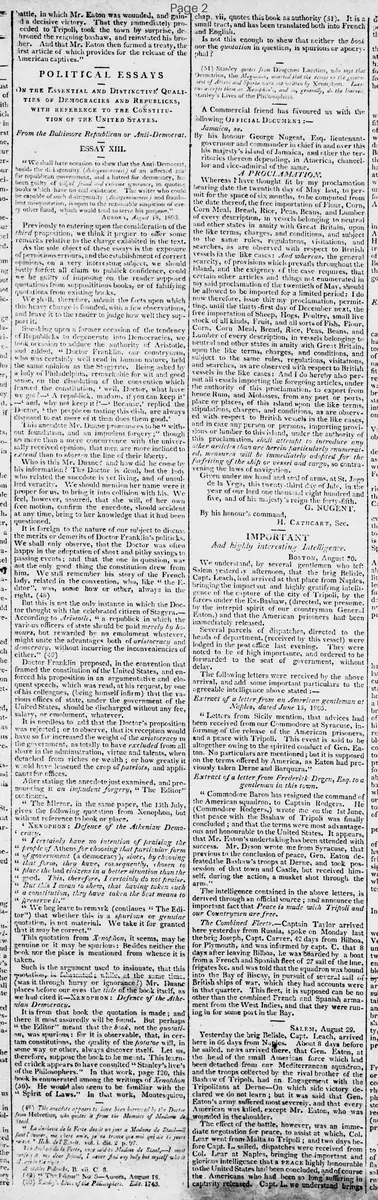
POLITICAL ESSAYS
On the Essential and Distinctive Qualities of Democracies And Republicks, WITH REFERENCE TO THE CONSTITUTION OF THE UNITED STATES.
From the Baltimore Republican or Anti-Democrat.
ESSAY XIII.
"We shall have occasion to shew that the Anti-Democrat, besides the disingenuity (disingenuousness) of an affected zeal for republican government, and a hatred for democracy, has been guilty of silly and foul fraud and extreme ignorance, in quoting books which have no real existence. The writer who could be capable of such disingenuity (disingenuousness) and fraudulent misquotation, is open to the reasonable suspicion of every other fraud, which would tend to serve his purpose."
Aurora, August 18, 1803.
Previously to entering upon the consideration of the third proposition, we think it proper to offer some remarks relative to the charge exhibited in the text.
As the sole object of these essays is the exposure of pernicious errours, and the establishment of correct opinions, on a very interesting subject, we should justly forfeit all claim to publick confidence, could we be guilty of imposing on the reader supposed quotations from supposititious books, or of falsifying quotations from existing books.
We shall, therefore, submit the facts upon which this heavy charge is founded, with a few observations, and leave it to the reader to judge how well they support it.
Speaking upon a former occasion of the tendency of Republicks to degenerate into Democracies, we took occasion to adduce the authority of Aristotle, and added, "Doctor Franklin, our countryman, who was certainly well read in human nature, held the same opinion as the Stagyrite. Being asked by a lady of Philadelphia, remarkable for wit and good sense, on the dissolution of the convention which framed the constitution, 'well, Doctor, what have we got?-' A republick, madam, if you can keep it'--'and, why not keep it?'--'Because,' replied the Doctor, 'the people on tasting this dish, are always disposed to eat more of it than does them good.'"
This anecdote Mr. Duane pronounces to be "without foundation, and an impudent forgery;" though no more than a mere concurrence with the universally received opinion, that men are more inclined to extend than to shorten the line of their liberty.
Who is this Mr. Duane? and how did he come by his information? The Doctor is dead, but the lady who related the anecdote is yet living, and of unsullied veracity. We should mention her name were it proper for us, to bring it into collision with his. We feel, however, assured, that she will, of her own free motion, confirm the anecdote, should accident at any time, bring to her knowledge that it had been questioned.
It is foreign to the nature of our subject to discuss the merits or demerits of Doctor Franklin's politicks.
We shall only observe, that the Doctor was often happy in the adoption of short and pithy sayings to passing events; and that the one in question, was not the only good thing the constitution drew from him. We still remember his story of the French lady, related in the convention, who, like "the Editor", was, some how or other, always in the right.
But this is not the only instance in which the Doctor thought with the celebrated citizen of Stagyra.
According to Aristotle, "a republick in which the various officers of state should be paid merely by honours, but rewarded by no emolument whatever, might unite the advantages both of aristocracy and democracy, without incurring the inconveniencies of either."
Doctor Franklin proposed, in the convention that framed the constitution of the United States, and enforced his proposition in an argumentative and eloquent speech, which was read, at his request, by one of his colleagues, (being himself infirm) that the various offices of state, under the government of the United States, should be discharged without any fee, salary, or emolument, whatever.
It is needless to add that the Doctor's proposition was rejected; or to observe, that its reception would have so far increased the weight of the aristocracy in the government, as totally to have excluded from all share in the administration, virtue and talents, when detached from riches or wealth; or how greatly it would have lessened the crop of patriots, and applicants for offices.
After stating the anecdote just examined, and pronouncing it an impudent forgery, "The Editor" continues.
"The Mirror, in the same paper, the 15th July, gives the following quotation from Xenophon, but without reference to book or place.
Xenophon: Defence of the Athenian Democracy.
'I certainly have no intention of praising the people of Athens for choosing that particular form of government (a democracy), since, by choosing that form, they have, consequently, chosen to place the bad citizens in a better situation than the good. This, therefore, I certainly do not praise.
But this I mean to shew, that having taken such a constitution, they have taken the best means to preserve it.'"
We beg leave to remark (continues "The Editor") that whether this is a spurious or genuine quotation, is not material. We take it for granted that it may be correct."
This quotation from Xenophon, it seems, may be genuine or it may be spurious: Besides neither the book nor the place is mentioned from whence it is taken.
Such is the argument used to insinuate, that this quotation is fabricated; while, at the same time, (was it through hurry or ignorance?) Mr. Duane places before our eyes the title of the book itself, as we had cited it--Xenophon: Defence of the Athenian Democracy.
It is from that book the quotation is made; and there it most assuredly will be found. But perhaps "the Editor" meant that the book, not the quotation, was spurious: for it is observable, that, in certain constitutions, the quality of the potatoe will, in some way or other, always discover itself. Let us, therefore, suppose the book to be meant. This learned critick appears to have consulted "Stanley's Lives of the Philosophers." In that work, page 120, this book is enumerated among the writings of Xenophon. He would also seem to be familiar with the "Spirit of Laws." In that work, Montesquieu, chap. vii, quotes this book as authority.
It is a small tract, and has been translated both into French and English.
Is not this enough to shew that neither the book nor the quotation in question, is spurious or apocryphal?
(51) Stanley quotes from Diogenes Laertius, who says that Demetrius, the Magnesian, asserted that the essays on the government of Athens and Sparta were not written by Xenophon. Laertius accepts them as Xenophon's, and so generally, do the learned.
Stanley's Lives of the Philosophers.
On the Essential and Distinctive Qualities of Democracies And Republicks, WITH REFERENCE TO THE CONSTITUTION OF THE UNITED STATES.
From the Baltimore Republican or Anti-Democrat.
ESSAY XIII.
"We shall have occasion to shew that the Anti-Democrat, besides the disingenuity (disingenuousness) of an affected zeal for republican government, and a hatred for democracy, has been guilty of silly and foul fraud and extreme ignorance, in quoting books which have no real existence. The writer who could be capable of such disingenuity (disingenuousness) and fraudulent misquotation, is open to the reasonable suspicion of every other fraud, which would tend to serve his purpose."
Aurora, August 18, 1803.
Previously to entering upon the consideration of the third proposition, we think it proper to offer some remarks relative to the charge exhibited in the text.
As the sole object of these essays is the exposure of pernicious errours, and the establishment of correct opinions, on a very interesting subject, we should justly forfeit all claim to publick confidence, could we be guilty of imposing on the reader supposed quotations from supposititious books, or of falsifying quotations from existing books.
We shall, therefore, submit the facts upon which this heavy charge is founded, with a few observations, and leave it to the reader to judge how well they support it.
Speaking upon a former occasion of the tendency of Republicks to degenerate into Democracies, we took occasion to adduce the authority of Aristotle, and added, "Doctor Franklin, our countryman, who was certainly well read in human nature, held the same opinion as the Stagyrite. Being asked by a lady of Philadelphia, remarkable for wit and good sense, on the dissolution of the convention which framed the constitution, 'well, Doctor, what have we got?-' A republick, madam, if you can keep it'--'and, why not keep it?'--'Because,' replied the Doctor, 'the people on tasting this dish, are always disposed to eat more of it than does them good.'"
This anecdote Mr. Duane pronounces to be "without foundation, and an impudent forgery;" though no more than a mere concurrence with the universally received opinion, that men are more inclined to extend than to shorten the line of their liberty.
Who is this Mr. Duane? and how did he come by his information? The Doctor is dead, but the lady who related the anecdote is yet living, and of unsullied veracity. We should mention her name were it proper for us, to bring it into collision with his. We feel, however, assured, that she will, of her own free motion, confirm the anecdote, should accident at any time, bring to her knowledge that it had been questioned.
It is foreign to the nature of our subject to discuss the merits or demerits of Doctor Franklin's politicks.
We shall only observe, that the Doctor was often happy in the adoption of short and pithy sayings to passing events; and that the one in question, was not the only good thing the constitution drew from him. We still remember his story of the French lady, related in the convention, who, like "the Editor", was, some how or other, always in the right.
But this is not the only instance in which the Doctor thought with the celebrated citizen of Stagyra.
According to Aristotle, "a republick in which the various officers of state should be paid merely by honours, but rewarded by no emolument whatever, might unite the advantages both of aristocracy and democracy, without incurring the inconveniencies of either."
Doctor Franklin proposed, in the convention that framed the constitution of the United States, and enforced his proposition in an argumentative and eloquent speech, which was read, at his request, by one of his colleagues, (being himself infirm) that the various offices of state, under the government of the United States, should be discharged without any fee, salary, or emolument, whatever.
It is needless to add that the Doctor's proposition was rejected; or to observe, that its reception would have so far increased the weight of the aristocracy in the government, as totally to have excluded from all share in the administration, virtue and talents, when detached from riches or wealth; or how greatly it would have lessened the crop of patriots, and applicants for offices.
After stating the anecdote just examined, and pronouncing it an impudent forgery, "The Editor" continues.
"The Mirror, in the same paper, the 15th July, gives the following quotation from Xenophon, but without reference to book or place.
Xenophon: Defence of the Athenian Democracy.
'I certainly have no intention of praising the people of Athens for choosing that particular form of government (a democracy), since, by choosing that form, they have, consequently, chosen to place the bad citizens in a better situation than the good. This, therefore, I certainly do not praise.
But this I mean to shew, that having taken such a constitution, they have taken the best means to preserve it.'"
We beg leave to remark (continues "The Editor") that whether this is a spurious or genuine quotation, is not material. We take it for granted that it may be correct."
This quotation from Xenophon, it seems, may be genuine or it may be spurious: Besides neither the book nor the place is mentioned from whence it is taken.
Such is the argument used to insinuate, that this quotation is fabricated; while, at the same time, (was it through hurry or ignorance?) Mr. Duane places before our eyes the title of the book itself, as we had cited it--Xenophon: Defence of the Athenian Democracy.
It is from that book the quotation is made; and there it most assuredly will be found. But perhaps "the Editor" meant that the book, not the quotation, was spurious: for it is observable, that, in certain constitutions, the quality of the potatoe will, in some way or other, always discover itself. Let us, therefore, suppose the book to be meant. This learned critick appears to have consulted "Stanley's Lives of the Philosophers." In that work, page 120, this book is enumerated among the writings of Xenophon. He would also seem to be familiar with the "Spirit of Laws." In that work, Montesquieu, chap. vii, quotes this book as authority.
It is a small tract, and has been translated both into French and English.
Is not this enough to shew that neither the book nor the quotation in question, is spurious or apocryphal?
(51) Stanley quotes from Diogenes Laertius, who says that Demetrius, the Magnesian, asserted that the essays on the government of Athens and Sparta were not written by Xenophon. Laertius accepts them as Xenophon's, and so generally, do the learned.
Stanley's Lives of the Philosophers.
What sub-type of article is it?
Constitutional
Partisan Politics
What keywords are associated?
Political Essays
Republic Vs Democracy
Quotation Authenticity
Benjamin Franklin
Xenophon
Us Constitution
Partisan Debate
What entities or persons were involved?
Aristotle
Doctor Franklin
Mr. Duane
Xenophon
Montesquieu
Stanley's Lives Of The Philosophers
Editorial Details
Primary Topic
Defense Against Accusations Of Forged Quotations On Republicanism And Democracy
Stance / Tone
Defensive Refutation Of Forgery Charges
Key Figures
Aristotle
Doctor Franklin
Mr. Duane
Xenophon
Montesquieu
Stanley's Lives Of The Philosophers
Key Arguments
Anecdote Of Franklin's Response To Lady About The Republic Is Authentic, Confirmed By Living Witness.
Franklin Proposed Unpaid Offices In Us Constitution Convention, Aligning With Aristotle's Views.
Quotation From Xenophon's 'Defence Of The Athenian Democracy' Is Genuine, Cited In Stanley And Montesquieu.
Duane's Insinuations Of Fraud Stem From Ignorance Or Hurry.
Author's Essays Aim To Expose Errors Without Fabrication.