Thank you for visiting SNEWPapers!
Sign up free
The Arkansas Advocate
Little Rock, Pulaski County, Arkansas
What is this article about?
In the U.S. Senate on January 21, Mr. Wilkins from the Judiciary Committee reported a bill, prompted by the President's message on South Carolina proceedings, to facilitate collection of import duties during unlawful obstructions by allowing relocation of custom houses, use of military force, and expanded federal court jurisdiction.
Clipping
OCR Quality
Full Text
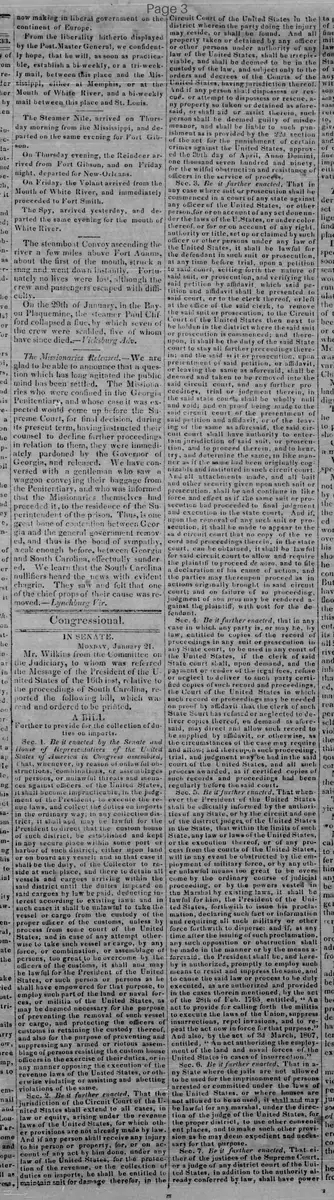
IN SENATE.
Monday, January 21.
Mr. Wilkins from the Committee on the Judiciary, to whom was referred the Message of the President of the United States of the 16th inst, relative to the proceedings of South Carolina, reported the following bill, which was read and ordered to be printed.
A BILL
Further to provide for the collection of duties on imports.
Sec. 1. Be it enacted by the Senate and House of Representatives of the United States of America in Congress assembled, That, whenever, by reason of unlawful obstructions, combinations, or assemblages of persons, or unlawful threats and menaces against officers of the United States, it shall become impracticable, in the judgment of the President, to execute the revenue laws, and collect the duties on imports in the ordinary way, in any collection district, it shall and may be lawful for the President to direct that the custom house of such district, be established and kept in any secure place within some port or harbor of such district, either upon land or on board any vessel; and in that case it shall be the duty, of the Collector to reside at such place, and there to detain all vessels and cargoes arriving within the said district until the duties imposed on said cargoes by law be paid, deducting interest according to existing laws: and in such cases it shall be unlawful to take the vessel or cargo from the custody of the proper officer of the customs, unless by process from some court of the United States; and in case of any attempt otherwise to take such vessel or cargo, by any force, or combination, or assemblage of persons, too great to be overcome by the officers of the customs, it shall and may be lawful for the President of the United States, or such person or persons as he shall have empowered for that purpose, to employ such part of the land or naval forces, or militia of the United States, as may be deemed necessary for the purpose of preventing the removal of such vessel or cargo, and protecting the officers of customs in retaining the custody thereof, and also for the purpose of preventing and suppressing any armed or riotous assemblage of persons resisting the custom house officers in the exercise of their duties, or in any manner opposing the execution of the revenue laws of the United States, or otherwise violating or assisting and abetting violations of the same.
Sec. 2. Be it further enacted, That the jurisdiction of the Circuit Court of the United States shall extend to all cases, in law or equity, arising under the revenue laws of the United States, for which other provisions are not already made by law. And if any person shall receive any injury to his person or property, for, or on account of any act by him done, under any law of the United States, for the protection of the revenue, or the collection of duties on imports, he shall be entitled to maintain suit for damages therefor, in the Circuit Court of the United States in the district wherein the party doing the injury may reside, or shall be found. And all property taken or detained by any officer or other persons under authority of any law of the United States, shall be irrepleviable, and shall be deemed to be in the custody of the law, and subject only to the orders and decrees of the Courts of the United States, having jurisdiction thereof. And if any person shall dispossess or rescue, or attempt to dispossess or rescue, any property so taken or detained as aforesaid, or shall aid or assist therein, such person shall be deemed guilty of misdemeanor, and shall be liable to such punishment as is provided by the 22d section of the act for the punishment of certain crimes against the United States, approved the 30th day of April, Anno Domini, one thousand seven hundred and ninety, for the wilful obstruction and resistance of officers in the service of process,
Sec. 3. Be it further enacted, That in any case where suit or prosecution shall be commenced in a court of any state against any officer of the United States, or other person, for or on account of any act done under the laws of the U. States, or under color thereof, or for or on account of any right, authority or title, set up or claimed by such officer or other persons under any law of the United States, it shall be lawful for the defendant in such suit or prosecution, at any time before trial, upon a petition to said court, setting forth the nature of said suit, or prosecution, and verifying the said petition by affidavit, which said petition and affidavit shall be presented to said court, or to the clerk thereof, or left at the office of the said clerk, to remove the said suit or prosecution, to the Circuit Court of the United States then next to be holden in the district where the said suit or prosecution is commenced; and thereupon, it shall be the duty of the said State court to stay all further proceedings therein; and the said suit or prosecution, upon presentment of said petition, or affidavit, or leaving the same as aforesaid, shall be deemed and taken to be removed into the said circuit court, and any further proceedings, trial or judgment therein, in the said state court, shall be wholly null and void; and on proof being made to the said circuit court of the presentment of said petition and affidavit, or of the leaving of the same as aforesaid, the said circuit court shall have authority to entertain jurisdiction of said suit, or prosecution, and to proceed therein, and to hear, try, and determine the same, in like manner as if the same had been originally cognizable and instituted in such circuit court. And all attachments made, and all bail and other security given upon such suit or prosecution, shall be and continue in like force and effect as if the same suit or prosecution had proceeded to final judgment and execution in the state court. And if, upon the removal of any such suit or prosecution, it shall be made to appear to the said circuit court that no copy of the record and proceedings therein, in the state court, can be obtained, it shall be lawful for said circuit court to allow and require the plaintiff to proceed de novo, and to file a declaration of his cause of action, and the parties may thereupon proceed as in actions originally brought in said circuit court; and on failure of so proceeding, judgment of non pros may be rendered against the plaintiff, with cost for the defendant.
Sec. 4. Be it further enacted, that in any case in which any party is, or may be, by law, entitled to copies of the record of proceedings in any suit or prosecution in any State court, to be used in any court of the United States, if the clerk of said State court shall, upon demand, and the payment or tender of the legal fees, refuse or neglect to deliver to such party certified copies of such record and proceedings, the Court of the United States in which such record or proceedings may be needed on proof by affidavit that the clerk of such State Court has refused or neglected to deliver copies thereof, on demand as aforesaid, may direct and allow such record to be supplied by affidavit, or otherwise, as the circumstances of the case may require and allow; and thereupon such proceeding, trial, and judgment may be had in the said court of the United States, and all such process awarded, as if certified copies of such records and proceedings had been regularly before the said court.
Sec. 5. Be it further enacted, That whenever the President of the United States shall be officially informed by the authorities of any State, or by the circuit and district judges of the United States in the State, that within the limits of such State, any law or laws of the United States, or the execution thereof, or of any process from the courts of the United States, will in any event be obstructed by the employment of military force, or by any other unlawful means too great to be overcome by the ordinary course of judicial proceeding, or by the powers vested in the Marshal by existing laws, it shall be lawful for him, the President of the United States, forthwith to issue his proclamation, declaring such fact or information and requiring all such military or other force forthwith to disperse: and if, at any time after the issuing of such proclamation, any such opposition or obstruction shall be made in the manner or by the means aforesaid, the President shall be, and hereby is authorized, promptly to employ such means to resist and suppress the same, and to cause the said law or process to be duly executed, as are authorized and provided in the cases therein mentioned, by the act of the 28th of Feb. 1795, entitled, "An act to provide for calling forth the militia to execute the laws of the Union, suppress insurrections, repel invasions, and to repeal the act now in force for that purpose." And also, by the act of 3d March, 1807, entitled, "An act authorizing the employment of the land and naval forces of the United States in cases of insurrection."
Sec. 6. Be it further enacted, That in any State where the jails are not allowed to be used for the imprisonment of persons arrested or committed under the laws of the United States, or where houses are not allowed to be so used, it shall and may be lawful for any marshal, under the direction of the judge of the United States, for the proper district, to use other convenient places, and to make such other provision as he may deem expedient and necessary for that purpose.
Sec. 7. Be it further enacted, That either of the justices of the Supreme Court, or a judge of any district court of the United States, in addition to the authority already conferred by law, shall have power to grant writs of habeas corpus in all cases of a prisoner or prisoners, in jail or confinement, where he or they shall be committed or held on or by any authority or law for any act done, or omitted to be done, in pursuance of a law of the United States, or any order, process or decree, of any judge or court thereof, any thing in any act of Congress to the contrary notwithstanding. And if any person or persons to whom such writ of habeas corpus may be directed, shall refuse to obey the same, or shall neglect or refuse to make return, or shall make a false return thereto, in addition to the remedies already given by law, he or they shall be deemed and taken to be guilty of a misdemeanor, and shall, on conviction before any court of competent jurisdiction, be punished by fine not exceeding five thousand dollars, and by imprisonment not exceeding one year, or by either, according to the nature and aggravation of the case.
What sub-type of article is it?
What keywords are associated?
What entities or persons were involved?
Domestic News Details
Event Date
Monday, January 21.
Key Persons
Outcome
bill reported, read, and ordered to be printed.
Event Details
Mr. Wilkins from the Committee on the Judiciary reported a bill further providing for the collection of duties on imports in response to the President's message relative to South Carolina proceedings. The bill includes provisions for relocating custom houses, detaining vessels, employing military forces, extending federal court jurisdiction, removing cases from state courts, and other measures to enforce revenue laws amid obstructions.