Thank you for visiting SNEWPapers!
Sign up free
The Guardian
Boston, Suffolk County, Massachusetts
What is this article about?
Editorial critiques historical persecution of free thinkers from Bacon to revolutionaries, parallels with modern dictators' thought control, and warns against post-WWII U.S. loyalty probes and witch-hunt mentality, citing Salem 1692 and Rosenberg case.
Merged-components note: Merged editorial from page 1 with its continuations on page 4, including the related Salem Village segment as part of the cohesive opinion piece.
Clippings
1 of 2
OCR Quality
Full Text
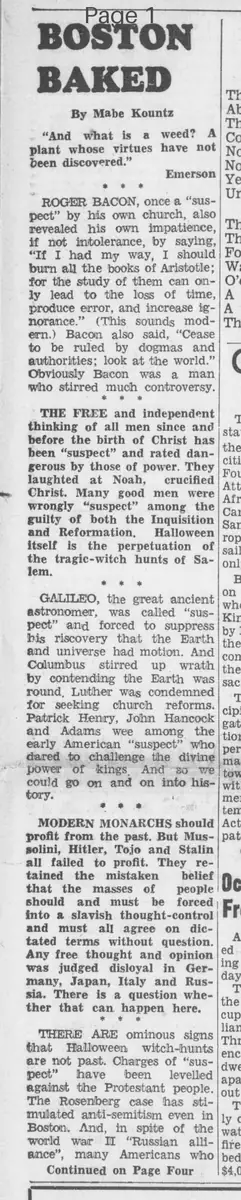
By Mabe Kountz
"And what is a weed? A plant whose virtues have not been discovered."
Emerson
ROGER BACON, once a "suspect" by his own church, also revealed his own impatience, if not intolerance, by saying, "If I had my way, I should burn all the books of Aristotle; for the study of them can only lead to the loss of time, produce error, and increase ignorance." (This sounds modern. Bacon also said, "Cease to be ruled by dogmas and authorities; look at the world.")
Obviously Bacon was a man who stirred much controversy.
THE FREE and independent thinking of all men since and before the birth of Christ has been "suspect" and rated dangerous by those of power. They laughed at Noah, crucified Christ. Many good men were wrongly "suspect" among the guilty of both the Inquisition and Reformation. Halloween itself is the perpetuation of the tragic witch hunts of Salem.
GALILEO, the great ancient astronomer, was called "suspect" and forced to suppress his discovery that the Earth and universe had motion. And Columbus stirred up wrath by contending the Earth was round. Luther was condemned for seeking church reforms. Patrick Henry, John Hancock and Adams were among the early American "suspects" who dared to challenge the divine power of kings. And so we could go on and on into history.
MODERN MONARCHS should profit from the past. But Mussolini, Hitler, Tojo and Stalin all failed to profit. They retained the mistaken belief that the masses of people should and must be forced into a slavish thought-control and must all agree on dictated terms without question. Any free thought and opinion was judged disloyal in Germany, Japan, Italy and Russia. There is a question whether that can happen here.
THERE ARE OMINOUS SIGNS that Halloween witch-hunts are not past. Charges of "suspect" have been levelled against the Protestant people. The Rosenberg case has stimulated anti-semitism even in Boston. And, in spite of the world war II "Russian alliance", many Americans who
Continued on Page Four
BOSTON BAKED
Continued From Page One
meant well in their associations, face investigations of loyalty and probable loss of jobs. Is this action sincere?
THE POLITICIAN who "welcomes" former enemy scientists, soldiers, and refugees into even some of our possible "security" positions and also votes huge loans to former Axis-killers of American troops, has today suddenly decided to "mistrust" his own American people who might have innocently "associated" with various groups during the desperate and confusing days of the Depression. A strange kind of justice.
FEDERAL AGENTS, including the Secret Service and FBI, have long proven their ability to cooperate quietly with other legal authorities and legal courts to apprehend law-breakers, including spies. These men, working without fan-fare, are to be publicly commended. But they are today menaced by politicians who seek to take over the law and to investigate and be judge and jury. This is not good for America.
SALEM VILLAGE, now a part of Danvers, was the scene of the original American witch-hunts in 1692. At that time, Tituba, a West Indian slave of Rev. Sam Parris and two old women were "suspect" of putting a hex on ten people. The witch-hunting spread. In four months, hundreds of people were in jail, and 19 were hung in public on various charges. Common sense finally returned. But the threat still remains today.
What sub-type of article is it?
What keywords are associated?
What entities or persons were involved?
Editorial Details
Primary Topic
Persecution Of Free Thinkers And Modern Loyalty Investigations
Stance / Tone
Defense Of Free Thought Against Historical And Contemporary Suppression
Key Figures
Key Arguments