Thank you for visiting SNEWPapers!
Sign up free
Gazette Of The United States, & Philadelphia Daily Advertiser
Philadelphia, Philadelphia County, Pennsylvania
What is this article about?
London papers from mid-December 1799 detail Austrian advances driving French from Italy, Russian army withdrawal, diplomatic missions in Berlin and Vienna, French post-Brumaire political debates on constitution, Chouan armistice and invasion plans, prisoner releases, and expectations of another European campaign against France.
Clipping
OCR Quality
Full Text
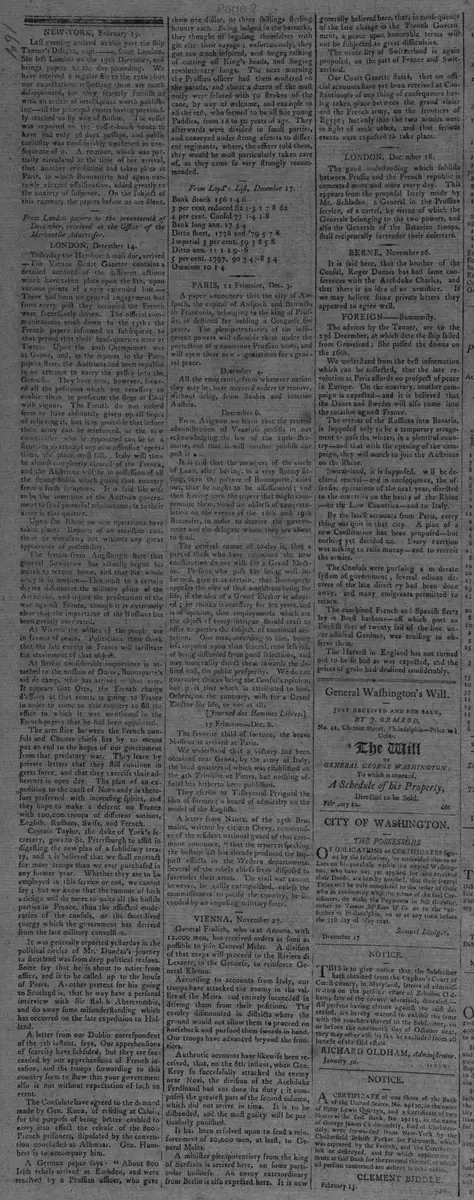
Last evening arrived at this port the ship Tanner's Delight, capt. __, from London.
She left London on the 10th December, and brings papers to the day preceding. We have received a regular file to the 17th; but our expectations respecting them are much disappointed, for they scarcely furnish us with an article of intelligence worth publishing—all the principal events having previously reached us by way of Boston. The vessel was reported on the coffee-house books to have had only 36 days passage, and public curiosity was considerably awakened in consequence of it. A rumour, which was partially circulated at the time of her arrival, that another revolution had taken place at Paris, in which Buonaparte had again narrowly escaped assassination, added greatly to the anxiety of suspense. On the subject of this rumour, the papers before us are silent.
From London papers to the seventeenth of December, received at the Office of the Mercantile Advertiser.
LONDON, December 14.
Yesterday the Hamburg mail due, arrived.—The Vienna Court Gazette contains a detailed account of the different actions which have taken place upon the 8th, upon various points of a very extended line.—There had been no general engagement but from every post they occupied the French were successively driven. The official communications reach down to the 15th: the French papers informed us subsequent to that period that their head-quarters were at Tietra. Upon the 20th Championet was at Genoa, and, as the reports in the Paris papers state, the Austrians had been repulsed in an attempt to carry the place into the Genoese. They have now, however, secured all the positions which are necessary to enable them to prosecute the siege of Coni with vigour. The French do not indeed seem to have absolutely given up all hopes of relieving it, but it is probable that before their army can be reinforced, or the new commander who is appointed can be in a situation to attempt any new offensive operations, the place must fall. Italy will then be almost completely cleared of the French, and the Austrians will be in possession of all the strong holds which guard that country from a fresh irruption. It is said likewise to be the intention of the Austrian government to send powerful reinforcements to their army in this quarter.
Upon the Rhine no new operations have taken place. Reports of an armistice continue to circulate, but without any great appearance of probability.
The letters from Augsburg state that general Suwarrow has actually begun his march to return home, and that his whole army is in motion—This must to a certain degree disconcert the military plans of the Archduke, and injure the prosecution of the war against France, though it is extremely clear that the importance of the Russians has been greatly over rated.
At Vienna the wishes of the people are in favour of peace. Politicians there think that the late events in France will facilitate the attainment of that object.
At Berlin considerable importance is attached to the mission of Duroc, Buonaparte's aid de camp, who has arrived in that city. It appears that Otto, the French charge d'affaires at that court, is going to France in order to come to this country to fill the office to which it was mentioned in the French papers that he had been appointed.
The armistice between the French consuls and Chouan chiefs has by no means put an end to the hopes of our government from that predatory war. They learn by private letters that they still continue in great force, and that they exercise their adherents in open day. The plan of an expedition to the coast of Normandy is therefore preserved with increasing spirits, and they hope to make a descent on France with 100,000 troops of different nations, English, Russians, Swiss, and French.
Captain Taylor, the duke of York's secretary, goes to St. Petersburgh to assist in digesting the new plan of a subsidiary treaty, and it is believed that we shall contract for more troops than we ever purchased in any former year. Whether they are to be employed in this service or not, we cannot say; but we know that the rumour of such a design will do more to unite all the hostile parties in France, than the affected moderation of the consuls, or the short-lived energy which the government has derived from the late military convulsion.
It was generally reported yesterday in the political circles of Mr. Dundas's journey to Scotland was from deep political reasons. Some say that he is about to retire from office, and is to be called up to the house of Peers. Another pretext for his going to Scotland is, that he may have a personal interview with Sir Ralph Abercrombie, and do away some misunderstanding which has occurred on the late expedition to Holland.
A letter from our Dublin correspondent of the 7th instant, says, Our apprehensions of scarcity have subsided, but they are succeeded by our apprehensions of French invasion, and the troops forwarding to this country seem to shew that your government also is not without expectation of such an event.
The Consulate have agreed to the demand made by Gen. Knox, of residing at Calais, for the purpose of being better enabled to carry into effect the release of the 800 French prisoners, stipulated by the convention concluded at Alkmaar. Gen. Humbert is to accompany him.
A German paper says: "About 800 Irish rebels arrived at Embden, and were received by a Prussian officer, who gave them one dollar, or three shillings sterling bounty each. Being lodged in the barracks, they thought of regaling themselves with gin after their voyage; unfortunately, they got too much inspired, and began talking of cutting off King's heads, and singing revolutionary songs. The next morning the Prussian officer had them mustered on the parade, and about a dozen of the most noisy were saluted with 50 strokes of the cane, by way of welcome, and example to all the rest, who seemed to be all fine young Paddies, from 18 to 30 years of age. They afterwards were divided in small parties, and conveyed under strong escorts to different regiments, where, the officer told them, they would be most particularly taken care of, as they came so very strongly recommended."
From Lloyd's List, December 17.
Bank Stock 156 1/4 6
3 per cent reduced 62 1/3 1/7 8 62
4 per cent. Consol 77 1/4 1/8
Bank long ann. 17 3/4
Ditto short, 1778 and '79 5 7/8
Imperial 3 per cent. 59 3/8 5/8
Ditto ann. 11 1/2 9/16
5 per cent. 1797, 90 3/4 7/8 3/4
Omnium 10 1/4
PARIS, 12 Frimaire, Dec. 3.
A paper announces that the city of Anspach, the capital of Anspach and Bareuth, in Franconia, belonging to the king of Prussia, is destined for holding a Congress for peace. The plenipotentiaries of the belligerent powers will assemble there under the protection of a numerous Prussian army, and will open there new negotiations for a general peace.
December 4.
All the emigrants, from whatever nation they may be, have received orders to remove, without delay, from Swabia and interior Austria.
December 6.
From Avignon we learn that the central administration of Vaucluse persists in not acknowledging the law of the 19th Brumaire, and that it will neither publish nor post it.
It is said that the members of the circle of Loan, after having, in a very stormy sitting, torn the picture of Buonaparte, cried out, that he ought to be assassinated; and then having torn the papers that might compromise them, voted an address of congratulation on the events of the 18th and 19th Brumaire, in order to deceive the government and the delegate whom they are about to send.
The general rumor of to-day is, that a part of those who have examined the new constitution do not wish for a Grand Elector. Persons who pass for being well informed, give it as certain, that Buonaparte opposes the idea of that magistrate being for life, if the idea of a Grand Elector is adopted; he thinks it necessary for ten years, and is of opinion, that employments which are the object of every intrigue should cease to offer to parties the subject of continual agitation. One man, according to him, being less imposed upon than several, runs less risk of being dissuaded from good elections, and may more easily direct them towards the desired end, the public prosperity. We do not guarantee this as being the Consul's opinion, but it is that which is attributed to him. Others, on the contrary, wish for a Grand Elector for life, or not at all.
[Journal des Hommes Libres.]
17 Frimaire—Dec. 8.
The favorite child of fortune, the brave Massena is arrived at Paris.
We understand that a victory has been obtained near Genoa, by the army of Italy, the head quarters of which was established on the 4th Frimaire at Pietra, but nothing official has hitherto been published.
They ascribe to Talleyrand Perigord the idea of forming a board of admiralty on the model of the English.
A letter from Nantes, of the 25th Brumaire, written by citizen Chevy, commander of the resident national guard of that commune announce, "that the report respecting the hostage act has already produced the happiest effects in the Western departments. Several of the rebels chiefs seem disposed to surrender their arms. The civil war cannot, however, be easily extinguished, unless the commissioners to pacify the country, be seconded by an imposing military force."
VIENNA, November 27.
General Froelich, who is at Ancona, with 12,000 men, has received orders as soon as possible to join General Melas. A division of that corps will proceed to the Riviera di Levante, in the Genoese, to reinforce Gen. Klenau.
According to accounts from Italy, our troops have attacked the enemy in the valleys of the Maira, and entirely succeeded in driving them from their positions. The cavalry dismounted in districts where the ground would not allow them to proceed on horseback and pursued them swords in hand.
Our troops have advanced beyond the frontiers.
Authentic accounts have likewise been received, that, on the 6th instant, when Gen. Kray so successfully attacked the enemy near Novi, the division of the Archduke Ferdinand had not done its duty; it composed the greatest part of the second column, which did not arrive in time. It is to be disbanded, and the most guilty will be particularly punished.
It has been resolved upon to send a reinforcement of 20,000 men, at least, to Gen. Melas.
A minister plenipotentiary from the king of Sardinia is arrived here, on some particular business. An envoy extraordinary from Berlin is also expected here. It is now generally believed here, that, in consequence of the late change in the French Government, a peace upon honorable terms will not be subjected to great difficulties.
The neutrality of Switzerland is again proposed, on the part of France and Switzerland.
Our Court Gazette states, that no official accounts have yet been received at Constantinople of any thing of consequence having taken place between the grand vizier and the French army, on the frontiers of Egypt; but only that the two armies were in sight of each other, and that serious events were expected to take place.
LONDON, December 18.
The good understanding which subsists between Prussia and the French republic is cemented more and more every day. This appears from the proposal lately made by Mr. Schladen, a General in the Prussian service, of a cartel, by virtue of which the Generals belonging to the two powers, and also the Generals of the Batavian troops, shall reciprocally surrender their deserters.
BERNE. November 26.
It is said here, that the brother of the Consul, Roger Ducos has had some conferences with the Archduke Charles, and that there is an idea of an armistice. If we may believe some private letters they appeared to agree well.
FOREIGN Summary.
The advices by the Tanner, are to the 23d December, at which date the ship sailed from Gravesend: She passed the Downs on the 26th.
We understand from the best information which can be collected, that the late revolution at Paris affords no prospect of peace in Europe. On the contrary, another campaign is expected—and it is believed that the Danes and Swedes will also come into the coalition against France.
The retreat of the Russians into Bavaria, is supposed only to be a temporary arrangement to pass the winter, in a plentiful country—and that with the opening of the campaign, they will march to join the Austrians on the Rhine.
Switzerland, it is supposed, will be declared neutral—and in consequence, the offensive operations of the next year, directed to the countries on the banks of the Rhine—to the Low Countries—and to Italy.
By the latest accounts from Paris, every thing was quiet in that city. A plan of a new Constitution has been proposed—but nothing yet decided on. Every exertion was making to raise money—and to recruit the armies.
The Consuls were pursuing a moderate system of government; several odious decrees of the late directory had been done away, and many emigrants permitted to return.
The combined French and Spanish fleets lay in Brest harbour—off which port an English fleet of twenty sail of the line, under admiral Gardner, was cruising to observe them.
The harvest in England has not turned out to be so bad as was expected, and the prices of grain had declined considerably.
What sub-type of article is it?
What keywords are associated?
What entities or persons were involved?
Where did it happen?
Foreign News Details
Primary Location
Italy
Event Date
December 1799
Key Persons
Outcome
austrians driving french from positions in italy, likely fall of coni, italy nearly cleared of french; russian army in motion to return home; no armistice on rhine; plans for 100,000-troop descent on normandy; french constitution debates ongoing; victory near genoa claimed; prussian handling of irish rebels; expectations of continued war and coalition expansion.
Event Details
London papers report Austrian successes against French in Italy on extended line from 8th, head-quarters at Tietra, Championet at Genoa, siege of Coni advancing; Rhine static with armistice rumors; Suwarrow's Russians marching home, disrupting Archduke's plans; Vienna public favors peace post-French events; Duroc's mission in Berlin, Otto's appointment; Chouan armistice ineffective, expedition to Normandy planned with 100,000 troops; Captain Taylor to St. Petersburgh for subsidiary treaty; Dundas journey rumors; Dublin fears French invasion; Knox to Calais for 800 prisoner release; Irish rebels disciplined in Embden; Paris: Anspach congress proposed, emigrants ordered from Austria, Vaucluse resists Brumaire law, constitution debates on Grand Elector term, Massena arrives, Genoa victory rumored, Talleyrand admiralty idea, Nantes hostage effects; Vienna: Froelich joins Melas, successes in Maira valleys, Kray action at Novi, 20,000 reinforcements, Sardinian minister, peace hopes, Swiss neutrality proposed, Egypt armies in sight; Prussia-France deserter cartel; Berne armistice idea; summary: no peace, another campaign, Russians temporary retreat, Swiss neutral, Paris quiet with constitution plan, fleets at Brest, English harvest improved.