Thank you for visiting SNEWPapers!
Sign up free
The Daily Press
Cincinnati, Hamilton County, Ohio
What is this article about?
Common Pleas court sentences multiple prisoners for burglary, larceny, and other crimes to penitentiary terms; includes personal pleas from defendants like John Thompson and Abram Cross.
Merged-components note: Continuation of the Law Report story on court sentencing proceedings, with spatial overlap in bounding boxes.
Clipping
OCR Quality
Full Text
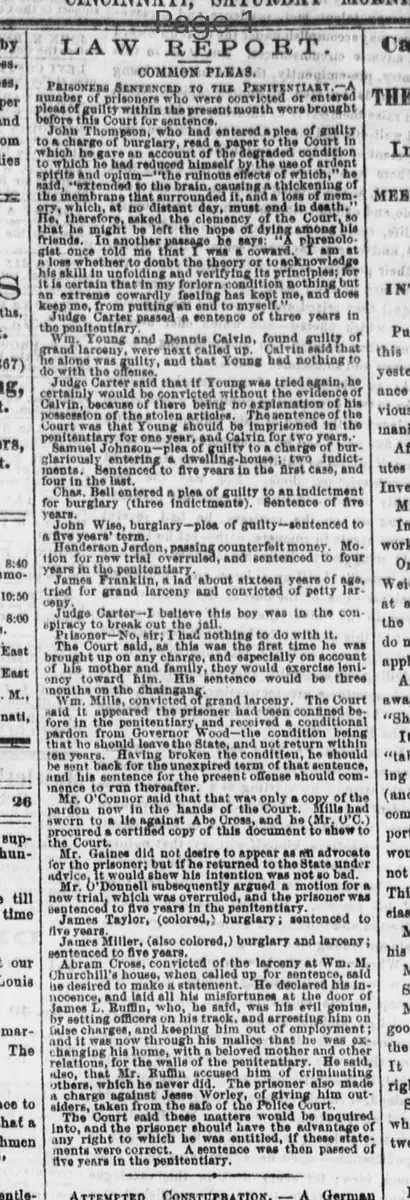
COMMON PLEAS.
PRISONERS SENTENCED TO THE PENITENTIARY.
A number of prisoners who were convicted or entered
pleas of guilty within the present month were brought
before this Court for sentence.
John Thompson, who had entered a plea of guilty
to a charge of burglary, read a paper to the Court in
which he gave an account of the degraded condition
to which he had reduced himself by the use of ardent
spirits and opium--"the ruinous effects of which," he
said, "extended to the brain, causing a thickening of
the membrane that surrounded it, and a loss of memory,
which, at no distant day, must end in death."
He, therefore, asked the clemency of the Court, so
that he might be left the hope of dying among his
friends. In another passage he says: "A phrenolo-
gist once told me that I was a coward. I am at
a loss whether to doubt the theory or to acknowledge
his skill in unfolding and verifying its principles; for
it is certain that in my forlorn condition nothing but
an extreme cowardly feeling has kept me, and does
keep me, from putting an end to myself."
Judge Carter passed a sentence of three years in
the penitentiary.
Wm. Young and Dennis Calvin, found guilty of
grand larceny, were next called up. Calvin said that
he alone was guilty, and that Young had nothing to
do with the offense.
Judge Carter said that if Young was tried again, he
certainly would be convicted without the evidence of
Calvin, because of there being no explanation of his
possession of the stolen articles. The sentence of the
Court was that Young should be imprisoned in the
penitentiary for one year, and Calvin for two years.
Samuel Johnson-plea of guilty to a charge of bur-
glariously entering a dwelling-house; two indict-
ments. Sentenced to five years in the first case, and
four in the last.
Chas. Bell entered a plea of guilty to an indictment
for burglary (three indictments). Sentence of five
years,
John Wise, burglary-plea of guilty-sentenced to
a five years' term
Henderson Jordan, passing counterfeit money, Mo-
tion for new trial overruled, and sentenced to four
years in the penitentiary
James Franklin, a lad about sixteen years of age,
tried for grand larceny and convicted of petty lar-
ceny.
Judge Carter-I believe this boy was in the con-
spiracy to break out the jail.
Prisoner-No, sir; I had nothing to do with it.
The Court said, as this was the first time he was
brought up on any charge, and especially on account
of his mother and family, they would exercise leni-
ency toward him. His sentence would be three
months on the chain-gang.
Wm. Mills, convicted of grand larceny. The Court
said it appeared the prisoner had been confined be-
fore in the penitentiary, and received a conditional
pardon from Governor Wood-the condition being
that he should leave the State, and not return within
ten years. Having broken the condition, he should
be sent back for the unexpired term of that sentence,
and his sentence for the present offense should com-
mence to run thereafter.
Mr. O'Connor said that that was only a copy of the
pardon now in the hands of the Court. Mills had
sworn to a lie against Abe Cross, and he (Mr. O'C.)
procured a certified copy of this document to show to
the Court.
Mr. Gaines did not desire to appear as an advocate
for the prisoner; but if he returned to the State under
advice, it would show his intention was not so bad.
Mr. O'Donnell subsequently argued a motion for a
new trial, which was overruled, and the prisoner was
sentenced to five years in the penitentiary.
James Taylor, (colored,) burglary; sentenced to
five years.
James Miller, (also colored,) burglary and larceny;
sentenced to five years.
Abram Cross, convicted of the larceny at Wm. M.
Churchill's house, when called up for sentence, said
he desired to make a statement. He declared his in-
nocence, and laid all his misfortunes at the door of
James L. Ruffin, who, he said, was his evil genius,
by setting officers on his track, and arresting him on
false charges, and keeping him out of employment;
and it was now through his malice that he was ex-
changing his home, with a beloved mother and other
relations, for the walls of the penitentiary. He said.
also, that Mr. Ruffin accused him of criminating
others, which he never did. The prisoner also made
a charge against Jesse Worley, of giving him out-
siders, taken from the safe of the Police Court.
The Court said these matters would be inquired
into, and the prisoner should have the advantage of
any right to which he was entitled, if these state-
ments were correct. A sentence was then passed of
five years in the penitentiary.
What sub-type of article is it?
What themes does it cover?
What keywords are associated?
What entities or persons were involved?
Where did it happen?
Story Details
Key Persons
Location
Common Pleas Court
Event Date
Within The Present Month
Story Details
Court sentences multiple prisoners for burglary, larceny, passing counterfeit money, and related crimes to various terms in the penitentiary; includes personal pleas and statements from defendants like Thompson on his addiction and Cross on his innocence.