Thank you for visiting SNEWPapers!
Sign up free
Story
February 1, 1854
Washington Telegraph
Washington, Hempstead County, Arkansas
What is this article about?
Detailed ethnographic account of Comanche Indian life on the Texas frontier, covering daily routines, migration, games, food, religion, and their philosophical enjoyment of nomadic existence and connection to nature.
Clipping
OCR Quality
98%
Excellent
Full Text
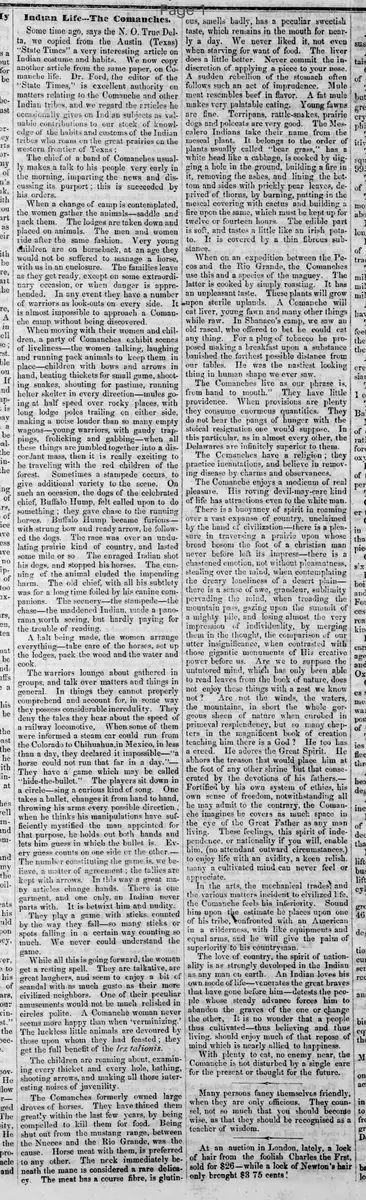
Life---The Comanches.
Some time ago, says the N. O. True Delta, we copied from the Austin (Texas) "State Times" a very interesting article on Indian costume and habits. We now copy another article from the same paper, on Comanche life. Dr. Ford, the editor of the "State Times," is excellent authority on matters relating to the Comanche and other Indian tribes, and we regard the articles he occasionally gives on Indian subjects as valuable contributions to our stock of knowledge of the habits and customs of the Indian tribes who roam on the great prairies on the western frontier of Texas:
The chief of a band of Comanches usually makes a talk to his people very early in the morning, imparting the news and discussing its purport; this is succeeded by his orders.
When a change of camp is contemplated, the women gather the animals--saddle and pack them. The lodges are taken down and placed on animals. The men and women ride after the same fashion. Very young children are on horseback, at an age they would not be suffered to manage a horse, with us in an enclosure. The families leave as they get ready, except on some extraordinary occasion, or when danger is apprehended. In any event they have a number of warriors as look-outs on every side. It is almost impossible to approach a Comanche camp without being discovered.
When moving with their women and children, a party of Comanches exhibit scenes of liveliness--the women talking, laughing and running pack animals to keep them in place--children with bows and arrows in hand, beating thickets for small game, shooting snakes, shouting for pastime, running helter skelter in every direction-mules going at half speed over rocky places, with long lodge poles trailing on either side, making a noise louder than so many empty wagons-young warriors, with gaudy trappings, frolicking and gabbing-when all these things are jumbled together into a discordant mass, then it is really exciting to be traveling with the red children of the forest. Sometimes a stampede occurs, to give additional variety to the scene. On such an occasion, the dogs of the celebrated chief, Buffalo Hump, felt called upon to do something ; they gave chase to the running horses. Buffalo Hump became furious-- with strung bow and ready arrow, he followed the dogs. The race was over an undulating prairie kind of country, and lasted some mile or so The enraged Indian shot his dogs, and stopped his horses. The cunning of the animal eluded the impending harm. The old chief, with all his subtlety was for a long time foiled by his canine companions. The scenery-the stampede--the chase-the maddened Indian, made a panorama worth seeing, but hardly paying for the trouble of reading.
A halt being made, the women arrange everything-take care of the horses, set up the lodges, pack the wood and the water and cook.
The warriors lounge about gathered in groups, and talk over matters and things in general. In things they cannot properly comprehend and account for, in some way they possess considerable incredulity. They deny the tales they hear about the speed of a railway locomotive, When some of them were informed a steam car could run from the Colorado to Chihuahua, in Mexico, in less than a day, they declared it impossible-"a horse could not run that far in a day."
They have a game which may be called "hide-the-bullet." The players sit down in a circle-sing a curious kind of song. One takes a bullet, changes it from hand to hand, throwing his arms every possible direction, when he thinks his manipulations have sufficiently mystified the man appointed for that purpose, he holds out both hands and lets him guess in which the bullet is. Every guess counts on one side or the other.- The number constituting the game is, we believe, a matter of agreement ; the tallies are kept with arrows. In this way a great many articles change hands. There is one garment, and one only, an Indian never parts with. It is betwixt him and nudity.
They play a game with sticks. counted by the way they fall-so many sticks or spots falling in a certain way counting so much. We never could understand the game.
While all this is going forward, the women get a resting spell. They are talkative, are great laughers, and seem to enjoy a bit of scandal with as much gusto as their more civilized neighbors. One of their peculiar amusements would not be much relished in circles polite. A Comanche woman never seems more happy than when 'verminizing. The luckless little animals are devoured by those upon whom they had feasted; they get the full benefit of the lex talionis.
The children are roaming about, examining every thicket and every hole, bathing, shooting arrows, and making all those interesting noises of juvenility.
The Comanches formerly owned large droves of horses. They have thinned them greatly within the last few years, by being compelled to kill them for food. Being shut out from the mustang range, between the Nueces and the Rio Grande, was the cause. Horse meat with them, is preferred to any other. The neck immediately beneath the mane is considered a rare delicacy. The meat has a coarse fibre, is glutinous, smells badly, has a peculiar sweetish taste, which remains in the mouth for nearly a day. We never liked it, not even when starving for want of food. The liver does a little better. Never commit the indiscretion of applying a piece to your nose. A sudden rebellion of the stomach often follows such an act of imprudence. Mule meat resembles beef in flavor. A fat mule makes very palatable eating. Young fawns are fine. Terrapins, rattle-snakes, prairie dogs and polecats are very good. The Mescalero Indians take their name from the mescal plant. It belongs to the order of plants usually called "bear grass," has a white head like a cabbage, is cooked by digging a hole in the ground, building a fire in it, removing the ashes, and lining the bottom and sides with prickly pear leaves, deprived of thorns, by burning, putting in the mescal covering with cactus and building a fire upon the same, which must be kept up for twelve or fourteen hours. The edible part is soft, and tastes a little like an Irish potato. It is covered by a thin fibrous substance.
When on an expedition between the Pecos and the Rio Grande, the Comanches use this and a species of the maguey. The latter is cooked by simply roasting. It has an unpleasant taste. These plants will grow upon sterile uplands. A Comanche will eat liver, young fawn and many other things while raw. In Shanaco's camp, we saw an old rascal, who offered to bet he could eat any thing. For a plug of tobacco he proposed making a breakfast upon a substance banished the farthest possible distance from our tables. It was the nastiest looking thing in human shape we ever saw.
The Comanches live as our phrase is, from hand to mouth." They have little providence. When provisions are plenty they consume enormous quantities. They do not bear the pangs of hunger with the stoical resignation one would suppose. In this particular, as in almost every other, the Delawares are infinitely superior to them.
The Comanches have a religion; they practice incantations, and believe in removing disease by charms and observances.
The Comanche enjoys a modicum of real pleasure. His roving devil-may-care kind of life has attractions even to the white man. There is a buoyancy of spirit in roaming over a vast expanse of country, unclaimed by the hand of civilization-there is a pleasure in traversing a prairie upon whose broad bosom the foot of a christian man never before left its impress-there is a chastened emotion, not without pleasantness, stealing over the mind, when contemplating the dreary loneliness of a desert plain- there is a sense of awe, grandeur, sublimity pervading the mind, when treading the mountain pass, gazing upon the summit of a mighty pile, and losing almost the very impression of individuality, by merging them in the thought, the comparison of our utter insignificance, when contrasted with those gigantic monuments of His creative power before us. Are we to suppose the untutored mind, which has only been able to read leaves from the book of nature, does not enjoy these things with a zest we know not? Are not the winds, the waters, the mountains, in short the whole gorgeous sheen of nature when enrobed in primeval resplendency, but so many chapters in the magnificent book of creation teaching him there is a God ? He too has a creed. He adores the Great Spirit. He abhors the treason that would place him at the foot of any other shrine but that consecrated by the devotions of his fathers.-- Fortified by his own system of ethics, his own sense of freedom, notwithstanding all he may admit to the contrary, the Comanche imagines he covers as much space in the eye of the Great Father as any man living. These feelings, this spirit of independence, or nationality if you will, enable him, (no attendant outward circumstances.) to enjoy life with an avidity, a keen relish. many a cultivated mind can never feel or appreciate.
In the arts. the mechanical trades: and the various matters incident to civilized life. the Comanche feels his inferiority. Sound him upon the estimate he places upon one of his tribe, confronted with an American in a wilderness, with like equipments and equal arms, and he will give the palm of superiority to his countryman.
The love of country. the spirit of nationality is as strongly developed in the Indian as any man on earth. An Indian loves his own mode of life--venerates the great braves that have gone before him--detests the people whose steady advance forces him to abandon the graves of the one or change the other, It is no wonder that a people thus cultivated-thus believing and thus living. should enjoy much of that repose of mind which is nearly allied to happiness.
With plenty to eat, no enemy near, the Comanche is not disturbed by a single care for the present or thought for the future.
Some time ago, says the N. O. True Delta, we copied from the Austin (Texas) "State Times" a very interesting article on Indian costume and habits. We now copy another article from the same paper, on Comanche life. Dr. Ford, the editor of the "State Times," is excellent authority on matters relating to the Comanche and other Indian tribes, and we regard the articles he occasionally gives on Indian subjects as valuable contributions to our stock of knowledge of the habits and customs of the Indian tribes who roam on the great prairies on the western frontier of Texas:
The chief of a band of Comanches usually makes a talk to his people very early in the morning, imparting the news and discussing its purport; this is succeeded by his orders.
When a change of camp is contemplated, the women gather the animals--saddle and pack them. The lodges are taken down and placed on animals. The men and women ride after the same fashion. Very young children are on horseback, at an age they would not be suffered to manage a horse, with us in an enclosure. The families leave as they get ready, except on some extraordinary occasion, or when danger is apprehended. In any event they have a number of warriors as look-outs on every side. It is almost impossible to approach a Comanche camp without being discovered.
When moving with their women and children, a party of Comanches exhibit scenes of liveliness--the women talking, laughing and running pack animals to keep them in place--children with bows and arrows in hand, beating thickets for small game, shooting snakes, shouting for pastime, running helter skelter in every direction-mules going at half speed over rocky places, with long lodge poles trailing on either side, making a noise louder than so many empty wagons-young warriors, with gaudy trappings, frolicking and gabbing-when all these things are jumbled together into a discordant mass, then it is really exciting to be traveling with the red children of the forest. Sometimes a stampede occurs, to give additional variety to the scene. On such an occasion, the dogs of the celebrated chief, Buffalo Hump, felt called upon to do something ; they gave chase to the running horses. Buffalo Hump became furious-- with strung bow and ready arrow, he followed the dogs. The race was over an undulating prairie kind of country, and lasted some mile or so The enraged Indian shot his dogs, and stopped his horses. The cunning of the animal eluded the impending harm. The old chief, with all his subtlety was for a long time foiled by his canine companions. The scenery-the stampede--the chase-the maddened Indian, made a panorama worth seeing, but hardly paying for the trouble of reading.
A halt being made, the women arrange everything-take care of the horses, set up the lodges, pack the wood and the water and cook.
The warriors lounge about gathered in groups, and talk over matters and things in general. In things they cannot properly comprehend and account for, in some way they possess considerable incredulity. They deny the tales they hear about the speed of a railway locomotive, When some of them were informed a steam car could run from the Colorado to Chihuahua, in Mexico, in less than a day, they declared it impossible-"a horse could not run that far in a day."
They have a game which may be called "hide-the-bullet." The players sit down in a circle-sing a curious kind of song. One takes a bullet, changes it from hand to hand, throwing his arms every possible direction, when he thinks his manipulations have sufficiently mystified the man appointed for that purpose, he holds out both hands and lets him guess in which the bullet is. Every guess counts on one side or the other.- The number constituting the game is, we believe, a matter of agreement ; the tallies are kept with arrows. In this way a great many articles change hands. There is one garment, and one only, an Indian never parts with. It is betwixt him and nudity.
They play a game with sticks. counted by the way they fall-so many sticks or spots falling in a certain way counting so much. We never could understand the game.
While all this is going forward, the women get a resting spell. They are talkative, are great laughers, and seem to enjoy a bit of scandal with as much gusto as their more civilized neighbors. One of their peculiar amusements would not be much relished in circles polite. A Comanche woman never seems more happy than when 'verminizing. The luckless little animals are devoured by those upon whom they had feasted; they get the full benefit of the lex talionis.
The children are roaming about, examining every thicket and every hole, bathing, shooting arrows, and making all those interesting noises of juvenility.
The Comanches formerly owned large droves of horses. They have thinned them greatly within the last few years, by being compelled to kill them for food. Being shut out from the mustang range, between the Nueces and the Rio Grande, was the cause. Horse meat with them, is preferred to any other. The neck immediately beneath the mane is considered a rare delicacy. The meat has a coarse fibre, is glutinous, smells badly, has a peculiar sweetish taste, which remains in the mouth for nearly a day. We never liked it, not even when starving for want of food. The liver does a little better. Never commit the indiscretion of applying a piece to your nose. A sudden rebellion of the stomach often follows such an act of imprudence. Mule meat resembles beef in flavor. A fat mule makes very palatable eating. Young fawns are fine. Terrapins, rattle-snakes, prairie dogs and polecats are very good. The Mescalero Indians take their name from the mescal plant. It belongs to the order of plants usually called "bear grass," has a white head like a cabbage, is cooked by digging a hole in the ground, building a fire in it, removing the ashes, and lining the bottom and sides with prickly pear leaves, deprived of thorns, by burning, putting in the mescal covering with cactus and building a fire upon the same, which must be kept up for twelve or fourteen hours. The edible part is soft, and tastes a little like an Irish potato. It is covered by a thin fibrous substance.
When on an expedition between the Pecos and the Rio Grande, the Comanches use this and a species of the maguey. The latter is cooked by simply roasting. It has an unpleasant taste. These plants will grow upon sterile uplands. A Comanche will eat liver, young fawn and many other things while raw. In Shanaco's camp, we saw an old rascal, who offered to bet he could eat any thing. For a plug of tobacco he proposed making a breakfast upon a substance banished the farthest possible distance from our tables. It was the nastiest looking thing in human shape we ever saw.
The Comanches live as our phrase is, from hand to mouth." They have little providence. When provisions are plenty they consume enormous quantities. They do not bear the pangs of hunger with the stoical resignation one would suppose. In this particular, as in almost every other, the Delawares are infinitely superior to them.
The Comanches have a religion; they practice incantations, and believe in removing disease by charms and observances.
The Comanche enjoys a modicum of real pleasure. His roving devil-may-care kind of life has attractions even to the white man. There is a buoyancy of spirit in roaming over a vast expanse of country, unclaimed by the hand of civilization-there is a pleasure in traversing a prairie upon whose broad bosom the foot of a christian man never before left its impress-there is a chastened emotion, not without pleasantness, stealing over the mind, when contemplating the dreary loneliness of a desert plain- there is a sense of awe, grandeur, sublimity pervading the mind, when treading the mountain pass, gazing upon the summit of a mighty pile, and losing almost the very impression of individuality, by merging them in the thought, the comparison of our utter insignificance, when contrasted with those gigantic monuments of His creative power before us. Are we to suppose the untutored mind, which has only been able to read leaves from the book of nature, does not enjoy these things with a zest we know not? Are not the winds, the waters, the mountains, in short the whole gorgeous sheen of nature when enrobed in primeval resplendency, but so many chapters in the magnificent book of creation teaching him there is a God ? He too has a creed. He adores the Great Spirit. He abhors the treason that would place him at the foot of any other shrine but that consecrated by the devotions of his fathers.-- Fortified by his own system of ethics, his own sense of freedom, notwithstanding all he may admit to the contrary, the Comanche imagines he covers as much space in the eye of the Great Father as any man living. These feelings, this spirit of independence, or nationality if you will, enable him, (no attendant outward circumstances.) to enjoy life with an avidity, a keen relish. many a cultivated mind can never feel or appreciate.
In the arts. the mechanical trades: and the various matters incident to civilized life. the Comanche feels his inferiority. Sound him upon the estimate he places upon one of his tribe, confronted with an American in a wilderness, with like equipments and equal arms, and he will give the palm of superiority to his countryman.
The love of country. the spirit of nationality is as strongly developed in the Indian as any man on earth. An Indian loves his own mode of life--venerates the great braves that have gone before him--detests the people whose steady advance forces him to abandon the graves of the one or change the other, It is no wonder that a people thus cultivated-thus believing and thus living. should enjoy much of that repose of mind which is nearly allied to happiness.
With plenty to eat, no enemy near, the Comanche is not disturbed by a single care for the present or thought for the future.
What sub-type of article is it?
Curiosity
Historical Event
Biography
What themes does it cover?
Nature
Survival
Providence Divine
What keywords are associated?
Comanche Life
Indian Customs
Nomadic Migration
Tribal Games
Horse Meat
Mescal Plant
Great Spirit
Texas Frontier
What entities or persons were involved?
Dr. Ford
Buffalo Hump
Shanaco
Where did it happen?
Western Frontier Of Texas
Story Details
Key Persons
Dr. Ford
Buffalo Hump
Shanaco
Location
Western Frontier Of Texas
Story Details
Description of Comanche daily life, including morning assemblies, camp migrations with lively scenes, games like hide-the-bullet and stick games, food preferences such as horse meat and mescal, religious beliefs in the Great Spirit, and their enjoyment of nomadic freedom and connection to nature.