Thank you for visiting SNEWPapers!
Sign up free
Editorial
October 2, 1811
Alexandria Daily Gazette, Commercial & Political
Alexandria, Virginia
What is this article about?
Editorial from New York Evening Post, signed Hamilton, critiques Jefferson administration for destroying national credit by abolishing pledged excise taxes, leading to revenue failure, inability to secure loans, and vulnerability in potential war with Britain benefiting France. Advocates internal taxation but doubts feasibility due to past breaches of faith.
Clipping
OCR Quality
95%
Excellent
Full Text
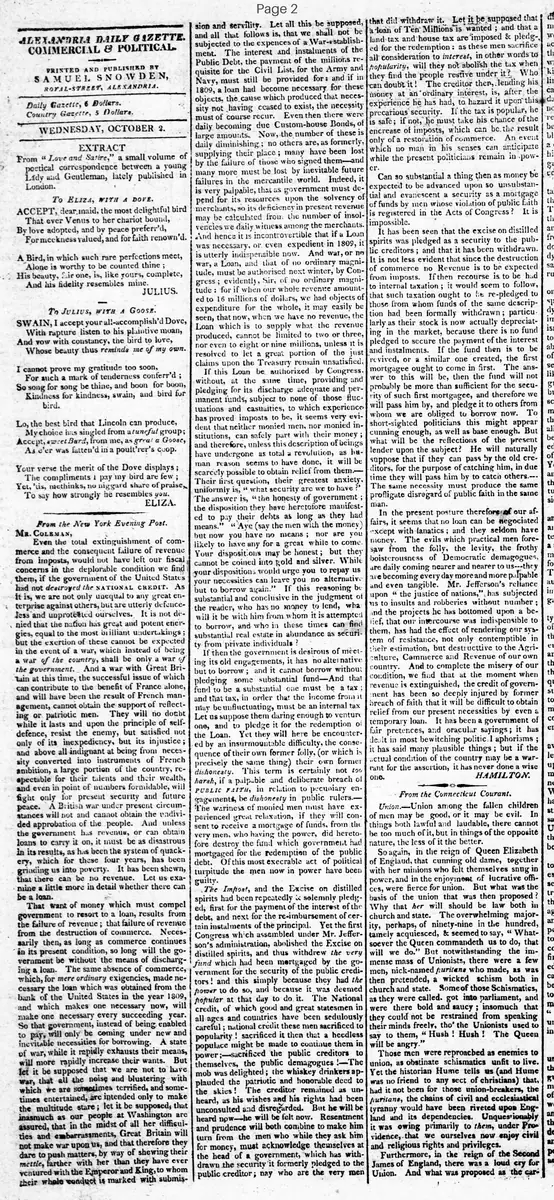
From the New York Evening Post.
MR. COLEMAN,
Even the total extinguishment of commerce and the consequent failure of revenue
from imposts, would not have left our fiscal
concerns in the deplorable condition we find
them, if the government of the United States
had not destroyed the NATIONAL CREDIT. As
it is, we are not only unequal to any great en-
terprise against others, but are utterly defence-
less and unprotected ourselves. It is not de-
ied that the nation has great and potent ener-
gies, equal to the most brilliant undertakings;
but the exertion of these cannot be expected
in the event of a war, which instead of being
a war of the country, shall be only a war of
the government. And a war with Great Bri-
tain at this time, the successful issue of which
can contribute to the benefit of France alone,
and will have been the result of French man-
agement, cannot obtain the support of reflect-
ing or patriotic men. They will no doubt
while it lasts and upon the principle of self.
defence, resist the enemy, but satisfied not
only of its inexpediency, but its injustice;
and above all indignant at being from neces-
sity converted into instruments of French
ambition, a large portion of the country, re-
spectable for their talents and their wealth,
and even in point of numbers formidable, will
fight only for present security and future
peace. A British war under present circum-
stances will not and cannot obtain the undivi-
ded approbation of the people. And unless
the government has revenue, or can obtain
loans to carry it on, it must be as disastrous
in its results, as has been the system of quack-
ery, which for these four years, has been
grinding us into poverty. It has been shewn,
that there can be no revenue. Let us exa-
mine a little more in detail whether there can
be a loan.
That want of money which must compel
government to resort to a loan, results from
the failure of revenue; that failure of revenue
from the destruction of commerce. Neces-
sarily then, as long as commerce continues
in its present condition, so long will the go-
vernment be without the means of discharg-
ing a loan. The same absence of commerce,
which, for mere ordinary exigencies, made ne-
cessary the loan which was obtained from the
bank of the United States in the year 1809,
and which makes one necessary now, will
make one necessary every succeeding year.
So that government, instead of being enabled
to pay, will only be coming under new and
inevitable necessities for borrowing. A state
of war, while it rapidly exhausts their means,
will more rapidly increase their wants. But
let it be supposed that we are not to have
war, that all the noise and blustering with
which we are sometimes terrified, and some-
times entertained, are intended only to make
the multitude stare; let it be supposed, that
inasmuch as our people at Washington are
assured, that in the midst of all her difficul-
ties and embarrassments, Great Britain will
not make war upon us, and that therefore they
dare to push matters, by way of shewing their
mettle, farther with her than they have ever
ventured with the Emperor and King, to whom
their whole conduct is marked with submis-
sion and servility. Let all this be supposed,
and all that follows is, that we shall not be
subjected to the expences of a War-establish-
ment. The interest and instalments of the
Public Debt, the payment of the millions re-
quisite for the Civil List, for the Army and
Navy, must still be provided for: and if in
1809, a loan had become necessary for these
objects, the cause which produced that neces-
sity not having ceased to exist, the necessity
must of course recur. Even then there were
daily becoming due Custom-house Bonds, of
large amounts. Now, the number of these is
daily diminishing; no others are, as formerly.
supplying their place; many have been lost
by the failure of those who signed them--and
many more must be lost by inevitable future
failures in the mercantile world. Indeed, it
is very palpable, that as government must de-
pend for its resources upon the solvency of
merchants, so its deficiency in present revenue
may be calculated from the number of insol-
vencies we daily witness among the merchants.
And hence it is incontrovertible that if a Loan
was necessary, or even expedient in 1809, it
is utterly indispensible now. And war, or no
war, a Loan, and that of no ordinary magni-
tude, must be authorised next winter, by Con-
gress; evidently, Sir, of no ordinary magni-
tude: for if when our whole revenue amount-
ed to 16 millions of dollars, we had objects of
expenditure for the whole, it may easily be
seen, that now, when we have no revenue, the
Loan which is to supply what the revenue
produced, cannot be limited to two or three,
nor even to eight or nine millions, unless it is
resolved to let a great portion of the just
claims upon the Treasury remain unsatisfied.
If this Loan be authorized by Congress,
without, at the same time, providing and
pledging for its discharge adequate and per-
manent funds, subject to none of those un-
tuations and casualties, to which experience
has proved imposts to be, it seems very evi-
dent that neither monied men, nor monied in-
stitutions, can safely part with their money;
and therefore, unless this description of beings
have undergone as total a revolution, as hu-
man reason seems to have done, it will be
scarcely possible to obtain relief from them.-
Their first question, their greatest anxiety,
uniformly is, "what security are we to have?"
The answer is, "the honesty of government;
the disposition they have heretofore manifest-
ed to pay their debts as long as they had
means."
"Aye (say the men with the money)
but now you have no means; nor are you
likely to have any for a great while to come.
Your dispositions may be honest; but they
cannot be coined into gold and silver. While
your dispositions would urge you to repay us
your necessities can leave you no alternative
but to borrow again." If this reasoning be
substantial and conclusive in the judgment of
the reader, who has no money to lend, what
will it be with him from whom it is attempted
to borrow, and who in these times can find
substantial real estate in abundance as securi-
ty from private individuals?
If then the government is desirous of meet-
ing its old engagements, it has no alternative
but to borrow; and it cannot borrow without
pledging some substantial fund--And that
fund to be a substantial one must be a tax;
and that tax, in order that the income from it
may be unfluctuating, must be an internal tax
Let us suppose them daring enough to venture
one, and to pledge it for the redemption of
the Loan. Yet they will here be encounter-
ed by an insurmountable difficulty, the conse-
quence of their own former folly. (for which is
precisely the same thing) their own former
dishonesty. This term is certainly not too
harsh, if a palpable and deliberate breach of
PUBLIC Faith, in relation to pecuniary en-
gagements, be dishonesty in public rulers.-
The wariness of monied men must have ex-
perienced great relaxation, if they will con-
sent to receive a mortgage of funds. from these
very men, who having the power, did hereto-
fore destroy the fund which government had
mortgaged for the redemption of the public
debt. Of this most execrable act of political
turpitude the men now in power have been
guilty.
The Import, and the Excise on distilled
spirits had been repeatedly and solemnly pledg-
ed; first for the payment of the interest of the
debt, and next for the re-imbursement of cer-
tain instalments of the principal. Yet the first
Congress which assembled under Mr. Jeffer-
son's administration, abolished the Excise on
distilled spirits, and thus withdrew the very
fund which had been mortgaged by the go-
vernment for the security of the public credi-
tors! and this simply because they had the
power to do so, and because it was deemed
popular at that day to do it. The National
credit, of which good and great statesmen in
all ages and countries have been sedulously
careful; national credit these men sacrificed to
popularity! sacrificed it then that a heedless
populace might be made to continue them in
power;--sacrificed the public creditors to
themselves, the public demagogues!--The
mob was delighted; the whiskey drinkers ap-
plauded the patriotic and honorable deed to
the skies! The creditor remained as un-
heard, as his wishes and his rights had been
unconsulted and disregarded. But he will be
heard now--he will be felt now. Resentment
and prudence will both combine to make him
turn from the men who while they ask him
for money, must acknowledge themselves at
the head of a government, which has with-
drawn the security it formerly pledged to the
public creditor; nay who are the very men
that did withdraw it. Let it be supposed that
a loan of Ten Millions is wanted; and that a
land tax and house tax are imposed & pledged
for the redemption: as these men sacrifice
all consideration to interest, in other words to
popularity, will they not abolish the tax when
they find the people restive under it? Who
can doubt it! The creditor then, lending his
money at an ordinary interest, is, after the
experience he has had, to hazard it upon this
precarious security. If the tax is popular, he
is safe; if not, he must take his chance of the
encrease of imposts, which can be the result
only of a restoration of commerce. An event
which no man in his senses can anticipate
while the present politicians remain in power.
Can so substantial a thing then as money be
expected to be advanced upon so unsubstan-
tial and evanescent a security as a mortgage
of funds by men whose violation of public faith
is registered in the Acts of Congress? It is
impossible.
It has been seen that the excise on distilled
spirits was pledged as a security to the pub-
lic creditors; and that it has been withdrawn.
It is not less evident that since the destruction
of commerce no Revenue is to be expected
from imposts. If then recourse is to be had
to internal taxation; it would seem to follow,
that such taxation ought to be re-pledged to
those from whom funds of the same descrip-
tion had been formally withdrawn: particu-
larly as their stock is now actually depreciat-
ing in the market, because there is no fund
pledged to secure the payment of the interest
and instalments. If the fund then is to be
revived, or a similar one created, the first
mortgagee ought to come in first. The ans-
wer to this will be, then the fund will not
probably be more than sufficient for the secu-
rity of such first mortgagee, and therefore we
will pass him by, and pledge it to others from
whom we are obliged to borrow now. To
short-sighted politicians this might appear
cunning enough, as well as base enough. But
what will be the reflections of the present
lender upon the subject? He will naturally
suppose that if they can pass by the old cre-
ditors, for the purpose of catching him, in due
time they will pass him by to catch others.--.
The same necessity must produce the same
profligate disregard of public faith in the same
man.
In the present posture therefore of our af-
fairs, it seems that no loan can be negociated
except with fanatics; and they seldom have
money. The evils which practical men fore-
saw from the folly, the levity, the frothy
boisterousness of Democratic demagogues,
are daily coming nearer and nearer to us---they
are becoming every day more and more palpable
and even tangible. Mr. Jefferson's reliance
upon "the justice of nations," has subjected
us to insults and robberies without number:
and the projects he has bottomed upon a be-
lief, that our intercourse was indispensible to
them, has had the effect of rendering our sys-
tem of resistance, not only contemptible in
their estimation, but destructive to the Agri-
culture, Commerce and Revenue of our own
country. And to complete the misery of our
condition, we find that at the moment when
revenue is extinguished, the credit of govern-
ment has been so deeply injured by former
breach of faith that it will be difficult to obtain
relief from our present necessities by even a
temporary loan. It has been a government of
fair pretences, and oracular sayings; it has
dealt in most bewitching political aphorisms;
it has said many plausible things; but if the
actual condition of the country may be a war-
rant for the assertion, it has never done a wise
one.
HAMILTON.
MR. COLEMAN,
Even the total extinguishment of commerce and the consequent failure of revenue
from imposts, would not have left our fiscal
concerns in the deplorable condition we find
them, if the government of the United States
had not destroyed the NATIONAL CREDIT. As
it is, we are not only unequal to any great en-
terprise against others, but are utterly defence-
less and unprotected ourselves. It is not de-
ied that the nation has great and potent ener-
gies, equal to the most brilliant undertakings;
but the exertion of these cannot be expected
in the event of a war, which instead of being
a war of the country, shall be only a war of
the government. And a war with Great Bri-
tain at this time, the successful issue of which
can contribute to the benefit of France alone,
and will have been the result of French man-
agement, cannot obtain the support of reflect-
ing or patriotic men. They will no doubt
while it lasts and upon the principle of self.
defence, resist the enemy, but satisfied not
only of its inexpediency, but its injustice;
and above all indignant at being from neces-
sity converted into instruments of French
ambition, a large portion of the country, re-
spectable for their talents and their wealth,
and even in point of numbers formidable, will
fight only for present security and future
peace. A British war under present circum-
stances will not and cannot obtain the undivi-
ded approbation of the people. And unless
the government has revenue, or can obtain
loans to carry it on, it must be as disastrous
in its results, as has been the system of quack-
ery, which for these four years, has been
grinding us into poverty. It has been shewn,
that there can be no revenue. Let us exa-
mine a little more in detail whether there can
be a loan.
That want of money which must compel
government to resort to a loan, results from
the failure of revenue; that failure of revenue
from the destruction of commerce. Neces-
sarily then, as long as commerce continues
in its present condition, so long will the go-
vernment be without the means of discharg-
ing a loan. The same absence of commerce,
which, for mere ordinary exigencies, made ne-
cessary the loan which was obtained from the
bank of the United States in the year 1809,
and which makes one necessary now, will
make one necessary every succeeding year.
So that government, instead of being enabled
to pay, will only be coming under new and
inevitable necessities for borrowing. A state
of war, while it rapidly exhausts their means,
will more rapidly increase their wants. But
let it be supposed that we are not to have
war, that all the noise and blustering with
which we are sometimes terrified, and some-
times entertained, are intended only to make
the multitude stare; let it be supposed, that
inasmuch as our people at Washington are
assured, that in the midst of all her difficul-
ties and embarrassments, Great Britain will
not make war upon us, and that therefore they
dare to push matters, by way of shewing their
mettle, farther with her than they have ever
ventured with the Emperor and King, to whom
their whole conduct is marked with submis-
sion and servility. Let all this be supposed,
and all that follows is, that we shall not be
subjected to the expences of a War-establish-
ment. The interest and instalments of the
Public Debt, the payment of the millions re-
quisite for the Civil List, for the Army and
Navy, must still be provided for: and if in
1809, a loan had become necessary for these
objects, the cause which produced that neces-
sity not having ceased to exist, the necessity
must of course recur. Even then there were
daily becoming due Custom-house Bonds, of
large amounts. Now, the number of these is
daily diminishing; no others are, as formerly.
supplying their place; many have been lost
by the failure of those who signed them--and
many more must be lost by inevitable future
failures in the mercantile world. Indeed, it
is very palpable, that as government must de-
pend for its resources upon the solvency of
merchants, so its deficiency in present revenue
may be calculated from the number of insol-
vencies we daily witness among the merchants.
And hence it is incontrovertible that if a Loan
was necessary, or even expedient in 1809, it
is utterly indispensible now. And war, or no
war, a Loan, and that of no ordinary magni-
tude, must be authorised next winter, by Con-
gress; evidently, Sir, of no ordinary magni-
tude: for if when our whole revenue amount-
ed to 16 millions of dollars, we had objects of
expenditure for the whole, it may easily be
seen, that now, when we have no revenue, the
Loan which is to supply what the revenue
produced, cannot be limited to two or three,
nor even to eight or nine millions, unless it is
resolved to let a great portion of the just
claims upon the Treasury remain unsatisfied.
If this Loan be authorized by Congress,
without, at the same time, providing and
pledging for its discharge adequate and per-
manent funds, subject to none of those un-
tuations and casualties, to which experience
has proved imposts to be, it seems very evi-
dent that neither monied men, nor monied in-
stitutions, can safely part with their money;
and therefore, unless this description of beings
have undergone as total a revolution, as hu-
man reason seems to have done, it will be
scarcely possible to obtain relief from them.-
Their first question, their greatest anxiety,
uniformly is, "what security are we to have?"
The answer is, "the honesty of government;
the disposition they have heretofore manifest-
ed to pay their debts as long as they had
means."
"Aye (say the men with the money)
but now you have no means; nor are you
likely to have any for a great while to come.
Your dispositions may be honest; but they
cannot be coined into gold and silver. While
your dispositions would urge you to repay us
your necessities can leave you no alternative
but to borrow again." If this reasoning be
substantial and conclusive in the judgment of
the reader, who has no money to lend, what
will it be with him from whom it is attempted
to borrow, and who in these times can find
substantial real estate in abundance as securi-
ty from private individuals?
If then the government is desirous of meet-
ing its old engagements, it has no alternative
but to borrow; and it cannot borrow without
pledging some substantial fund--And that
fund to be a substantial one must be a tax;
and that tax, in order that the income from it
may be unfluctuating, must be an internal tax
Let us suppose them daring enough to venture
one, and to pledge it for the redemption of
the Loan. Yet they will here be encounter-
ed by an insurmountable difficulty, the conse-
quence of their own former folly. (for which is
precisely the same thing) their own former
dishonesty. This term is certainly not too
harsh, if a palpable and deliberate breach of
PUBLIC Faith, in relation to pecuniary en-
gagements, be dishonesty in public rulers.-
The wariness of monied men must have ex-
perienced great relaxation, if they will con-
sent to receive a mortgage of funds. from these
very men, who having the power, did hereto-
fore destroy the fund which government had
mortgaged for the redemption of the public
debt. Of this most execrable act of political
turpitude the men now in power have been
guilty.
The Import, and the Excise on distilled
spirits had been repeatedly and solemnly pledg-
ed; first for the payment of the interest of the
debt, and next for the re-imbursement of cer-
tain instalments of the principal. Yet the first
Congress which assembled under Mr. Jeffer-
son's administration, abolished the Excise on
distilled spirits, and thus withdrew the very
fund which had been mortgaged by the go-
vernment for the security of the public credi-
tors! and this simply because they had the
power to do so, and because it was deemed
popular at that day to do it. The National
credit, of which good and great statesmen in
all ages and countries have been sedulously
careful; national credit these men sacrificed to
popularity! sacrificed it then that a heedless
populace might be made to continue them in
power;--sacrificed the public creditors to
themselves, the public demagogues!--The
mob was delighted; the whiskey drinkers ap-
plauded the patriotic and honorable deed to
the skies! The creditor remained as un-
heard, as his wishes and his rights had been
unconsulted and disregarded. But he will be
heard now--he will be felt now. Resentment
and prudence will both combine to make him
turn from the men who while they ask him
for money, must acknowledge themselves at
the head of a government, which has with-
drawn the security it formerly pledged to the
public creditor; nay who are the very men
that did withdraw it. Let it be supposed that
a loan of Ten Millions is wanted; and that a
land tax and house tax are imposed & pledged
for the redemption: as these men sacrifice
all consideration to interest, in other words to
popularity, will they not abolish the tax when
they find the people restive under it? Who
can doubt it! The creditor then, lending his
money at an ordinary interest, is, after the
experience he has had, to hazard it upon this
precarious security. If the tax is popular, he
is safe; if not, he must take his chance of the
encrease of imposts, which can be the result
only of a restoration of commerce. An event
which no man in his senses can anticipate
while the present politicians remain in power.
Can so substantial a thing then as money be
expected to be advanced upon so unsubstan-
tial and evanescent a security as a mortgage
of funds by men whose violation of public faith
is registered in the Acts of Congress? It is
impossible.
It has been seen that the excise on distilled
spirits was pledged as a security to the pub-
lic creditors; and that it has been withdrawn.
It is not less evident that since the destruction
of commerce no Revenue is to be expected
from imposts. If then recourse is to be had
to internal taxation; it would seem to follow,
that such taxation ought to be re-pledged to
those from whom funds of the same descrip-
tion had been formally withdrawn: particu-
larly as their stock is now actually depreciat-
ing in the market, because there is no fund
pledged to secure the payment of the interest
and instalments. If the fund then is to be
revived, or a similar one created, the first
mortgagee ought to come in first. The ans-
wer to this will be, then the fund will not
probably be more than sufficient for the secu-
rity of such first mortgagee, and therefore we
will pass him by, and pledge it to others from
whom we are obliged to borrow now. To
short-sighted politicians this might appear
cunning enough, as well as base enough. But
what will be the reflections of the present
lender upon the subject? He will naturally
suppose that if they can pass by the old cre-
ditors, for the purpose of catching him, in due
time they will pass him by to catch others.--.
The same necessity must produce the same
profligate disregard of public faith in the same
man.
In the present posture therefore of our af-
fairs, it seems that no loan can be negociated
except with fanatics; and they seldom have
money. The evils which practical men fore-
saw from the folly, the levity, the frothy
boisterousness of Democratic demagogues,
are daily coming nearer and nearer to us---they
are becoming every day more and more palpable
and even tangible. Mr. Jefferson's reliance
upon "the justice of nations," has subjected
us to insults and robberies without number:
and the projects he has bottomed upon a be-
lief, that our intercourse was indispensible to
them, has had the effect of rendering our sys-
tem of resistance, not only contemptible in
their estimation, but destructive to the Agri-
culture, Commerce and Revenue of our own
country. And to complete the misery of our
condition, we find that at the moment when
revenue is extinguished, the credit of govern-
ment has been so deeply injured by former
breach of faith that it will be difficult to obtain
relief from our present necessities by even a
temporary loan. It has been a government of
fair pretences, and oracular sayings; it has
dealt in most bewitching political aphorisms;
it has said many plausible things; but if the
actual condition of the country may be a war-
rant for the assertion, it has never done a wise
one.
HAMILTON.
What sub-type of article is it?
Economic Policy
Foreign Affairs
Partisan Politics
What keywords are associated?
National Credit
Government Loans
Public Debt
Internal Taxation
War With Britain
Jefferson Administration
Excise Abolition
French Influence
What entities or persons were involved?
Jefferson Administration
Congress
Great Britain
France
Public Creditors
Democratic Demagogues
Editorial Details
Primary Topic
Destruction Of National Credit And Inability To Secure Loans
Stance / Tone
Strongly Critical Of Jefferson Administration
Key Figures
Jefferson Administration
Congress
Great Britain
France
Public Creditors
Democratic Demagogues
Key Arguments
Government Destroyed National Credit By Abolishing Pledged Excise On Distilled Spirits
Failure Of Commerce Leads To Revenue Shortage And Need For Loans
Potential War With Britain Would Benefit France And Lack Public Support
Loans Impossible Without Secure Internal Taxation, Doubted Due To Past Breaches Of Faith
Criticism Of Reliance On Justice Of Nations And Destructive Policies Harming Agriculture, Commerce, Revenue