Thank you for visiting SNEWPapers!
Sign up free
Literary
October 3, 1946
The Tri County News
Grand Rapids, Wood County, Ohio
What is this article about?
In 'Treasure of the Sea,' Dick Jordan, a prisoner escaping during a shipwreck, drifts on a raft near death from starvation and thirst. He revives by eating raw shrimp from seaweed, regains will to live, and is rescued by a Caribbean fishing lugger crewed by Caribs.
Clipping
OCR Quality
95%
Excellent
Full Text
TREASURE
OF
THE
SEA
By George E. Walik
WNU Release
CHAPTER
Such a small thing as a shrimp may save a man's life by putting new heart into him at a time when his digestive organs have ceased to function for lack of fuel. If the will to live or die is dependent upon a bunch of nerve cells and ganglions, the proper activity of the latter is contingent upon the regular carbonisation of commonplace foods.
Dick Jordan had reached the point of semi-starvation and physical exhaustion when lethal forgetfulness seemed the greatest boon to man—to drift off painlessly into a world of dreams and fancies that ends in death. He didn't want to live: he had lost the will to go on and suffer: he craved surcease from the torture of wind and sun and waves—and from thirst and hunger!
Clinging to his frail support that had been the toy of the waves for days and nights—he scarcely knew how many—he raised his head for one last look around his narrow undulating horizon before releasing his hold to slip down into the green waters clamoring to receive him. It was the last despairing look of a dying man when the faculties flare up an instant, in full intelligence, before the final collapse.
Then, coming on the crest of a wave, sliding down its slope to meet him, a small island of seaweed thrust its tentacles of air-bladders and greenish fronds about his neck and shoulders, rustling and murmuring against the sides of his raft.
Aroused an instant by this unexpected break in the monotony of his horizon the castaway stared at it in stupified wonder. It was alive with crustaceans and molluscs, those tiny forms of life that cling to algae and make their homes in their branches—squids, snails, slugs, barnacles and anthropods.
A tiny crab floated on the surface. Dick made a grab for it, but missed it. His splash startled from their hiding place a school of shrimp.
Catching one of these, he decapitated it and ate it raw. The taste awakened dormant impulses in him.
He began fishing warily for the tiny creatures, driving them into the open with one hand and cupping them with the other, or corralling them into a dense mass of seaweed, he would fling them on his float with the algae and scramble for them before they could leap back into the sea.
It became an exciting game, with real food as the prize. Every time he caught one and swallowed it, his appetite craved more, and his fagged brain power rallied to his assistance, giving him the necessary mental alertness and skill for the work.
'A Handful of Shrimp
Revives Will to Live'
It saved his life—the shrimp and the game! By the time he had scavenged the mass of seaweed, robbing it of every form of life that could be called food, his mind was clearer through the functioning of his digestive organs, and the will to live and fight it out flared up again.
But the handful of raw shrimps had, after all, been a mere morsel to a starving man, and the salt of them, which had tasted good at first, was beginning to intensify his thirst.
He had been fortunate in securing rain water for the first three days, but the last of it was gone, and the agony of thirst was beginning to add to the tortures of an empty stomach.
"If there was a sail now—"
he began, and then stopped. Insanity lay in that direction. He had looked for a sail so long that his eyes were sore and unsteady; he had prayed for it until in a frenzy of disappointment he had anathematized all prayer as silly and misleading: he had hoped and longed for the sight of a ship until he had seen them in his dreams—a dozen of them—sailing around and around him, mocking him, tantalizing him even in his waking moments. There had been strange illusions, mirages of ships and argosies, pictures of islands and headlands, of towns and cities, of people walking their streets. They had come and gone until the befuddled brain was at odds with itself.
"There isn't any sail!" he muttered aloud, closing his teeth.
"There are dream sails, mirages of them, but nothing real. They disappeared from the ocean ages ago. I know, for I saw the last of them."
He had glimpsed a sail—a real sail—when he thrust his head upward after his meal of shrimp; but he wouldn't believe it—wanted to believe it—but wouldn't.
"It's only in my eye," he added. "I'd get cross-eyed if I tried to look at all the ships I've seen since—since that night."
That night was forever indelibly impressing itself upon his mind—a nightmare of horror! The steamer had struck in the middle of the night, and out of the staterooms had streamed an endless array of strange forms—white-faced women, frightened children and nurses, grim-lipped men, and weak-kneed passengers of both sexes who needed help to get them in the small boats.
Dick himself had helped women and children into the first boats, winning smiles of trust from the latter and glances of frightened approval from the former. There had been a few others of the passengers who actively arrayed themselves alongside the officers to maintain order and system.
One of them was Pettigrew—Hen Pettigrew—whose whole life and training made him immune to fear and excitement. Hen had distinguished himself in that melee, as he always did, and won the approval of the captain.
Early in the confusion they had separated—Hen Pettigrew and Dick Jordan—for the exigency of the moment severed all conventional bonds. Dick had been allowed to go his own way, free as any other passenger: but he knew, or felt, that the other's eyes were on him, watching that he didn't slip into one of the boats filled mostly with women and children. He had an unpleasant sensation that he was still being watched as a criminal. The vigilance of the law never relaxed—not even in the panic of a shipwreck.
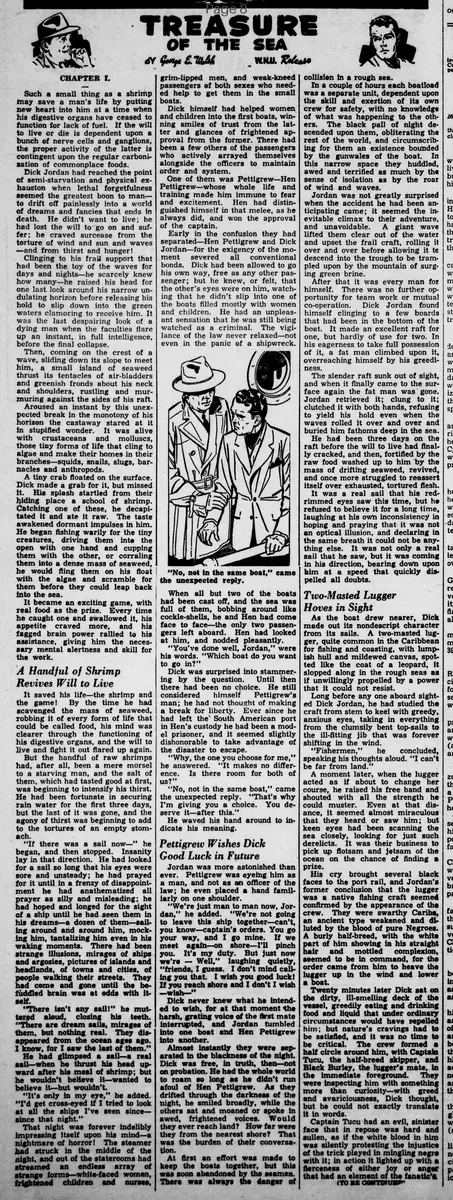
"No, not in the same boat," came the unexpected reply.
When all but two of the boats had been cast off, and the sea was full of them, bobbing around like cockle-shells, he and Hen had come face to face—the only two passengers left aboard. Hen had looked at him, and nodded pleasantly.
"You've done well, Jordan," were his words. "Which boat do you want to go in?"
Dick was surprised into stammering by the question. Until then there had been no choice. He still considered himself Pettigrew's man; he had not thought of making a break for liberty. Ever since he had left the South American port in Hen's custody he had been a model prisoner, and it seemed slightly dishonorable to take advantage of the disaster to escape.
"Why, the one you choose for me," he answered. "It makes no difference. Is there room for both of us?"
"No, not in the same boat," came the unexpected reply. "That's why I'm giving you a choice. You deserve it—after this."
He waved his hand around to indicate his meaning.
'Pettigrew Wishes Dick
Good Luck in Future'
Jordan was more astonished than ever. Pettigrew was eyeing him as a man, and not as an officer of the law; he even placed a hand familiarly on one shoulder.
"We're just man to man now, Jordan," he added. "We're not going to leave this ship together—can't, you know—captain's orders. You go your way, and I go mine. If we meet again—on shore—I'll pinch you. It's my duty. But just now we're—Well," laughing quietly, "friends, I guess. I don't mind calling you that. I wish you good luck! If you reach shore and I don't I wish—wish—"
Dick never knew what he intended to wish, for at that moment the harsh, grating voice of the first mate interrupted, and Jordan tumbled into one boat and Hen Pettigrew into another.
Almost instantly they were separated in the blackness of the night. Dick was free, in truth, then—not on probation. He had the whole world to roam so long as he didn't run afoul of Hen Pettigrew. As they drifted through the darkness of the night, he smiled broadly, while the others sat and moaned or spoke in awed, frightened voices. Would they ever reach land? How far were they from the nearest shore? That was the burden of their conversation.
At first an effort was made to keep the boats together, but this was soon abandoned by the seamen. There was always the danger of collision in a rough sea.
In a couple of hours each boatload was a separate unit, dependent upon the skill and exertion of its own crew for safety, with no knowledge of what was happening to the others. The black pall of night descended upon them, obliterating the rest of the world, and circumscribing for them an existence bounded by the gunwales of the boat. In this narrow space they huddled, awed and terrified as much by the sense of isolation as by the roar of wind and waves.
Jordan was not greatly surprised when the accident he had been anticipating came: it seemed the inevitable climax to their adventure, and unavoidable. A giant wave lifted them clear out of the water and upset the frail craft, rolling it over and over before allowing it to descend into the trough to be trampled upon by the mountain of surging green brine.
After that it was every man for himself. There was no further opportunity for team work or mutual co-operation. Dick Jordan found himself clinging to a few boards that had been in the bottom of the boat. It made an excellent raft for one, but hardly of use for two. In his eagerness to take full possession of it, a fat man climbed upon it, overreaching himself by his greediness.
The slender raft sunk out of sight, and when it finally came to the surface again the fat man was gone.
Jordan retrieved it; clung to it; clutched it with both hands, refusing to yield his hold even when the waves rolled it over and over and buried him fathoms deep in the sea.
He had been three days on the raft before the will to live had finally cracked, and then, fortified by the raw food washed up to him by the mass of drifting seaweed, revived, and once more struggled to reassert itself over exhausted, tortured flesh.
It was a real sail that his red-rimmed eyes saw this time, but he refused to believe it for a long time, laughing at his own inconsistency in hoping and praying that it was not an optical illusion, and declaring in the same breath it could not be anything else. It was not only a real sail that he saw, but it was coming in his direction, bearing down upon him at a speed that quickly dispelled all doubts.
'Two-Masted Lugger
Hoves in Sight'
As the boat drew nearer, Dick made out its nondescript character from its sails. A two-masted lugger, quite common in the Caribbean for fishing and coasting, with lumpy hull and mildewed canvas, spotted like the coat of a leopard, it slopped along in the rough seas as if unwillingly propelled by a power that it could not resist.
Long before any one aboard sighted Dick Jordan, he had studied the craft from stem to keel with greedy, anxious eyes, taking in everything from the clumsily bent top-sails to the ill-fitting jib that was forever shifting in the wind.
"Fishermen," he concluded, speaking his thoughts aloud. "I can't be far from land."
A moment later, when the lugger acted as if about to change her course, he raised his free hand and shouted with all the strength he could muster. Even at that distance, it seemed almost miraculous that they heard or saw him; but keen eyes had been scanning the sea closely, looking for just such derelicts. It was their business to pick up flotsam and jetsam of the ocean on the chance of finding prize.
His cry brought several black faces to the port rail, and Jordan's former conclusion that the lugger was a native fishing craft seemed confirmed by the appearance of the crew. They were swarthy Caribs, an ancient type weakened and diluted by the blood of pure Negroes.
A burly half-breed, with the white part of him showing in his straight hair and mottled complexion, seemed to be in command, for the order came from him to heave the lugger up in the wind and lower boat.
Twenty minutes later Dick sat on the dirty, ill-smelling deck of the vessel, greedily eating and drinking food and liquid that under ordinary circumstances would have repelled him; but nature's cravings had to be satisfied, and it was no time to be critical. The crew formed a half circle around him, with Captain Tucu, the half-breed skipper, and Black Burley, the lugger's mate, in the immediate foreground. They were inspecting him with something more than curiosity—with greed and avariciousness, Dick thought, but he could not exactly translate it in words.
Captain Tucu had an evil, sinister face that in repose was hard and sullen, as if the white blood in him was silently protesting the injustice of the trick played in mingling negro with it; in action it lighted up with fierceness of either joy or anger that had an element of the fanatic's
OF
THE
SEA
By George E. Walik
WNU Release
CHAPTER
Such a small thing as a shrimp may save a man's life by putting new heart into him at a time when his digestive organs have ceased to function for lack of fuel. If the will to live or die is dependent upon a bunch of nerve cells and ganglions, the proper activity of the latter is contingent upon the regular carbonisation of commonplace foods.
Dick Jordan had reached the point of semi-starvation and physical exhaustion when lethal forgetfulness seemed the greatest boon to man—to drift off painlessly into a world of dreams and fancies that ends in death. He didn't want to live: he had lost the will to go on and suffer: he craved surcease from the torture of wind and sun and waves—and from thirst and hunger!
Clinging to his frail support that had been the toy of the waves for days and nights—he scarcely knew how many—he raised his head for one last look around his narrow undulating horizon before releasing his hold to slip down into the green waters clamoring to receive him. It was the last despairing look of a dying man when the faculties flare up an instant, in full intelligence, before the final collapse.
Then, coming on the crest of a wave, sliding down its slope to meet him, a small island of seaweed thrust its tentacles of air-bladders and greenish fronds about his neck and shoulders, rustling and murmuring against the sides of his raft.
Aroused an instant by this unexpected break in the monotony of his horizon the castaway stared at it in stupified wonder. It was alive with crustaceans and molluscs, those tiny forms of life that cling to algae and make their homes in their branches—squids, snails, slugs, barnacles and anthropods.
A tiny crab floated on the surface. Dick made a grab for it, but missed it. His splash startled from their hiding place a school of shrimp.
Catching one of these, he decapitated it and ate it raw. The taste awakened dormant impulses in him.
He began fishing warily for the tiny creatures, driving them into the open with one hand and cupping them with the other, or corralling them into a dense mass of seaweed, he would fling them on his float with the algae and scramble for them before they could leap back into the sea.
It became an exciting game, with real food as the prize. Every time he caught one and swallowed it, his appetite craved more, and his fagged brain power rallied to his assistance, giving him the necessary mental alertness and skill for the work.
'A Handful of Shrimp
Revives Will to Live'
It saved his life—the shrimp and the game! By the time he had scavenged the mass of seaweed, robbing it of every form of life that could be called food, his mind was clearer through the functioning of his digestive organs, and the will to live and fight it out flared up again.
But the handful of raw shrimps had, after all, been a mere morsel to a starving man, and the salt of them, which had tasted good at first, was beginning to intensify his thirst.
He had been fortunate in securing rain water for the first three days, but the last of it was gone, and the agony of thirst was beginning to add to the tortures of an empty stomach.
"If there was a sail now—"
he began, and then stopped. Insanity lay in that direction. He had looked for a sail so long that his eyes were sore and unsteady; he had prayed for it until in a frenzy of disappointment he had anathematized all prayer as silly and misleading: he had hoped and longed for the sight of a ship until he had seen them in his dreams—a dozen of them—sailing around and around him, mocking him, tantalizing him even in his waking moments. There had been strange illusions, mirages of ships and argosies, pictures of islands and headlands, of towns and cities, of people walking their streets. They had come and gone until the befuddled brain was at odds with itself.
"There isn't any sail!" he muttered aloud, closing his teeth.
"There are dream sails, mirages of them, but nothing real. They disappeared from the ocean ages ago. I know, for I saw the last of them."
He had glimpsed a sail—a real sail—when he thrust his head upward after his meal of shrimp; but he wouldn't believe it—wanted to believe it—but wouldn't.
"It's only in my eye," he added. "I'd get cross-eyed if I tried to look at all the ships I've seen since—since that night."
That night was forever indelibly impressing itself upon his mind—a nightmare of horror! The steamer had struck in the middle of the night, and out of the staterooms had streamed an endless array of strange forms—white-faced women, frightened children and nurses, grim-lipped men, and weak-kneed passengers of both sexes who needed help to get them in the small boats.
Dick himself had helped women and children into the first boats, winning smiles of trust from the latter and glances of frightened approval from the former. There had been a few others of the passengers who actively arrayed themselves alongside the officers to maintain order and system.
One of them was Pettigrew—Hen Pettigrew—whose whole life and training made him immune to fear and excitement. Hen had distinguished himself in that melee, as he always did, and won the approval of the captain.
Early in the confusion they had separated—Hen Pettigrew and Dick Jordan—for the exigency of the moment severed all conventional bonds. Dick had been allowed to go his own way, free as any other passenger: but he knew, or felt, that the other's eyes were on him, watching that he didn't slip into one of the boats filled mostly with women and children. He had an unpleasant sensation that he was still being watched as a criminal. The vigilance of the law never relaxed—not even in the panic of a shipwreck.
"No, not in the same boat," came the unexpected reply.
When all but two of the boats had been cast off, and the sea was full of them, bobbing around like cockle-shells, he and Hen had come face to face—the only two passengers left aboard. Hen had looked at him, and nodded pleasantly.
"You've done well, Jordan," were his words. "Which boat do you want to go in?"
Dick was surprised into stammering by the question. Until then there had been no choice. He still considered himself Pettigrew's man; he had not thought of making a break for liberty. Ever since he had left the South American port in Hen's custody he had been a model prisoner, and it seemed slightly dishonorable to take advantage of the disaster to escape.
"Why, the one you choose for me," he answered. "It makes no difference. Is there room for both of us?"
"No, not in the same boat," came the unexpected reply. "That's why I'm giving you a choice. You deserve it—after this."
He waved his hand around to indicate his meaning.
'Pettigrew Wishes Dick
Good Luck in Future'
Jordan was more astonished than ever. Pettigrew was eyeing him as a man, and not as an officer of the law; he even placed a hand familiarly on one shoulder.
"We're just man to man now, Jordan," he added. "We're not going to leave this ship together—can't, you know—captain's orders. You go your way, and I go mine. If we meet again—on shore—I'll pinch you. It's my duty. But just now we're—Well," laughing quietly, "friends, I guess. I don't mind calling you that. I wish you good luck! If you reach shore and I don't I wish—wish—"
Dick never knew what he intended to wish, for at that moment the harsh, grating voice of the first mate interrupted, and Jordan tumbled into one boat and Hen Pettigrew into another.
Almost instantly they were separated in the blackness of the night. Dick was free, in truth, then—not on probation. He had the whole world to roam so long as he didn't run afoul of Hen Pettigrew. As they drifted through the darkness of the night, he smiled broadly, while the others sat and moaned or spoke in awed, frightened voices. Would they ever reach land? How far were they from the nearest shore? That was the burden of their conversation.
At first an effort was made to keep the boats together, but this was soon abandoned by the seamen. There was always the danger of collision in a rough sea.
In a couple of hours each boatload was a separate unit, dependent upon the skill and exertion of its own crew for safety, with no knowledge of what was happening to the others. The black pall of night descended upon them, obliterating the rest of the world, and circumscribing for them an existence bounded by the gunwales of the boat. In this narrow space they huddled, awed and terrified as much by the sense of isolation as by the roar of wind and waves.
Jordan was not greatly surprised when the accident he had been anticipating came: it seemed the inevitable climax to their adventure, and unavoidable. A giant wave lifted them clear out of the water and upset the frail craft, rolling it over and over before allowing it to descend into the trough to be trampled upon by the mountain of surging green brine.
After that it was every man for himself. There was no further opportunity for team work or mutual co-operation. Dick Jordan found himself clinging to a few boards that had been in the bottom of the boat. It made an excellent raft for one, but hardly of use for two. In his eagerness to take full possession of it, a fat man climbed upon it, overreaching himself by his greediness.
The slender raft sunk out of sight, and when it finally came to the surface again the fat man was gone.
Jordan retrieved it; clung to it; clutched it with both hands, refusing to yield his hold even when the waves rolled it over and over and buried him fathoms deep in the sea.
He had been three days on the raft before the will to live had finally cracked, and then, fortified by the raw food washed up to him by the mass of drifting seaweed, revived, and once more struggled to reassert itself over exhausted, tortured flesh.
It was a real sail that his red-rimmed eyes saw this time, but he refused to believe it for a long time, laughing at his own inconsistency in hoping and praying that it was not an optical illusion, and declaring in the same breath it could not be anything else. It was not only a real sail that he saw, but it was coming in his direction, bearing down upon him at a speed that quickly dispelled all doubts.
'Two-Masted Lugger
Hoves in Sight'
As the boat drew nearer, Dick made out its nondescript character from its sails. A two-masted lugger, quite common in the Caribbean for fishing and coasting, with lumpy hull and mildewed canvas, spotted like the coat of a leopard, it slopped along in the rough seas as if unwillingly propelled by a power that it could not resist.
Long before any one aboard sighted Dick Jordan, he had studied the craft from stem to keel with greedy, anxious eyes, taking in everything from the clumsily bent top-sails to the ill-fitting jib that was forever shifting in the wind.
"Fishermen," he concluded, speaking his thoughts aloud. "I can't be far from land."
A moment later, when the lugger acted as if about to change her course, he raised his free hand and shouted with all the strength he could muster. Even at that distance, it seemed almost miraculous that they heard or saw him; but keen eyes had been scanning the sea closely, looking for just such derelicts. It was their business to pick up flotsam and jetsam of the ocean on the chance of finding prize.
His cry brought several black faces to the port rail, and Jordan's former conclusion that the lugger was a native fishing craft seemed confirmed by the appearance of the crew. They were swarthy Caribs, an ancient type weakened and diluted by the blood of pure Negroes.
A burly half-breed, with the white part of him showing in his straight hair and mottled complexion, seemed to be in command, for the order came from him to heave the lugger up in the wind and lower boat.
Twenty minutes later Dick sat on the dirty, ill-smelling deck of the vessel, greedily eating and drinking food and liquid that under ordinary circumstances would have repelled him; but nature's cravings had to be satisfied, and it was no time to be critical. The crew formed a half circle around him, with Captain Tucu, the half-breed skipper, and Black Burley, the lugger's mate, in the immediate foreground. They were inspecting him with something more than curiosity—with greed and avariciousness, Dick thought, but he could not exactly translate it in words.
Captain Tucu had an evil, sinister face that in repose was hard and sullen, as if the white blood in him was silently protesting the injustice of the trick played in mingling negro with it; in action it lighted up with fierceness of either joy or anger that had an element of the fanatic's
What sub-type of article is it?
Prose Fiction
Journey Narrative
What themes does it cover?
Liberty Freedom
Death Mortality
Nature
What keywords are associated?
Shipwreck Survival
Raft Escape
Raw Shrimp
Prisoner Liberty
Caribbean Lugger
Sea Rescue
What entities or persons were involved?
By George E. Walik
Literary Details
Title
Treasure Of The Sea
Author
By George E. Walik
Key Lines
Such A Small Thing As A Shrimp May Save A Man's Life By Putting New Heart Into Him At A Time When His Digestive Organs Have Ceased To Function For Lack Of Fuel.
"We've Just Man To Man Now, Jordan," He Added. "We're Not Going To Leave This Ship Together—Can't, You Know—Captain's Orders. You Go Your Way, And I Go Mine."
It Saved His Life—The Shrimp And The Game!
A Two Masted Lugger, Quite Common In The Caribbean For Fishing And Coasting, With Lumpy Hull And Mildewed Canvas, Spotted Like The Coat Of A Leopard, It Slopped Along In The Rough Seas As If Unwillingly Propelled By A Power That It Could Not Resist.
Captain Tucu Had An Evil, Sinister Face That In Repose Was Hard And Sullen, As If The White Blood In Him Was Silently Protesting The Injustice Of The Trick Played In Mingling Negro With It; In Action It Lighted Up With Fierceness Of Either Joy Or Anger That Had An Element Of The Fanatic's