Thank you for visiting SNEWPapers!
Sign up free
Editorial
April 23, 1819
Kentucky Gazette
Lexington, Fayette County, Kentucky
What is this article about?
Editorial satirizes the Aurora's indecision on 1824 presidential candidates (Monroe, Crawford, Clay, Clinton, Tompkins, Adams) and excerpts its critiques of their influences, travels, and rivalries, including Crawford's southern sway, Clay's blocked popularity on South American independence, and Adams' compromises.
Clipping
OCR Quality
95%
Excellent
Full Text
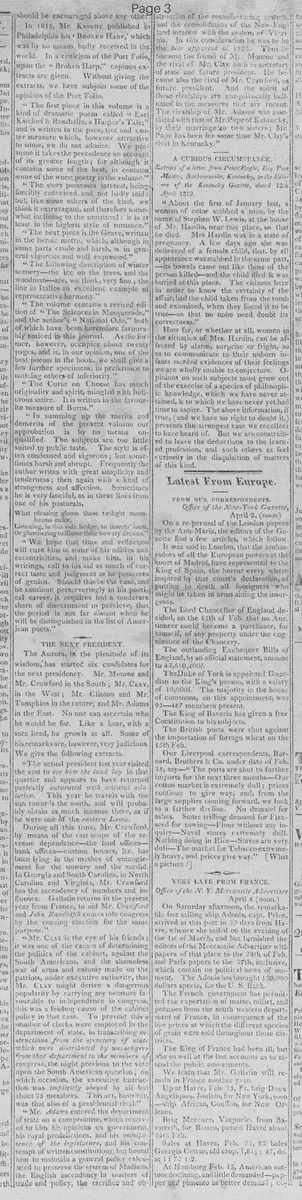
THE NEXT PRESIDENT
The Aurora, in the plenitude of its wisdom, has started six candidates for the next presidency. Mr. Monroe and Mr. Crawford in the South; Mr. Clay, in the West; Mr. Clinton and Mr. Tompkins in the centre; and Mr. Adams in the East. No one can ascertain who he would be for. Like a bear, with a sore head, he growls at all. Some of his remarks are, however, very judicious. We give the following extracts.
"The actual president last year visited the east to see how the land lay in that quarter and appears to have returned perfectly saturated with oriental adulation. This year he travels with the sun towards the south, and will probably obtain as much incense there, as if he were one of the eastern Lama.
During all this time, Mr. Crawford, by means of the vast scope of the revenue dependence—the land offices—bank offices—custom houses, &c. has been lying in the meshes of entanglement for the unwary and the sordid. In Georgia and South Carolina, in North Carolina and Virginia, Mr. Crawford has the ascendency of numbers and influence. Gallatin returns in the present year from France, to aid Mr. Crawford and John Randolph comes into congress by the ensuing election for the same purpose."
"Mr. Clay is the eye of his friends: it was one of the causes of determining the politics of the cabinet, against the South Americans, and the shameless war of arms and calumny made on the patriots, under executive authority, that Mr. Clay might derive a dangerous popularity by carrying any measure favourable to independence in congress; this was a leading cause of the cabinet policy in that case. To prevent this a number of clerks were employed in the department of state, in transcribing instructions from the secretary of state which were distributed by messengers from that department to the members of congress, the night previous to the vote upon the South American question; on which occasion, the executive instruction was implicitly obeyed by all but about 25 members. This act, however was that also of a presidential rival."
"Mr. Adams entered the department of state on a compromise, which reserved to him his opinions on government. his royal predilections, and his omniscience of the legislature, and his contempt of written constitutions; but bound him to maintain a general policy calculated to preserve the system of Madison. the English ascendency in matters of trade and policy, the sacrifice and obstruction of the manufacturing system, and the consolidation of the New-England interest with the system of Virginia. In this consideration he was to be the heir apparent of 1825. Thus he became the friend of Mr. Monroe and the rival of Mr. Clay both as secretary of state and future president. He became also the rival of Mr. Crawford, as future president. And the spirit of these rivalships are unequivocally indicated in the measures that are recent. The rivalship of Mr. Adams was associated with that of Mr. Pope of Kentucky, by their marriage to two sisters; Mr. Pope has been for some time Mr. Clay's rival in Kentucky."
The Aurora, in the plenitude of its wisdom, has started six candidates for the next presidency. Mr. Monroe and Mr. Crawford in the South; Mr. Clay, in the West; Mr. Clinton and Mr. Tompkins in the centre; and Mr. Adams in the East. No one can ascertain who he would be for. Like a bear, with a sore head, he growls at all. Some of his remarks are, however, very judicious. We give the following extracts.
"The actual president last year visited the east to see how the land lay in that quarter and appears to have returned perfectly saturated with oriental adulation. This year he travels with the sun towards the south, and will probably obtain as much incense there, as if he were one of the eastern Lama.
During all this time, Mr. Crawford, by means of the vast scope of the revenue dependence—the land offices—bank offices—custom houses, &c. has been lying in the meshes of entanglement for the unwary and the sordid. In Georgia and South Carolina, in North Carolina and Virginia, Mr. Crawford has the ascendency of numbers and influence. Gallatin returns in the present year from France, to aid Mr. Crawford and John Randolph comes into congress by the ensuing election for the same purpose."
"Mr. Clay is the eye of his friends: it was one of the causes of determining the politics of the cabinet, against the South Americans, and the shameless war of arms and calumny made on the patriots, under executive authority, that Mr. Clay might derive a dangerous popularity by carrying any measure favourable to independence in congress; this was a leading cause of the cabinet policy in that case. To prevent this a number of clerks were employed in the department of state, in transcribing instructions from the secretary of state which were distributed by messengers from that department to the members of congress, the night previous to the vote upon the South American question; on which occasion, the executive instruction was implicitly obeyed by all but about 25 members. This act, however was that also of a presidential rival."
"Mr. Adams entered the department of state on a compromise, which reserved to him his opinions on government. his royal predilections, and his omniscience of the legislature, and his contempt of written constitutions; but bound him to maintain a general policy calculated to preserve the system of Madison. the English ascendency in matters of trade and policy, the sacrifice and obstruction of the manufacturing system, and the consolidation of the New-England interest with the system of Virginia. In this consideration he was to be the heir apparent of 1825. Thus he became the friend of Mr. Monroe and the rival of Mr. Clay both as secretary of state and future president. He became also the rival of Mr. Crawford, as future president. And the spirit of these rivalships are unequivocally indicated in the measures that are recent. The rivalship of Mr. Adams was associated with that of Mr. Pope of Kentucky, by their marriage to two sisters; Mr. Pope has been for some time Mr. Clay's rival in Kentucky."
What sub-type of article is it?
Partisan Politics
What keywords are associated?
Presidential Election
Candidates
Monroe
Crawford
Clay
Adams
Political Rivalries
South American Policy
Aurora Newspaper
What entities or persons were involved?
Aurora
Mr. Monroe
Mr. Crawford
Mr. Clay
Mr. Clinton
Mr. Tompkins
Mr. Adams
Gallatin
John Randolph
Mr. Pope
Editorial Details
Primary Topic
Presidential Candidates And Rivalries
Stance / Tone
Satirical Criticism
Key Figures
Aurora
Mr. Monroe
Mr. Crawford
Mr. Clay
Mr. Clinton
Mr. Tompkins
Mr. Adams
Gallatin
John Randolph
Mr. Pope
Key Arguments
Aurora Indecisive On Presidential Candidates From Different Regions
President Monroe Seeks Adulation In Travels
Crawford Uses Government Offices For Influence In Southern States
Gallatin And Randolph To Aid Crawford
Clay's Popularity Blocked By Cabinet Against South American Independence
State Department Influenced Congress Vote On South American Question
Adams Entered State Department On Compromise Preserving Madison's System
Adams Rival To Clay And Crawford, Linked To Pope Via Marriage