Thank you for visiting SNEWPapers!
Sign up free
Editorial
October 11, 1905
The New Haven Union
New Haven, New Haven County, Connecticut
What is this article about?
Editorial questions the demotion of Detective Frey to Grade A officer after an incident where he allegedly grabbed a woman's arm and inquired about her dog, suspecting liquor involvement and criticizing the police board's lack of transparency on reasons.
Clipping
OCR Quality
98%
Excellent
Full Text
WEDNESDAY, OCTOBER 11, 1905.
DETECTIVE VS. GRADE A.
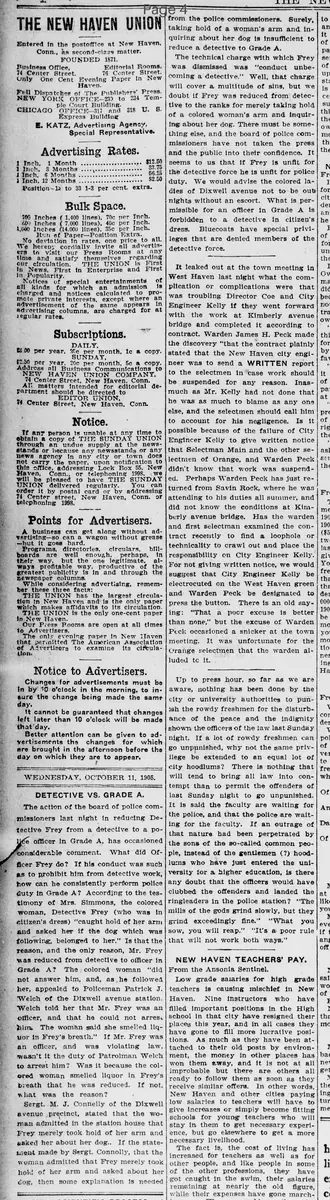
The action of the board of police commissioners last night in reducing Detective Frey from a detective to a police officer in Grade A, has occasioned considerable comment. What did Officer Frey do? If his conduct was such as to prohibit him from detective work, how can he consistently perform police duty in Grade A? According to the testimony of Mrs. Simmons, the colored woman, Detective Frey (who was in citizen's dress) "caught hold of her arm and asked her if the dog which was following, belonged to her." Is that the reason, and the only reason, Mr. Frey was reduced from detective to officer in Grade A? The colored woman "did not answer him, and, as he followed her, appealed to Policeman Patrick J. Welch of the Dixwell avenue station."
Welch told her that Mr. Frey was an officer, and that he could not arrest him. The woman said she smelled liquor in Frey's breath."
If Mr. Frey was an officer, and was violating law, wasn't it the duty of Patrolman Welch to arrest him? Was it because the colored woman smelled liquor in Frey's breath that he was reduced. If not, what was the reason?
Sergt. M. J. Connelly of the Dixwell avenue precinct, stated that the woman admitted in the station house that Frey merely took hold of her arm and asked her about her dog. If the statement made by Sergt. Connolly, that the woman admitted that Frey merely took hold of her arm and asked about her dog, then some explanation is needed.
from the police commissioners. Surely, taking hold of a woman's arm and inquiring about her dog is insufficient to reduce a detective to Grade A.
The technical charge with which Frey was dismissed was "conduct unbecoming a detective." Well, that charge will cover a multitude of sins, but we doubt if Frey was reduced from detective to the ranks for merely taking hold of a colored woman's arm and inquiring about her dog. There must be something else, and the board of police commissioners have not taken the press and the public into their confidence. It seems to us that if Frey is unfit for the detective force he is unfit for police duty. We would advise the colored ladies of Dixwell avenue not to be out nights without an escort. What is permissible for an officer in Grade A is forbidden to a detective in citizen's dress. Bluecoats have special privileges that are denied members of the detective force.
DETECTIVE VS. GRADE A.
The action of the board of police commissioners last night in reducing Detective Frey from a detective to a police officer in Grade A, has occasioned considerable comment. What did Officer Frey do? If his conduct was such as to prohibit him from detective work, how can he consistently perform police duty in Grade A? According to the testimony of Mrs. Simmons, the colored woman, Detective Frey (who was in citizen's dress) "caught hold of her arm and asked her if the dog which was following, belonged to her." Is that the reason, and the only reason, Mr. Frey was reduced from detective to officer in Grade A? The colored woman "did not answer him, and, as he followed her, appealed to Policeman Patrick J. Welch of the Dixwell avenue station."
Welch told her that Mr. Frey was an officer, and that he could not arrest him. The woman said she smelled liquor in Frey's breath."
If Mr. Frey was an officer, and was violating law, wasn't it the duty of Patrolman Welch to arrest him? Was it because the colored woman smelled liquor in Frey's breath that he was reduced. If not, what was the reason?
Sergt. M. J. Connelly of the Dixwell avenue precinct, stated that the woman admitted in the station house that Frey merely took hold of her arm and asked her about her dog. If the statement made by Sergt. Connolly, that the woman admitted that Frey merely took hold of her arm and asked about her dog, then some explanation is needed.
from the police commissioners. Surely, taking hold of a woman's arm and inquiring about her dog is insufficient to reduce a detective to Grade A.
The technical charge with which Frey was dismissed was "conduct unbecoming a detective." Well, that charge will cover a multitude of sins, but we doubt if Frey was reduced from detective to the ranks for merely taking hold of a colored woman's arm and inquiring about her dog. There must be something else, and the board of police commissioners have not taken the press and the public into their confidence. It seems to us that if Frey is unfit for the detective force he is unfit for police duty. We would advise the colored ladies of Dixwell avenue not to be out nights without an escort. What is permissible for an officer in Grade A is forbidden to a detective in citizen's dress. Bluecoats have special privileges that are denied members of the detective force.
What sub-type of article is it?
Crime Or Punishment
What keywords are associated?
Detective Demotion
Police Misconduct
Frey Case
Dixwell Avenue
Conduct Unbecoming
What entities or persons were involved?
Detective Frey
Mrs. Simmons
Policeman Patrick J. Welch
Sergt. M. J. Connelly
Board Of Police Commissioners
Editorial Details
Primary Topic
Demotion Of Detective Frey For Alleged Misconduct
Stance / Tone
Critical Of Police Board's Opaque Decision Making
Key Figures
Detective Frey
Mrs. Simmons
Policeman Patrick J. Welch
Sergt. M. J. Connelly
Board Of Police Commissioners
Key Arguments
Frey's Demotion From Detective To Grade A Officer Based On Minor Interaction With Woman
Testimony Claims Frey Only Grabbed Arm And Asked About Dog
Woman Alleged Smelling Liquor On Frey's Breath
Welch Failed To Arrest Frey If Violating Law
Charge Of 'Conduct Unbecoming A Detective' Seems Insufficient
Hidden Reasons Suspected For Demotion
Inconsistency In Standards For Detectives Vs. Uniformed Officers