Thank you for visiting SNEWPapers!
Sign up free
New Hampshire Statesman
Concord, Merrimack County, New Hampshire
What is this article about?
An article denounces the cruelty of check-reins on horses, describing physical injuries like raw mouths and enlargements from bit friction, signs of agony such as tossing heads and open mouths, and examples where loosening the rein improves performance and reduces distress. It appeals to drivers and ladies to end the practice.
Clipping
OCR Quality
Full Text
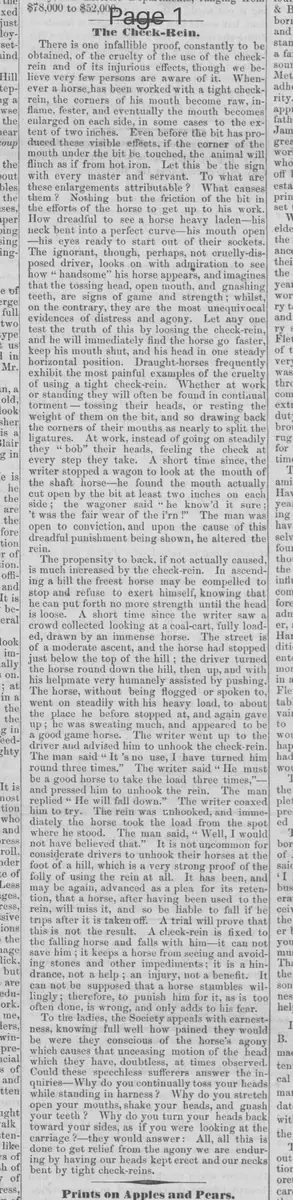
There is one infallible proof, constantly to be obtained, of the cruelty of the use of the check-rein and of its injurious effects, though we believe very few persons are aware of it. Whenever a horse has been worked with a tight check-rein, the corners of his mouth become raw, inflame, fester, and eventually the mouth becomes enlarged on each side, in some cases to the extent of two inches. Even before the bit has produced these visible effects, if the corner of the mouth under the bit be touched, the animal will flinch as if from hot iron. Let this be the sign with every master and servant. To what are these enlargements attributable? What causes them? Nothing but the friction of the bit in the efforts of the horse to get up to his work. How dreadful to see a horse heavy laden—his neck bent into a perfect curve—his mouth open—his eyes ready to start out of their sockets. The ignorant, though, perhaps, not cruelly-disposed driver, looks on with admiration to see how "handsome" his horse appears, and imagines that the tossing head, open mouth, and gnashing teeth, are signs of game and strength; whilst, on the contrary, they are the most unequivocal evidence of distress and agony. Let any one test the truth of this by loosing the check-rein, and he will immediately find the horse go faster, keep his mouth shut, and his head in one steady horizontal position.
Draught-horses frequently exhibit the most painful examples of the cruelty of using a tight check-rein. Whether at work or standing they will often be found in continual torment—tossing their heads, or resting the weight of them on the bit, and so drawing back the corners of their mouths as nearly to split the ligatures. At work, instead of going on steadily they "bob" their heads, feeling the check at every step they take. A short time since, the writer stopped a wagon to look at the mouth of the shaft horse—he found the mouth actually cut open by the bit at least two inches on each side; the wagoner said "he know'd it sure; 'twas the fair wear of the i'rn!" The man was open to conviction, and upon the cause of this dreadful punishment being shown, he altered the rein.
The propensity to back, if not actually caused is much increased by the check-rein. In ascending a hill the freest horse may be compelled to stop and refuse to exert himself, knowing that he can put forth no more strength until the head is loose. A short time since the writer saw a crowd collected looking at a coal-cart, fully loaded, drawn by an immense horse. The street is of a moderate ascent, and the horse had stopped just below the top of the hill; the driver turned the horse round down the hill, then up, and with his helpmate very humanely assisted by pushing. The horse, without being flogged or spoken to, went on steadily with his heavy load, to about the place he before stopped at, and again gave up; he was sweating much, and appeared to be a good game horse. The writer went up to the driver and advised him to unhook the check-rein. The man said "It's no use, I have turned him round three times." The writer said "He must be a good horse to take the load three times," and pressed him to unhook the rein. The man replied "He will fall down." The writer coaxed him to try. The rein was unhooked, and immediately the horse took the load from the spot where he stood. The man said, "Well, I would not have believed that."
It is not uncommon for considerate drivers to unhook their horses at the foot of a hill, which is a very strong proof of the folly of using the rein at all. It has been, and may be again, advanced as a plea for its retention, that a horse, after having been used to the rein, will miss it, and so be liable to fall if he trips after it is taken off. A trial will prove that this is not the result. A check-rein is fixed to the falling horse and falls with him—it can not save him; it keeps a horse from seeing and avoiding stones and other impediments; it is a hindrance, not a help; an injury, not a benefit. It can not be supposed that a horse stumbles wilfully; therefore, to punish him for it, as is too often done, is wrong, and only adds to his fear.
To the ladies, the Society appeals with earnestness, knowing full well how pained they would be were they conscious of the horse's agony which causes that unceasing motion of the head which they have, doubtless, at times observed. Could these speechless sufferers answer the inquiries—Why do you continually toss your heads while standing in harness? Why do you stretch open your mouths, shake your heads, and gnash your teeth? Why do you turn your heads back toward your sides, as if you were looking at the carriage?—they would answer: All, all this is done to get relief from the agony we are enduring by having our heads kept erect and our necks bent by tight check-reins.
What sub-type of article is it?
What themes does it cover?
What keywords are associated?
Story Details
Story Details
The article argues against the use of check-reins on horses, detailing the physical harm they cause such as mouth enlargements and raw sores from bit friction, signs of distress like head tossing and open mouths misinterpreted as strength, and anecdotes where loosening the rein allows horses to perform better, especially on hills, emphasizing the cruelty and folly of the practice.