Thank you for visiting SNEWPapers!
Sign up free
Daily Richmond Whig
Richmond, Virginia
What is this article about?
During the 1865 trial of Lincoln's assassins, witnesses presented evidence including a letter from Judge W.G. Oldham to Jefferson Davis proposing sabotage by burning enemy ships and towns using secret preparations. Testimonies detailed arrests, confessions, and a government spy in the Surratt household.
Clipping
OCR Quality
Full Text
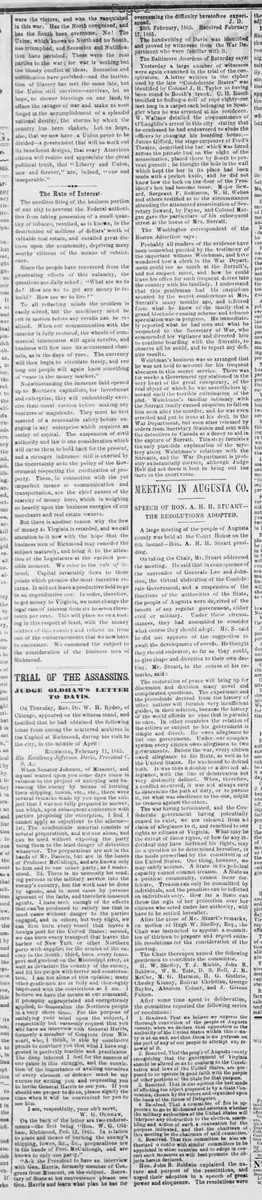
JUDGE OLDHAM'S LETTER
TO DAVIS.
On Thursday, Rev. Dr. W. H. Ryder, of Chicago, appeared on the witness stand, and testified that he had obtained the following letter from among the scattered archives in the Capitol at Richmond, during his visit to the city, in the middle of April :
RICHMOND, February 11, 1865.
His Excellency Jefferson Davis, President C. S. A.:
When Senator Johnson, of Missouri, and myself waited upon you some days since in relation to the project of annoying and harassing the enemy by means of burning their shipping, towns, etc., etc., there were several remarks made by you upon the subject that I was not fully prepared to answer, but which, upon subsequent conference with parties proposing the enterprise, I find I cannot apply as objections to the scheme—
1st. The combustible material consists of several preparations, and not one alone, and can be used without exposing the party using them to the least danger of detection whatever. The preparations are not in the hands of Mr. Daniels, but are in the hands of Professor McCullough, and are known only to him and to one other party, as I understood. 2d. There is no necessity for sending persons in the military service into the enemy's country, but the work may be done by agents, and in most cases by persons ignorant of the facts, and therefore innocent agents. I have seen enough of the effects that can be produced to satisfy me that in most cases without danger to the parties engaged, and in others, but very slight, we can first burn every vessel that leaves a foreign port for the United States; second, we can burn every transport that leaves the harbor of New York or other Northern ports with supplies for the armies of the enemy in the South; third, burn every transport and gunboat on the Mississippi river, as well as devastate the country of the enemy, and fill his people with terror and consternation. I am not alone of this opinion; many other gentlemen are as fully and thoroughly impressed with the convictions as I am. I believe we have the means at our command, if promptly appropriated and energetically applied, to demoralize the Northern people in a very short time. For the purpose of satisfying your mind upon the subject, I respectfully but earnestly request that you will have an interview with General Harris, formerly a member of Congress from Missouri, who, I think, is able by conclusive proofs to convince you that what I have suggested is perfectly feasible and practicable. The deep interest I feel for the success of our cause in this struggle, and the conviction of the importance of availing ourselves of every element of defence must be my excuse for writing you and requesting you to invite General Harris to see you. If you should see proper to do so, please signify the time when it will be convenient for you to see him.
I am, respectfully, your ob't servt,
W. G. OLDHAM,
On the back of the letter are two endorsements—the first being "Hon. W. G. Oldham, Richmond, Feb. 12, 1865. In relation to plans and means of burning the enemy's shipping, towns, &c., &c., preparations are in the hands of Prof. McCullough, and are known to only one party."
"Ask the President to have an interview with Gen. Harris, formerly member of Congress from Missouri, on the subject. Secretary of State at his convenience please see Gen. Harris and learn what plan he has for overcoming the difficulty heretofore experienced.
J. D.
20th February, 1865. Received February 17,1865."
The handwriting of Davis was identified and proved by witnesses from the War Department who were familiar with it.
The Baltimore American of Saturday says:
Yesterday a large number of witnesses were again examined in the trial of the conspirators. A letter written in the cipher used by the late "Confederate States" was identified by Colonel J. H. Taylor as having been found in Booth's trunk. C. I. Rosch testified to finding a coil of rope eighty-one feet long in a carpet sack belonging to Spangler when he was arrested at his residence.
W. Wallace detailed the circumstances of O'Laughlin's arrest in this city stating that he confessed he had endeavored to elude the officers by changing his boarding house.
James Gifford, the stage carpenter of Ford's Theatre, described the bar which was found across the private box on the night of the assassination, placed there by Booth to prevent pursuit: he thought the hole in the wall which kept the bar in its place had been made with a pocket knife, and he did not know how the lock on the door of the President's box had become loose. Major Seward, Sergeant F. Robinson, W. H. Welles and others testified as to the circumstances attending the attempted assassination of Secretary Seward, by Payne, and Colonel Morgan gave the particulars of his subsequent arrest at the house of Mrs. Surratt.
The Washington correspondent of the Boston Advertiser says:
Probably all readers of the evidence have been somewhat puzzled by the testimony of the important witness Weichman, and have wondered how a clerk in the War Department could see so much at the Surratt's, and not suspect more, and how he could leave his office for such frequent drives into the country with his landlady. I understand that this gentleman had his suspicions aroused by the secret conferences at Mrs. Surratt's many months ago, and inferred from what he knew of the family that a grand blockade-running scheme and tobacco speculation was in progress. He immediately reported what he had seen and what he suspected to the Secretary of War, who commended his vigilance and directed him to continue boarding with the Surratts, to observe all he could, and to report any definite results.
Weichman's business was so arranged that he was not held to account for his frequent absences in this secret service. There was for weeks a Government spy stationed in the very heart of the great conspiracy, of the real object of which he was nevertheless ignorant until the terrible culmination of the plot. Weichman's familiar intimacy with the Surratt family caused suspicion to fall on him soon after the murder, and he was even arrested and put in irons at his desk in the War Department, but soon after released by orders from Secretary Stanton and sent with the detectives to Canada as a decoy to aid in the capture of Surratt. This story furnishes the only plausible explanation of the mystery about Weichman's relations with the Surratts, and the War Department is probably substantially correct, although Judge Holt did not deem it best to bring out the facts in the court room.
What sub-type of article is it?
What themes does it cover?
What keywords are associated?
What entities or persons were involved?
Where did it happen?
Story Details
Key Persons
Location
Washington, D.C.; Richmond, Virginia
Event Date
1865
Story Details
In the trial of Lincoln's assassins, Rev. Dr. Ryder testified about a letter from Judge Oldham to Davis proposing Confederate sabotage via incendiary agents. Additional evidence included cipher letters from Booth's trunk, rope from Spangler, O'Laughlin's arrest and confession, details of the assassination setup at Ford's Theatre, the attack on Secretary Seward, and Weichman's role as a government spy in the Surratt household.