Thank you for visiting SNEWPapers!
Sign up free
Literary
May 21, 1834
Morning Star
Limerick, York County, Maine
What is this article about?
An article explores how everyday Eastern customs in India vividly illustrate obscure biblical passages, drawing from a travel extract in 'Fragments of Voyages and Travels.' Examples include women grinding at the mill and a man taking up his bed, highlighting Scripture's accuracy.
Clipping
OCR Quality
95%
Excellent
Full Text
Miscellaneous.
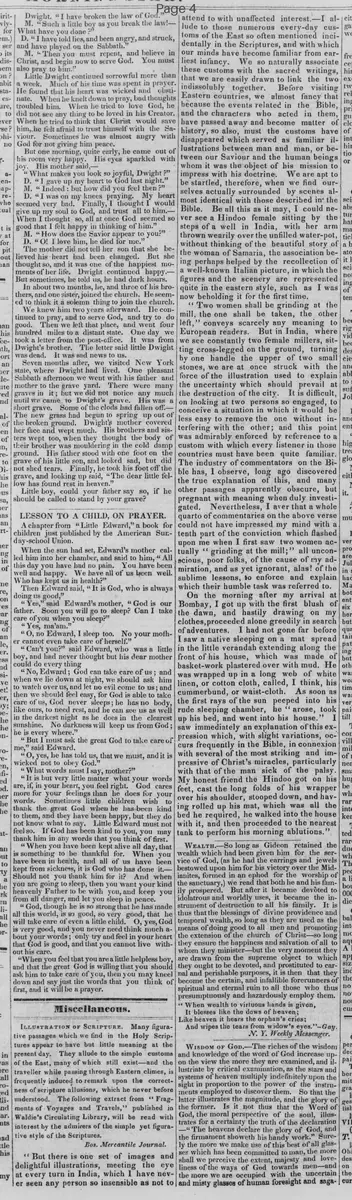
ILLUSTRATION OF SCRIPTURE. Many figurative passages which we find in the Holy Scriptures appear to have but little meaning at the present day. They allude to the simple customs of the East, many of which still exist—and the traveller while passing through Eastern climes, is frequently induced to remark upon the correctness of scripture allusions, which he never before understood. The following extract from "Fragments of Voyages and Travels," published in Waldie's Circulating Library, will be read with interest by the admirers of the simple yet figurative style of the Scriptures.
Bos. Mercantile Journal.
"But there is one set of images and delightful illustrations, meeting the eye at every turn in India, which I have never seen any person so insensible as not to attend to with unaffected interest.—I allude to those numerous every-day customs of the East so often mentioned incidentally in the Scriptures, and with which our minds have become familiar from earliest infancy. We so naturally associate these customs with the sacred writings, that we are easily drawn to link the two indissolubly together. Before visiting Eastern countries, we almost fancy that because the events related in the Bible, and the characters who acted in them, have passed away and become matter of history, so also, must the customs have disappeared which served as familiar illustrations between man and man, or between our Saviour and the human beings whom it was the object of his mission to impress with his doctrine. We are apt to be startled, therefore, when we find ourselves actually surrounded by scenes almost identical with those described in the Bible. Be all this as it may, I could never see a Hindoo female sitting by the steps of a well in India, with her arm thrown wearily over the unfilled water-pot, without thinking of the beautiful story of the woman of Samaria, the association being perhaps helped by the recollection of a well-known Italian picture, in which the figures and the scenery are represented quite in the eastern style, such as I was now beholding it for the first time.
"Two women shall be grinding at the mill, the one shall be taken, the other left," conveys scarcely any meaning to European readers. But in India, where we see constantly two female millers, sitting cross-legged on the ground, turning by one handle the upper of two small stones, we are at once struck with the force of the illustration used to explain the uncertainty which should prevail at the destruction of the city. It is difficult, on looking at two persons so engaged, to conceive a situation in which it would be less easy to remove the one without interfering with the other; and this point was admirably enforced by reference to a custom with which every listener in those countries must have been quite familiar. The industry of commentators on the Bible has, I observe, long ago discovered the true explanation of this, and many other passages apparently obscure, but pregnant with meaning when duly investigated. Nevertheless, I aver that a whole quarto of commentaries on the above verse could not have impressed my mind with a tenth part of the conviction which flashed upon me when I first saw two women actually "grinding at the mill;" all unconscious, poor folks, of the cause of my admiration, and as yet ignorant, alas! of the sublime lessons, to enforce and explain which their humble task was referred to.
On the morning after my arrival at Bombay, I got up with the first blush of the dawn, and hastily drawing on my clothes, proceeded alone greedily in search of adventures. I had not gone far before I saw a native sleeping on a mat spread in the little verandah extending along the front of his house, which was made of basket-work plastered over with mud. He was wrapped up in a long web of white linen, or cotton cloth, called, I think, his cummerbund, or waist-cloth. As soon as the first rays of the sun peeped into his rude sleeping chamber, he arose, took up his bed, and went into his house." I saw immediately an explanation of this expression which, with slight variations, occurs frequently in the Bible, in connexion with several of the most striking and impressive of Christ's miracles, particularly with that of the man sick of the palsy. My honest friend the Hindoo got on his feet, cast the long folds of his wrapper over his shoulder, stooped down, and having rolled up his mat, which was all the bed he required, he walked into the house with it, and then proceeded to the nearest tank to perform his morning ablutions."
ILLUSTRATION OF SCRIPTURE. Many figurative passages which we find in the Holy Scriptures appear to have but little meaning at the present day. They allude to the simple customs of the East, many of which still exist—and the traveller while passing through Eastern climes, is frequently induced to remark upon the correctness of scripture allusions, which he never before understood. The following extract from "Fragments of Voyages and Travels," published in Waldie's Circulating Library, will be read with interest by the admirers of the simple yet figurative style of the Scriptures.
Bos. Mercantile Journal.
"But there is one set of images and delightful illustrations, meeting the eye at every turn in India, which I have never seen any person so insensible as not to attend to with unaffected interest.—I allude to those numerous every-day customs of the East so often mentioned incidentally in the Scriptures, and with which our minds have become familiar from earliest infancy. We so naturally associate these customs with the sacred writings, that we are easily drawn to link the two indissolubly together. Before visiting Eastern countries, we almost fancy that because the events related in the Bible, and the characters who acted in them, have passed away and become matter of history, so also, must the customs have disappeared which served as familiar illustrations between man and man, or between our Saviour and the human beings whom it was the object of his mission to impress with his doctrine. We are apt to be startled, therefore, when we find ourselves actually surrounded by scenes almost identical with those described in the Bible. Be all this as it may, I could never see a Hindoo female sitting by the steps of a well in India, with her arm thrown wearily over the unfilled water-pot, without thinking of the beautiful story of the woman of Samaria, the association being perhaps helped by the recollection of a well-known Italian picture, in which the figures and the scenery are represented quite in the eastern style, such as I was now beholding it for the first time.
"Two women shall be grinding at the mill, the one shall be taken, the other left," conveys scarcely any meaning to European readers. But in India, where we see constantly two female millers, sitting cross-legged on the ground, turning by one handle the upper of two small stones, we are at once struck with the force of the illustration used to explain the uncertainty which should prevail at the destruction of the city. It is difficult, on looking at two persons so engaged, to conceive a situation in which it would be less easy to remove the one without interfering with the other; and this point was admirably enforced by reference to a custom with which every listener in those countries must have been quite familiar. The industry of commentators on the Bible has, I observe, long ago discovered the true explanation of this, and many other passages apparently obscure, but pregnant with meaning when duly investigated. Nevertheless, I aver that a whole quarto of commentaries on the above verse could not have impressed my mind with a tenth part of the conviction which flashed upon me when I first saw two women actually "grinding at the mill;" all unconscious, poor folks, of the cause of my admiration, and as yet ignorant, alas! of the sublime lessons, to enforce and explain which their humble task was referred to.
On the morning after my arrival at Bombay, I got up with the first blush of the dawn, and hastily drawing on my clothes, proceeded alone greedily in search of adventures. I had not gone far before I saw a native sleeping on a mat spread in the little verandah extending along the front of his house, which was made of basket-work plastered over with mud. He was wrapped up in a long web of white linen, or cotton cloth, called, I think, his cummerbund, or waist-cloth. As soon as the first rays of the sun peeped into his rude sleeping chamber, he arose, took up his bed, and went into his house." I saw immediately an explanation of this expression which, with slight variations, occurs frequently in the Bible, in connexion with several of the most striking and impressive of Christ's miracles, particularly with that of the man sick of the palsy. My honest friend the Hindoo got on his feet, cast the long folds of his wrapper over his shoulder, stooped down, and having rolled up his mat, which was all the bed he required, he walked into the house with it, and then proceeded to the nearest tank to perform his morning ablutions."
What sub-type of article is it?
Essay
What themes does it cover?
Religious
What keywords are associated?
Scripture Illustrations
Eastern Customs
Bible Allusions
India Travel
Hindoo Women
Grinding At The Mill
Taking Up Bed
What entities or persons were involved?
From "Fragments Of Voyages And Travels," Published In Waldie's Circulating Library
Literary Details
Title
Illustration Of Scripture
Author
From "Fragments Of Voyages And Travels," Published In Waldie's Circulating Library
Subject
Illustrations Of Biblical Passages Through Eastern Customs Observed In India
Form / Style
Prose Reflection With Travel Observations
Key Lines
Two Women Shall Be Grinding At The Mill, The One Shall Be Taken, The Other Left
He Arose, Took Up His Bed, And Went Into His House