Thank you for visiting SNEWPapers!
Sign up free
Literary
November 13, 1809
Portland Gazette, And Maine Advertiser
Portland, Cumberland County, Maine
What is this article about?
The Monitor No. X is a moral essay urging caution in conduct and opinions to avoid vice and destruction, illustrated by a young heir's downfall, drawing on a biblical precept from Psalms.
Clipping
OCR Quality
98%
Excellent
Full Text
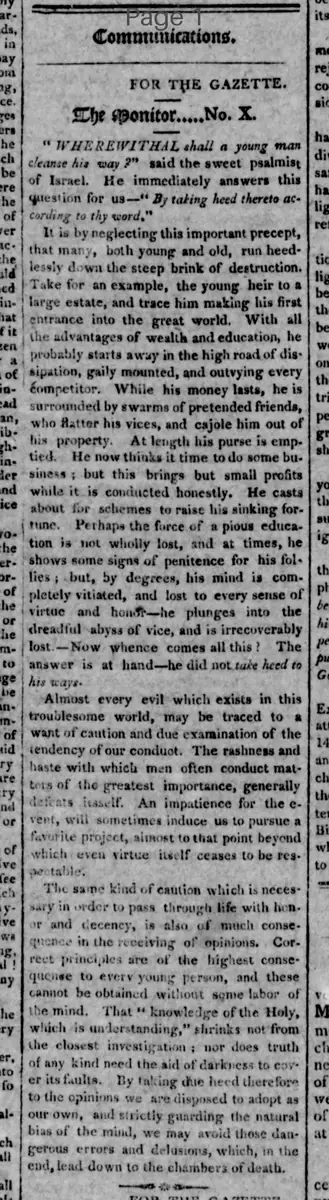
Communications.
FOR THE GAZETTE.
The Monitor.....No. X.
"WHEREWITHAL shall a young man cleanse his way?" said the sweet psalmist of Israel. He immediately answers this question for us—"By taking heed thereto according to thy word."
It is by neglecting this important precept, that many, both young and old, run heedlessly down the steep brink of destruction. Take for an example, the young heir to a large estate, and trace him making his first entrance into the great world. With all the advantages of wealth and education, he probably starts away in the high road of dissipation, gaily mounted, and outvying every competitor. While his money lasts, he is surrounded by swarms of pretended friends, who flatter his vices, and cajole him out of his property. At length his purse is emptied. He now thinks it time to do some business; but this brings but small profits while it is conducted honestly. He casts about or schemes to raise his sinking fortune. Perhaps the force of a pious education is not wholly lost, and at times, he shows some signs of penitence for his follies;—but, by degrees, his mind is completely vitiated, and lost to every sense of virtue and honor—he plunges into the dreadful abyss of vice, and is irrecoverably lost.—Now whence comes all this? The answer is at hand—he did not take heed to his ways.
Almost every evil which exists in this troublesome world, may be traced to a want of caution and due examination of the tendency of our conduct. The rashness and haste with which men often conduct matters of the greatest importance, generally defeats itself. An impatience for the event, will sometimes induce us to pursue a favorite project, almost to that point beyond which even virtue itself ceases to be respectable.
The same kind of caution which is necessary in order to pass through life with honor and decency, is also of much consequence in the receiving of opinions. Correct principles are of the highest consequence to every young person, and these cannot be obtained without some labor of the mind. That "knowledge of the Holy which is understanding," shrinks not from the closest investigation: nor does truth of any kind need the aid of darkness to cover its faults. By taking heed therefore to the opinions we are disposed to adopt as our own, and strictly guarding the natural bias of the mind, we may avoid those dangerous errors and delusions, which, in the end, lead down to the chambers of death.
FOR THE GAZETTE.
The Monitor.....No. X.
"WHEREWITHAL shall a young man cleanse his way?" said the sweet psalmist of Israel. He immediately answers this question for us—"By taking heed thereto according to thy word."
It is by neglecting this important precept, that many, both young and old, run heedlessly down the steep brink of destruction. Take for an example, the young heir to a large estate, and trace him making his first entrance into the great world. With all the advantages of wealth and education, he probably starts away in the high road of dissipation, gaily mounted, and outvying every competitor. While his money lasts, he is surrounded by swarms of pretended friends, who flatter his vices, and cajole him out of his property. At length his purse is emptied. He now thinks it time to do some business; but this brings but small profits while it is conducted honestly. He casts about or schemes to raise his sinking fortune. Perhaps the force of a pious education is not wholly lost, and at times, he shows some signs of penitence for his follies;—but, by degrees, his mind is completely vitiated, and lost to every sense of virtue and honor—he plunges into the dreadful abyss of vice, and is irrecoverably lost.—Now whence comes all this? The answer is at hand—he did not take heed to his ways.
Almost every evil which exists in this troublesome world, may be traced to a want of caution and due examination of the tendency of our conduct. The rashness and haste with which men often conduct matters of the greatest importance, generally defeats itself. An impatience for the event, will sometimes induce us to pursue a favorite project, almost to that point beyond which even virtue itself ceases to be respectable.
The same kind of caution which is necessary in order to pass through life with honor and decency, is also of much consequence in the receiving of opinions. Correct principles are of the highest consequence to every young person, and these cannot be obtained without some labor of the mind. That "knowledge of the Holy which is understanding," shrinks not from the closest investigation: nor does truth of any kind need the aid of darkness to cover its faults. By taking heed therefore to the opinions we are disposed to adopt as our own, and strictly guarding the natural bias of the mind, we may avoid those dangerous errors and delusions, which, in the end, lead down to the chambers of death.
What sub-type of article is it?
Essay
What themes does it cover?
Moral Virtue
Religious
What keywords are associated?
Moral Essay
Caution
Virtue
Dissipation
Biblical Precept
Opinions
Youthful Folly
Literary Details
Title
The Monitor.....No. X.
Subject
On Taking Heed To One's Ways And Opinions
Key Lines
"Wherewithal Shall A Young Man Cleanse His Way?" Said The Sweet Psalmist Of Israel. He Immediately Answers This Question For Us—"By Taking Heed Thereto According To Thy Word."
Now Whence Comes All This? The Answer Is At Hand—He Did Not Take Heed To His Ways.
By Taking Heed Therefore To The Opinions We Are Disposed To Adopt As Our Own, And Strictly Guarding The Natural Bias Of The Mind, We May Avoid Those Dangerous Errors And Delusions, Which, In The End, Lead Down To The Chambers Of Death.