Thank you for visiting SNEWPapers!
Sign up free
Literary
July 17, 1926
The Bismarck Tribune
Bismarck, Mandan, Burleigh County, Morton County, North Dakota
What is this article about?
In this continuation of 'SANDY,' Sandy cares for her ailing mother while grappling with guilt over her affair with Ramon. She meets him secretly despite reservations, encounters a shadowy figure, and in Chapter 64, confronts jealousy over his past, receiving a pleading letter before a tense reconciliation drive.
Merged-components note: Merged serialized 'SANDY' story parts across pages 3 and 4; reading orders indicate continuation.
Clippings
1 of 2
OCR Quality
88%
Good
Full Text
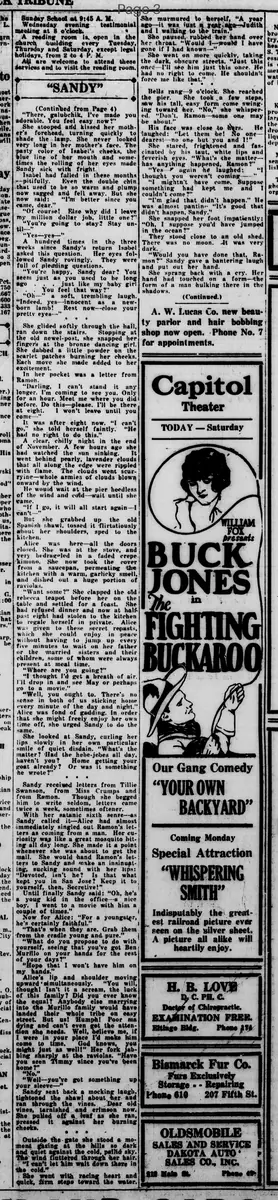
"SANDY"
(Continued from Page 4)
"There, galubchik, I've made you adorable. You feel easy now?"
She stooped and kissed her mother's forehead, turning quickly to shade the lamp. She never looked very long in her mother's face. The pasty color of Isabel's cheeks, the blue line of her mouth and sometimes the rolling of her eyes made Sandy sick with fright.
Isabel had failed in these months - pitifully. Even the double chin that used to be so warm and plump now sagged and fell away. But she now said: "I'm better since you came, dear."
"Of course! Else why did I leave my million dollar job, little one?"
"You're going to stay? Stay un- til-"
"Yes-yes-"
A hundred times in the three weeks since Sandy's return Isabel asked this question. Her eyes followed Sandy rovingly. They were full of pleading questions.
"You're happy, Sandy dear? You seem just as you used to be long ago just like my baby girl You feel that way?"
"Oh," a soft, trembling laugh.
"Indeed, yes--innocent as a newborn lamb! Rest now--close your pretty eyes--"
She glided softly through the hall, ran down the stairs. Stopping at the old newel-post, she snapped her fingers at the bronze dancing girl. She dabbed a little powder on the scarlet patches burning her cheeks. Each move she made added to her excitement.
In her pocket was a letter from Ramon.
"Darling, I can't stand it any longer. I'm coming to see you. Only for an hour. Meet me where you did before. Do this-please. I'll be there at eight.
I won't leave until you come-"
It was after eight now. "I can't go," she told herself faintly. "He had no right to do this."
A clear, chilly night in the end of November. A few hours ago she had watched the sun sinking. It went behind pearly, lavender clouds that all along the edge were rippled with flame. The clouds went scurry ing—whole armies of clouds blown onward by the wind.
He would wait at the pier heedless of the wind and cold--wait until she came.
"If I go, it will all start again-I can't-"
But she grabbed up the old Spanish shawl, tossed it flirtatiously about her shoulders, sped to the kitchen.
Alice was here-all the doors closed. She was at the stove, and very bedraggled in a faded crepe kimono. She now took the cover from a saucepan, permeating the kitchen with a warm, garlicky smell, and dished out a huge portion of raviolas.
"Want some?" She clapped the old rebecca teapot before her on the table and settled for a feast. She had refused dinner and now at half past eight had stolen to the kitchen to regale herself in private. Alice was given to these secret repasts, which she could enjoy in peace without having to jump up every five minutes to wait on her father or the married sisters and their children, some of whom were always present at meal time.
"Where are you going?"
"I thought I'd get a breath of air. I'll drop in and see May or perhaps go to a movie."
"Well, you ought to. There's no sense in both of us sticking home every minute of the day and night."
Alice was fond of gadding. In order that she might freely enjoy her own time off, she urged Sandy to do the same.
She looked at Sandy, curling her lips slowly in her own particular smile of quiet disdain. "What's the matter? Had the hebe-jebes all day, haven't you? Home getting your goat already? Or was it something he wrote?"
Sandy received letters from Tillie Swanson, from Miss Crumps and from Ramon. Though she begged him to write seldom, letters came twice a week, sometimes oftener.
With her satanic sixth sense--as Sandy called it--Alice had almost immediately singled out Ramon's letters as coming from a man. Her cu- riosity was like a great mosquito hit- ting all day long. She made it a point whenever she was about to get the mail. She would hand Ramon's let- ters to Sandy and make an insinuating; sucking sound with her lips: "Devoted, isn't he? Is that what kept you in San Jose? Keep it to yourself, then, Secretive!"
Until finally Sandy said: "Oh, he's a young kid in the office-a nice boy. I went to a movie with him a couple of times."
Now for Alice: "For youngster, he's certainly faithful."
"That's when they are. Grab them 'from the cradle young and pure.
"What do you propose to do with yourself, seeing that you've got Ben Murillo on your hands for the rest of your days?"
"Hope that won't have him on my hands."
Alice's lip and shoulder moving upward simultaneously.
"You will, though! Isn't it a scream, the luck of this family? Did you ever know the equal? Anybody else marrying into the Murillo family would have landed their whole tribe on easy street. But us! Humph! Poor ma dying and can't even get the atten- tion she needs. Well, believe me, if I were in your place I'd make him come to time. God knows, you might just as well!" Her fork jab- bing sharply at the raviolas. "Have you seen Timmy since you've been home?"
"No."
"Well--you've got something up your sleeve-"
Sandy sent back a mocking laugh, tightened the shawl about her- and ran through the vines. Dear old vines, tarnished and crimson now. She pulled off a leaf as she ran, pressed it against her burning cheeks.
Outside the gate she stood a mo- ment. xing at the hills so dark and quiet against the cold, pallid sky. The wind fluttered through her hair.
"I can't let him wait down there in the cold."
She went with racing heart and quick, firm steps toward the water.
She murmured to herself, "A year ago--it was just a week ago--Judith end I walking to the train."
She paused, rubbed her hand over her throat. "Would I--would I have gone if I had known-"
She went on more quickly, taking the dark, obscure streets, "Just this once--I'll see him just this once. He had no right to come. He shouldn't force me like that."
Bells rang--9 o'clock. She reached the pier. She took a few steps saw his tall, easy form come swing- ing toward her. "No." she whis- pered. "Don't, Ramon---some one may be about."
His face was close to hers. He laughed: "Let them be! No one- dearest--no one but you and I!"
She stared, frightened and fas- cinated by his taut, white lips and feverish eyes. "What's the matter- has anything happened, Ramon?"
"Yes-y again he laughed: "I thought you weren't coming
"I mightn't have come. Suppose something had kept me and couldn't come?"
"I'm glad that didn't happen." He was almost panting "It's good that didn't happen, Sandy."
She snapped her foot impatiently: "Oh. I suppose you'd have jumped in the ocean?"
They stood close to an old shed. There was no moon. It was very dark.
"Would you have done that, Ra- mon?" Sandy gave a bantering laugh and put out her hand.
She sprang back with a cry. Her hand had touched on a form-the form of a man hulking there in the shadows.
(Continued.)
THE BISMARCK TRIBUNE
The Villain Still Pursues
"SANDY"
BY
ELENORE
MEHERIN
The Story so Far
Sandy McNeil, in love with life, marries Ben Murillo, a rich Italian, to please her impoverished family. Tyranny by Murillo and frequent quarrels follow. A son dies at birth. Bob McNeil, her uncle, aids in plans for Sandy and her mother to take a trip to Honolulu. There she meets Ramon Worth, who saves her life in the surf. On the same steamer home he declares his love. Murillo says he will never release her. Judith Moore, a cousin, tells Sandy love is everything. Murillo overtakes her as she goes for a tryst with Ramon. He appears unexpectedly at a party she is giving for her friends. After the party he strikes her. She leaves his house and accepts the kindly attentions of Ramon, whose home she shares. She then accepts a position in the city and boards out. One evening she and Ramon drive to his home. They are about to enter when the door is opened by a girl whom Ramon had known two years ago. Furious, Sandy is driven back to the city.
GO ON WITH THE STORY FROM HERE
Chapter 64
It was an old fashioned house where Sandy had taken a room, set far back in the garden. Before it was a magnificent old oak. Ramon drew her to its shadow.
"You're not going to leave me like this, Sandy?"
She looked past him to the wide bay windows, pulled down just a little from the top. "We can't talk here. It's almost morning."
In the impenetrable darkness they could just make out the white blur of each other's face. He was leaning against the tree, his head thrown back.
"Let me go, Ramon. I can't help it that I feel so. I do. And now I want to go. Oh, everything is terrible!"
He pulled her to him. "I won't let you go. I can't let you go."
She waited, mute and cold. His humility laid wounds on her. She wanted to escape.
"What have I done, Sandy? Loved you this whole year. Thought of no one else. Longed to serve you. Isn't this true?"
"I can't help it."
"And now because of an accident—mere accident—you forget everything. Don't—please—I can't stand it! Oh, Sandy, I can't—I can't!"
Suddenly he wrapped his arms desperately about her and sobbed like a boy.
She hung up her coat—the long knitted coat Ramon had sent her. She brushed a white speck from the collar. She went about the room, faint and chilled, stopping before the bureau to arrange pins in a little hand-painted tray. She remained a long time doing this, hearing the break in his voice. She shut her ears against it. Then she felt the weight of his arms. They took the strength from her.
"Why do I blame him?" she murmured, sinking down and staring at the ceiling. "I've no right to blame him." Oppressive—the whole affair weighed on her heavily like his desperate arms.
It no longer seemed romantic—a brave and beautiful thing that she had done with Ramon. That girl in the purple kimono had also gone with him. The girl who came to the door with a soft, tinkling laugh to say wickedly: "Alone, darlin'? Did you send her away?" And she, Sandy, sitting there in the machine, hearing this—
She shrank from this vision of herself—a rival of that insolent, seductive thing who had calmly gone to his house, uninvited—waiting brilliant and certain for his coming. She and that girl were the same. Memory rose hotly and denied this. They were not the same! There was that Sunday when he kneeled and chafed her feet... there was all that sweetness of his service when she came stumbling to him in the dark, without even hat or coat. The gentleness of that time set this affair of theirs apart—made it different.
How good he had been to her! He was now. She had kissed him and she had begged him not to care so; that she had taken his face and said smiling: "I'm not aiming you. No—I won't—"
All this didn't alter the overpowering relief that the door was now closed between them and he was gone. She began to cry. She told herself in alarmed quiet: "I want it ended. Lord—I do—I do!" It appalled her to admit this. But she remembered her reluctance of the last two months; the lightness that was almost joy in the weekend when he couldn't come. And she lay with her hands over her face, whispering: "I won't go there again. I can never go there again."
She fought with dismal reluctance against awaking; close her mind against the thoughts of the night—keep it closed. But there they were awaiting at the bed like wet, clammy garments one is forced to resume.
At 10 o'clock a special delivery letter came from Ramon. Page after page, pleading and tempestuous.
"You must see me, Sandy—you won't refuse this? Listen—did I make any pretensions to you? Did I make myself out anything but what I am? From all the things I've told you, you've surely known the kind of life I've lived. Why, then, does this incident seem so unforgivable? Why does it make me a person to be shunned?
"I've told you in a way some episodes similar to this one. You never seemed to take these things much to heart or to consider them very criminal.
"Why now are you so despondent? It was ghastly. I appreciate this. Not for worlds would I have had it happen. But it has. Are you going to hold it against me?
"I can't believe this. I won't believe it. Sandy I don't dare to believe it! For the simple reason that my life is now without purpose or meaning, except in you.
"I can't change the past for you, though I gladly would. No one knows how gladly I'd wipe out every thought except the ones of you.
"I wish I'd never looked at any girl. I have. There have been many. But you know this. You surely know it. They have all passed. Most of them are completely forgotten. Only once did I love—love really. I was 19 then. She died. There was no other till you came. There can be no other now.
"Surely you don't mean to end it? You spoke so? You were distracted. Isn't this so?
"Come and ride with me when you receive this. I'll be waiting—you know where. Come. I won't be able to stand it if you turn from me now.
"How I loved you when you came to me that night—how I love you now. And if you had not kissed me last night—but you did—and you'll come!"
A cold oppression fell upon her. She whispered to herself in a terror: "I can't get away—Lord—I can't—I can't."
They drove through the valley. Bright, sunny day with roses climbing to every roof and the flowering sage looking so brilliant, bushes of purple fire.
The laughter that had first attracted her in Ramon's face was gone. It was set and imploring, though he kept turning to her and smiling.
They stopped on a hill with the valley unrolling so graciously about them.
"You don't forgive me," Sandy? It was a clumsy, ugly thing to happen. And in some way you think I should have foreseen it—avoided it?"
"No—I don't think that. But everything is terrible, Ramon. All this concealment and sneaking—the mortal terror of being seen. It shames us—"
"We've not been seen. Is that all, Sandy? Then you care for me as you did?"
She couldn't answer this. She wanted to say: "Let me go, Ramon—we can't go on like this—let it be ended." She looked at his pleading face and grew mute. She couldn't say this. She would never be able to say it. "Do you care for me? Oh, say that you do!"
And he asked this many times. And finally she answered: "Of course I care—don't let us be so tragic about things."
BY CONDO
This Evening
(Continued from Page 4)
"There, galubchik, I've made you adorable. You feel easy now?"
She stooped and kissed her mother's forehead, turning quickly to shade the lamp. She never looked very long in her mother's face. The pasty color of Isabel's cheeks, the blue line of her mouth and sometimes the rolling of her eyes made Sandy sick with fright.
Isabel had failed in these months - pitifully. Even the double chin that used to be so warm and plump now sagged and fell away. But she now said: "I'm better since you came, dear."
"Of course! Else why did I leave my million dollar job, little one?"
"You're going to stay? Stay un- til-"
"Yes-yes-"
A hundred times in the three weeks since Sandy's return Isabel asked this question. Her eyes followed Sandy rovingly. They were full of pleading questions.
"You're happy, Sandy dear? You seem just as you used to be long ago just like my baby girl You feel that way?"
"Oh," a soft, trembling laugh.
"Indeed, yes--innocent as a newborn lamb! Rest now--close your pretty eyes--"
She glided softly through the hall, ran down the stairs. Stopping at the old newel-post, she snapped her fingers at the bronze dancing girl. She dabbed a little powder on the scarlet patches burning her cheeks. Each move she made added to her excitement.
In her pocket was a letter from Ramon.
"Darling, I can't stand it any longer. I'm coming to see you. Only for an hour. Meet me where you did before. Do this-please. I'll be there at eight.
I won't leave until you come-"
It was after eight now. "I can't go," she told herself faintly. "He had no right to do this."
A clear, chilly night in the end of November. A few hours ago she had watched the sun sinking. It went behind pearly, lavender clouds that all along the edge were rippled with flame. The clouds went scurry ing—whole armies of clouds blown onward by the wind.
He would wait at the pier heedless of the wind and cold--wait until she came.
"If I go, it will all start again-I can't-"
But she grabbed up the old Spanish shawl, tossed it flirtatiously about her shoulders, sped to the kitchen.
Alice was here-all the doors closed. She was at the stove, and very bedraggled in a faded crepe kimono. She now took the cover from a saucepan, permeating the kitchen with a warm, garlicky smell, and dished out a huge portion of raviolas.
"Want some?" She clapped the old rebecca teapot before her on the table and settled for a feast. She had refused dinner and now at half past eight had stolen to the kitchen to regale herself in private. Alice was given to these secret repasts, which she could enjoy in peace without having to jump up every five minutes to wait on her father or the married sisters and their children, some of whom were always present at meal time.
"Where are you going?"
"I thought I'd get a breath of air. I'll drop in and see May or perhaps go to a movie."
"Well, you ought to. There's no sense in both of us sticking home every minute of the day and night."
Alice was fond of gadding. In order that she might freely enjoy her own time off, she urged Sandy to do the same.
She looked at Sandy, curling her lips slowly in her own particular smile of quiet disdain. "What's the matter? Had the hebe-jebes all day, haven't you? Home getting your goat already? Or was it something he wrote?"
Sandy received letters from Tillie Swanson, from Miss Crumps and from Ramon. Though she begged him to write seldom, letters came twice a week, sometimes oftener.
With her satanic sixth sense--as Sandy called it--Alice had almost immediately singled out Ramon's letters as coming from a man. Her cu- riosity was like a great mosquito hit- ting all day long. She made it a point whenever she was about to get the mail. She would hand Ramon's let- ters to Sandy and make an insinuating; sucking sound with her lips: "Devoted, isn't he? Is that what kept you in San Jose? Keep it to yourself, then, Secretive!"
Until finally Sandy said: "Oh, he's a young kid in the office-a nice boy. I went to a movie with him a couple of times."
Now for Alice: "For youngster, he's certainly faithful."
"That's when they are. Grab them 'from the cradle young and pure.
"What do you propose to do with yourself, seeing that you've got Ben Murillo on your hands for the rest of your days?"
"Hope that won't have him on my hands."
Alice's lip and shoulder moving upward simultaneously.
"You will, though! Isn't it a scream, the luck of this family? Did you ever know the equal? Anybody else marrying into the Murillo family would have landed their whole tribe on easy street. But us! Humph! Poor ma dying and can't even get the atten- tion she needs. Well, believe me, if I were in your place I'd make him come to time. God knows, you might just as well!" Her fork jab- bing sharply at the raviolas. "Have you seen Timmy since you've been home?"
"No."
"Well--you've got something up your sleeve-"
Sandy sent back a mocking laugh, tightened the shawl about her- and ran through the vines. Dear old vines, tarnished and crimson now. She pulled off a leaf as she ran, pressed it against her burning cheeks.
Outside the gate she stood a mo- ment. xing at the hills so dark and quiet against the cold, pallid sky. The wind fluttered through her hair.
"I can't let him wait down there in the cold."
She went with racing heart and quick, firm steps toward the water.
She murmured to herself, "A year ago--it was just a week ago--Judith end I walking to the train."
She paused, rubbed her hand over her throat. "Would I--would I have gone if I had known-"
She went on more quickly, taking the dark, obscure streets, "Just this once--I'll see him just this once. He had no right to come. He shouldn't force me like that."
Bells rang--9 o'clock. She reached the pier. She took a few steps saw his tall, easy form come swing- ing toward her. "No." she whis- pered. "Don't, Ramon---some one may be about."
His face was close to hers. He laughed: "Let them be! No one- dearest--no one but you and I!"
She stared, frightened and fas- cinated by his taut, white lips and feverish eyes. "What's the matter- has anything happened, Ramon?"
"Yes-y again he laughed: "I thought you weren't coming
"I mightn't have come. Suppose something had kept me and couldn't come?"
"I'm glad that didn't happen." He was almost panting "It's good that didn't happen, Sandy."
She snapped her foot impatiently: "Oh. I suppose you'd have jumped in the ocean?"
They stood close to an old shed. There was no moon. It was very dark.
"Would you have done that, Ra- mon?" Sandy gave a bantering laugh and put out her hand.
She sprang back with a cry. Her hand had touched on a form-the form of a man hulking there in the shadows.
(Continued.)
THE BISMARCK TRIBUNE
The Villain Still Pursues
"SANDY"
BY
ELENORE
MEHERIN
The Story so Far
Sandy McNeil, in love with life, marries Ben Murillo, a rich Italian, to please her impoverished family. Tyranny by Murillo and frequent quarrels follow. A son dies at birth. Bob McNeil, her uncle, aids in plans for Sandy and her mother to take a trip to Honolulu. There she meets Ramon Worth, who saves her life in the surf. On the same steamer home he declares his love. Murillo says he will never release her. Judith Moore, a cousin, tells Sandy love is everything. Murillo overtakes her as she goes for a tryst with Ramon. He appears unexpectedly at a party she is giving for her friends. After the party he strikes her. She leaves his house and accepts the kindly attentions of Ramon, whose home she shares. She then accepts a position in the city and boards out. One evening she and Ramon drive to his home. They are about to enter when the door is opened by a girl whom Ramon had known two years ago. Furious, Sandy is driven back to the city.
GO ON WITH THE STORY FROM HERE
Chapter 64
It was an old fashioned house where Sandy had taken a room, set far back in the garden. Before it was a magnificent old oak. Ramon drew her to its shadow.
"You're not going to leave me like this, Sandy?"
She looked past him to the wide bay windows, pulled down just a little from the top. "We can't talk here. It's almost morning."
In the impenetrable darkness they could just make out the white blur of each other's face. He was leaning against the tree, his head thrown back.
"Let me go, Ramon. I can't help it that I feel so. I do. And now I want to go. Oh, everything is terrible!"
He pulled her to him. "I won't let you go. I can't let you go."
She waited, mute and cold. His humility laid wounds on her. She wanted to escape.
"What have I done, Sandy? Loved you this whole year. Thought of no one else. Longed to serve you. Isn't this true?"
"I can't help it."
"And now because of an accident—mere accident—you forget everything. Don't—please—I can't stand it! Oh, Sandy, I can't—I can't!"
Suddenly he wrapped his arms desperately about her and sobbed like a boy.
She hung up her coat—the long knitted coat Ramon had sent her. She brushed a white speck from the collar. She went about the room, faint and chilled, stopping before the bureau to arrange pins in a little hand-painted tray. She remained a long time doing this, hearing the break in his voice. She shut her ears against it. Then she felt the weight of his arms. They took the strength from her.
"Why do I blame him?" she murmured, sinking down and staring at the ceiling. "I've no right to blame him." Oppressive—the whole affair weighed on her heavily like his desperate arms.
It no longer seemed romantic—a brave and beautiful thing that she had done with Ramon. That girl in the purple kimono had also gone with him. The girl who came to the door with a soft, tinkling laugh to say wickedly: "Alone, darlin'? Did you send her away?" And she, Sandy, sitting there in the machine, hearing this—
She shrank from this vision of herself—a rival of that insolent, seductive thing who had calmly gone to his house, uninvited—waiting brilliant and certain for his coming. She and that girl were the same. Memory rose hotly and denied this. They were not the same! There was that Sunday when he kneeled and chafed her feet... there was all that sweetness of his service when she came stumbling to him in the dark, without even hat or coat. The gentleness of that time set this affair of theirs apart—made it different.
How good he had been to her! He was now. She had kissed him and she had begged him not to care so; that she had taken his face and said smiling: "I'm not aiming you. No—I won't—"
All this didn't alter the overpowering relief that the door was now closed between them and he was gone. She began to cry. She told herself in alarmed quiet: "I want it ended. Lord—I do—I do!" It appalled her to admit this. But she remembered her reluctance of the last two months; the lightness that was almost joy in the weekend when he couldn't come. And she lay with her hands over her face, whispering: "I won't go there again. I can never go there again."
She fought with dismal reluctance against awaking; close her mind against the thoughts of the night—keep it closed. But there they were awaiting at the bed like wet, clammy garments one is forced to resume.
At 10 o'clock a special delivery letter came from Ramon. Page after page, pleading and tempestuous.
"You must see me, Sandy—you won't refuse this? Listen—did I make any pretensions to you? Did I make myself out anything but what I am? From all the things I've told you, you've surely known the kind of life I've lived. Why, then, does this incident seem so unforgivable? Why does it make me a person to be shunned?
"I've told you in a way some episodes similar to this one. You never seemed to take these things much to heart or to consider them very criminal.
"Why now are you so despondent? It was ghastly. I appreciate this. Not for worlds would I have had it happen. But it has. Are you going to hold it against me?
"I can't believe this. I won't believe it. Sandy I don't dare to believe it! For the simple reason that my life is now without purpose or meaning, except in you.
"I can't change the past for you, though I gladly would. No one knows how gladly I'd wipe out every thought except the ones of you.
"I wish I'd never looked at any girl. I have. There have been many. But you know this. You surely know it. They have all passed. Most of them are completely forgotten. Only once did I love—love really. I was 19 then. She died. There was no other till you came. There can be no other now.
"Surely you don't mean to end it? You spoke so? You were distracted. Isn't this so?
"Come and ride with me when you receive this. I'll be waiting—you know where. Come. I won't be able to stand it if you turn from me now.
"How I loved you when you came to me that night—how I love you now. And if you had not kissed me last night—but you did—and you'll come!"
A cold oppression fell upon her. She whispered to herself in a terror: "I can't get away—Lord—I can't—I can't."
They drove through the valley. Bright, sunny day with roses climbing to every roof and the flowering sage looking so brilliant, bushes of purple fire.
The laughter that had first attracted her in Ramon's face was gone. It was set and imploring, though he kept turning to her and smiling.
They stopped on a hill with the valley unrolling so graciously about them.
"You don't forgive me," Sandy? It was a clumsy, ugly thing to happen. And in some way you think I should have foreseen it—avoided it?"
"No—I don't think that. But everything is terrible, Ramon. All this concealment and sneaking—the mortal terror of being seen. It shames us—"
"We've not been seen. Is that all, Sandy? Then you care for me as you did?"
She couldn't answer this. She wanted to say: "Let me go, Ramon—we can't go on like this—let it be ended." She looked at his pleading face and grew mute. She couldn't say this. She would never be able to say it. "Do you care for me? Oh, say that you do!"
And he asked this many times. And finally she answered: "Of course I care—don't let us be so tragic about things."
BY CONDO
This Evening
What sub-type of article is it?
Prose Fiction
What themes does it cover?
Love Romance
Moral Virtue
Social Manners
What keywords are associated?
Romantic Affair
Family Obligations
Jealousy
Guilt
Secret Meeting
Pleading Letter
What entities or persons were involved?
By Elenore Meherin
Literary Details
Title
Sandy Chapter 64
Author
By Elenore Meherin
Key Lines
"I Can't Get Away—Lord—I Can't—I Can't."
"Do You Care For Me? Oh, Say That You Do!"
"Of Course I Care—Don't Let Us Be So Tragic About Things."
"You Must See Me, Sandy—You Won't Refuse This?"
She Sprang Back With A Cry. Her Hand Had Touched On A Form The Form Of A Man Hulking There In The Shadows.