Thank you for visiting SNEWPapers!
Sign up free
Editorial
March 18, 1774
The New Hampshire Gazette And Historical Chronicle
Portsmouth, Greenland, Rockingham County, New Hampshire
What is this article about?
This editorial concludes an argument on the duty of English clergymen, drawing from St. Paul's Epistle to the Romans and other apostolic writings, urging obedience to civil authorities, non-interference in political disputes like taxation and resistance, and avoidance of factionalism to maintain spiritual purity. Signed 'PROBUS.'
Clipping
OCR Quality
98%
Excellent
Full Text
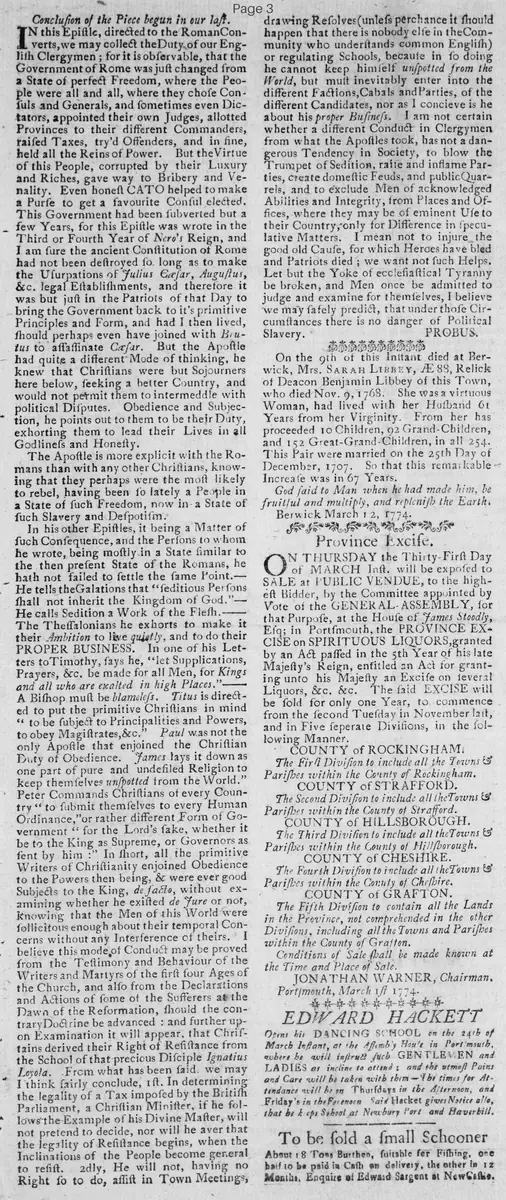
Conclusion of the Piece begun in our last.
In this Epistle, directed to the Roman Converts, we may collect the Duty of our English Clergymen; for it is observable, that the Government of Rome was just changed from a State of perfect Freedom, where the People were all in all, where they chose Consuls and Generals, and sometimes even Dictators, appointed their own Judges, allotted Provinces to their different Commanders, raised Taxes, tried Offenders, and in fine, held all the Reins of Power. But the Virtue of this People, corrupted by their Luxury and Riches, gave way to Bribery and Venality. Even honest CATO helped to make a Purse to get a favourite Consul elected. This Government had been subverted but a few Years, for this Epistle was wrote in the Third or Fourth Year of Nero's Reign, and I am sure the ancient Constitution of Rome had not been destroyed so long as to make the Usurpations of Julius Caesar, Augustus, &c. legal Establishments, and therefore it was but just in the Patriots of that Day to bring the Government back to it's primitive Principles and Form. and had I then lived, should perhaps even have joined with Brutus to assassinate Caesar. But the Apostle had quite a different Mode of thinking, he knew that Christians were but Sojourners here below, seeking a better Country. and would not permit them to intermeddle with political Disputes. Obedience and Subjection, he points out to them to be their Duty, exhorting them to lead their Lives in all Godliness and Honesty.
The Apostle is more explicit with the Romans than with any other Christians, knowing that they perhaps were the most likely to rebel, having been so lately a People in a State of such Freedom, now in a State of such Slavery and Despotism.
In his other Epistles, it being a Matter of such Consequence, and the Persons to whom he wrote, being mostly in a State similar to the then present State of the Romans, he hath not failed to settle the same Point.-- He tells the Galatians that "seditions Persons shall not inherit the Kingdom of God."
He calls Sedition a Work of the Flesh.-- The Thessalonians he exhorts to make it their Ambition to live quietly, and to do their PROPER BUSINESS. In one of his Letters to Timothy, says he, "let Supplications, Prayers, &c. be made for all Men, for Kings and all who are exalted in high Places."
A Bishop must be blameless. Titus is directed to put the primitive Christians in mind " to be subject to Principalities and Powers, to obey Magistrates,&c." Paul was not the only Apostle that enjoined the Christian Duty of Obedience. James lays it down as one part of pure and undefiled Religion to keep themselves unspotted from the World."
Peter Commands Christians of every Country " to submit themselves to every Human Ordinance,"or rather different Form of Government " for the Lord's sake, whether it be to the King as Supreme, or Governors as sent by him :" In short, all the primitive Writers of Christianity enjoined Obedience to the Powers then being, & were ever good Subjects to the King, de facto, without examining whether he existed de Jure or not, knowing that the Men of this World were solicitous enough about their temporal Concerns without any Interference of theirs. I believe this mode of Conduct may be proved from the Testimony and Behaviour of the Writers and Martyrs of the first four Ages of the Church, and also from the Declarations and Actions of some of the Sufferers at the Dawn of the Reformation, should the contrary Doctrine be advanced : and further upon Examination it will appear, that Christians derived their Right of Resistance from the School of that precious Disciple Ignatius Loyola. From what has been said. we may I think fairly conclude, 1st. In determining the legality of a Tax imposed by the British Parliament. a Christian Minister, if he follows the Example of his Divine Master, will not pretend to decide, nor will he aver that the legality of Resistance begins, when the Inclinations of the People become general to resist. 2dly, He will not, having no Right so to do, assist in Town Meetings, drawing Resolves (unless perchance it should happen that there is nobody else in the Community who understands common English) or regulating Schools, because in so doing he cannot keep himself unspotted from the World, but must inevitably enter into the different Factions,Cabals and Parties. of the different Candidates, nor as I conceive is he about his proper Business. I am not certain whether a different Conduct in Clergymen from what the Apostles took, has not a dangerous Tendency in Society, to blow the Trumpet of Sedition, raise and inflame Parties, create domestic Feuds, and public Quarrels, and to exclude Men of acknowledged Abilities and Integrity, from Places and Offices. where they may be of eminent Use to their Country,only for Difference in speculative Matters. I mean not to injure the good old Cause, for which Heroes have bled and Patriots died ; we want not such Helps. Let but the Yoke of ecclesiastical Tyranny be broken, and Men once be admitted to judge and examine for themselves, I believe we may safely predict, that under those Circumstances there is no danger of Political Slavery.
PROBUS.
In this Epistle, directed to the Roman Converts, we may collect the Duty of our English Clergymen; for it is observable, that the Government of Rome was just changed from a State of perfect Freedom, where the People were all in all, where they chose Consuls and Generals, and sometimes even Dictators, appointed their own Judges, allotted Provinces to their different Commanders, raised Taxes, tried Offenders, and in fine, held all the Reins of Power. But the Virtue of this People, corrupted by their Luxury and Riches, gave way to Bribery and Venality. Even honest CATO helped to make a Purse to get a favourite Consul elected. This Government had been subverted but a few Years, for this Epistle was wrote in the Third or Fourth Year of Nero's Reign, and I am sure the ancient Constitution of Rome had not been destroyed so long as to make the Usurpations of Julius Caesar, Augustus, &c. legal Establishments, and therefore it was but just in the Patriots of that Day to bring the Government back to it's primitive Principles and Form. and had I then lived, should perhaps even have joined with Brutus to assassinate Caesar. But the Apostle had quite a different Mode of thinking, he knew that Christians were but Sojourners here below, seeking a better Country. and would not permit them to intermeddle with political Disputes. Obedience and Subjection, he points out to them to be their Duty, exhorting them to lead their Lives in all Godliness and Honesty.
The Apostle is more explicit with the Romans than with any other Christians, knowing that they perhaps were the most likely to rebel, having been so lately a People in a State of such Freedom, now in a State of such Slavery and Despotism.
In his other Epistles, it being a Matter of such Consequence, and the Persons to whom he wrote, being mostly in a State similar to the then present State of the Romans, he hath not failed to settle the same Point.-- He tells the Galatians that "seditions Persons shall not inherit the Kingdom of God."
He calls Sedition a Work of the Flesh.-- The Thessalonians he exhorts to make it their Ambition to live quietly, and to do their PROPER BUSINESS. In one of his Letters to Timothy, says he, "let Supplications, Prayers, &c. be made for all Men, for Kings and all who are exalted in high Places."
A Bishop must be blameless. Titus is directed to put the primitive Christians in mind " to be subject to Principalities and Powers, to obey Magistrates,&c." Paul was not the only Apostle that enjoined the Christian Duty of Obedience. James lays it down as one part of pure and undefiled Religion to keep themselves unspotted from the World."
Peter Commands Christians of every Country " to submit themselves to every Human Ordinance,"or rather different Form of Government " for the Lord's sake, whether it be to the King as Supreme, or Governors as sent by him :" In short, all the primitive Writers of Christianity enjoined Obedience to the Powers then being, & were ever good Subjects to the King, de facto, without examining whether he existed de Jure or not, knowing that the Men of this World were solicitous enough about their temporal Concerns without any Interference of theirs. I believe this mode of Conduct may be proved from the Testimony and Behaviour of the Writers and Martyrs of the first four Ages of the Church, and also from the Declarations and Actions of some of the Sufferers at the Dawn of the Reformation, should the contrary Doctrine be advanced : and further upon Examination it will appear, that Christians derived their Right of Resistance from the School of that precious Disciple Ignatius Loyola. From what has been said. we may I think fairly conclude, 1st. In determining the legality of a Tax imposed by the British Parliament. a Christian Minister, if he follows the Example of his Divine Master, will not pretend to decide, nor will he aver that the legality of Resistance begins, when the Inclinations of the People become general to resist. 2dly, He will not, having no Right so to do, assist in Town Meetings, drawing Resolves (unless perchance it should happen that there is nobody else in the Community who understands common English) or regulating Schools, because in so doing he cannot keep himself unspotted from the World, but must inevitably enter into the different Factions,Cabals and Parties. of the different Candidates, nor as I conceive is he about his proper Business. I am not certain whether a different Conduct in Clergymen from what the Apostles took, has not a dangerous Tendency in Society, to blow the Trumpet of Sedition, raise and inflame Parties, create domestic Feuds, and public Quarrels, and to exclude Men of acknowledged Abilities and Integrity, from Places and Offices. where they may be of eminent Use to their Country,only for Difference in speculative Matters. I mean not to injure the good old Cause, for which Heroes have bled and Patriots died ; we want not such Helps. Let but the Yoke of ecclesiastical Tyranny be broken, and Men once be admitted to judge and examine for themselves, I believe we may safely predict, that under those Circumstances there is no danger of Political Slavery.
PROBUS.
What sub-type of article is it?
Moral Or Religious
Constitutional
What keywords are associated?
Clerical Obedience
Apostolic Teachings
Political Non Interference
Roman Epistle
Christian Duty
Sedition Warning
British Taxation
Ecclesiastical Tyranny
What entities or persons were involved?
St. Paul
Apostle Peter
Apostle James
Cato
Brutus
Julius Caesar
Augustus
Nero
Ignatius Loyola
British Parliament
Editorial Details
Primary Topic
Duty Of Clergymen To Obey Government And Avoid Political Interference
Stance / Tone
Advocating Apostolic Obedience And Clerical Non Engagement In Politics
Key Figures
St. Paul
Apostle Peter
Apostle James
Cato
Brutus
Julius Caesar
Augustus
Nero
Ignatius Loyola
British Parliament
Key Arguments
Christians Must Obey Civil Authorities As Sojourners Seeking A Better Country
Apostles Explicitly Taught Subjection To Principalities And Powers
Sedition Is A Work Of The Flesh And Disqualifies From God's Kingdom
Clergy Should Not Decide On Tax Legality Or Join Town Meetings And Factions
Interference By Clergy Risks Inflaming Sedition And Excluding Capable Leaders
True Religion Requires Keeping Unspotted From The World
Right Of Resistance Derives From Non Christian Sources Like Loyola